Baby Congested at Night Only: Causes and Safe Relief
Your baby plays, feeds, and breathes comfortably all afternoon. Then bedtime arrives, the lights go down, and within an hour the nose sounds full, breathing gets noisy, and sleep falls apart. Looking up baby congested at night only makes sense, and you're not imagining the pattern, and you don't have to solve it in one night. The timing itself is useful information. Compared across several nights and rooms, it can help you and your pediatrician sort out what's likely going on.
Table of Contents
- Why Night Stuffiness Can Feel Worse in Bed
- Matching Night-Only Stuffiness to Its Likely Causes
- Keeping Back-to-Sleep Safe While Congested
- Gentle Home Relief and Room Changes That Help
- Tracking Night Patterns to Share With the Care Team
- When Stuffiness Needs Urgent Care or a Pediatrician Call
Why Night Stuffiness Can Feel Worse in Bed
A familiar version goes like this. A baby is clear during tummy time and a late feed, settles into the crib, and then starts snuffling, stirring, and waking as if the nose filled up after lights out.
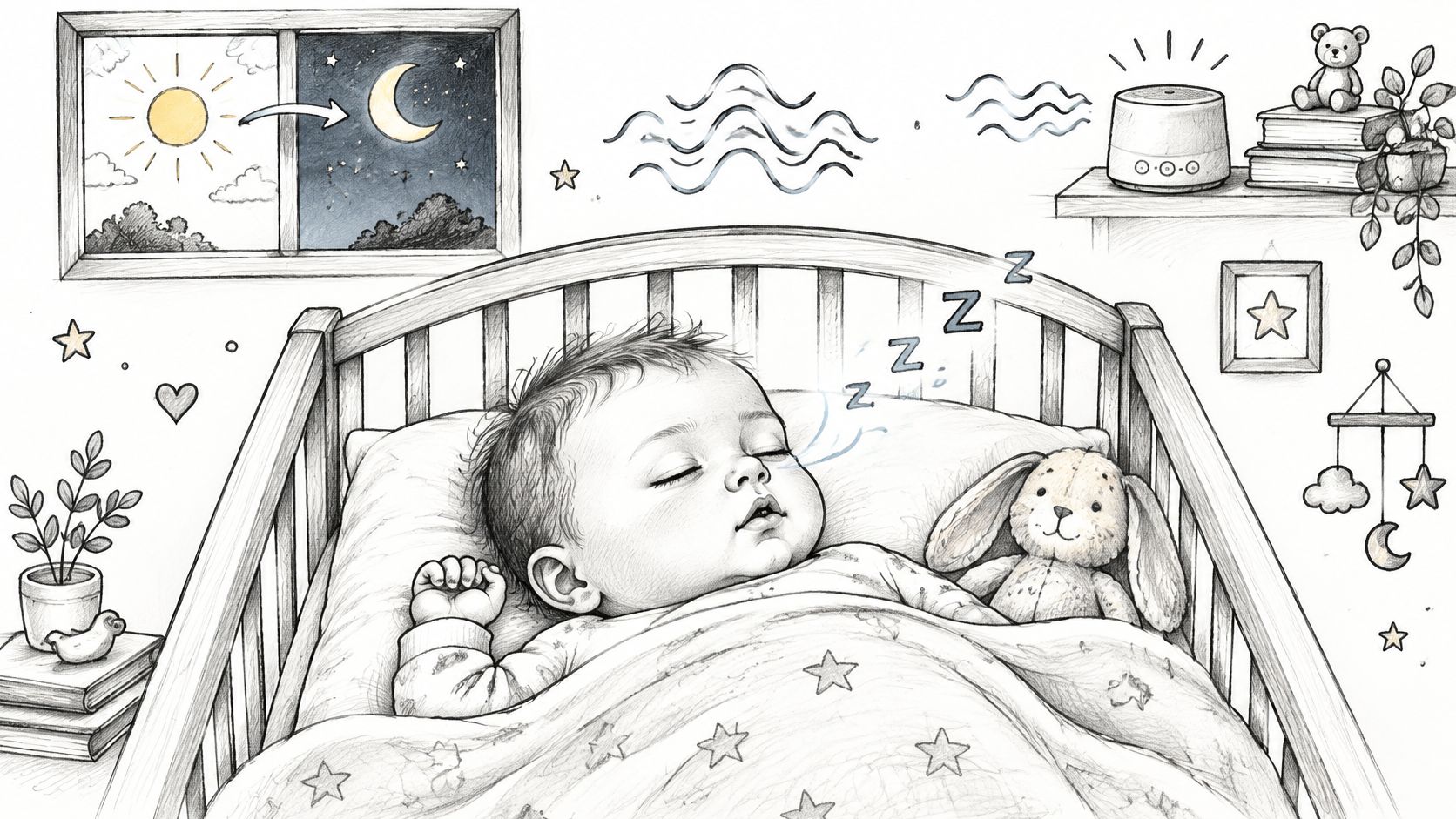
Two basics explain a lot of that shift. Infants depend heavily on nasal breathing, and their nasal passages are already narrow, so a small amount of mucus or swelling can sound and feel bigger than it would in an older child.
What lying flat changes
During the day, your baby is upright, held, and moving between positions, which gives secretions more chances to drain. At night, long stretches lying down let mucus pool instead of draining. The nasal lining can also hold more blood when a baby is flat, which can make swelling feel stronger once they're settled.
Night timing is a clue to compare, not a diagnosis by itself.
Research on young children offers context, not proof. A nationwide questionnaire study of preschool children in Japan found nasal symptoms were widespread in infancy and that cough and wheezing often became more prominent during sleep. It didn't prove that nighttime conditions cause the congestion itself.
That distinction matters. Night-only stuffiness may reflect position, dry air, or an underlying cold rather than a separate nighttime disease. If the noisy breathing is also splitting sleep into short stretches, it may help to read about why a baby keeps waking every hour at night alongside the congestion pattern, then bring both timelines to your pediatrician if symptoms persist or affect feeding, sleep, or breathing.
Matching Night-Only Stuffiness to Its Likely Causes
Night-only congestion usually isn't one thing. It often reflects a mix of anatomy, position, and environment, which is why a single remedy sometimes helps one family and does nothing for another. A clinical review of nasal obstruction in infants describes how secretions can pool when a baby lies flat, how recumbent blood flow can amplify mucosal swelling, and how dry air may thicken secretions.
Night-only congestion causes and the clues that separate them
| Likely cause | Night-only clue | What to note across nights |
|---|---|---|
| Lying flat and mucus pooling | Worse after the baby settles flat on the back | Time of onset and position at sleep start |
| Dry air from heating or air conditioning | Worse in the bedroom when heat or AC runs in the evening | Heater, AC or humidifier use each night |
| Allergy or irritant exposure | Worse in one room, with sneezing, itchy eyes, smoke, fragrance, pets or dust | Exposures present in that room and when they started |
| Cold or respiratory infection | Congestion continues through the day with cough or fever | Fever readings, cough pattern and feeding changes |
| Structural or persistent causes | Mostly one nostril, recurrent or lasting longer than expected | Which nostril, how long it lasts, and any noisy breathing |
Start with the first two rows if your baby is mostly clear by morning. Stuffiness that builds after settling flat points toward pooling and swelling. Stuffiness that tracks with the heater or air conditioner points toward the room air, especially if daytime naps elsewhere sound clearer.
Here's a household example. A nanny notices a baby naps comfortably in the living room but sounds blocked in the nursery, where the heater runs all evening. That comparison doesn't prove dry air is the cause, but it gives the pediatrician a sharper starting point than saying bedtime is always hard.
Clues that widen the picture
- One room only: Note smoke, fragrance, pets, dust, cleaning products, and recent bedding changes.
- Daytime symptoms too: Record cough, fever, feeding trouble, and noisy breathing, since a cold rarely respects bedtime.
- Mostly one nostril: Write down which side, night after night, rather than relying on memory.
MedlinePlus guidance on a stuffy nose lists colds, flu, allergies, irritants, and foreign objects among possible causes, and advises medical review when symptoms persist or occur with fever or concerning discharge. Don't infer that worse-at-night alone proves reflux or allergy. Recurrent, persistent, or mainly one-sided symptoms belong in a clinician conversation, and onset in a very young infant deserves particular assessment. Treat the table as a map for that talk, not a verdict.
Keeping Back-to-Sleep Safe While Congested
A stuffy nose doesn't change the sleep rule. Your baby goes on the back, on a firm, flat, non-inclined surface, for every nap and every night. The American Academy of Pediatrics guidance for a baby with a stuffy nose warns that pillows, towels, wedges, and inclined mattresses can bend an infant's neck and narrow the airway.
It's easy to understand the impulse. Propping looks like it should help drainage, and a worried caregiver at midnight wants to do something. But congestion and respiratory illness can make sleep more vulnerable, so safe-sleep habits matter more in this situation, not less.
A short crib check
- Flat mattress: Keep it level, not tilted with towels or books underneath.
- Clear surface: No pillows, wedges, positioners, or loose items added to lift the head.
- Back position: Don't switch to stomach or side sleeping because the nose sounds full.
- Same instruction everywhere: Parents, partners, grandparents, nannies, and daycare staff all follow the same setup.
The CDC recommendation to place babies on their backs for every sleep covers naps as well as nighttime, which helps when different caregivers handle different parts of the day. If you're still building the bedtime routine itself, a step-by-step approach to putting a newborn to sleep can sit alongside these safety basics.
A line that travels well: Even when she's stuffy, she sleeps flat on her back in an empty crib. We clear her nose before bed instead of propping her up.
If your baby sounds stuffed on the back, the answer is gentle nasal care before sleep, not a new position. Any sleeping device or exception should come from your pediatrician, not from a product label.
Gentle Home Relief and Room Changes That Help
When a baby sounds stuffy after bedtime, compare what changes from one night to the next. A warm, dry room or thick mucus may make breathing through the nose less comfortable. Gentle care can loosen mucus and reduce possible irritants, while sleep stays on the same safe, flat surface.
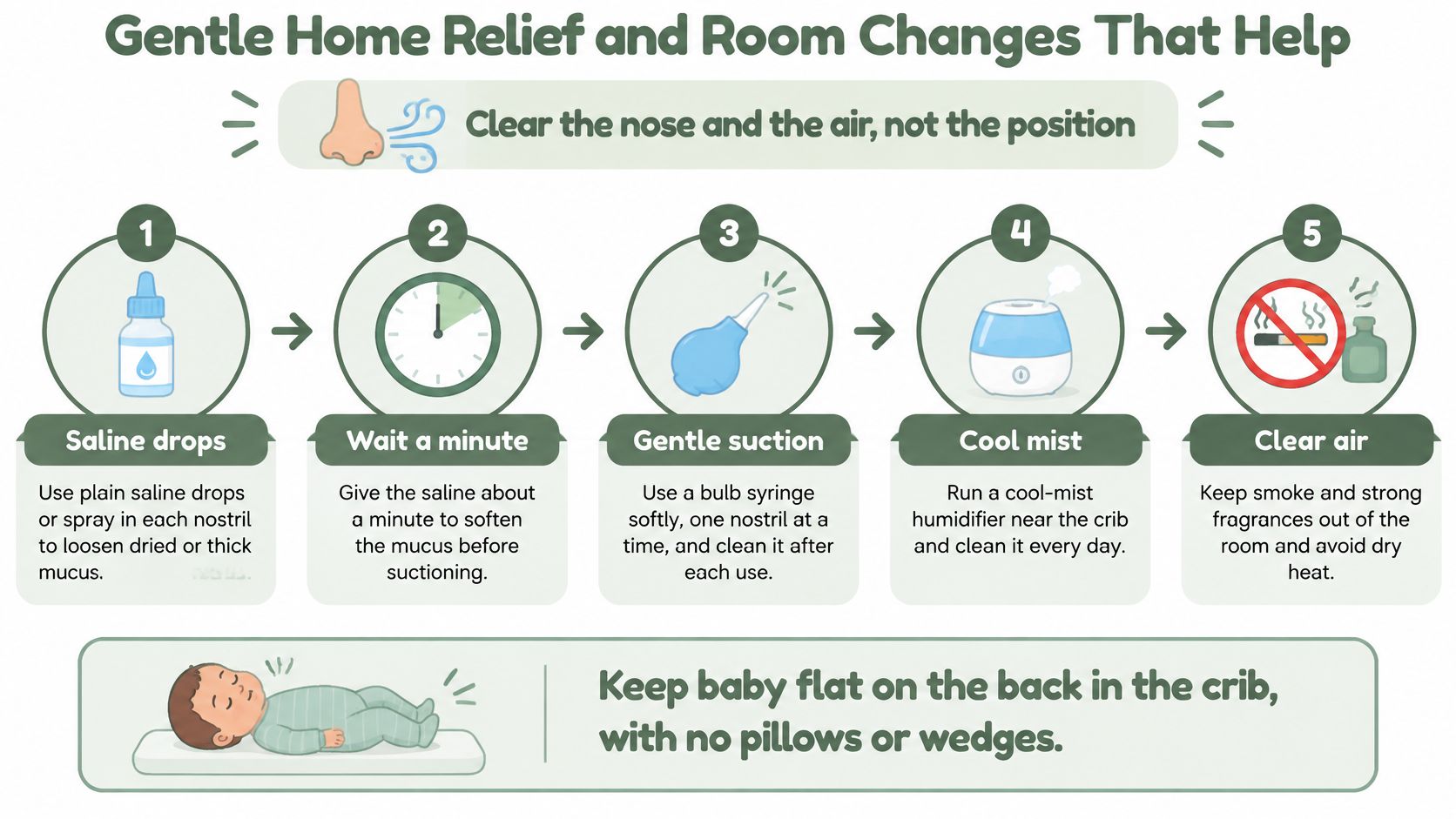
Saline and suction for dried or thick mucus
- Choose a saline product suitable for your baby's age. Use the number of drops stated on its label, or confirm the amount with your pediatrician or pharmacist.
- Gently suction one nostril at a time, following the product instructions or the technique your clinician recommends.
- Wipe the outside of the nose, then clean the suction bulb or device as directed.
Saline can loosen dried mucus, so gentle suction may remove it more easily. Keep cotton swabs out of the nose because they can irritate or injure the delicate lining. Suction can be uncomfortable for a baby, so use a gentle touch and ask your pediatrician or pharmacist to show you the steps if you are unsure.
Some families find nasal care helpful before a feed or bedtime. Notice whether your baby seems more comfortable afterward, but don't assume the room or congestion is the only reason for a difficult feed or restless night.
Room changes worth checking
- Smoke-free air: Keep smoke, candles, and fragrance sprays away from the sleep area.
- Dust and pet hair: Wash crib bedding as directed and reduce dust and pet hair near the crib.
- Dry air check: Notice whether heating or air conditioning runs through the evening. Compare nights with different room conditions rather than changing several things at once.
- Humidifier caution: Ask your pediatrician before using one, and follow its cleaning instructions carefully.
A simple example can help: if the baby is stuffy in the nursery but not during a nap in another room, note the locations and what was running in each room. Parents, nannies, and other caregivers can share those observations, so the pediatrician can see the pattern across nights instead of hearing separate fragments.
Keep an eye on feeding, too. If your baby repeatedly stops or refuses feeds, or seems to work harder to breathe while feeding, contact the pediatrician for guidance. Spanish-speaking families can ask a pediatrician or pharmacist to explain the saline and suction instructions in Spanish, including terms such as suero salino, then share the same directions with the caregiver handling bedtime.
Tracking Night Patterns to Share With the Care Team
Memory is the weak link in most night-congestion stories. At 2 a.m., nobody reliably remembers when the stuffiness started three nights ago, whether the heater was on, or which nostril sounded blocked. By the pediatrician visit, separate caregivers often hold separate fragments.

Fields to record for a night-congestion log
| Log field | Why it helps | Example entry |
|---|---|---|
| Time congestion starts and bedtime | Shows whether it is truly night-only | Bedtime 7.30 p.m., stuffy by 8.15 p.m. |
| Room and sleep location | Separates bedroom from other sleep spots | Nursery crib; grandparent's guest room |
| Heating, cooling, humidifier or fan use | Tracks dry-air patterns | Heater on from 6 p.m. |
| Smoke, fragrance, pets or dust exposure | Flags irritant triggers | Candle burned in the hallway |
| Sleep position at start | Confirms the back-sleeping rule was followed | Placed on back on firm, flat surface |
| Feeding, wet diapers, temperature and breathing notes | Shows whether congestion affects basics | Stopped feeding twice; fast breathing at 2 a.m. |
The comparison method is simple. Review several nights together and ask what changed. Was the heater new that week, did a cleaning product get used in the nursery, did the cat start sleeping by the crib, or did your baby sleep clearly at a grandparent's home?
Log at the moment of the change, not from memory the next morning.
A shared record helps because the person who notices the clue isn't always the person at the appointment. Cradlo is a shared baby tracker for families, nannies, and daycares, so a partner, grandparent, nanny, or daycare teacher can add entries to the same timeline in English or Spanish. It offers a 7-day free trial on its monthly plan only, and there's no free plan. Families managing a longer illness stretch may also find a sick day timeline approach useful for organizing symptoms, feeds, and sleep in one place.
Bring the finished timeline to the visit or read the key nights aloud on the call. It isn't a diagnosis. It's a clean set of observations that lets your pediatrician ask better follow-up questions.
When Stuffiness Needs Urgent Care or a Pediatrician Call
Your baby's nose may sound blocked at bedtime, yet they breathe comfortably and feed as usual. That pattern is different from struggling to breathe. Congestion is one thing, breathing effort is another. A noisy nose alone does not show how hard breathing is, so watch your baby's color, effort, and ability to make sounds.
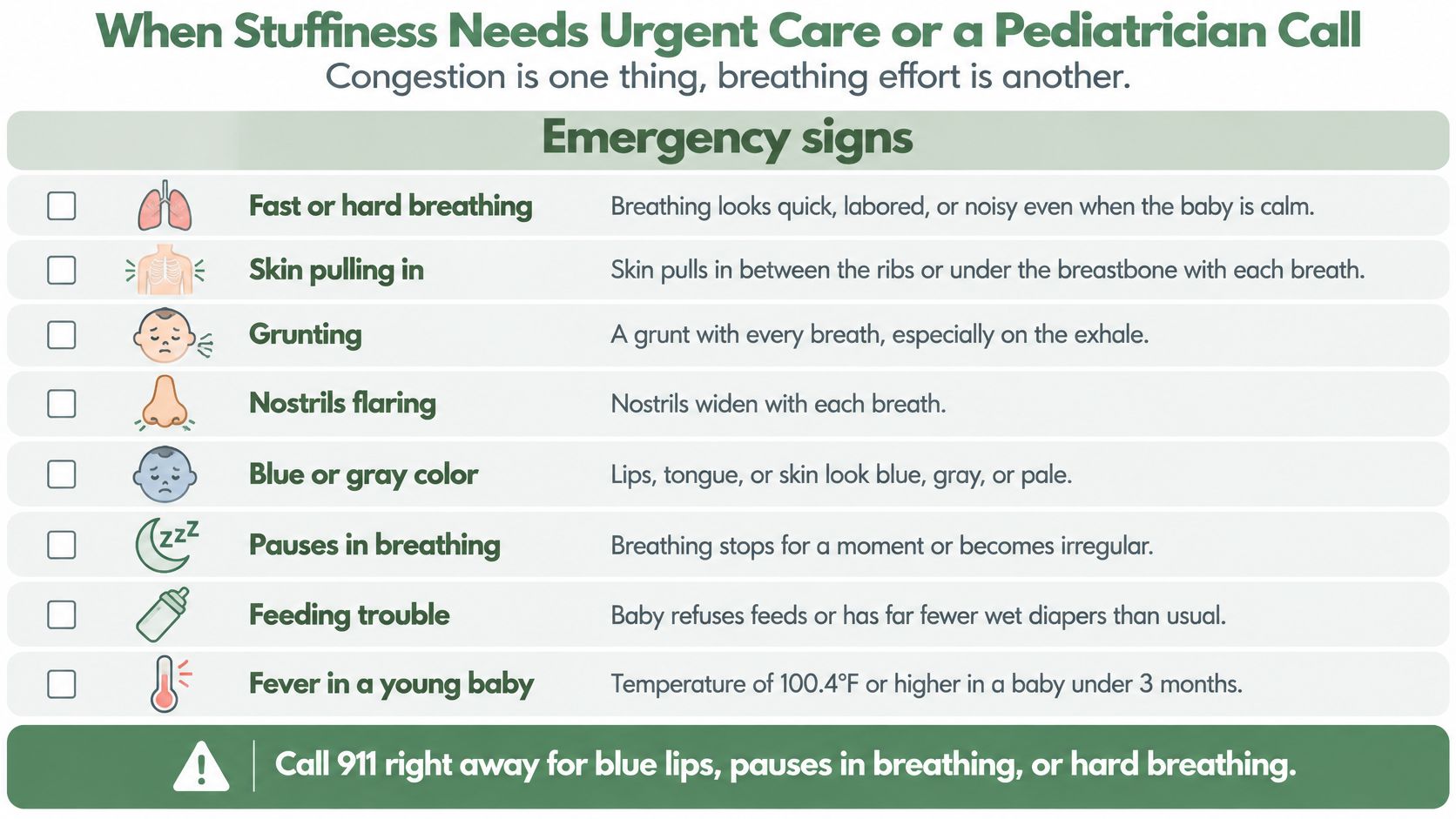
Signs that mean emergency care or a clinician call
| Sign | What it may point to | Who to contact |
|---|---|---|
| Struggling to breathe, pauses, grunting, or skin pulling in around the ribs | Breathing effort that needs immediate help | Emergency services now |
| Blue or gray lips, face, or skin, including bluish color during coughing | Possible low oxygen | Emergency services now |
| Barely crying or making sounds | Severe distress | Emergency services now |
| Breathing much faster than usual, or wheezing | Breathing effort that needs medical review | Pediatrician or urgent care promptly |
| Cough that stops sleep, feeding, or play | Sleep or feeding disruption | Pediatrician |
| No urine for more than 8 hours, dark urine, very dry mouth, or no tears | Dehydration | Pediatrician promptly |
| Fever in a baby younger than 3 months | Needs prompt assessment | Pediatrician or urgent assessment right away |
Call emergency services now if your baby struggles with each breath, can barely cry or make sounds, or has blue or gray lips, face, or skin. This includes bluish color during a coughing spell. NHS first aid guidance for babies also identifies fast or difficult breathing, grunting, pauses in breathing, and muscles pulling in around the ribs as emergency warning signs. Do not wait overnight to see if these signs pass.
Prompt calls and time-based checkpoints
Call a pediatrician or seek urgent care promptly for breathing that is much faster than usual, wheezing, or trouble breathing that continues after you clear your baby's nose. Signs of dehydration, including no urine for more than 8 hours, dark urine, a very dry mouth, or no tears, also need prompt attention. A fever in an infant younger than 3 months needs prompt assessment. Any blue, gray, or bluish skin color, including during coughing, calls for emergency services now, not a routine call.
For less urgent concerns, Seattle Children's guidance on colds advises contacting a doctor within 24 hours for children younger than 6 months with cold symptoms. It also recommends medical review if a blocked nose wakes the child, breathing trouble occurs, fever lasts more than 3 days, nasal discharge lasts longer than 14 days, or a cough lasts longer than 3 weeks.
Emergency signs override those timelines. If you call about a non-emergency concern, keep your notes nearby: which nights and rooms were involved, what seemed to help, and who cared for your baby. A shared timeline from parents, nannies, or daycare can make it easier to describe how the pattern changed across nights and sleep locations, without relying on tired memories.
When you're unsure whether to call, call. That's what your pediatrician's line is for.
You do not need to know the cause before asking for help. Describe your baby's breathing effort, feeding, wet diapers, temperature, and whether the stuffiness is limited to certain nights or places. Those details help the clinician guide your next step.