2 Year Old Sleep Regression What Helps and When to Ask
You finally get your two-year-old settled after a long bedtime routine. Then come the requests: another book, a drink, the bathroom, one more hug. A child who once went to sleep easily may start resisting lights-out, waking during the night, waking early, or refusing a nap the next day.
Many families call this the 2 year old sleep regression. The name can sound as though sleep skills have disappeared, but that isn't what's happening. A toddler's sleep can wobble while language, independence, social awareness, physical development, and daily routines are changing at the same time.
This phase is common, and health organizations and parenting references generally describe it as temporary. Different expert summaries describe disruptions lasting about 2–6 weeks or 10–14 days, so there isn't one exact timetable that fits every child. The useful question isn't whether you've caused the problem. It's what pattern your child is showing, and which gentle adjustment fits that pattern.
You may be dealing with developmental excitement, a nap that now falls at the wrong time, a new bed, potty-training requests, separation protests, or a bedtime routine that has accidentally become a long negotiation. Sometimes several of these arrive together.
The suggestions below are for education, not medical advice. If you're worried about pain, illness, breathing, or persistent distress, contact your child's pediatrician. If feeding or lactation questions are part of the picture, a lactation professional can help.
If your child spends the day with a partner, grandparent, nanny, or daycare, start by comparing observations rather than relying on one exhausted person's memory. A shared view of naps, bedtime, and night waking often shows whether the change is happening everywhere or only after a particular kind of day.
Table of Contents
- What a 2 Year Old Sleep Regression Really Means
- Why Sleep Shifts at Age Two
- Is It a Regression a Schedule Mismatch or Bedtime Stalling
- Gentle Ways to Steady Nights and Naps
- How Shared Tracking Helps Every Caregiver Stay in Sync
- When to Reach Out for Extra Support
What a 2 Year Old Sleep Regression Really Means
Think of sleep pressure as a small bucket that fills while your toddler is awake. A nap pours some water out. Overnight sleep empties more of it. If the bucket is nearly empty at bedtime, your child may not be ready to settle. If it becomes too full because a nap was missed or shortened, overtiredness can also make settling and staying asleep harder.
That analogy helps explain why a toddler can look tired and still resist sleep. The problem may not be a lack of willingness. The timing of sleep pressure may no longer match the old routine.
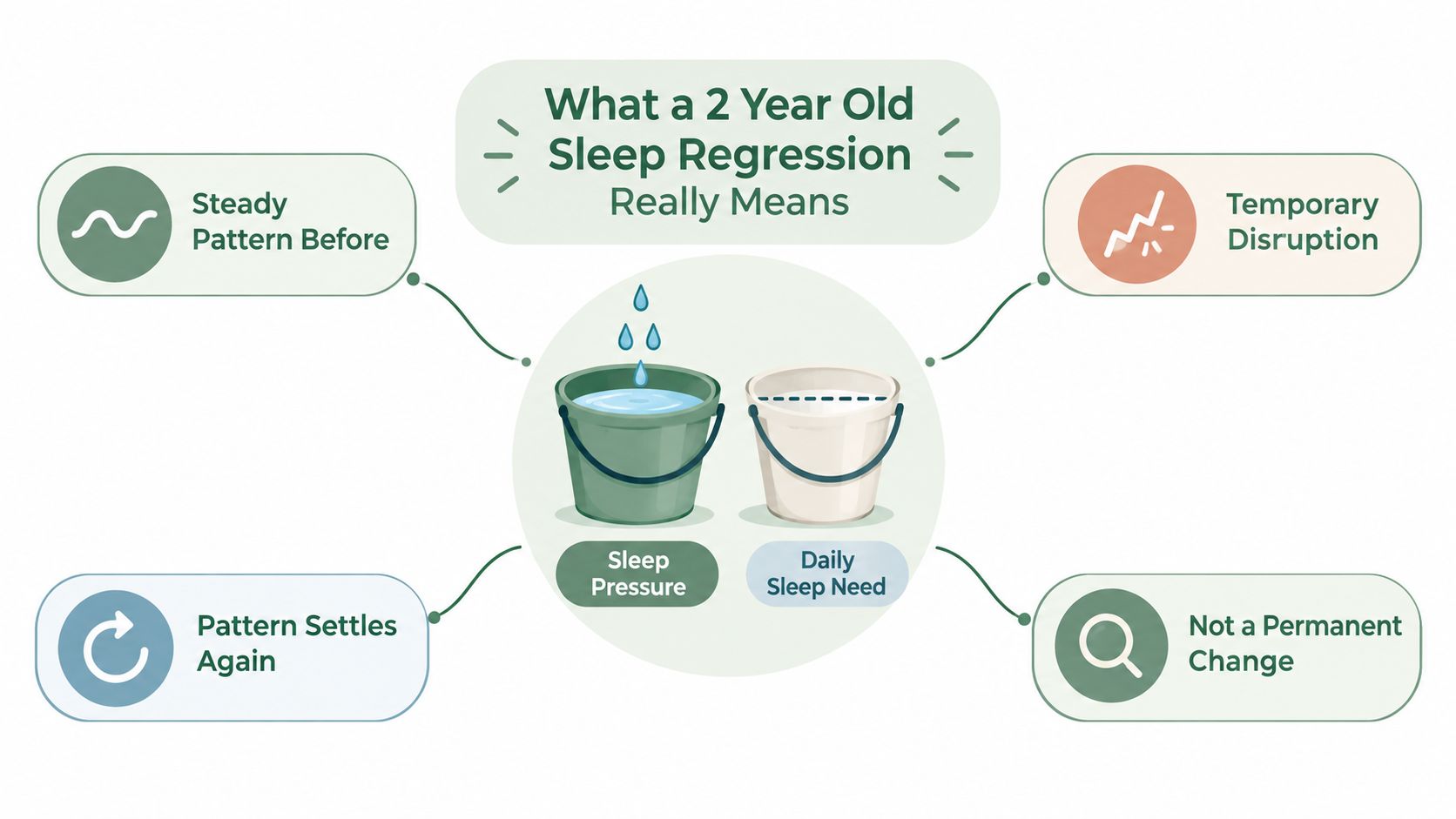
The sleep target is a reference point
Most two-year-olds need 11–14 hours of total sleep in a 24-hour period, with roughly 10–12 hours at night and 1.5–3 hours during the day, according to pediatric sleep guidance summarized for the two-year regression. These figures aren't a test your child has to pass every day. They're a helpful reference when you're trying to understand why several disrupted nights may affect mood, naps, and bedtime.
A regression usually means a previously steadier pattern has become unsettled. Common signs include:
- Bedtime resistance: Your toddler takes longer to fall asleep, calls out, cries, or keeps finding reasons to leave the room.
- More night waking: A child who had been sleeping more continuously starts waking again or wakes more often.
- Nap disruption: The nap becomes shorter, harder to start, or disappears on some days.
- Early mornings: Your toddler wakes earlier than usual and can't return to sleep.
One difficult night is normal toddler variability. A pattern that appears suddenly and continues across several days deserves closer observation, especially when it coincides with a developmental or routine change.
The central idea: A sleep regression is a developmental disruption, not an illness and not proof that your parenting has failed.
The word “regression” can make parents expect a permanent setback. In practice, many children settle again when their routines become predictable and the underlying transition passes. A sleep regression chart by age can help you compare the timing and signs of different phases without treating a chart as a diagnosis.
Why Sleep Shifts at Age Two
A two-year-old's brain and body are busy. New language gives your child more ways to ask, protest, remember, and negotiate. New motor skills can bring excitement that continues into the evening. Growing social awareness can make separation feel more noticeable when you leave the room.
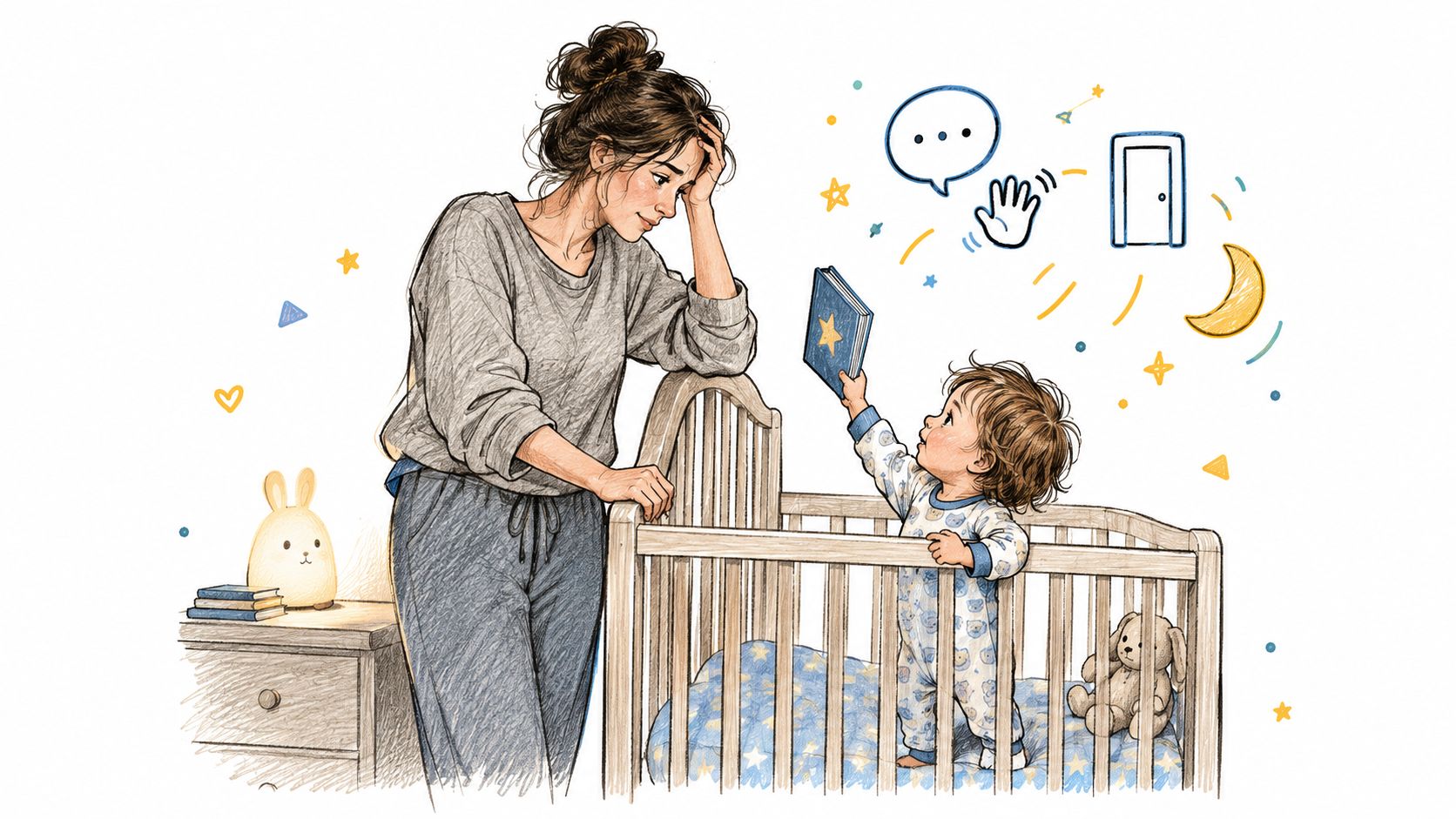
Development can show up as a bedtime protest
A toddler who says, “Stay,” “Again,” or “My turn” isn't necessarily trying to make the night difficult. They're practicing language and discovering that communication can change what happens next. The same child may resist separation at bedtime, wake and call for a caregiver, or ask to repeat a familiar routine.
Independence adds another layer. Your child may want to choose the pajamas, carry the cup, turn off the light, and decide when the story ends. Giving limited choices can support that need without handing over the entire bedtime plan. “Blue pajamas or green pajamas?” offers control. “Are you ready to sleep?” can invite a negotiation that lasts much longer.
Boundary testing often appears alongside imagination and memory. A toddler may remember that one more request once led to extra time with a parent. That doesn't make the child manipulative. It means the response pattern has become part of what bedtime feels like.
Physical discomfort can interrupt an otherwise good plan
Second-year molars commonly erupt around 23–33 months, and transient discomfort can fragment sleep, according to clinical guidance on the two-year sleep regression. If your child seems uncomfortable, unusually distressed, or different from their usual self, speak with a pediatrician rather than assuming the behavior is only a regression.
Nap changes create a separate kind of confusion. Some two-year-olds begin resisting a nap because their sleep need is changing, while others still need that daytime rest and become overtired when it disappears. Research discussed in a summary of toddler nap-transition findings connects nap changes with brain and memory development, while clinical guidance notes that preschoolers may not fully stop napping until ages 3–5.
These causes can overlap. A toddler may have a later nap at daycare, feel ready for more independence, and also experience molar discomfort. One night may look like stalling, another like an early waking, and a third like a skipped nap. That variation is why a short log is often more useful than a single explanation.
Is It a Regression a Schedule Mismatch or Bedtime Stalling
The same behavior can come from different causes. A child who refuses to lie down might not be ready for sleep after a late nap. Another child might be tired but has learned that asking for the bathroom leads to extra time outside the bed.
Potty training deserves special attention. It gives toddlers a legitimate reason to leave the room, but it can also become part of a long chain of requests. New beds, separation anxiety, and “one more story” behavior can create the same confusion. Pediatric guidance on toddler sleep regression and bedtime behavior highlights the need to distinguish developmental changes from control-seeking routines and inconsistent schedules.
Compare the pattern before changing the plan
| Pattern | Typical Clues | What to Check Next |
|---|---|---|
| Short-term developmental disruption | A fairly sudden change in bedtime, naps, or night waking, often alongside new skills or separation protests | Keep the familiar routine steady and observe whether the pattern begins to settle |
| Nap-transition or schedule mismatch | A late or inconsistent nap, long bedtime settling, early waking after a missed nap, or different sleep behavior after daycare | Compare nap timing, morning start time, and the awake period before bed |
| Bedtime stalling | Repeated requests, bathroom trips, extra stories, calling out soon after lights-out, and quick settling when limits stay consistent | Decide which requests are real needs, then use one calm, repeatable response |
Use timing as a clue
A nap that runs late can leave too little awake time before bed. A nap that is skipped can create overtiredness, which may lead to bedtime stalling, earlier waking, or more night waking rather than an easier night. The aim isn't to force a nap or push bedtime later immediately. It's to test one timing change at a time and watch the whole day.
Write down when your child woke, when the nap began and ended, when the bedtime routine started, and roughly how long settling took. Add context such as daycare, a new classroom, travel, potty training, or a new sibling. After several comparable days, you may see that the hardest nights follow late naps or that stalling happens mainly when one caregiver responds differently.
A practical rule: Before labeling the whole phase a regression, compare the sleep pattern with the day that came before it.
A source summarizing pediatric guidance says many two-year-olds still need a daily nap and about 5.5–6 hours of awake time before bed, as described in this overview of two-year sleep guidance. Treat that as a reference, not a rigid prescription. Your child's response to the full schedule matters more than a single clock time.
Gentle Ways to Steady Nights and Naps
Start with the parts of the day caregivers can repeat. A predictable morning, a protected rest opportunity, and a familiar wind-down give your toddler clear signals even when development is changing quickly.
Begin with the daytime rhythm
Keep the morning start reasonably consistent across home and daycare. A drifting morning can push the nap later, which then pushes bedtime later, creating a cycle that is hard to read.
Protect a regular nap opportunity even if your toddler doesn't sleep every time. Quiet rest in a familiar space can preserve the expectation that daytime has a pause. If the nap is consistently too late or bedtime takes a long time, adjust the timing gently rather than removing the nap after a few difficult days. A practical two-year-old sleep schedule can provide a starting framework for comparing your child's current rhythm.
Active play during the day can help your child arrive at rest with enough physical and mental activity behind them. Outdoor time, climbing, pretend play, books, and simple household tasks all count. You don't need to create an elaborate activity plan.
Make bedtime predictable without making it rigid
Use the same sequence most nights, such as washing, pajamas, books, a song, and lights out. The exact routine can vary by family, including Spanish-speaking families who use familiar Spanish phrases or bilingual books. What matters is that the order stays recognizable.
Offer choices inside the routine, then close the choices. “You can choose one book” is clearer than repeatedly asking whether your child wants another. If the bathroom is part of potty training, offer a calm final trip before bed, then respond briefly if your toddler asks again.
At night, keep reassurance quiet and boring. Use a short phrase, return your child to the agreed sleep space, and avoid turning the waking into play or a lengthy conversation. Partners, grandparents, nannies, and daycare staff should agree on the same basic response so your toddler doesn't have to learn a different set of rules from each caregiver.
- Anchor the morning: Keep the day from drifting later after a difficult night.
- Protect rest: Keep a dependable nap or quiet-time opportunity while you observe timing.
- Set kind limits: Repeat the same short response to extra stories, drinks, or bathroom requests.
- Review gradually: Change one part of the schedule, then observe before changing another.
Let consistency include imperfect days
A sick day, family event, or daycare disruption doesn't erase your progress. Return to the familiar sequence at the next opportunity. Consistency means the overall response is recognizable, not that every night follows the plan perfectly.
Health questions belong with your pediatrician. Ask before making assumptions about discomfort, breathing, illness, or anything that seems outside your toddler's usual sleep behavior.
How Shared Tracking Helps Every Caregiver Stay in Sync
A shared timeline can reveal details that disappear during a rushed handoff. Instead of saying, “The nap was bad,” a caregiver can record that the nap started later than usual, ended early, and was followed by a longer bedtime routine. That distinction helps the next caregiver respond to the pattern rather than the frustration.
Cradlo is a shared baby and toddler care tracker that lets families, nannies, grandparents, and daycare caregivers record sleep and naps under their own identities. Daycare can use a bookmarked browser page on an iPad without installing the app, while entries sync to the parents' phones. Families can also log offline and allow the information to sync later.
Log the clues that answer the real question
For this age, sleep start and end times are useful, but context makes the record more meaningful. Note whether your toddler fell asleep quickly, protested, asked for the bathroom, woke soon after bedtime, or woke repeatedly overnight. Include daycare changes, nap location, illness concerns, travel, and new routines.
That information can help separate three possibilities:
- A broad disruption: Sleep is unsettled across home and daycare, even when timing is similar.
- A schedule pattern: Difficult nights follow late, shortened, or missed naps.
- A learned response: Stalling follows a predictable request and improves when every caregiver uses the same boundary.
Gentle AI features can turn those entries into nap-window predictions, a calm daily brief, and daycare summaries. The app supports English and Spanish, which can make shared instructions easier for multilingual households. The purpose is not to chase perfect logs or sleep streaks. It's to reduce guesswork when several adults care for the same child.
A toddler tracker app can be especially useful when one caregiver sees bedtime and another sees daycare naps. Cradlo offers a 7-day free trial on the monthly plan, with no free plan. Families can use the trial to decide whether shared tracking fits their routine.
When to Reach Out for Extra Support
Sleep disruption is common in early childhood. One summary reports that approximately 20–30% of infants and toddlers experience night awakenings and sleep difficulties through the first two years of life, as described in this pediatric sleep overview. That context can be reassuring, but common doesn't mean you have to handle every concern alone.
Contact your pediatrician if your child seems persistently distressed, appears to be in pain, has breathing concerns during sleep, or shows a change that feels medically unusual. Also reach out when disrupted sleep continues well beyond the typical few-week window or leaves your child and family struggling despite a consistent routine. For feeding or lactation concerns, contact a qualified lactation professional.
Bring a simple record rather than trying to remember every night. Include recent total sleep, nap start and end times, bedtime settling, night-waking frequency, early mornings, and changes such as illness, travel, potty training, a new bed, a new sibling, or a classroom transition.
Asking for support isn't an overreaction. It gives your child's clinician clearer information and gives you a calmer next step.
Cradlo brings sleep, nap, and caregiver notes into one shared timeline, with nap-window predictions, calm daily briefs, daycare summaries, offline logging, and English or Spanish support. Visit Cradlo to try the monthly plan for seven days and see whether coordinated tracking helps your family understand the pattern with less guesswork.