8 Month Old Wake Windows: How Long Baby Can Stay Awake
Why should the first nap happen at the same time after a settled night and a night full of waking? That's the missing piece in many conversations about 8 month old wake windows. The clock helps, but the night before, the nap that just ended, and the way each caregiver records waking all matter.
You don't need to get every interval right. You need a shared starting point, a few useful observations, and permission to adjust when your baby's day doesn't match a chart.
Table of Contents
- 8 Month Old Wake Windows at a Glance
- Why Nights Shape Your Daytime Wake Windows
- How Many Naps and How Long Each One Lasts
- Telling Overtired From Under-Tired Signs
- A Sample Day and How to Adjust It
- Keeping Everyone on the Same Clock Across Caregivers
8 Month Old Wake Windows at a Glance
An 8-month-old may stay awake for 2.5 to 4.5 hours at a stretch, the range Cleveland Clinic gives for babies aged 7 to 10 months. That's a broad planning range, not a goal to reach before offering sleep. A baby who's ready earlier doesn't need to be kept awake to match its upper end.
The more useful daily anchor is total sleep. The American Academy of Sleep Medicine recommends 12 to 16 hours per 24 hours for infants aged 4 to 12 months, including naps. That recommendation covers an age band, not a prescribed schedule for every baby within it.
Typical sleep and wake window values at 8 months
| Measure | Typical range | Source |
|---|---|---|
| Total sleep in 24 hours | 12 to 16 hours | American Academy of Sleep Medicine |
| Total awake time in 24 hours | Roughly 8 to 12 hours | Arithmetic derived from the total sleep range above |
| Wake window length at 7 to 10 months | 2.5 to 4.5 hours | Cleveland Clinic |
| Night sleep stretch | 9 to 12 hours | Nemours KidsHealth, with its age-specific guidance linked in the nap section |
Count from when your baby fully wakes, not from the feed, diaper change, or moment you leave the bedroom. The interval ends when sleep begins. Record the first sleepy cue separately so you can see when winding down might help.
Practical rule: Use the range to plan an opportunity for sleep, not to decide whether your baby is allowed to be tired.
A longer night leaves less total waking time within the daily sleep budget. A disrupted night may also mean your baby needs an earlier morning nap, but neither observation tells you exactly how long an individual window should be.
If naps repeatedly begin with distressed settling or a long period of cheerful wakefulness, look at the log and make a gentle adjustment. A single unsettled afternoon doesn't mean your schedule is wrong.
Why Nights Shape Your Daytime Wake Windows
Think of night sleep as a savings account and daytime wakefulness as spending from it. It's an imperfect analogy, but it explains why the same clock time can feel different after different nights. Your baby doesn't begin every morning equally rested.
A University of Pennsylvania pediatric sleep reference describes nighttime sleep consolidating to 10 to 12 hours during the 6-to-9-month period, with 1 to 2 awakenings for feeding. Consolidated sleep doesn't necessarily mean uninterrupted sleep, and a night feed alone doesn't tell you that daytime timing needs changing.
Compare different mornings
After a settled night, your baby might feed, play, and remain comfortably engaged until the usual morning nap. That's a reason to follow the familiar rhythm, not automatically extend it. The first window doesn't have to be the longest window of the day.
After a fragmented night, the same baby might lose interest in toys earlier and need a quieter morning. Offer the wind-down when those cues appear rather than holding out for yesterday's nap time. The nap that follows could be short or long, so don't assume its duration in advance.
- Note what changed overnight. A later bedtime, prolonged waking, or a feed that stretched into the morning provides context.
- Keep daytime observations concrete. Record reduced engagement or eye rubbing rather than writing tired.
- Separate health questions from timing questions. Illness, discomfort, and feeding concerns belong with a pediatrician or lactation professional.
Look for a repeatable relationship
Across several days, record bedtime, overnight waking, morning waking, and the start of the first nap. Compare similar nights rather than treating every morning as interchangeable. You're looking for whether earlier sleep cues reliably follow more disrupted nights.
Developmental changes can complicate that picture. Our article on sleep disruption around the first birthday discusses a later stage, not an age-specific timetable for your baby now.
The log, not a single morning, shows whether an adjustment is worth keeping.
How Many Naps and How Long Each One Lasts
Your baby's day may resemble a settled morning-and-afternoon nap pattern, or it may still include a late catnap. Those patterns create different amounts of awake time between sleep opportunities. Dropping a nap isn't an achievement to rush toward.
For babies aged 8 to 12 months, Nemours KidsHealth describes two naps per day as likely, with individual naps lasting from 30 minutes to 2 hours. It also describes a nighttime stretch of 9 to 12 hours for that age group. These are reference values, not a requirement that every nap reach the longer end.
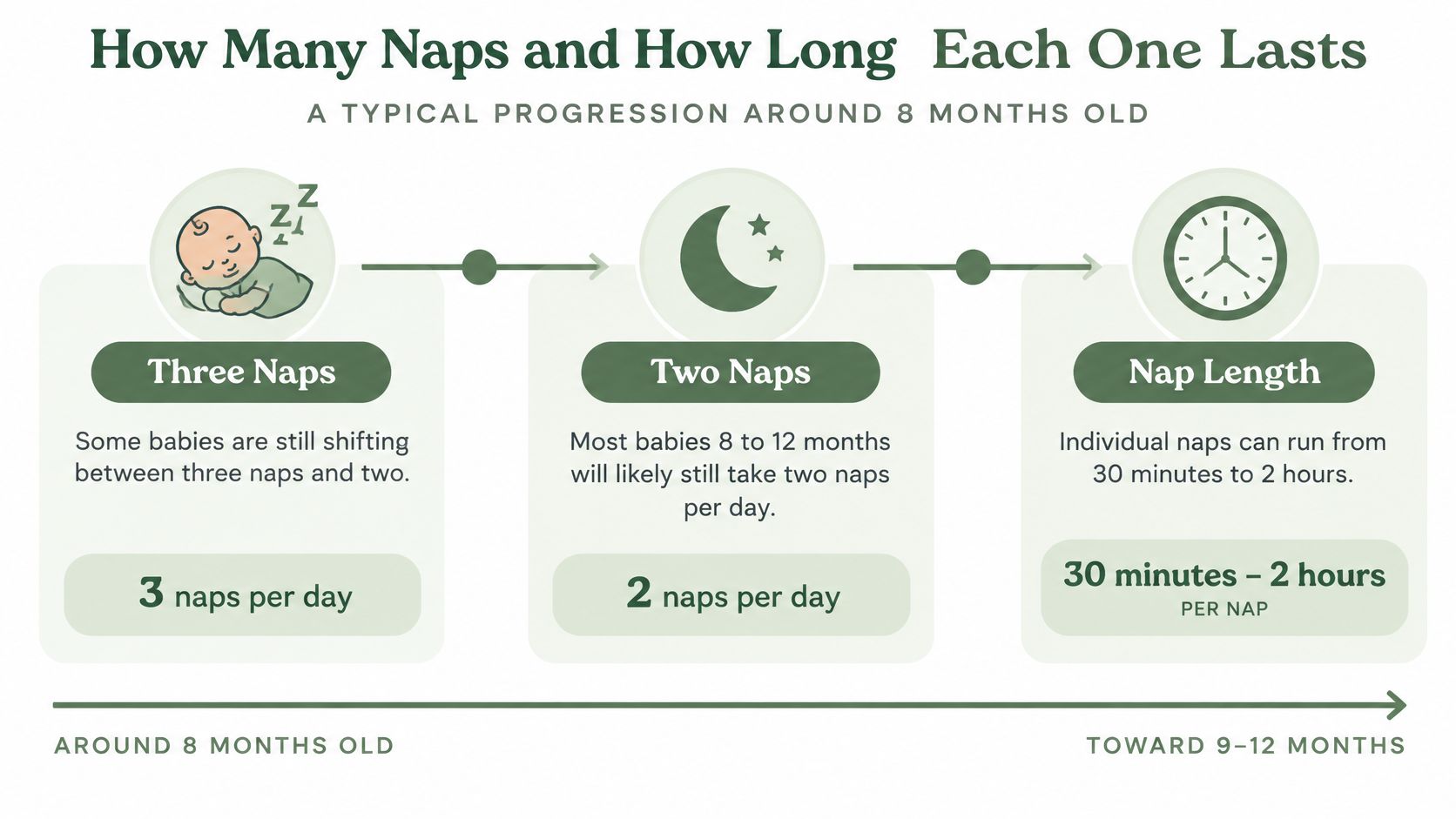
Two-nap and three-nap patterns at 8 months
| Pattern | Naps per day | Typical nap length | Window pattern |
|---|---|---|---|
| Two-nap day | Two | 30 minutes to 2 hours each, per Nemours KidsHealth | Morning wake interval, morning nap, midday interval, afternoon nap, final stretch before bedtime |
| Three-nap day | Three | Morning and afternoon naps, plus a short evening catnap | Shorter intervals between sleep opportunities, with less awake time to bridge before bedtime |
The table shows the sequence, not a fixed hierarchy of window lengths. Some babies need their morning sleep sooner than later naps. A shorter nap may also leave less comfortable waking time before the next sleep opportunity.
Watch the whole transition
A shrinking morning nap, repeated afternoon refusal, or late-afternoon distress can signal that the current arrangement needs another look. None proves by itself that your baby should lose a nap. Consider whether the baby can comfortably manage the day without that extra sleep opportunity.
- Count what happens. Include unplanned sleep during outings, rather than recording only intended crib naps.
- Pair nap length with mood. A baby who wakes content gives you different information from one who wakes distressed and still sleepy.
- Keep the wider picture visible. Our explanation of how many hours babies sleep can help you distinguish a daily sleep question from a nap-timing question.
A mixed pattern is information, not a failed transition. Let repeated observations guide the next change.
Telling Overtired From Under-Tired Signs
Yawning, rubbing eyes, staring, and a dip in play can suggest that your baby is ready to wind down. Look for a change from their usual behavior rather than waiting for every cue to appear. Some babies become quieter; others become more demanding.
An overtired-looking pattern may include fussiness, clinginess, arching, or renewed activity after earlier sleepy cues. An under-tired-looking pattern may involve relaxed, bright alertness and resistance to a sleep opportunity offered too soon. Neither pattern is a diagnosis, and arching or distress shouldn't automatically be explained as a scheduling issue.
Common sleep cues, possible readings and next steps
| Cue | Possible reading | Next step |
|---|---|---|
| Yawning, rubbing eyes, staring | Window may be ending | Begin the wind-down and offer sleep |
| Fussy, clingy, arching, hard to settle | Window may have run long, or something else may be bothering baby | Check comfort and the previous nap; consider an earlier next sleep opportunity |
| Bright, bouncy, refuses an expected nap | Baby may not yet have enough sleep pressure | Allow some quiet awake time and reassess |
| Repeated unusually short naps | Possible window mismatch or another source of disruption | Compare several days; discuss persistent concerns with a pediatrician |
| Very hard to wake or sleeping far more or less than usual | Possible health question | Contact a pediatrician rather than relying on schedule changes |
Sleep pressure means the increasing readiness for sleep during waking time. A long or late nap can leave less readiness at bedtime, while repeatedly extending awake time can leave a baby distressed and harder to settle. Offering every nap too early can also mean spending more time trying to get an alert baby to sleep.
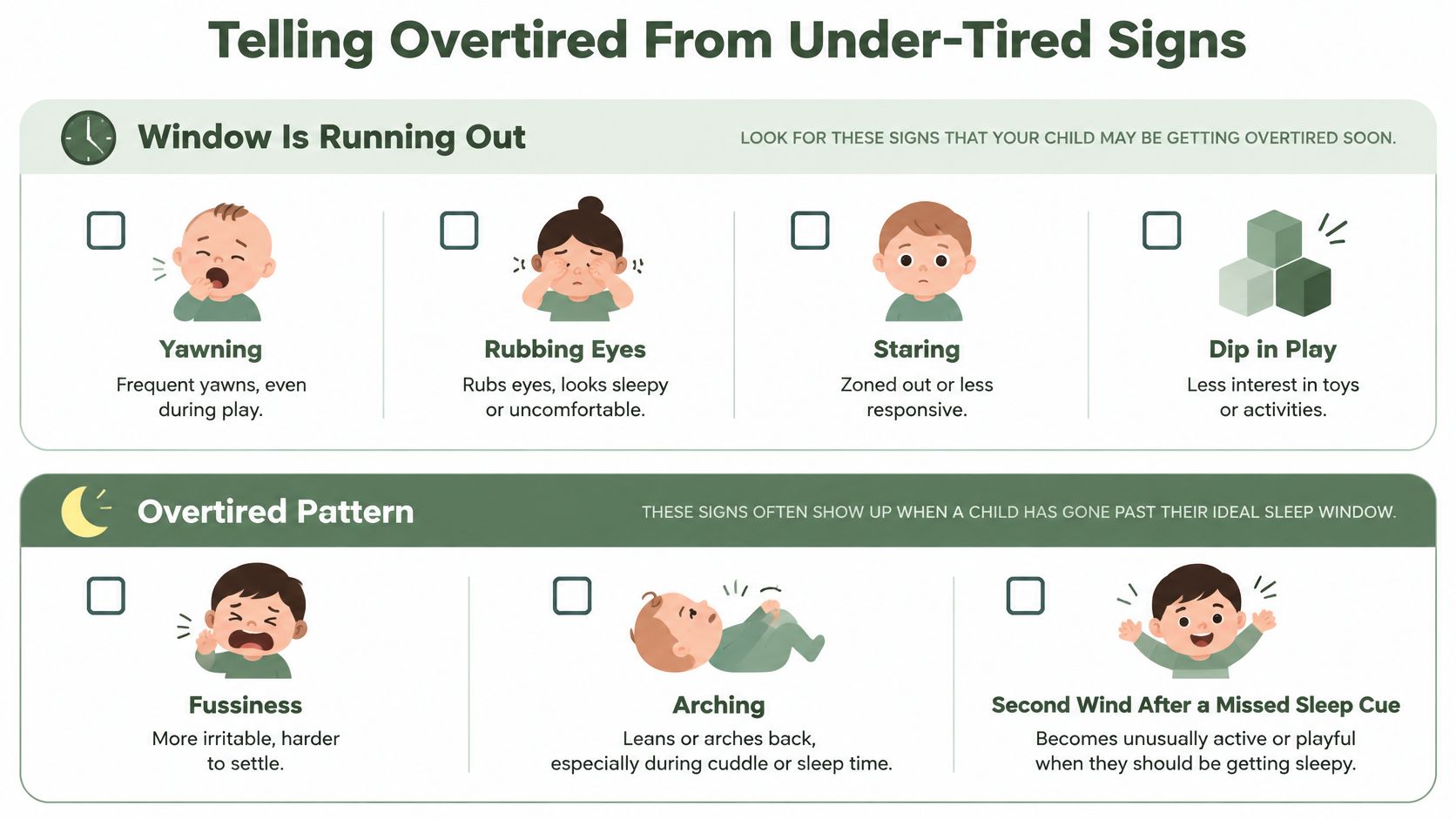
Check context before changing timing
Use the American Academy of Sleep Medicine's pediatric sleep guidance to keep total sleep in view, rather than interpreting each refused nap alone. Compare the rolling daily total with the recommended age-band range, count actual naps, and record how long your baby was awake before the first cue.
A cue helps you choose what to try. Your baby's response helps you decide whether to keep trying it.
Early waking alone doesn't distinguish overtiredness from insufficient sleep pressure. Look across several days before labeling a pattern. If sleep changes sharply, remains unusually short or long, or your baby is difficult to wake, contact a pediatrician.
A Sample Day and How to Adjust It
For a hypothetical two-nap day, suppose your baby wakes around 7:00 am, sleeps from 9:30 to 10:30 am, and takes another nap around 1:00 pm, waking between 2:00 and 2:30 pm. Those example times illustrate the order of events, not a recommended timetable. Bedtime would depend on the last nap and your baby's evening cues rather than an obligation to reach a particular hour.
The morning begins with feeding, connection, and play, followed by a quieter wind-down. After the morning nap, begin counting awake time again from full waking. Keep the afternoon flexible enough that an unexpectedly short nap doesn't require your baby to manage the original plan unchanged.
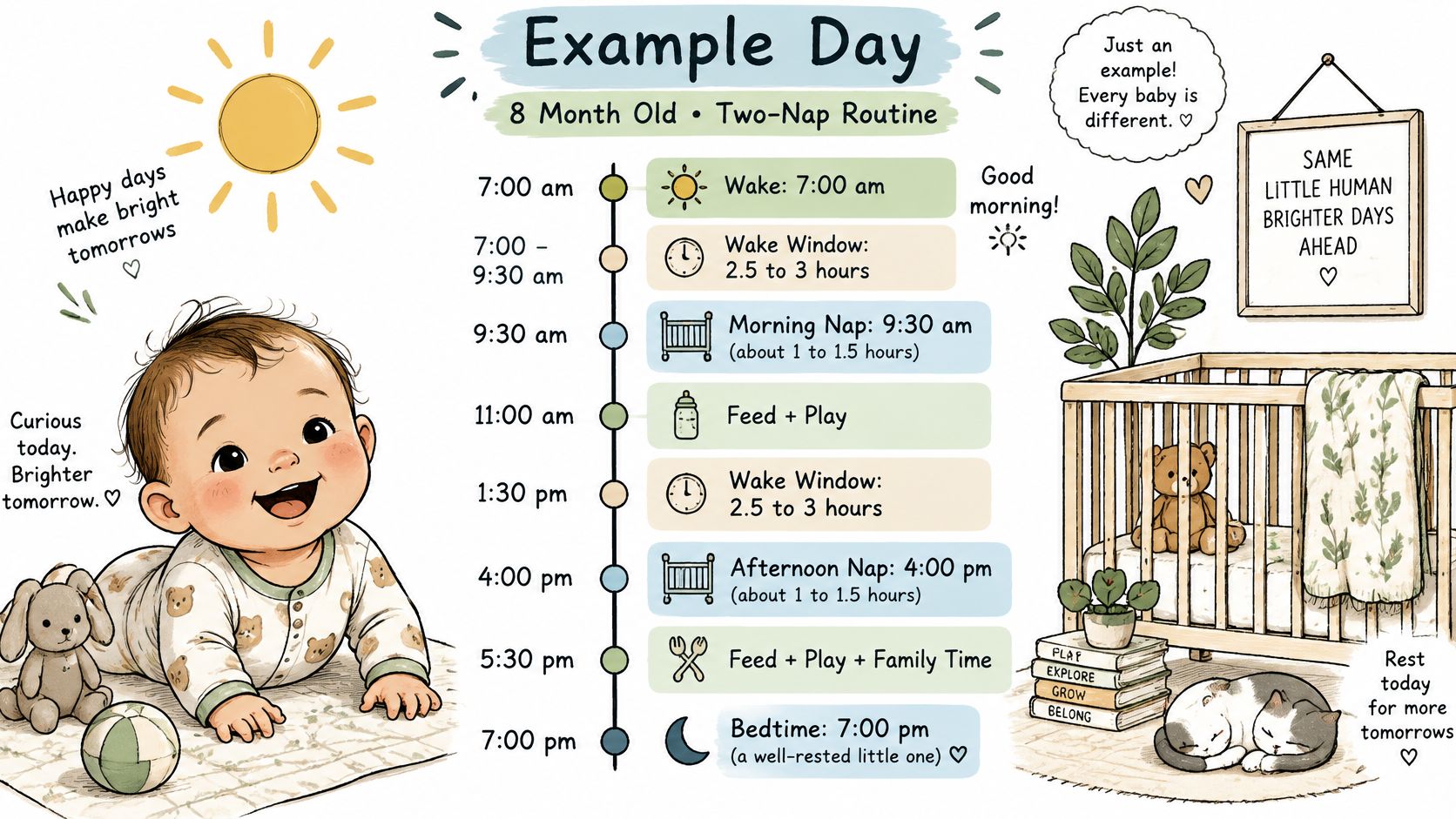
Adjust the next opportunity, not the whole day
- After a short morning nap, consider offering the next nap earlier if your baby shows readiness. Don't stretch the interval just to preserve the printed schedule.
- After a longer morning nap, allow a little more awake time only if your baby remains comfortable. A longer nap doesn't require a matching extension.
- After an afternoon nap refusal, keep the bedtime routine familiar, but reconsider its timing if your baby is struggling. A short late catnap may still be useful for a baby who needs it.
The American Academy of Sleep Medicine consensus recommendation concerns adequate daily sleep, not adherence to these example times. A rhythm that responds to your baby is more useful than a timetable you have to defend.
Keep feeds on the same timeline
A breastfeed, bottle, or solid meal doesn't reset awake time unless your baby sleeps. If a meal falls near the usual nap, follow your baby's cues and record both events rather than delaying sleep to create a new window.
Don't assume a new food caused a disrupted nap based on an isolated occurrence. Note the context and bring feeding or discomfort questions to a pediatrician or lactation professional.
Keeping Everyone on the Same Clock Across Caregivers
A parent counts from the end of the nap, a grandparent counts from the last bottle, and a nanny counts from the first yawn. Each person may be paying close attention, yet they're measuring different things. That makes a handoff confusing even when everyone has recorded something.
Agree on this definition before sharing care: a wake window starts when the baby fully wakes and ends when the baby falls asleep again. Record the first sleep cue as a separate marker. Ending the window at a cue would hide the awake time spent winding down and settling.
Record observations everyone can interpret
Keep these fields together on the shared timeline:
- Wake time. When the baby was fully awake, not when someone entered the room.
- Feed time and type. Breastfeed, bottle, or solids, with relevant context.
- Nap start. When sleep began, rather than when the baby was placed down.
- Nap end. When sleep finished, including an unplanned nap.
- Cue before sleep. A concrete observation such as eye rubbing, reduced play, or fussiness.
A hypothetical handoff might read: awake since 9:10, bottle at 10:00, eye rubbing at 11:30, nap not started yet. That tells the incoming caregiver both elapsed time and current behavior. Saying the baby is due leaves much more room for interpretation.
Daycare teachers can use the same fields, allowing parents to review the last nap before planning the evening. In Spanish-speaking households, caregivers can write observations in their preferred language while keeping the field meanings consistent. Agreement matters more than identical wording.
Build a shared routine
- Record the morning waking accurately. If the time is uncertain, mark it as approximate instead of presenting a guess as exact.
- Keep feeds and sleep together. Use a shared timeline so a partner, grandparent, nanny, or daycare teacher doesn't have to reconstruct the day from messages.
- Compare related events across several days. Look at overnight disruption, the first awake interval, the morning nap, and evening settling together.
- Agree on changes before making them. Write down what you're trying and why, so different caregivers aren't unknowingly testing different schedules.
Our approach to consistent naps across caregivers focuses on shared context rather than expecting every setting to produce identical naps. A daycare day and a home day can differ without either caregiver doing anything wrong.
With Cradlo, we offer a wake window calculator alongside shared logging: every feed, nap, and diaper logged by any caregiver shows up instantly for everyone. Daycare doesn't need to install an app or create a login to contribute.
At handoff: Share what happened, what you noticed, and what hasn't happened yet.
Bring the log to your pediatrician if sleep remains persistently unusual, your baby is hard to wake, or the pattern changes sharply. The window is a guide, not a target, and keeping everyone informed is more valuable than keeping every day identical.
Cradlo combines a wake window calculator and shared care timeline, so the next caregiver can plan from the sleep that happened. Visit Cradlo to explore shared tracking and start a 7-day free trial on the monthly plan.