How Many Hours Do Babies Sleep? Age-by-Age Totals
Babies aged 0 to 3 months generally sleep 14 to 17 hours in 24 hours, and babies aged 4 to 11 months generally sleep 12 to 16 hours in 24 hours, with naps included in both totals. That raises a simple question many charts skip. If your baby's night looks short, are they short on sleep, or are you only counting part of the day?
That's the gap that matters most when you're asking how many hours do babies sleep. A baby can wake often overnight, nap well during the day, and still land inside a healthy range. Another baby can give you one long night and then barely nap for two days. The 24-hour total, watched over several days, tells you more than either night on its own.
Table of Contents
- Total Sleep Hours by Age at a Glance
- Nighttime Sleep and Daytime Naps by Age
- Why Sleep Totals Vary From Baby to Baby
- Counting Every Nap and Setting Up One Shared Log
- Factors That Shift Your Baby's Sleep Hours
- When a Sleep Pattern Is Worth Raising With a Pediatrician
Total Sleep Hours by Age at a Glance
How much sleep does your baby get across a full day? In the first three months, babies generally sleep 14 to 17 hours in 24 hours. From four to eleven months, the typical range is 12 to 16 hours, including naps. The NICHD fact sheet on infant sleep describes the newborn range as based on National Sleep Foundation recommendations and the older-infant range as based on American Academy of Sleep Medicine recommendations.
Recommended Total Sleep Per 24 Hours by Age
| Age | Total sleep per 24 hours (naps included) | How to read the range |
|---|---|---|
| 0 to 3 months | 14 to 17 hours | Sleep comes in many short bouts; judge the 24-hour total, not one stretch |
| 4 to 11 months | 12 to 16 hours | Night sleep starts to consolidate; naps still count toward the total |
Each sleep episode contributes to the total: short naps, contact naps, car naps, and overnight stretches, even when feeds interrupt them. A 20-minute doze is still part of the day's sleep. Those smaller pieces can add up, especially in the early months.
The ranges are broad because infant sleep is often fragmented. A baby who sleeps well at night but takes short naps may still get a typical total; frequent night waking alone does not show how much sleep they get over 24 hours. The reverse is true, too: long naps do not reveal the whole picture if nighttime sleep is broken.
Practical rule: Add every sleep episode across three to five days, then average the daily totals and compare that average with your baby's age row.
A multi-day average puts one rough night or unusually sleepy day in context. It also helps when caregivers see different parts of the day. If one person records a nap and another misses it, their totals for the same baby will differ. A shared log can bring those records together, so the daily total reflects what each caregiver observed.
These are population-level ranges, not daily targets or diagnostic cutoffs. Some days will fall outside them. Look at the pattern over time alongside your baby's feeding, growth, and behavior while awake. If sleep remains far outside the range, or you have concerns about feeding, growth, breathing, or alertness, discuss them with a qualified healthcare professional.
Nighttime Sleep and Daytime Naps by Age
Think of the 24-hour total as a pie. Early on, the slices are spread almost evenly across day and night. As your baby grows, the night slice gets bigger, the day slice gets smaller, and the whole pie shrinks a little.
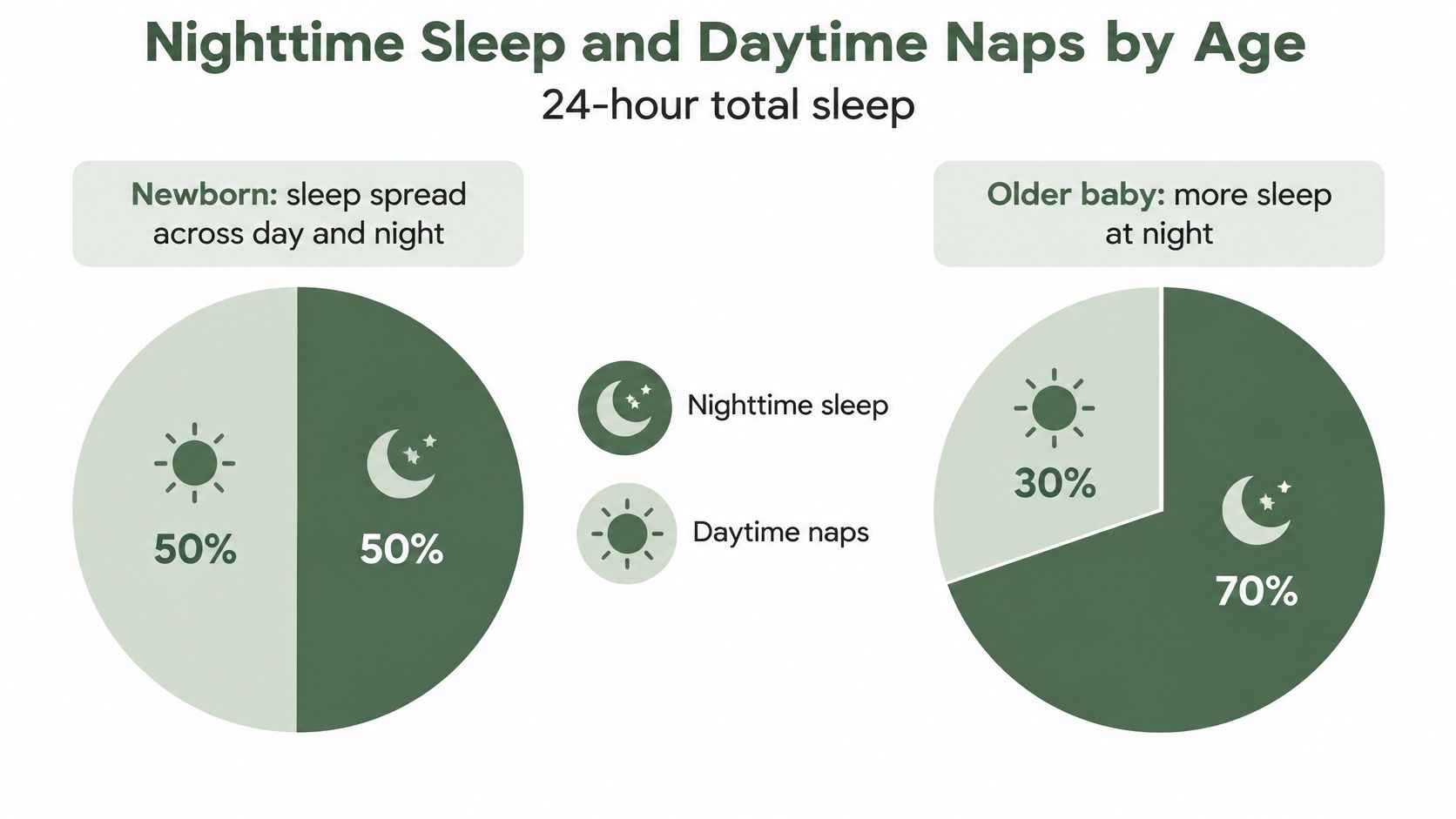
The Children's Hospital of Philadelphia overview of infant sleep describes newborns as sleeping roughly eight to nine hours during the day and about eight hours at night, often only one to two hours at a stretch. That surprises many first-time parents. A newborn isn't failing to sleep at night. Their sleep just isn't organized around night yet.
Night and Daytime Sleep at Reference Ages
| Age | Nighttime sleep | Daytime sleep | Total per day |
|---|---|---|---|
| Newborn | about 8 hours | 8 to 9 hours | about 16 to 17 hours |
| 3 months | 9 to 10 hours | 4 to 5 hours | about 15 hours |
| 6 months | about 10 hours | about 4 hours | about 14 hours |
Read the table down, not across. At 3 months, the average is about 15 total hours, with more of it moving into the night. At 6 months, the average is about 14 total hours, and daytime sleep has usually consolidated into fewer, more predictable naps.
That trend gives you a useful diagnostic habit, in the everyday sense of the word. If the total is in range but the night slice feels short, the issue is often timing or nap structure, not the total amount of sleep. A late, long afternoon nap can push bedtime later. A very short morning nap can leave a baby overtired and unsettled by evening.
These are averages, not a schedule your baby owes you. Your baby can sit above or below these figures for a while without a problem, especially during growth spurts, illness, or a change in routine. Use the split to understand the shape of the day. Use the 24-hour total to judge the amount.
Why Sleep Totals Vary From Baby to Baby
A baby's sleep can look very different from one day to the next, even when the overall pattern is typical. A long night alone does not show how much sleep a baby gets across the full day.
A meta-analysis summarized in Infant and Child Development found that average infant sleep declines from about 14.6 hours per day in the first two months to 12.9 hours by six months. The reported ranges were wide: roughly 9 to 20 hours early on and 9 to 17 hours at six months. Babies of the same age can differ by several hours, so an average is a reference point, not a pass-or-fail target.
What One Study Measured Over Time
Johns Hopkins Medicine's overview of healthy sleep habits reports mean total sleep of 12.2 hours per day at 6 months, 12.8 hours at 1 year, and 11.9 hours at 2 years.
| Age | Mean total sleep per day | Standard deviation |
|---|---|---|
| 6 months | 12.2 hours | 2.0 hours |
| 1 year | 12.8 hours | 1.6 hours |
| 2 years | 11.9 hours | 1.3 hours |
The six-month mean in this study is lower than the roughly 14-hour reference total shown in the age table above. These figures come from different summaries, so they should not be treated as one exact target. The age table gives a useful broad picture: about 10 hours at night and 4 by day at six months. The Johns Hopkins figures show that measured averages can differ across sources and groups.
Standard deviation describes how spread out the measurements are around the mean. At six months, for example, a standard deviation of 2.0 hours signals meaningful variation among babies. A single average cannot describe every baby's pattern.
The 24-hour total puts night sleep in context. A baby may sleep for a long stretch overnight and still have a different daily total depending on daytime sleep. Look at the pattern across several days, alongside the longest sleep stretch, wakings, and how your baby feeds and behaves while awake. Breastfeeding, bed-sharing, and how closely a caregiver observes the baby can also affect which wakings get noticed and recorded.
Night-to-night changes are common. Several days of patterns give a clearer picture than one unusually short or long night.
Counting Every Nap and Setting Up One Shared Log
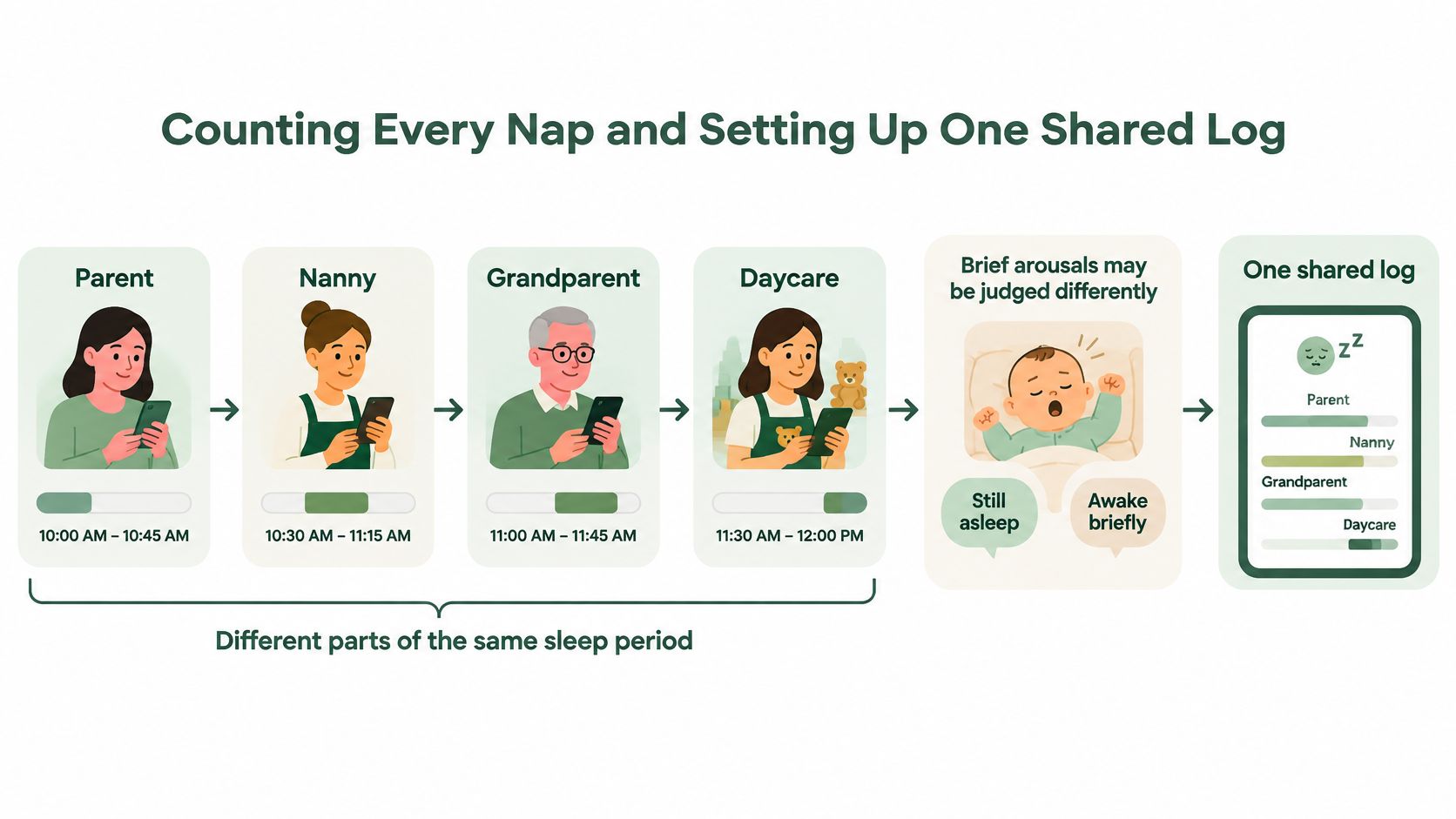
Two caregivers can record the same baby's sleep differently. One may mark the start when the baby is put down; another, when the baby falls asleep. They may also disagree about whether a brief stir ended a nap. Parents' impressions of short wakings can differ from what a device records, so small differences between entries do not necessarily mean anyone made a mistake.
A Counting Routine Everyone Can Follow
- Agree on start and end points. Choose whether sleep begins when your baby is put down or when they fall asleep, then use the same rule.
- Log naps separately from overnight sleep. Separate entries make it easier to see both the daytime and nighttime portions of the 24-hour total.
- Set a shared rule for brief wakes. Decide whether a short stir ends an episode, and apply that approach consistently.
- Count contact naps and car naps. Include sleep wherever it happens so the daily total reflects the whole day.
- Keep one record per baby. If two caregivers log the same nap, check that it appears only once in the total.
- Review three to five days. Compare the average with the age range, rather than drawing conclusions from a single day.
How Each Sleep Episode Counts Toward the Total
| Sleep episode | Where it counts | Example |
|---|---|---|
| Overnight stretch | Night total and 24-hour total | Asleep from 7:40 p.m. to 1:15 a.m. |
| Daytime nap | Daytime total and 24-hour total | Morning nap after the first feed of the day |
| Contact nap or car nap | Daytime total and 24-hour total | Nap in a carrier during an errand |
| Brief wake or feed | Ends one episode; log the start and end | Night feed at 2:10 a.m., then back to sleep |
| Overlapping caregiver entries | Keep one record | A parent and a nanny both log the same nap |
A shared timeline helps everyone use the same conventions. Cradlo lets parents and invited caregivers log sleep, feeds, diapers, growth, and health events for a child, with each entry appearing instantly for everyone. Daycare can use one browser link bookmarked on an iPad, and its logs flow to the parent's phone in real time. No app install or login is needed for daycare. A baby daily log template can also give caregivers a shared set of fields to record throughout the day.
The goal is a record consistent enough to show a pattern, not a perfect account of every stir. Keep the 24-hour total in view, and treat small differences between entries as ordinary uncertainty rather than evidence that someone logged incorrectly.
Factors That Shift Your Baby's Sleep Hours
A baby's total sleep can change even when the night looks much the same. The 24-hour total includes both nighttime sleep and naps, so a shorter night may be balanced by longer daytime sleep. Body-clock development and the time a baby has been awake also influence when sleep happens.
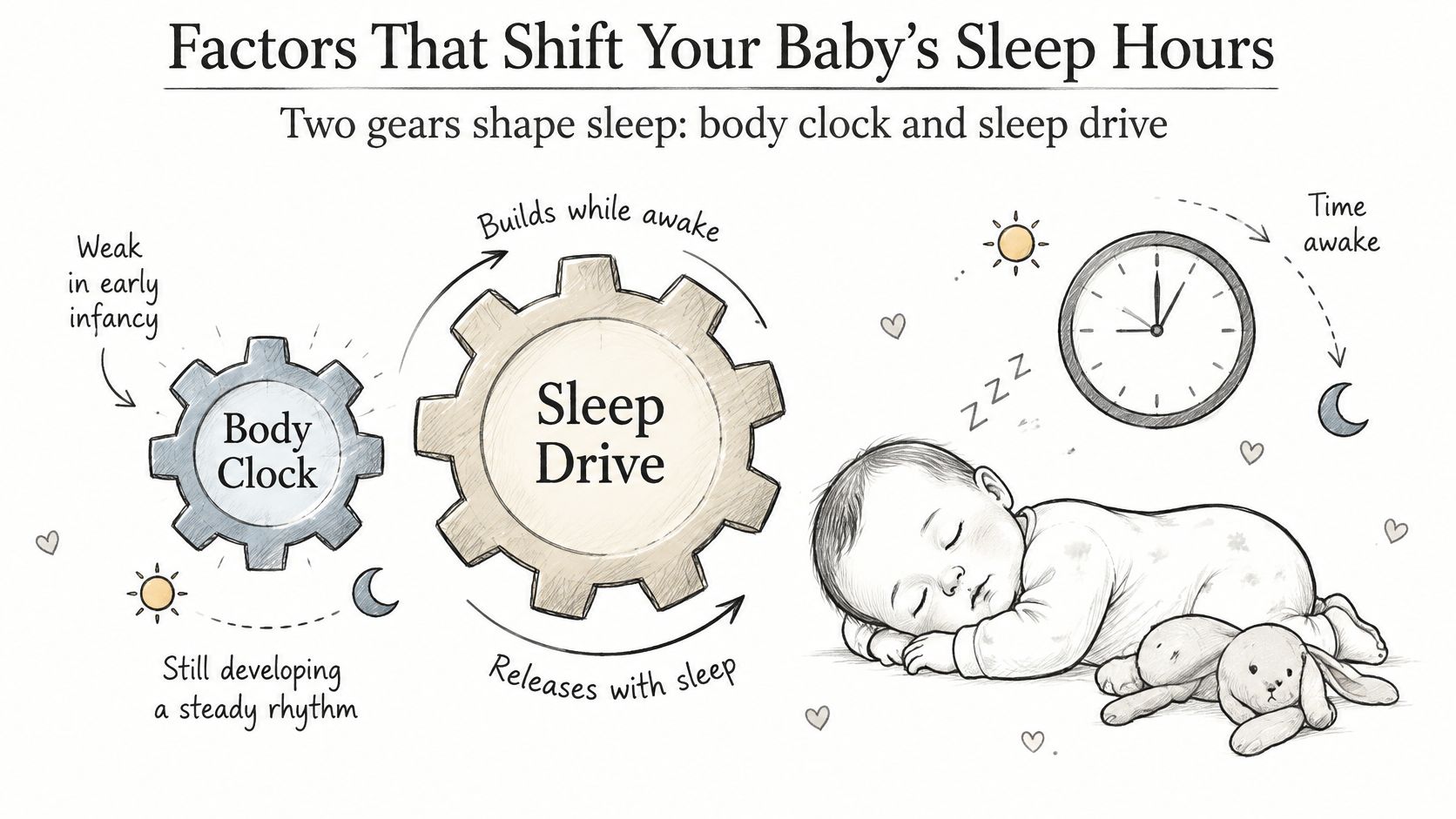
A longitudinal model published in PLOS Computational Biology examines sleep patterns from 2 to 540 days after birth. It describes a general trend: total sleep declines through early childhood as more sleep shifts to nighttime. Early in life, the body clock is still developing, and sleep pressure builds and clears more quickly. Day-and-night rhythms emerge gradually. A guide to baby wake windows can help explain why time awake offers a rough clue to when sleep may come, rather than a strict timer.
Everyday Factors That Move the Numbers
- Feeding needs: Frequent feeds in the early months can break sleep into shorter stretches.
- Growth and development: Growth spurts and new skills, such as rolling, may unsettle sleep for a while.
- Illness: Congestion, fever, or discomfort can shorten sleep stretches or increase daytime sleep.
- Schedule changes: Travel, visitors, or a new daycare routine can shift naps and bedtime.
- The sleep environment: Light, noise, temperature, and where your baby sleeps can affect how easily they settle.
- Bedtime consistency: A bedtime that varies widely can make the last stretch of the day harder to predict.
These influences can change sleep temporarily. A new daycare routine or a week with different family schedules may shift naps and bedtime, changing the 24-hour total. The pattern may settle again as the routine changes.
For every sleep, place babies on their backs on a firm, separate infant sleep surface without soft or loose bedding. Missouri's summary of American Academy of Pediatrics recommendations advises back sleeping until age 1 and room-sharing without bed-sharing for the first 6 months. If sleep changes alongside concerns about breathing, feeding, or health, discuss them with your pediatrician. A sudden, sustained change from your baby's usual pattern is also worth bringing up.
When a Sleep Pattern Is Worth Raising With a Pediatrician
A few days of notes can help you describe what has changed, but you do not need a perfect chart to ask a question. Sleep guidance bodies sometimes publish slightly different ranges for the same age. Treat those numbers as guides to typical patterns, not pass-or-fail rules.
Patterns Worth Bringing Up
- A sudden, lasting change: your baby moves away from their usual pattern and stays there, rather than sleeping differently for a night or two.
- Sleep changes alongside feeding concerns: feeds become harder, or you are concerned about weight gain.
- Breathing that worries you: tell your pediatrician about anything concerning you notice in your baby's breathing during sleep.
- A change in daytime alertness: your baby is unusually hard to wake or unsettled during the day.
Frequent night waking on its own is common and can be part of development. If your baby is waking up every hour at night, a shared record can help show whether the waking is a temporary phase or part of a lasting change. Bring the record to an appointment if you have concerns. Daily 24-hour totals, the longest stretches of sleep, and brief notes about feeds and wakings give a clinician more context than memory alone, especially when two caregivers have been logging at different times.
A lactation professional can help with feeding questions, while a pediatrician can address broader health concerns. You do not need to arrive with answers. Asking early is reasonable, even if the pattern turns out to be normal for your baby.
If naps, night wakings, and daycare notes are scattered across separate texts, Cradlo gives parents and invited caregivers one shared log. Every sleep entry appears for everyone in real time, making it easier to see the full 24-hour total rather than judging sleep by the night alone. That record can help you follow a pattern across several days and describe it clearly to your pediatrician.