Formula Feeding Schedule by Age and Cues
It's just before 6 a.m. and you're holding a crying baby in a quiet kitchen. Your partner fed her sometime in the night, but you're not sure when, how much she drank, or whether she finished. A useful formula feeding schedule answers that moment. It isn't a promise that she'll be hungry at set times. It's a shared picture of what's typical for her age, plus a clear record of what happened last.
Table of Contents
- A Shared Starting Point Not a Strict Clock
- Formula Amounts and Timing by Age
- Safe Bottle Timing for Every Caregiver
- How to Follow the Schedule Together
- When Growth Illness or Solids Change the Day
- Handoff Habits That Prevent a Second Bottle
- Log the Next Bottle Before the Handoff
A Shared Starting Point Not a Strict Clock
At 3:20 a.m., one parent warms a bottle, watches the baby drink part of it, and stumbles back to bed thinking they'll pass the details along in the morning. By 6 a.m., the other parent is awake with a fussy baby and no idea whether that bottle was finished, barely touched, or followed by a long, content sleep. So they guess. Sometimes the guess is a second full bottle an hour after the first one.
What a schedule can and can't do
Think of the schedule as two tools in one. First, it's a set of age-based ranges you can glance at, roughly how much and how often babies at this stage often eat. Second, it's a handoff record that shows the last feed, the amount taken, and how the baby seemed afterward. The ranges give you a starting point. The record tells you what your baby did.
That distinction matters because healthy full-term babies are usually fed when they show hunger, not when a clock says it's time. At the same time, a household with several caregivers needs enough structure that nobody double-feeds by accident. Both things can be true. You follow the baby's cues, and you write down what happened so the next person can do the same.
A schedule your baby never has to obey can still be a schedule your caregivers rely on.
You'll find the age ranges first, then a routine for turning them into cue-led feeds, the bottle timing rules every caregiver should share, and what changes with growth, illness, and solids after about 6 months. If you're also trying to make sense of day-to-day rhythms, our overview of infant feeding patterns sits alongside this piece. Any question about your individual baby belongs with your pediatrician or a lactation professional, not with a chart.
Formula Amounts and Timing by Age
A caregiver arriving halfway through the day needs two things: a quick age-based range and a written record of the last bottle. Use the table as a lookup, not a rigid clock. Each row describes a typical pattern, while hunger cues and your pediatrician's guidance help make sense of what your baby needs today.
| Age window | Amount per feed | How often | Daily pattern |
|---|---|---|---|
| First week | 1–2 oz (30–60 mL) | Every 2–3 hours, on hunger cues | Often 8–12 feedings in 24 hours |
| First month | 3–4 oz (90–120 mL) by month's end | Commonly every 3–4 hours, on demand early | About 32 oz a day total |
| 3 to 9 months | Often rising toward 7–8 oz | Every 3–4 hours is a common interval | Generally no need to exceed 32 oz in 24 hours |
| 6 to 12 months | Formula continues alongside solids | Formula and solids about 5–6 times in 24 hours | Individual needs vary; ask the pediatrician |
Reading the first rows
In the first days after birth, offer about 1–2 ounces (30–60 milliliters) every 2–3 hours, while responding to hunger cues rather than enforcing a strict schedule. This often adds up to 8–12 feedings over 24 hours. The U.S. Centers for Disease Control and Prevention formula feeding guidance describes this starting pattern. Small amounts offered often are typical, so wanting another bottle soon does not by itself mean something is wrong.
As babies take more at a feed, the intervals commonly lengthen to about every 3–4 hours, according to the same CDC guidance. During the first month, intake gradually increases to about 3–4 ounces (90–120 mL) per feed, with a total of about 32 ounces per day. The bottle grows, and the gaps between feeds often grow too. Keep the amount and time from the last feed in the shared log, so the next caregiver can compare the range with what the baby drank.
Reading the later rows
From 3 to 9 months, amounts often rise toward 7–8 ounces per feed, and intake generally does not need to exceed 32 ounces in 24 hours. Fewer, larger feeds can replace the frequent smaller ones of the newborn weeks. A larger bottle is part of a changing pattern, not a reason to keep offering more automatically.
By 6–12 months, formula and solid foods are generally offered about 5–6 times in 24 hours, though individual needs vary. Formula continues alongside solids, with the balance shifting gradually. The table gives a rough age-based range; the log adds the context of the last feed, the amount taken, and the baby's cues.
These ranges are starting points, not personal targets. Birth weight, gestational age, illness, and your clinician's instructions can all affect what is right for your baby. When caregivers share a day, checking the written log before offering a bottle helps turn an age range into a useful handoff, rather than relying on someone's sleepy recollection.
Safe Bottle Timing for Every Caregiver
A bottle has its own clock, and it starts running the moment you mix it. When several people prepare bottles across a day, the safety steps and the timestamps matter as much as the ounces.
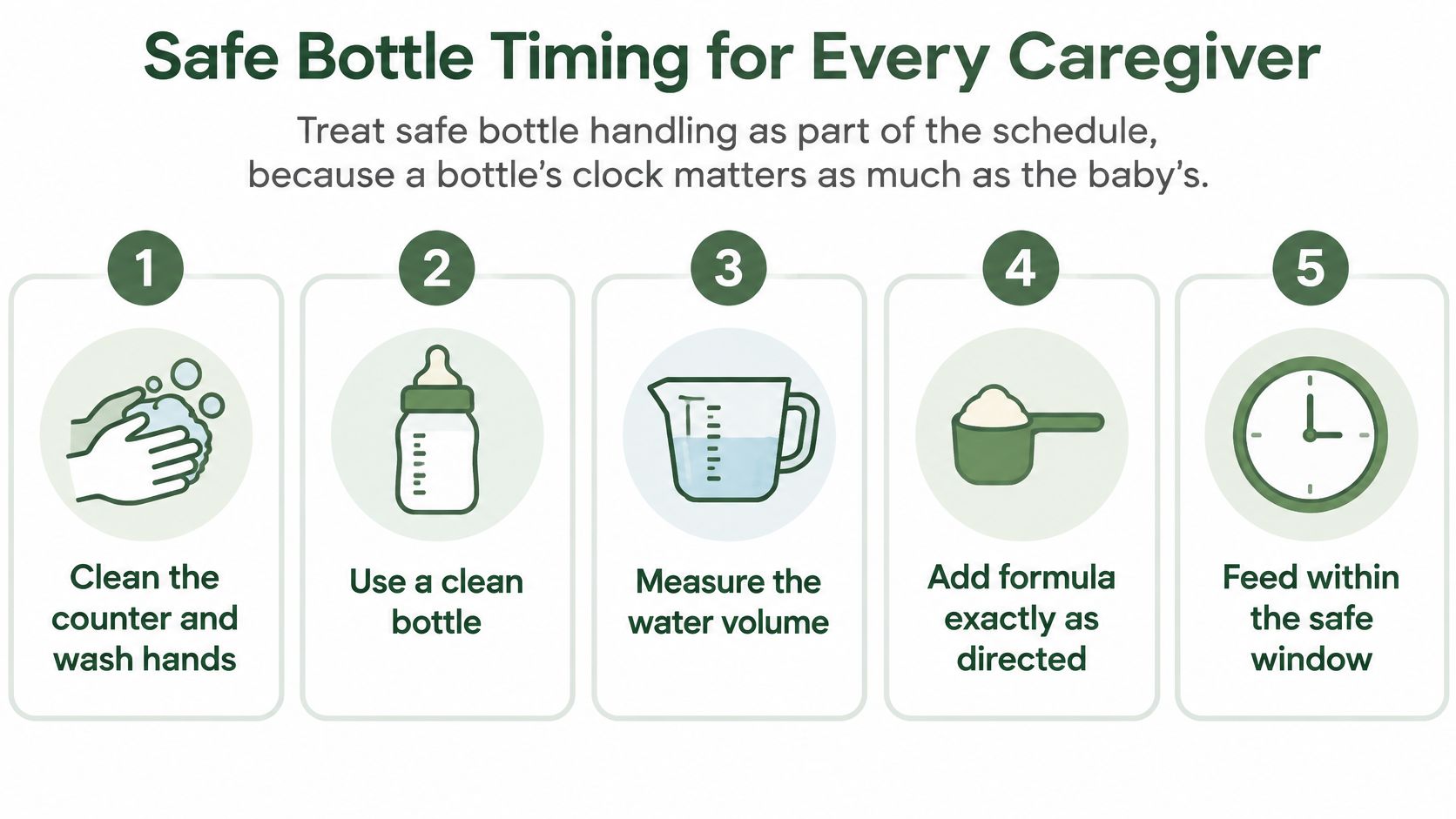
Preparing the bottle the same way every time
- Clean the counter and wash your hands. Whoever makes the bottle starts here, every time, even at 3 a.m.
- Use a clean bottle. Don't top up a bottle from an earlier feed.
- Measure the water first. Use the exact water volume printed on that formula's label, measured carefully rather than eyeballed.
- Add the manufacturer's level scoop of powder, then mix as directed. Never dilute, concentrate, swap in a scoop from another product, or guess the water, because incorrect dilution can create clinically significant electrolyte and nutritional exposure.
The World Health Organization guidance on preparing powdered infant formula lays out this same sequence, cleaning and disinfecting the preparation surface, washing hands, measuring the exact water volume specified on the product label first, then adding the manufacturer's level scoop of powder. Following the label exactly is the step that protects your baby from a bottle that's too weak or too strong, and it's the step tired caregivers are most likely to rush.
The three time windows
Prepared formula should be used within 2 hours of preparation and within 1 hour after feeding begins, and if it won't be used within 2 hours, it should be refrigerated immediately and used within 24 hours. Those are three different clocks, and confusing them is where shared care gets risky.
- Sitting out before a feed. Once mixed, a bottle left at room temperature has a short window. If the feed won't happen soon, refrigerate it right away rather than leaving it on the counter while the baby naps.
- Once feeding starts. The moment the baby begins drinking, the clock shortens. Finish or discard the bottle within the hour.
- Leftovers after a feed. Discard them. Contact with your baby's mouth introduces contamination, so a started bottle doesn't go back in the fridge for later.
- When nobody's sure. If no one can say how long a bottle sat out, throw it out. A fresh bottle costs minutes. Guessing costs certainty.
When in doubt, discard it. Uncertainty about a bottle's age is itself the answer.
Logging times, not just ounces
For shared care, record four times for each bottle. Note when it was prepared, whether it was refrigerated, when the feed started, and when it was discarded. A nanny arriving at noon should be able to see that a bottle mixed at 9:40 and left on the counter is no longer an option, without calling anyone to ask. A grandparent at pickup shouldn't have to reconstruct the morning from memory.
The same limits apply at daycare, at a grandparent's house, and in your own kitchen. In households where one caregiver is more comfortable reading Spanish, written times travel better than a spoken summary at the door. Numbers and timestamps don't need translating mid-handoff, and nobody has to rely on remembering a conversation they had while half asleep. The log holds the bottle's clock so you don't have to.
How to Follow the Schedule Together
A chart on the fridge doesn't feed a baby. A routine that every caregiver repeats the same way does. Here's one you can run on a tired morning without turning the age ranges into rules.
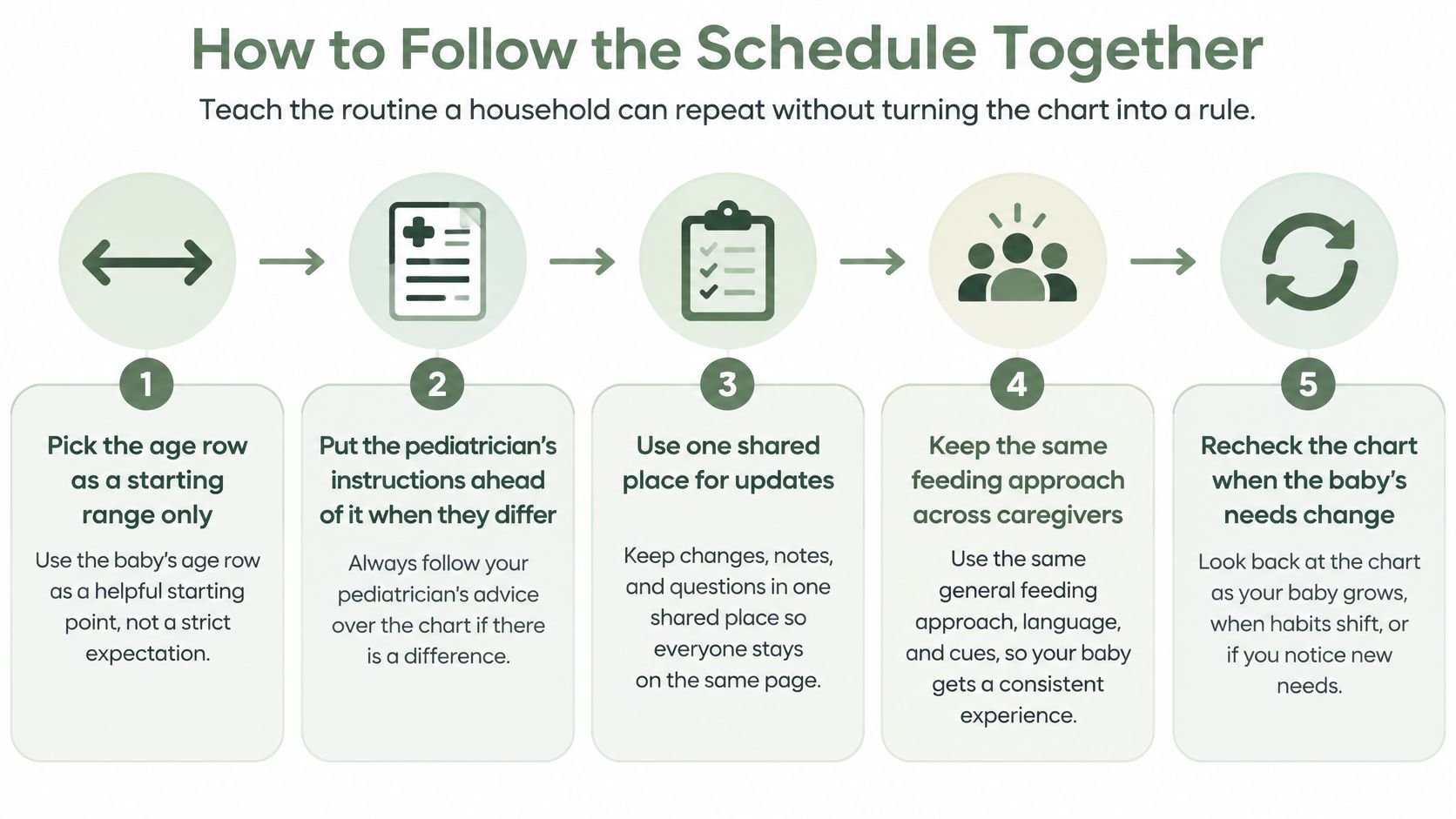
The eight steps of one feed
- Pick the age row as a starting range only. It tells you roughly what size bottle to prepare, nothing more.
- Put your pediatrician's instructions ahead of the row. If they've given you a specific plan, that plan wins whenever the two differ.
- Look for hunger before you look at the clock. Rooting, hands drifting to the mouth, lip smacking, or fussing that eases when a bottle appears are earlier signals. Crying is usually a later one, and not every cry means hunger. A wet diaper, a burp, or plain tiredness can sound similar at first.
- Make one bottle in that range. Prepare it using the safe steps you've agreed on, and resist mixing a larger bottle to cover the whole shift. A bigger bottle invites pressure to finish it.
- Note the start time, the volume offered, and who's feeding. This takes seconds and saves the next person a guessing game.
- Stop when your baby says stop. Turning away, slowing down, or releasing the nipple are fullness cues. Don't coax the last ounce in just because it's there.
- Record what was consumed, whether the bottle was finished, and one short note. Still hungry, content, or sleepy is enough. Those three words tell the next caregiver more than a paragraph would.
- Treat a partial bottle as a real feed. If your baby drank half and turned away content, that counts. The next caregiver doesn't mix a fresh full bottle because their shift started.
What the guidance behind this routine says
The MedlinePlus guidance on bottle feeding supports using infant hunger and satiety cues rather than enforcing a rigid clock, with newborns commonly taking 60–90 mL (2–3 fl oz) per feed, totaling approximately 480–720 mL (16–24 fl oz) per day, and many reaching at least 120 mL (4 fl oz) per feed by the end of the first month. It also suggests recording start time, volume offered, volume consumed, and signs of hunger or fullness so caregivers can identify trends and avoid duplicate feeds. That's exactly the routine above, written as steps instead of principles.
A weight-based cross-check of about 75 mL (2.5 fl oz) per pound of body weight per day appears in that same guidance, but it's an average, not a target that should override your baby's cues or your clinician's advice. If the math and your baby disagree, believe your baby and raise it at the next visit.
One morning, two caregivers
Say a grandmother offers 4 ounces at 7:10 a.m. The baby drinks 3, slows down, and settles. She logs the start time, the 3 ounces taken, and one word, content. At 10:30, dad reads that entry before he reaches for a bottle. He knows the last feed was recent and satisfying, so he offers 4 ounces again rather than 6, just in case. Nobody made a phone call. Nobody had to remember a conversation from three hours earlier.
The entry from the last feed is the best briefing the next caregiver will ever get.
Finally, review the day only after several feeds, and read it as number of feeds and total drunk, never as a score. One small feed means very little. A pattern across a day or two means more. Questions about waking a baby for feeds, low intake, repeated vomiting, signs of dehydration, or weight gain belong with your pediatrician or a lactation professional, not with a bigger bottle mixed on the spot.
When Growth Illness or Solids Change the Day
The age row describes a typical day for a well baby at a steady stage. Real weeks include growth spurts, colds, and first spoonfuls of food. Each one bends the day differently, and each one asks you to record something slightly different.
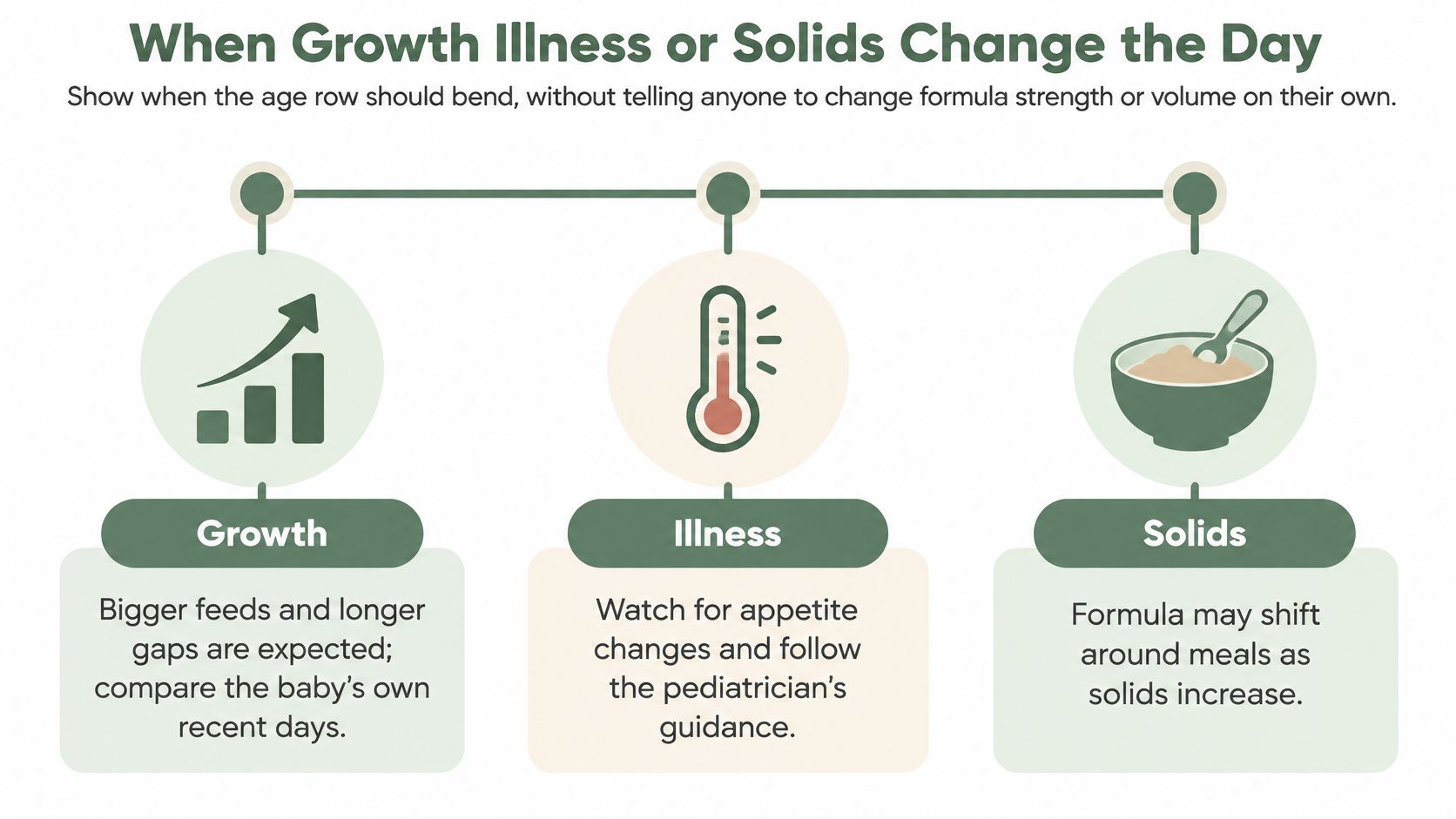
Growth changes the shape of the day
Bigger feeds and longer gaps are expected as your baby grows. The useful comparison is your baby's own recent days, plus the weight checks your clinician is already doing, not a neighbor's ounces or a cousin's timetable. Two babies the same age can settle into noticeably different patterns and both be doing fine.
What to record. Keep logging amounts and intervals as usual. When you look back, you'll see the shift happen gradually, a bottle finished more often, a gap stretching a little longer. That record is what makes a growth conversation with your pediatrician concrete instead of vague.
When to call. If intake jumps or drops sharply and stays there, or you're unsure whether a new pattern is a growth phase, ask rather than adjusting on your own.
Illness usually shrinks appetite first
A baby with a cold or a fever often drinks less for a short spell. That's common, and it isn't a cue to make formula stronger to catch up on calories. Never concentrate formula independently. Keep offering bottles in the usual range, follow your baby's cues, and write down what was drunk rather than what you hoped for.
What to record. Actual intake at each feed, plus anything your pediatrician's office would ask about, such as vomiting or fewer wet diapers. If diaper output is part of what you're watching, our guide to how many wet diapers to expect can help you describe what you're seeing. A written run of small feeds is far more useful on a phone call than a general sense that today seemed off.
When to call. Repeated vomiting, signs of dehydration, or persistent poor intake are reasons to contact your pediatrician promptly. Prematurity or any special feeding plan overrides the age chart entirely, on sick days and well days alike.
Solids join formula, they don't replace it
The World Health Organization guidance on complementary feeding recommends complementary foods beginning at 6 months while continuing breast milk or formula, with complementary foods offered 2–3 times daily at 6–8 months and 3–4 times daily at 9–24 months, while emphasizing responsive feeding based on hunger and fullness cues. Responsive feeding means recognizing your child's signals and responding promptly and supportively, so a solids timetable shouldn't become a rigid quota either.
A daycare lunch is not automatically a skipped bottle. Early on, much of a solids meal is tasting and exploring, and the amount swallowed can be small. So log four separate things rather than one blurry entry.
- Formula offered. What went into the bottle.
- Formula drunk. What your baby took.
- Foods tasted versus foods eaten. A lick of avocado and half a bowl of it are different events.
- Allergens and refusals. Note anything newly introduced, and anything firmly rejected, without pressuring another bite.
Picture a Saturday with grandparents. They log a tasted banana, a few spoonfuls eaten, and 5 ounces left in the bottle afterward. On Monday, daycare reads that and understands the smaller bottle intake came with an enthusiastic solids meal. Nobody assumes the baby suddenly needs more formula, and nobody repeats a brand-new food without knowing it was already introduced. A baby who loves solids and drinks less formula is a pattern to show your pediatrician, not a problem to solve by pushing the plate or the bottle harder.
Handoff Habits That Prevent a Second Bottle
Most duplicate bottles aren't caused by a hungry baby. They're caused by a missing sentence. One caregiver feeds, intends to mention it, gets interrupted, and the next person reasonably assumes the fussing baby hasn't eaten in hours. The chart can't fix that. Habits can.
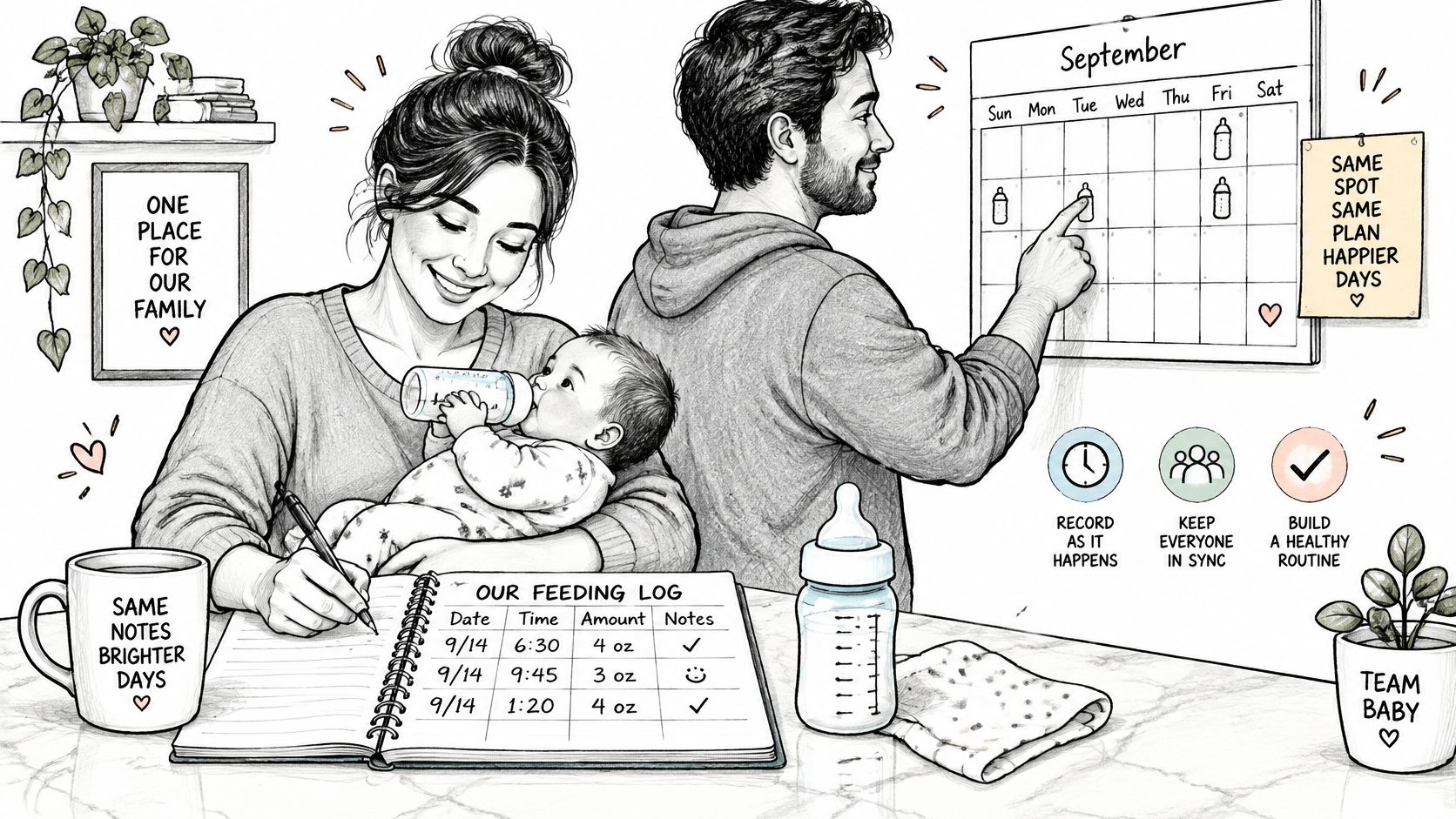
Why the log beats the clock
The American Academy of Pediatrics guidance on how much formula a baby needs gives rough averages, newborns commonly taking 2–3 oz every 3–4 hours, amounts often rising to about 7–8 oz per feed, and intake generally not needing to exceed 32 oz in 24 hours, while also saying healthy full-term babies should usually be fed on demand and judged by hunger, satiety, growth, and wellbeing. Averages describe a population. Your log describes your baby at 5 p.m. today. For the person walking through the door, the second one is the useful document.
Five habits that hold across caregivers
- Write each feed while it's happening. Entries reconstructed at the end of a shift blur together. Times drift, amounts round themselves up, and the note about mood disappears.
- Agree on one place everyone looks. A partner on night duty, a nanny, a grandparent, and daycare staff should all read the same timeline. Two notebooks in two rooms is the same as no record.
- Decide in advance what a partial bottle means. It counts as a feed, leftovers are discarded, and the next offer waits for cues rather than the clock. Agreeing beforehand prevents a well-meaning top-up.
- Add context beside each bottle. Mood, spit-up, and the time of the last nap help the next person separate hunger from tiredness or discomfort. A baby who fed an hour ago and missed a nap is probably telling you something different than a baby who fed four hours ago.
- Read before you pour. When someone's unsure, the log is the first stop, not an extra few ounces just in case.
For Spanish-speaking relatives, keep that same timeline available in Spanish so nobody has to translate a feeding history at the door while holding a baby. The record should be readable by every person who might pick up a bottle, in the language they're most comfortable reading when they're tired.
The habit that prevents most duplicate feeds: the feed is logged before the next person picks up the bottle.
That single sequence, log first, then hand off, turns a house full of helpers into one continuous caregiver. The baby gets fed for hunger, not for uncertainty.
Log the Next Bottle Before the Handoff
You don't need a perfect week to make this work. Start with the next bottle and a record the next caregiver can read.
Choose your baby's age row from the schedule and place any pediatrician guidance beside it. The row gives caregivers a general range; the note keeps your baby's specific plan visible. For the next feed, record the time, ounces offered, ounces taken, and one cue, such as still hungry, content, or sleepy. That gives the next person useful context without turning each entry into a report.
Add everyone who shares care to the same record before the next handoff. A partner, grandparent, nanny, or daycare caregiver can check what happened before deciding whether to prepare a bottle. When a question comes up in the middle of the night or during an afternoon shift, the written entry can answer it without relying on a sleepy status update.
For a format to copy, the baby feeding log template lays out the fields to track. Cradlo is a shared tracker for families, nannies, and daycares, keeping care records in one place. It offers a 7-day free trial, then Plus at $4.99/month or $49.99/year, or Lifetime at $99.99 one time. Each plan keeps every feature it launched with. Choose a format your household can maintain at 3 a.m.; a simple, regularly updated record is more useful than a polished one no one fills in.
The schedule is a lookup table, not a strict clock. It helps caregivers prepare a reasonable bottle and understand the usual gap, while the shared log adds the cues and context that make the next handoff clearer. If intake, vomiting, or weight gain worries you, call your pediatrician rather than changing the formula amount on your own.