22 Month Milestones: A Calm Guide for Caregivers
At pickup, the daycare teacher says your toddler pointed to a picture of a dog and tried a new word. At home, the same child is quiet, tired, and more interested in carrying a cup than talking. If you're wondering whether your 22-month milestones look “on track,” it can help to step back from the idea that every skill should appear on the same day, in every setting.
At this age, the useful question is often not “Can my toddler do this every time?” but “What's changing, and who has seen it?” A few specific observations from parents, partners, grandparents, nannies, and daycare can make the months before the next checkup easier to talk through, without turning development into a score.
Table of Contents
- Where 22 Months Sits in the Bigger Picture
- Milestones by Domain at 22 Months
- How to Record a Milestone the Useful Way
- Language and Communication at 22 Months
- Gentle Activities to Encourage Development
- Red Flags and When to Talk to a Pediatrician
- Feeding, Toileting, and Sleep Across the 24-Hour Day
- Tracking Progress Together Across Caregivers
- Preparing for the 24-Month Checkup
- What to Remember and What to Read Next
Where 22 Months Sits in the Bigger Picture
A parent might notice that their toddler walks confidently but rarely uses words at home. A nanny may have seen the child combine words during play, while a grandparent remembers a new gesture. Those accounts don't have to match perfectly to be useful. Together, they show what the child is doing, where it happens, and how skills are changing.
At 22 months, a child is between routine general developmental screening visits. The American Academy of Pediatrics recommends developmental screening at 9, 18, and 30 months, and autism-specific screening at 18 and 24 months. That puts 22 months between the general screens and close to the recommended 24-month autism screen. Screening is part of a pediatric visit, where a clinician uses a standardized tool and conversation with caregivers to decide whether more evaluation or support may be helpful. It isn't a diagnosis by itself. The CDC's milestone guidance also presents milestones as ways to monitor development, not as a pass-or-fail test.
This is why one missed or inconsistently observed skill shouldn't be treated as proof of a problem. Children develop at different rates, and one domain may be moving ahead while another is still emerging. A milestone list can help you notice what to discuss, but it can't tell you on its own why a child does or doesn't show a behavior.
A more useful checkpoint question: What has changed over time, and what have different caregivers noticed?
If a skill is emerging, note the examples. If you're concerned, bring that concern to your pediatrician rather than waiting for a particular birthday or trying to settle the question with a checklist.
Milestones by Domain at 22 Months
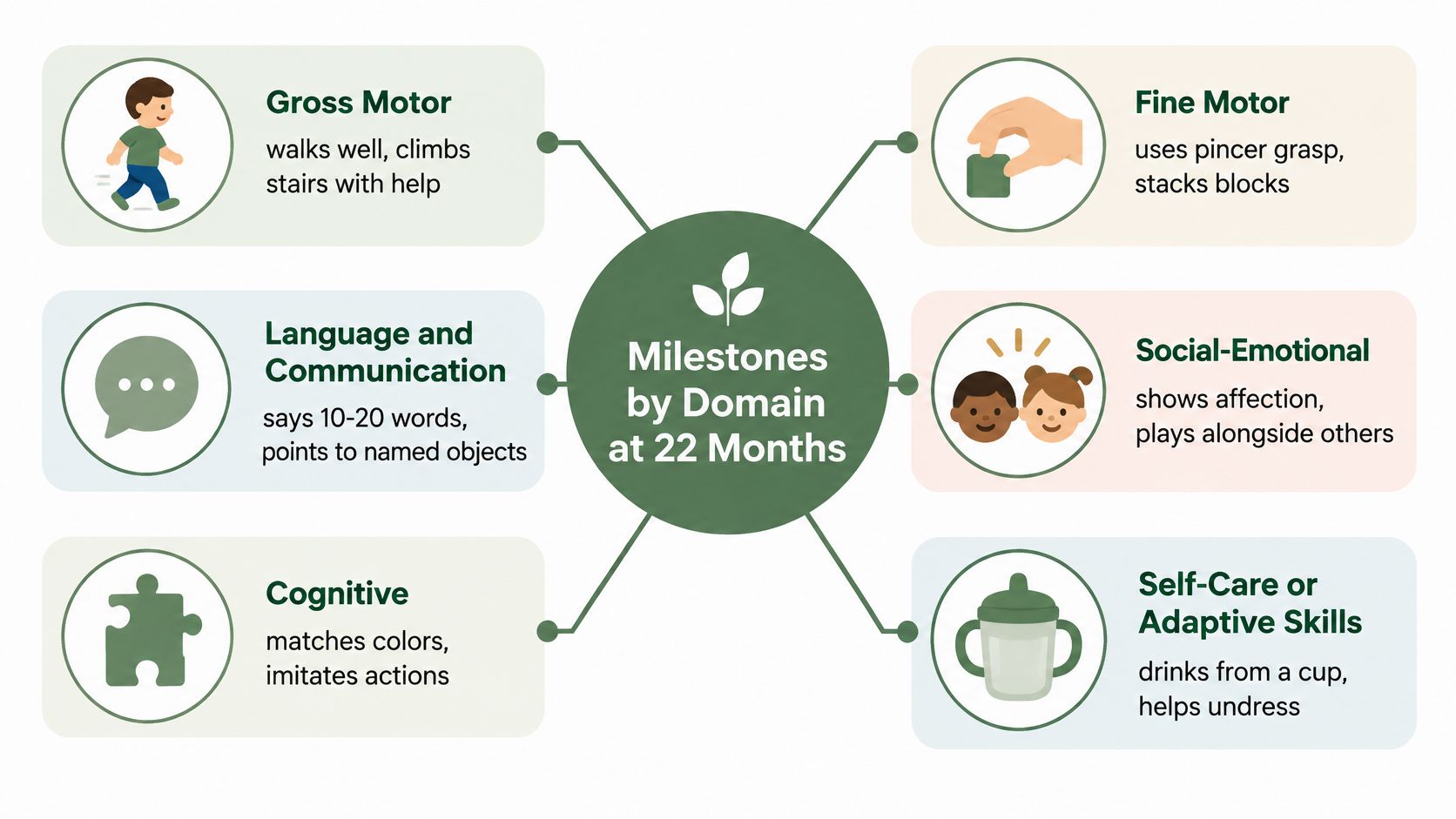
At 22 months, development makes more sense as a group of connected domains than as one long list. A child might climb easily but still spill while drinking, or use gestures often while spoken language is just beginning to grow. Look for examples and patterns, not perfect consistency.
Movement and hand skills
Gross motor development includes walking independently, climbing on and off furniture, and growing confidence moving around a space. The CDC groups several abilities in the 19–22-month window, including walking without holding onto a person or object and climbing on and off a couch or chair without help. A toddler may do this readily at home but hesitate somewhere unfamiliar, or climb when rested and avoid it when tired.
Fine motor skills involve smaller, more controlled movements. In this age window, children may scribble and become more practiced at handling everyday objects. You might see a child make marks with a crayon one day and lose interest the next. That variation doesn't erase the observation; it gives you context.
Communication, relationships, and thinking
Language and communication include words, gestures, imitation, and understanding. Notice whether your child points to share or request, imitates a sound or word, follows a familiar direction, or tries to combine words. Social-emotional observations include how a child seeks help, shows affection, responds to another person's feelings, or checks a caregiver's face when something is unfamiliar.
Cognitive skills show up in play and problem-solving. A toddler might put two toys together, try different ways to open a container, or copy an action they've watched. The CDC's 2-year milestone set is a nearby reference point, not a strict monthly deadline. It includes behaviors across social-emotional, communication, cognitive, and physical development. The AAP's developmental milestone overview can help caregivers understand the broad domains used in monitoring.
Self-care and everyday rhythms
Adaptive skills are practical actions such as feeding, drinking, and helping with dressing. The CDC's 19–22-month window includes finger-feeding, attempts to use a spoon, and drinking from an uncovered cup, even though spills may happen. Sleep is also part of the daily picture, but a nap or bedtime on its own isn't a developmental score. Consider whether a behavior appears across different routines and caregivers, and record what was happening when it did.
How to Record a Milestone the Useful Way
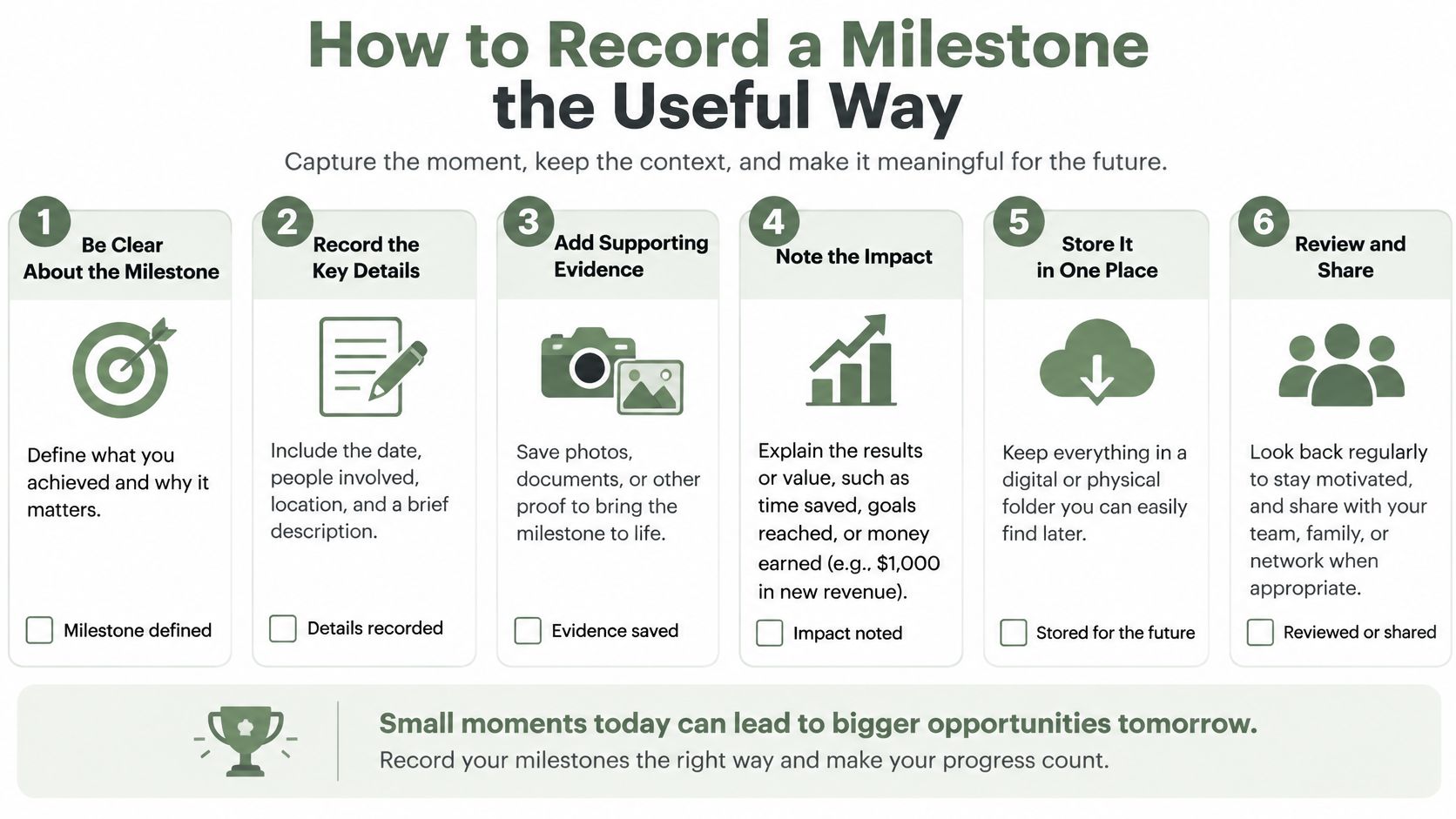
A checkmark answers only one question: did someone see a skill? A useful note captures what happened, so you can remember the example later and compare observations across settings without asking every caregiver to rely on memory.
Try recording a few practical details:
- Date and behavior: Write when it happened and what the child did. “Pointed at the dog in the book when asked” is more informative than “good communication.”
- Setting and observer: Note whether it was at home, daycare, or a relative's house, and who saw it.
- Language and communication: If a child used a word, gesture, or combination, note what it was and which language they used.
- Prompt or spontaneous: Record whether the child acted on their own or after a question, demonstration, or reminder.
- Context: Add details that may matter, such as fatigue, illness, a new routine, or whether the child was with a familiar person.
These details keep an emerging skill from being flattened into “can” or “can't.” For example, a child may use a word spontaneously with a grandparent but repeat it only after prompting at daycare. Both observations can be true, and each adds context.
A paper notebook or shared notes document can work if every caregiver can add observations. Cradlo is one shared tracker option: it lets families record milestones and other care notes in a shared timeline, with entries syncing across devices. For a broader explanation of recording behavior in context, see this guide to behavioral tracking.
Language and Communication at 22 Months
Language often feels like the most pressing part of the 22-month question, especially when relatives or other caregivers compare what a toddler says. But word count alone leaves out important ways children communicate. A child may be using gestures to ask for help, understanding a familiar request, or trying to imitate a word before saying it clearly.
Vocabulary often grows rapidly between 16 and 24 months, as toddlers move from single words toward combinations. OpenStax describes this broader pattern and notes that by approximately age two, a toddler commonly uses about 50–200 words. That's a reference range, not a target to force or a diagnostic threshold. The overview of 22-month development and communication also emphasizes looking beyond word counts and noticing interaction.
Listen for more than labels. Does your child try to combine words, copy words they hear, follow a familiar simple direction, or point to something when you name it? Do gestures help them communicate when a word doesn't come? At a storybook or during snack, these everyday moments can offer clearer examples than asking a child to perform on demand.
For Spanish-speaking or bilingual families, record the words and communication behaviors used in each language. Do not add word counts across languages without considering the child's total conceptual vocabulary. A word used in one language may express the same idea as a different word in another. The setting matters, too: a toddler might speak more with one caregiver or in a familiar routine.
At a pediatric visit, bring concrete examples rather than trying to label the child's development yourself. Note what your child says or gestures, what they seem to understand, and where you've noticed change. If you're sharing observations among caregivers, this guide to sharing first words offers a way to keep examples from getting lost between home and childcare.
Gentle Activities to Encourage Development
A toddler doesn't need a formal lesson to practice new skills. Ordinary routines already offer chances to move, communicate, imitate, and explore. Keep activities simple, follow the child's interest, and stop when they've had enough.
- For hand skills: Offer a chunky crayon and paper for scribbling, or stack a few blocks together and let your toddler knock them down. Talk about what's happening without asking for a performance.
- For language: Look at a familiar book and pause so your child can point, make a sound, or turn the page. You can name what they notice and respond to their gestures.
- For movement: On a walk, let your toddler carry a light, safe item to a nearby adult, or explore a clear space where they can walk and climb safely with supervision.
- For everyday independence: During a routine, narrate a small action such as putting a spoon on the table or placing clothes in a basket. A child may join in, watch, or move on.
- For connection: Take turns dropping a toy into a container or rolling a ball back and forth. The shared attention matters more than keeping the activity going.
These ideas can fit into a day with parents, partners, grandparents, nannies, and daycare teachers. A story before a meal or a few turns with blocks can be enough. There's no need to turn every moment into a test of what your toddler can do.

Red Flags and When to Talk to a Pediatrician
A skill that appears inconsistently isn't the same as a skill a child has lost. A toddler may talk less when tired, act differently with unfamiliar adults, or show a behavior at daycare that hasn't appeared at home. A quiet stretch during an illness can also look different from a lasting change. Context helps describe a pattern, but it shouldn't be used to dismiss a concern.
Loss of a previously used skill deserves a prompt conversation with a pediatrician. That may include a child no longer using words or gestures they used before, no longer showing a familiar social behavior, or losing a movement skill they had established. Language regression has been reported within the age range around a toddler's second birthday, but regression by itself doesn't identify a cause. This review of parent-recalled language regression in autism describes reported timing; it doesn't mean that every fluctuation or quiet period indicates autism.
If you notice a possible loss, contact your child's pediatrician promptly and describe what changed. You don't need to wait until a scheduled visit to raise a concern. If there's an urgent health concern, seek guidance from a clinician.
Before you speak, write down the specific behavior, when you last saw it, where it had been happening, which language was used, and who observed the change. Note whether the behavior has appeared again with another caregiver, and mention any hearing, illness, or health concerns. A clear account from home and daycare can help the clinician understand whether you're seeing a setting difference, an inconsistent emerging skill, or a sustained loss.
Feeding, Toileting, and Sleep Across the 24-Hour Day
A daycare nap can change how bedtime goes. A small lunch can lead to more snacking later. Looking at the full day helps caregivers describe routines without judging one meal, nap, or night in isolation.
For sleep, record overnight rest separately from naps, including nap start and end times and any interruptions. Guidance summarized by Johns Hopkins lists 11 to 14 hours of sleep per 24 hours for toddlers aged one to two, usually including one or two naps, while noting that individual children vary. This is general guidance, not a number to force. Persistent sleep concerns belong in a conversation with your pediatrician.
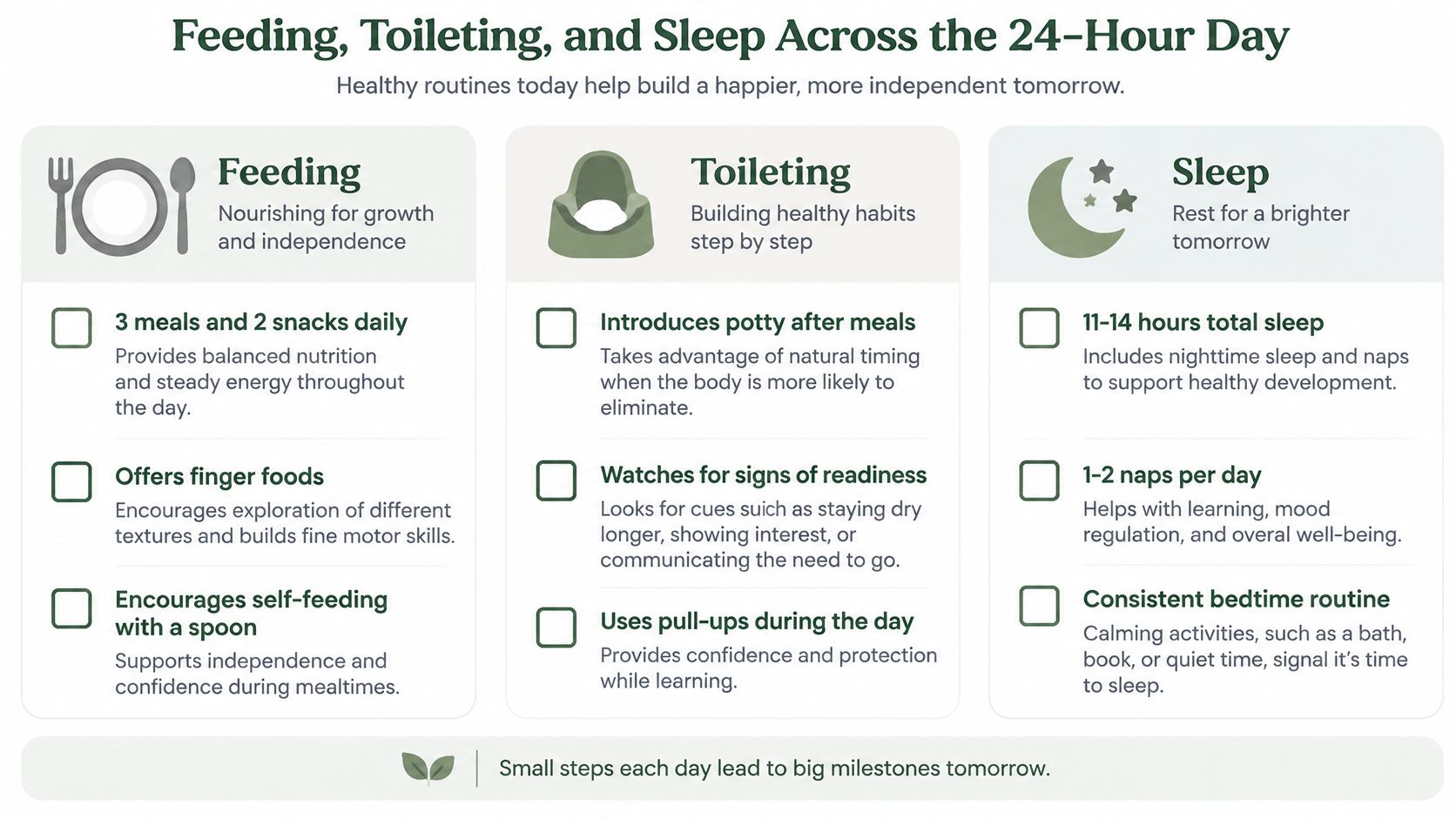
At meals, a log can note what was offered, what the child tried, and whether they used a cup, fingers, or spoon. A two-year-old is generally learning to use a spoon, drink from a cup, and manage a variety of finger foods. Keep food preparation and supervision in mind: whole grapes, nuts, popcorn, hard candies, gum, marshmallows, chunks of peanut butter, and large pieces of meat or raw produce are choking hazards identified in pediatric safety guidance. HealthyChildren.org's feeding guidance describes age-appropriate eating and safety considerations. Follow your pediatrician's guidance for your child's individual needs.
Potty learning varies, and a tracking note can record signs of interest or a routine the child has tried. You don't need to turn the log into a target. If you have questions about feeding, swallowing, toileting readiness, or sleep, ask your pediatrician for guidance specific to your child.
Tracking Progress Together Across Caregivers
One caregiver may notice a new gesture; another may know that it appears only during a familiar song. A shared timeline lets those observations sit together, rather than depending on a rushed handoff at pickup or a parent trying to remember every detail later.
For any tracker, look for room to record the date, exact behavior, setting, observer, language, and whether the child acted spontaneously or with prompting. A simple paper notebook can do the job if it travels between caregivers and everyone knows where to write. The point is continuity, not a perfect record.
Cradlo is a shared baby and toddler tracker for families with children aged 0–5. One log syncs in real time across iPhone, Android, and the web; daycare can log in through a bookmarked browser URL on an iPad, without installing an app or creating an account. Families can use the shared timeline to keep care notes and observations together. That can make it easier to bring examples to a pediatrician, but tracking does not diagnose a developmental condition.
A calm summary of what changed can be more helpful than a streak or score. If caregivers disagree, preserve both observations and their contexts. A difference between home and daycare is information to discuss, not evidence that one person is wrong.
Preparing for the 24-Month Checkup
The visit can be easier when you bring examples instead of trying to remember everything in the moment. You don't need to decide what a behavior means before you talk with the pediatrician.
Use this quick list to gather notes:
- Communication: Examples of words, word combinations, gestures, and familiar directions your child understands.
- Languages: Words and gestures in each language used at home or in childcare.
- Settings and observers: Where a behavior happened and which caregiver noticed it.
- Changes: Any new skills, inconsistencies, or loss of something your child previously did.
- Questions: Anything you're unsure about, including hearing, movement, feeding, or sleep.
Ask what the clinician's screening process includes and whether any follow-up or support would be useful. If you have a concern, say what you've noticed and when. You don't need to arrive with a diagnosis or a perfectly complete log.
If you keep observations in a shared record, this guide to exporting information for a pediatrician can help you prepare a concise account to discuss at the visit.
What to Remember and What to Read Next
Milestones are monitoring markers, not a monthly grade for a toddler or a caregiver. The most useful record is one that shows what happened, when it happened, and whether the behavior appeared across people and settings. That kind of detail can support a calmer conversation with a pediatrician without pretending that an app, checklist, or caregiver can diagnose a child.
For a next step that fits your family's routine, you might explore:
- For bilingual households: Review the language observations above and keep examples in each language rather than relying on a single word tally.
- For daycare-heavy schedules: Agree on a simple handoff note that records an example and its context, not just whether a skill appeared.
- For the upcoming checkup: Gather your dated observations and questions in one place before you go.
You don't have to solve every uncertainty tonight. Notice what your toddler is showing you, share concerns with the pediatrician, and let the people who care for your child contribute what they see.
Cradlo brings care notes and milestone observations into one shared timeline for families and childcare caregivers, with entries that sync across devices. If you'd like a shared place to keep track of what your toddler does at home and in daycare, visit Cradlo.