10 Month Old Baby Milestones: What to Expect and Watch For
Your baby pulls up on the coffee table, babbles at the dog, and pinches a piece of banana between their fingers. You watch, pleased, then wonder: Does that count as a milestone, or should they be doing something else by now?
10 month old baby milestones are easier to understand as a transition than as a checklist for one exact month. The CDC's 9-month milestone framework gives you a useful starting point, while the broader 10-to-12-month range shows how skills may continue to develop. A baby might be practicing familiar abilities while beginning new ones, and those changes won't necessarily happen on a schedule you can predict.

It helps to notice what your baby does in ordinary moments, rather than testing them or comparing them with another child. The examples below can help parents, partners, grandparents, nannies, and daycare caregivers describe what they see and share observations without turning development into a scorecard.
Table of Contents
- A Day in the Life of a 10 Month Old
- How Milestones Actually Work at This Age
- Movement, Hands, and Feeding
- Communication and Social Connection
- Thinking and Play in Everyday Moments
- Calm Red Flags Worth Noticing
- Activities That Nurture Development at 10 Months
- Logging Milestones With Everyone Who Cares
A Day in the Life of a 10 Month Old
The coffee table is just the right height for a baby who has figured out how to pull up. One hand grips the edge, the other reaches toward a toy. Across the room, the dog moves, and the baby answers with an enthusiastic string of sounds.
At snack time, a banana slice sits within reach. The baby pinches it, lets it go, and tries again. A caregiver might be thinking, “Does that count?” The short answer is that these moments are worth noticing, but they don't need to qualify as a pass or a fail.
At this age, development is best viewed as a transition between the CDC's 9-month checkpoint and the broader 10-to-12-month period. A baby may keep practicing skills that appear in the 9-month framework while also experimenting with new movement, gestures, or sounds. Those abilities don't all arrive together, and a single day won't show the whole picture.
That's why a helpful milestone record captures what happened, where it happened, and who noticed. A parent might see a baby pull to stand at home, while a nanny notices the same effort during play. Daycare may see a wave at pickup that no one has seen elsewhere yet.
The aim isn't to make every caregiver watch for everything. It's to build a clearer picture over time, with room for everyday variation. The milestone examples that follow can help you decide what to observe and what details are useful to share with the baby's healthcare professional.
How Milestones Actually Work at This Age
A developmental milestone is something that most children, at least 75%, can do by a specified age, as the CDC explains in its 9-month milestone framework. That definition matters: a milestone offers a reference point for observing development, not a deadline that every child meets in the same way.
At the 9-month checkpoint, the CDC includes abilities across social, communication, cognitive, and motor development. A baby may respond to their name, react when a caregiver leaves, smile during peek-a-boo, make repeated sounds such as “mamamama” or “bababababa,” look for an object that disappeared, move an object from one hand to the other, rake food toward themselves with their fingers, or sit without support.
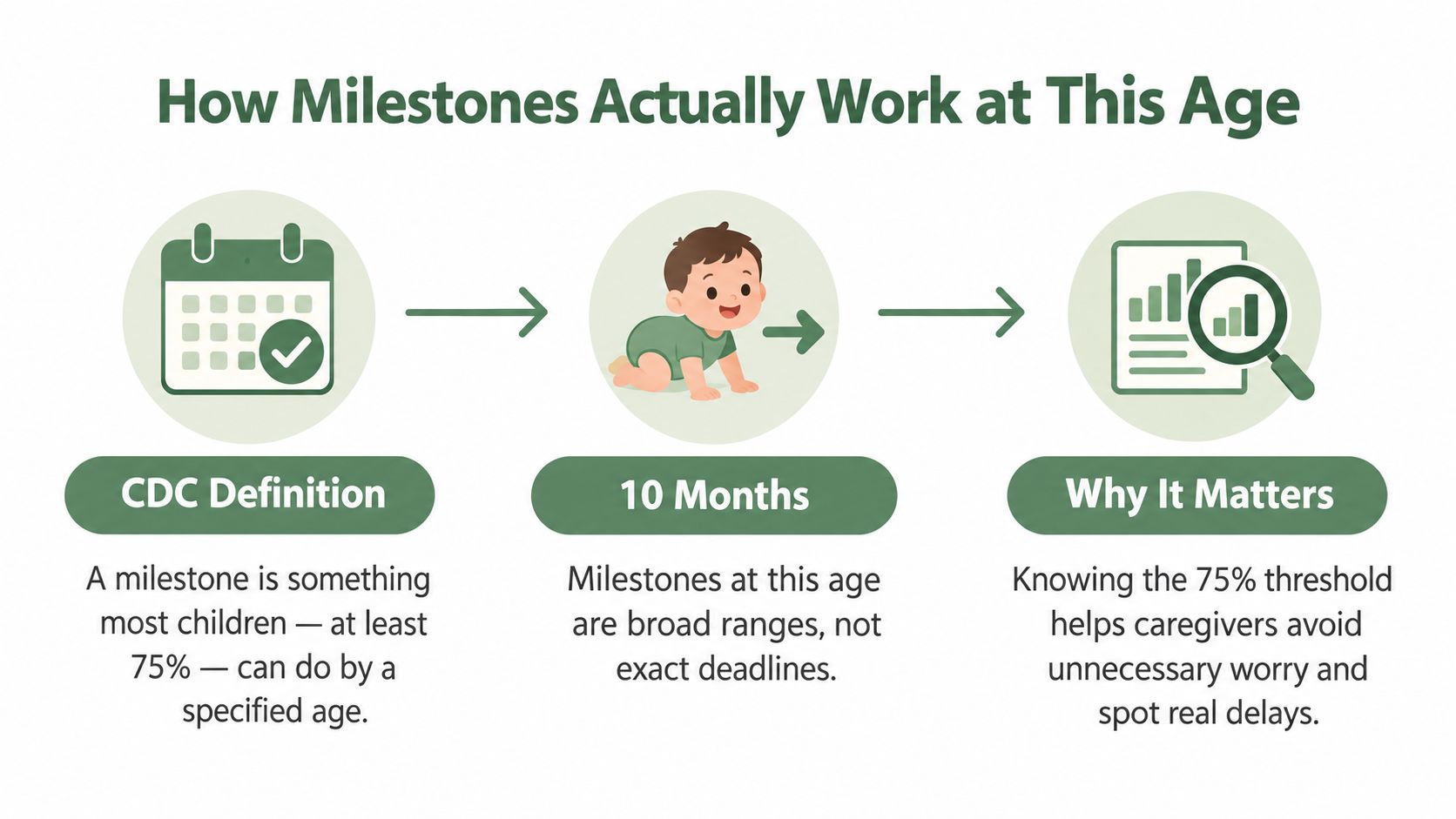
At 10 months, some babies are still consolidating those abilities. Others are adding more movement, problem-solving, and social communication. A baby who isn't walking independently, for example, isn't automatically behind. The point is to notice the overall pattern, not to grade one skill in isolation.
Screening and everyday observation
The CDC recommends standardized developmental screening at 9, 18, and 30 months, with autism-specific screening at 18 and 24 months, or earlier if a parent or clinician has a concern. A milestone list isn't a diagnostic tool. If you're worried, write down what you've noticed and discuss it with a healthcare professional.
One missed skill doesn't automatically mean there's a problem. A persistent concern is still worth bringing up, especially when caregivers see the same difficulty in more than one setting. The broader guide to infant development milestones can also help you understand how different areas of development fit together.
Movement, Hands, and Feeding
A baby may be busy moving without taking independent steps. Crawling can look different from one child to another; some babies creep, crawl, pull up to stand, or cruise along furniture. Walking while holding a caregiver's hands can be another way to explore. The Mayo Clinic's infant development overview describes creeping, crawling, and walking while holding furniture as steps that can lead toward unsupported walking. Independent walking has a commonly cited range of about 9 to 15 months, so it isn't required at 10 months.
Hands are busy too. A baby might pass a toy from one hand to the other, rake a piece of food closer, bang two objects together, or look for a toy after it disappears from view. These actions show emerging coordination and object permanence. A brief note about what the baby did is more useful than a label such as “good with toys.”
The WHO's complementary-feeding guidance covers children from 9 to 23 months and recommends 3–4 meals per day, with 1–2 additional snacks as needed. WHO also advises gradually increasing the consistency, variety, and frequency of complementary foods as a child grows. Treat those figures as guidance, not a required amount for every baby.
Movement and feeding at a glance
| Domain | What you might see | Why it matters |
|---|---|---|
| Gross motor | Crawling, pulling to stand, cruising, or walking with support | Shows how your baby moves between positions and explores their surroundings |
| Fine motor | Transferring objects, raking food, or searching for a hidden toy | Offers a glimpse of coordination and early problem-solving |
| Feeding | Exploring foods, showing interest or fullness, and eating meals with snacks as needed | Helps caregivers respond to the baby's cues instead of treating a particular amount as a target |
WHO defines responsive feeding as offering food in a way that encourages a child to eat autonomously and in response to their needs. Caregivers can note what was offered and whether the baby seemed interested or full without scoring the meal. For guidance about breast milk, formula, allergies, choking safety, or a child's individual intake, talk with a pediatrician or lactation professional. You can also read about introducing solids and tracking baby feeding.
Communication and Social Connection
Communication at this age isn't just a count of spoken words. A baby may reach toward an object, point, wave, show or give a toy, imitate a gesture, copy an adult's sounds, or respond to a simple phrase. Some babies may say one or two meaningful words, such as “mama,” “dada,” “hi,” or “bye,” within the 10-to-12-month communication range described by the American Academy of Pediatric Dentistry.
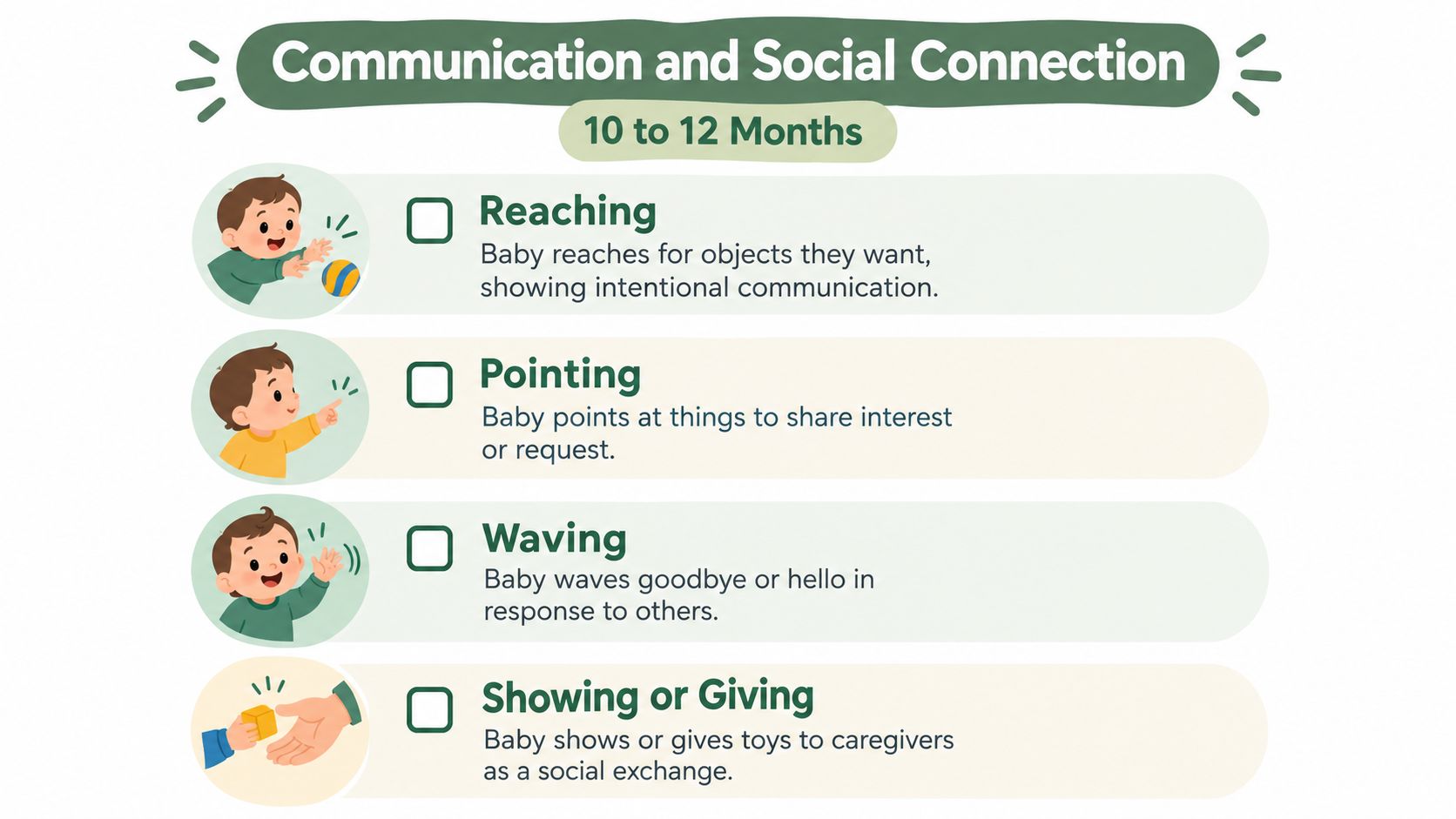
What matters is the interaction. A baby points, you look where they're pointing, and you respond. That back-and-forth gives the baby a chance to practice joint attention, turn-taking, and the connection between a sound or gesture and what it means.
Log the cue and response
Instead of writing only “talking,” record the moment more specifically. Did the baby wave after hearing “bye-bye”? Did they hand over a toy, copy your sound, or use the same sound for a familiar person or object? The cue and response make the observation easier for another caregiver to understand.
Home and daycare may look different. A baby may be tired after a busy day, hear different words in each setting, or have more chances to imitate a gesture with one caregiver than another. Those differences don't automatically mean a skill has been lost.
Bring concerns to a pediatrician if your baby loses communication skills they previously had, rarely responds to their name or social interaction, or makes little progress across several weeks. Developmental observation can help identify when an evaluation is worth discussing, but a checklist on its own can't diagnose a child.
Thinking and Play in Everyday Moments
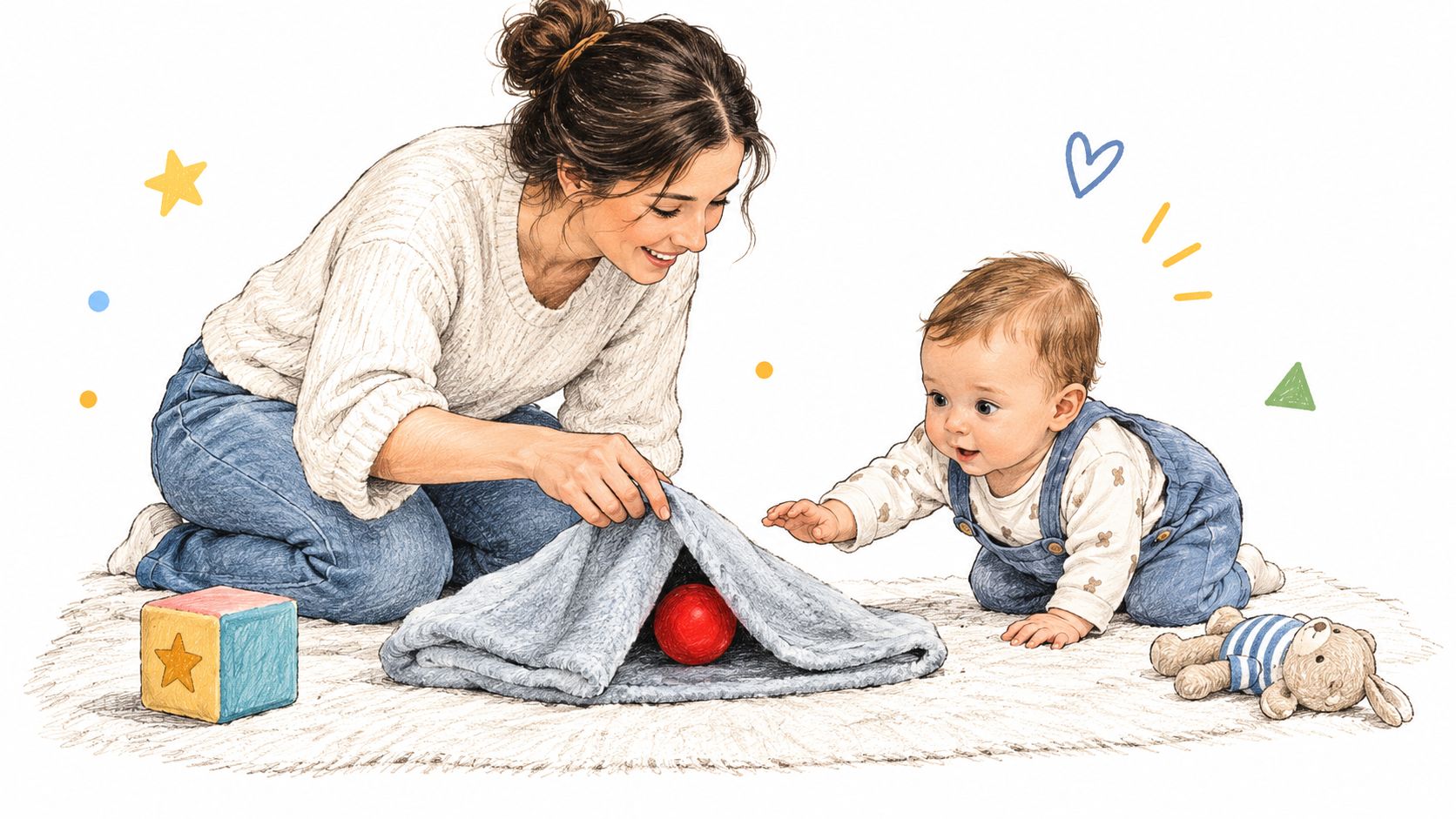
A toy rolling under a blanket can become a small lesson in object permanence. Your baby watches it disappear, then lifts the fabric or reaches underneath to find it. You don't need a formal activity or special toy. A ball and a blanket can be enough.
During a meal, dropping a spoon from the high chair and watching what happens may be a way to explore cause and effect. In play, a baby might copy your clap, tongue click, or simple sign. These ordinary moments show how thinking, movement, and interaction can overlap.
A new skill may appear differently at home, with a nanny, or at daycare. A baby who is relaxed in a familiar room may be quieter around new people; another may show a favorite game only with a particular caregiver. Tiredness, novelty, and who happens to be paying attention can all shape what gets noticed.
Record the moment, not just the label
If a baby searches for the ball under a blanket, note what happened and where. Add the date and the caregiver who saw it. One attempt is worth recording, but repeated observations help show whether a behavior is becoming a familiar part of the baby's play.
Parents, partners, grandparents, nannies, and daycare staff may each notice different pieces of the picture. A shared record helps bring those observations together without asking anyone to turn playtime into a test. If you later have a question for a clinician, a clear example is easier to discuss than a vague note that the baby “seems clever.”
Calm Red Flags Worth Noticing
A list of concerns can feel heavy, but paying attention doesn't mean assuming the worst. Milestones support observation; they don't diagnose a baby. If something concerns you, you can bring it up with your pediatrician rather than waiting for a checklist to settle the question.
Consider noting and discussing concerns such as:
- Loss of a skill: Your baby stops doing something they previously could do, including a communication or social behavior.
- Limited response: Your baby rarely responds to their name, familiar voices, or attempts to interact.
- Little shared enjoyment: You notice very limited eye contact or few moments of shared interest with caregivers.
- Little exploration: Your baby shows little interest in reaching for objects or exploring different textures.
- Persistent feeding difficulty: Feeding remains difficult beyond ordinary variation in appetite or preferences.
- Unusual muscle tone: Your baby's movements seem consistently very floppy or very stiff.
A concern is more useful to discuss when you can describe what happens repeatedly, rather than relying on one difficult moment. In practical terms, note whether the pattern continues over several weeks or appears in more than one setting. You don't need to decide whether a behavior is significant before talking with a professional.
Write down what you saw, when it happened, and who observed it. If a concern involves feeding, development, or another health question, your pediatrician can help you decide what evaluation or support may be appropriate. A shared record can make it easier for caregivers to compare observations, but it isn't a substitute for professional guidance.
Activities That Nurture Development at 10 Months
You don't need to arrange a special lesson to support your baby's development. Short, familiar play invitations fit naturally into the day and give your baby chances to practice movement, hand use, sounds, and social gestures.
Movement and hands
- Make room to move: Offer safe floor time for crawling, creeping, and cruising along suitable furniture. A few moments of supported standing between a caregiver's legs can be another option.
- Set up a simple route: Place couch cushions to create an easy path to a favorite toy, with an adult close by.
- Offer objects to explore: Larger soft blocks can be stacked and knocked down. Simple cause-and-effect toys give your baby a chance to act and notice what happens.
- Serve appropriate finger foods: Foods offered during meals can give your baby practice reaching and picking up pieces. Ask a pediatrician or lactation professional about food safety questions for your child.
Sounds, gestures, and shared play
Narrate routines in plain language: “We're putting on your socks,” or “Here's your cup.” Pause after you speak so your baby has time to look, gesture, or make a sound. Board books invite pointing, and copy-cat play can start with a wave, clap, or babble.
Keep activities brief and flexible. Parents, grandparents, nannies, and daycare staff can each repeat a favorite game during their usual routines, without needing to coordinate a strict schedule. The goal is a chance to engage, not a performance.
Logging Milestones With Everyone Who Cares
A shared milestone log turns scattered observations into a record that caregivers can use together. Capture the date, what your baby did, who saw it, and the setting. “Waved after hearing ‘bye-bye' at pickup” tells more than “good communication,” and it leaves room for another caregiver to add a different example.
Cradlo is one option for recording milestones alongside care information. It gives parents, partners, grandparents, nannies, and daycare caregivers their own identities through QR-code invites, so they don't have to share a login. A daycare can bookmark a browser page on its iPad without installing an app, and its entries can sync with the parents' phones. The tracker also supports offline logging, English and Spanish, and shared records across iPhone, Android, and the web.
For Spanish-speaking households, language support can make shared notes easier to use across caregivers. A parent can record an observation at home, while a grandparent or daycare caregiver adds what they saw in their own routine. If you want to see how caregiver notes can support handoffs, read this guide to sharing a daycare summary.
Questions caregivers often ask
When should I bring a milestone concern to the pediatrician? Bring it up whenever you're concerned, especially if your baby loses a skill or you notice a pattern that persists. You don't need to wait for a scheduled screening.
What if home and daycare observations don't match? Record the specific behavior, setting, and caregiver. Differences may reflect opportunity, fatigue, or familiarity, and the details can help you and your pediatrician understand what's happening.
How do I try Cradlo? Cradlo offers a 7-day free trial on its monthly plan, then a paid plan. There's no free plan, and the tracker doesn't replace medical advice from your child's pediatrician or a lactation professional.
If you'd like one shared place for parents, grandparents, nannies, and daycare to log what they notice, Cradlo can keep milestone and care notes together, with English and Spanish support. Visit Cradlo to explore the tracker and start its 7-day free trial on the monthly plan.