What Should My Five Month Old Be Doing? a Parent's Guide
It's the end of the day, dishes are still in the sink, and your baby is on a blanket kicking at a soft toy. A friend sends a video of her baby, who's about the same age, rolling across the floor and laughing. You smile, then you look back at your baby and wonder, what should my five month old be doing right now? That question is common, and it doesn't mean you're anxious or doing anything wrong. It usually just means you care and you want a calmer way to notice what's changing. A range of normal is a more helpful lens than a single date on a calendar, especially when several caregivers are watching different parts of the day.
Table of Contents
- Every Baby Moves at Their Own Pace
- Typical Five Month Old Milestones
- How to Support Your Baby's Development
- A Realistic Day at Five Months
- Why Tracking Helps Every Caregiver
- Signs to Watch For and When to Ask for Help
Every Baby Moves at Their Own Pace
One evening, a parent watches her baby push up during tummy time, wobble, and flop happily onto a cheek. The next morning at daycare, that same baby rolls from tummy to back for the first time and looks surprised by it. Neither moment tells the whole story on its own. Together, they show a skill forming in small, uneven steps.
That's how development often looks at this age. A baby might spend a week babbling at a ceiling fan, then seem to forget babbling while all her energy goes into reaching. Another baby might reach early and take longer to enjoy being on his tummy. Both patterns can be part of normal progress.
Why Five Months Feels Like an In Between Age
At five months, many babies are approaching skills that public health authorities formally check around six months. The World Health Organization guidance on complementary feeding sits in that same window, because this period is close to a major nutrition transition that typically begins around 6 months. Your baby isn't late for not having every six month skill yet. She's in the practice phase.
Milestones aren't a pass or fail test. They're signposts that help you notice direction over time.
Think about learning to sit. First there's better head control. Then there's pushing up, leaning on hands, toppling sideways, and trying again. If you only look for the final version, you'll miss the weeks of real progress that came before it.
Watching Trends Instead of Single Days
A single fussy afternoon can make everything look harder. Your baby may refuse tummy time because he's tired, hungry, or done for the day. That doesn't erase what he did yesterday.
Try noticing patterns across a week instead:
- Tolerance is growing: She stays on her tummy a little longer before asking to be picked up, even if she still protests sometimes.
- Interest is widening: He watches faces longer, turns toward voices, or studies his own hands with real focus.
- Attempts are changing: She doesn't roll yet, but she rocks to one side, hikes a leg, or pushes harder with her arms.
Those small shifts matter. They're often the clearest sign that strength and coordination are building, even before a new skill looks tidy or repeatable.
Grandparents, partners, nannies, and daycare teachers may each see a different slice. One person catches the first squeal. Another notices the first reach with the left hand. When you put those observations together, the picture feels less like pressure and more like a story you're following together, one ordinary day at a time.
Typical Five Month Old Milestones
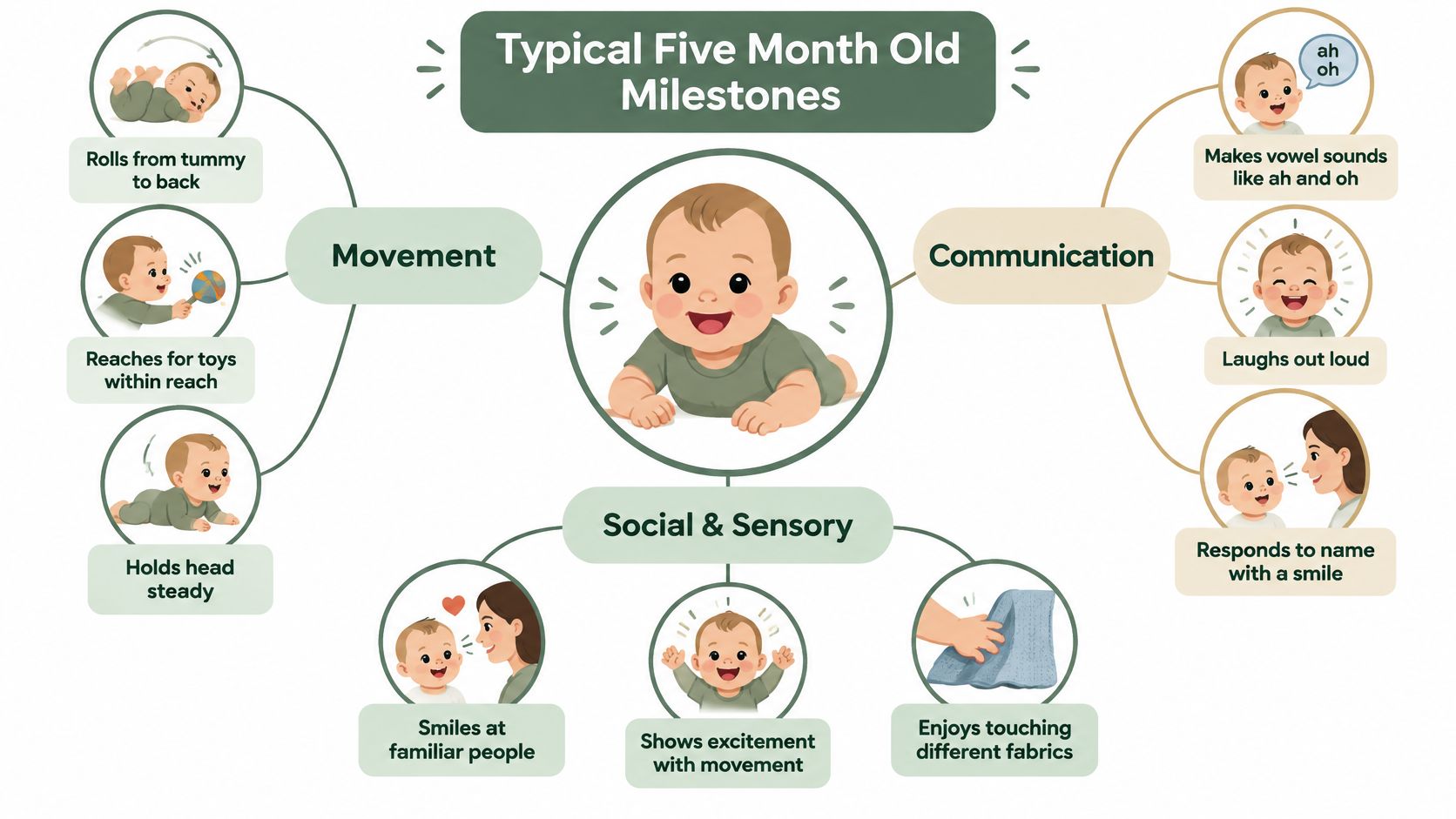
A helpful way to look at this age is to use the six month mark as a nearby benchmark, not a deadline for today. The CDC milestones for 6 months describe what most infants can do by the end of six months, including rolling from tummy to back, pushing up with straight arms, and sitting while leaning on their hands. At five months, many babies are working toward those skills rather than doing them perfectly every time.
Movement and Motor Skills
Movement at this stage is about trunk control, shoulder strength, and balance. During tummy time, your baby may push up with straighter arms to look around the room. That push builds the muscles she'll later use for rolling, sitting, and crawling.
You may also see:
- Rolling from tummy to back: Sometimes it's smooth, sometimes it's an accidental tip that becomes intentional with practice.
- Leaning on hands while sitting: He won't sit independently for long, but propping on his hands shows growing postural control.
- Reaching and grasping: She reaches for a toy she wants, bats at it, grabs it, and often brings it straight to her mouth.
If you're curious about how rolling usually unfolds step by step, this overview of when babies start rolling and what practice looks like can help you picture the in between stages. The key point is that reaching, turning the head, and shifting weight are all part of rolling, even before a full roll happens.
Social and Communication Skills
Social development is easy to spot in everyday moments. Your baby may recognize familiar people, light up when a parent walks in, and show clear pleasure during face to face play. Laughter often becomes more frequent, especially during gentle games and silly sounds.
Communication is also becoming a back and forth. Many babies around this stage take turns making sounds with a caregiver, squeal with excitement, and blow raspberries. You make a sound, pause, and your baby answers. That pause matters. It teaches her that sounds get a response and that conversation has a rhythm.
Learning and Exploration
Learning right now looks a lot like mouthing everything. Babies explore by looking, touching, and bringing objects to the mouth. That's not random. The mouth gives a baby a lot of information about texture, shape, and size.
What to notice: Curiosity itself is a skill. A baby who studies a rattle, turns it, shakes it, and mouths it is practicing problem solving in a five month old way.
You'll also notice more purposeful reaching. Instead of swiping at everything, your baby may reach for one specific toy, close his fingers around it, and work to keep hold of it. These are emerging abilities, not requirements for a single afternoon. Some days they'll be clear. Other days he'll be tired and less interested, and that's expected too.
How to Support Your Baby's Development
You don't need special equipment or a strict routine to support development. Most of what helps is already in your day: floor time, your voice, your face, and safe objects to explore. The goal isn't to train a skill on a schedule. It's to offer chances to practice while your baby is awake, supervised, and in the mood to play.
Make Floor Play the Default
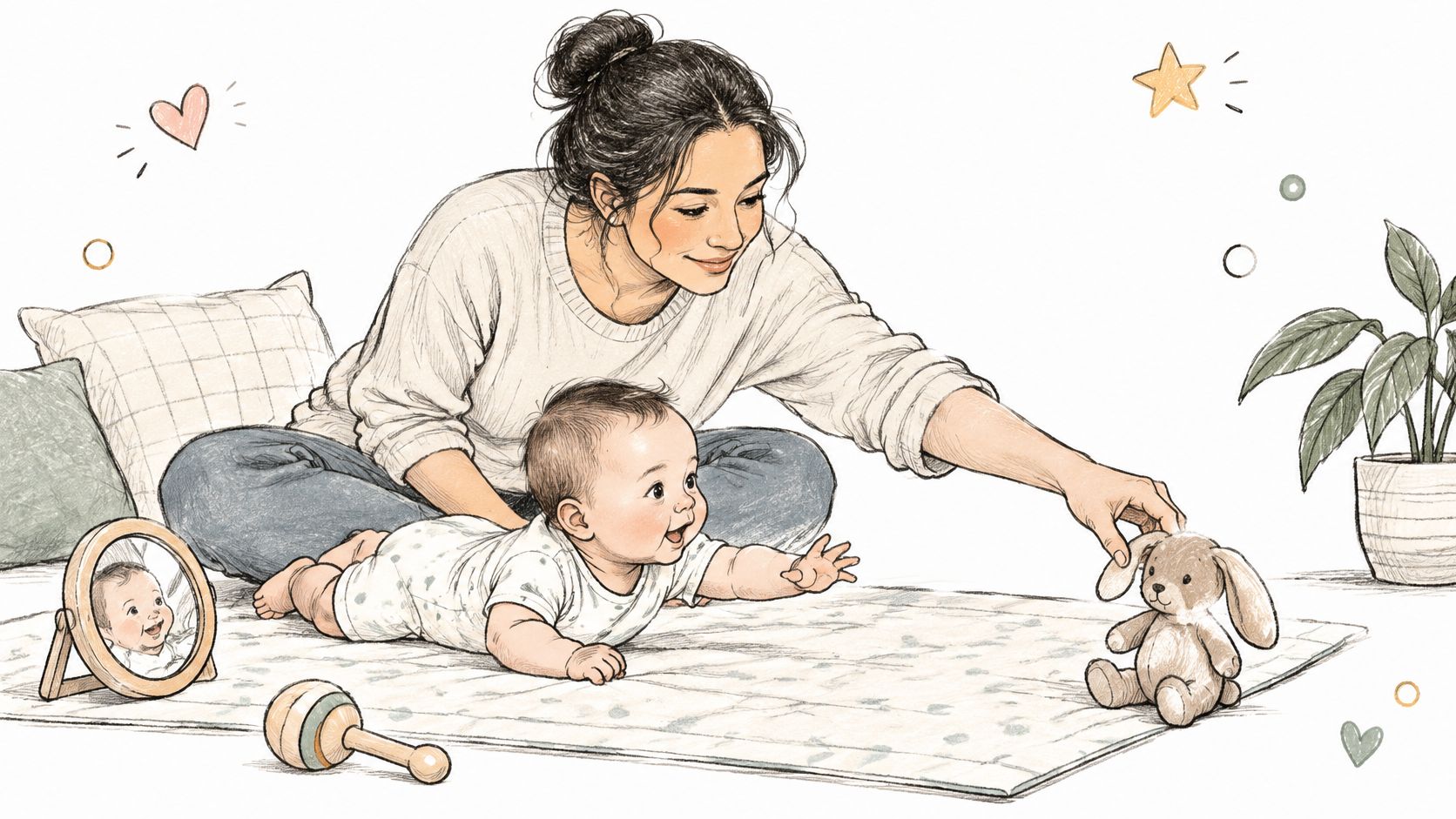
Supervised floor play gives your baby room to push, reach, turn, and shift weight without being held in one position. A firm, flat surface works well because it lets arms and legs get real feedback from the ground. Soft blankets are fine for comfort, but avoid surfaces so squishy that pushing up becomes harder.
Try short, frequent sessions of daily tummy time while awake rather than one long session your baby dreads. Get down at eye level so she has a reason to lift her head. Place a favorite toy just within reach, then a little to the side, so she practices turning and reaching in both directions.
Don't place your baby in a sitting position she can't maintain on her own for long stretches. Brief supported sitting on your lap for play is different from propping her and walking away. Floor time, back play, and side lying play all give her body varied input.
Talk, Pause, and Respond
Narrate ordinary moments in plain language. You're changing a diaper, warming a bottle, or folding laundry, and you're telling your baby what you see. That steady stream of words helps connect sounds, faces, and routines.
When your baby squeals or babbles, respond and then wait:
- Copy the sound: If he says a long vowel sound, echo it back with a smile.
- Add a little: Turn his sound into a word or a short phrase, keeping your tone warm and simple.
- Pause: Give him space to answer, kick, smile, or try another sound.
For Spanish speaking families, and for families mixing languages at home, the same back and forth works in whichever language feels natural in that moment. What matters is the response, not performing perfect lessons.
Offer Safe Objects That Invite Grasping
Choose objects that are easy to grasp, light enough to lift, and safe for mouthing. A soft rattle, a textured cloth, or a ring your baby can hold with both hands gives her something to practice on. Rotate a few items rather than surrounding her with many toys at once.
Watch how she uses them. Reaching with either hand, passing attention from one object to another, and bringing hands together at the middle are all meaningful practice. If she gets frustrated, bring the toy a little closer. Support should make play feel possible, not like a test she has to pass.
A Realistic Day at Five Months
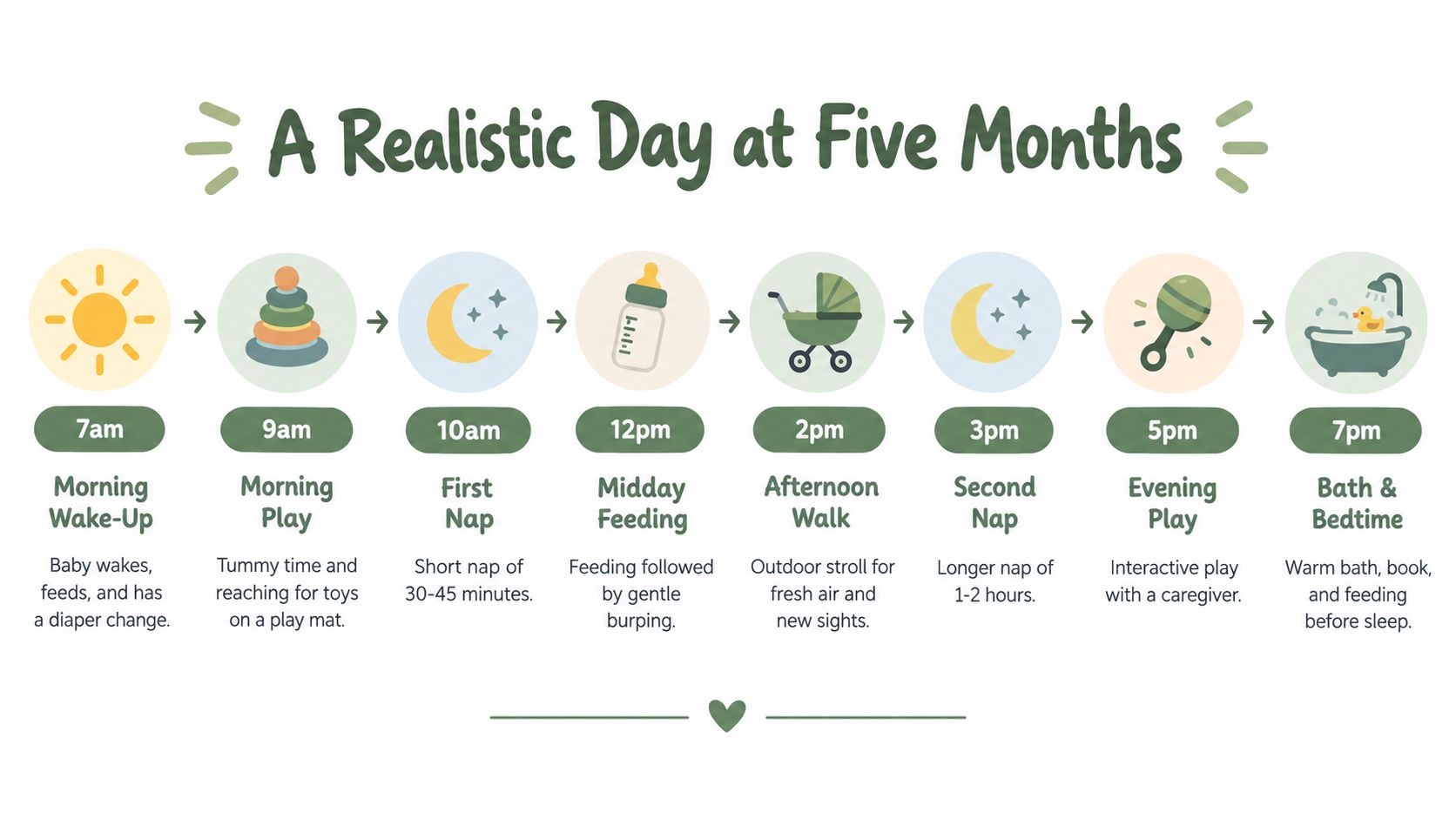
A realistic day at five months is a loose rhythm, not a timetable you have to hit perfectly. Sleep, feeding, and play repeat in cycles, but the order shifts. Some mornings start bright and social. Other days begin with a short nap that seems to happen almost immediately after waking.
Sleep as Context, Not a Scorecard
The American Academy of Pediatrics infant timeline for sleep describes infants getting 9 to 12 hours of sleep at night, along with 1 to 4 naps per day lasting 30 minutes to 2 hours. At five months, treat those figures as context for what's common, not as a rule your baby must match every day. Short naps and night waking happen, and they don't by themselves mean you've done something wrong.
If naps feel unpredictable right now, a gentle look at a sample 5 month old nap schedule and wake patterns can give you ideas without forcing a strict clock. Many families do better watching sleepy cues, like staring, fussing, or losing interest in play, than watching minutes.
Feeding Through the Day
Feeding still anchors much of the day. The WHO infant nutrition guidance on exclusive breastfeeding defines exclusive breastfeeding as only breast milk for the first 6 months, with no other liquids or solids including water, except specified medical or nutritional supplements, and recommends adding safe complementary foods at 6 months while continuing breastfeeding to age 2 years or beyond. If your family uses infant formula, follow your pediatrician's guidance on amounts and timing rather than changing a plan based on a milestone article.
A shared feeding record can show what was offered and when. It can't tell you whether a pattern is medically appropriate. That's a question for your pediatrician or a lactation professional.
Play Fits Between the Basics
Play doesn't need a separate block labeled enrichment. It fits naturally after a feed and diaper change, when your baby is alert and comfortable. A few minutes of tummy time, a song during a change, and a stroller walk where he watches trees move all count as learning.
A day might look like this:
- Morning: Feed, change, floor play, then a nap when cues appear.
- Midday: Feed, face to face babbling, reaching practice, another nap.
- Evening: Feed, calmer play, bath if it's a bath day, book, and bedtime routine.
Your version may include daycare pickup, a grandparent's visit, or a commute. That's fine. Babies learn from repeated, responsive care, not from a perfect sequence. If today falls apart, tomorrow gives you another chance to find the rhythm again.
Why Tracking Helps Every Caregiver
When only one person is with a baby all day, memory can carry a lot. When care is shared, memory gets stretched. A partner does the early feed, a nanny handles naps, daycare logs a diaper, and a grandparent sees the first roll. Without a shared record, handoffs become guesswork and repeated questions.
A simple log solves a practical problem. It shows what happened, when it happened, and who saw it, so the next caregiver can start from facts instead of assumptions. That's especially helpful at five months, when patterns are forming but aren't yet predictable.
What Is Worth Writing Down
You don't need to record everything. A few steady categories give you the clearest picture:
- Sleep: When naps started and ended, and how the night went in broad strokes.
- Feeds: What was offered and roughly when, so the next caregiver isn't guessing about timing.
- Diapers: A basic count and any notes a caregiver would want the next person to know.
- Milestones and context: The date a new skill appeared, plus details like which hand she reached with or how she tolerated tummy time that day.
Context is what turns a checklist into useful information. Writing that your baby rolled during floor play after a nap, or that he babbled most during face to face time in the morning, helps everyone see trends. If you're comparing options, this overview of a baby milestone tracker app and shared logging features shows what shared tracking can include.
How a Shared Log Lowers Pressure
Tracking shouldn't feel like grading. There are no streaks to keep and no score to protect. If someone forgets to log a feed, the day isn't ruined. The value comes from the overall pattern across many entries, not from perfection in any single one.
One option for families who want that shared view is Cradlo, a tracker where parents, partners, grandparents, nannies, and daycare can each log under their own identity and see entries sync across phones and the web. Daycare can use a browser link without installing an app, and the log covers sleep, feeds, diapers, and milestones in English and Spanish. Whether you use an app, a notebook on the counter, or a shared note, the principle is the same. Everyone sees the same timeline.
A calm way to use a log: Review it to answer a question, like whether naps are shifting, then put it away. You don't need to study it every hour.
Over time, that shared record also becomes handy at pediatric visits. Instead of trying to recall when a skill appeared, you can show dates and notes from several caregivers. That gives your clinician a fuller picture and gives you less to hold in your head.
Signs to Watch For and When to Ask for Help
Most variation at five months is normal, and most questions can wait for a regular pediatric visit. A few patterns are worth raising sooner, not because they prove something is wrong, but because a clinician can look at the whole picture with you. Asking early is a reasonable, caring step. It isn't overreacting.
Patterns Worth Discussing Promptly
Contact your baby's pediatrician if you notice any of these, especially if they persist or involve several areas at once:
- Loss of a previously acquired skill: She used to babble, reach, or roll in a way she no longer does.
- Markedly asymmetric movement: He consistently uses one side much more than the other, or one side seems notably weaker or stiffer.
- Difficulty engaging: She seems unusually hard to engage socially, or you're concerned about how she responds to faces and voices.
- Concerns about senses or movement: You have ongoing worries about hearing, vision, communication, or how he moves, even if you can't name the exact issue.
A single missed skill on a list isn't diagnostic. Clinicians look at trends across movement, communication, and social interaction, along with growth and medical history. That's why your notes about context and change over time are so useful.
How to Make That Conversation Easier
Bring specifics, not apologies. You might say that your baby reached with both hands last month and now mostly reaches with one, or that tummy time tolerance hasn't progressed despite daily practice. Dates help. Short videos of everyday play can help too, because babies don't always perform new skills in an exam room.
Don't wait for a specific age cutoff if something feels off. If a baby loses a skill, or if several expected skills aren't emerging, it's better to ask than to sit with worry for weeks. Your pediatrician can advise whether to watch and wait, adjust play at home, or refer you to another professional. This article can't make that call for your child, and no tracker can either.
A Gentle Way to Hold All of This
You know your baby's everyday moods, sounds, and rhythms in a way no list can capture. Trust that knowledge. Keep offering floor play, conversation, and safe objects to explore. Keep noticing small changes, and share them with the other people who love and care for your baby.
Development isn't a race with the baby in the next video. It's a series of small, real steps, some tidy and some messy, that add up over months. You're already doing the most important part by paying attention with warmth and curiosity, and by asking for help when you need it.
If shared notes would make handoffs calmer in your home, Cradlo lets parents, partners, grandparents, nannies, and daycare log sleep, feeds, diapers, and milestones in one shared timeline that syncs across devices. You can start with a 7-day free trial on the monthly plan and see whether seeing everyone's observations in one place helps you notice your baby's progress with less guesswork.