24 Month Old Milestones and When to Ask for Help
Your toddler just turned two, and by bedtime you're comparing notes in your head. At daycare pickup someone mentioned stairs. At home your child said a new phrase once, then not again. A grandparent swears there was a different new word yesterday. It's easy to wonder what's typical, what to write down, and what can wait until the next visit. Thinking about 24 month old milestones as dated observations, shared by the people who care for your child, can make that wondering calmer and more useful.
Table of Contents
- Typical Skills at 24 Months, Domain by Domain
- Why One Missing Skill Is Not a Verdict
- Language at 24 Months in Everyday Moments
- Movement, Play and Self-Care Skills to Notice
- Social and Emotional Skills and How to Encourage Them
- When a Gap Calls for a Pediatrician Visit
- Track Milestones in One Shared Record and Prepare for the Checkup
Typical Skills at 24 Months, Domain by Domain
Most children show a set of skills by about age two, grouped into language, thinking, social, movement, and self-care areas.
| Domain | Typical skills at 24 months | Where to notice it |
|---|---|---|
| Language and communication | Points to an object in a book when asked; combines at least two words such as "more milk"; identifies at least two body parts on request; uses gestures beyond waving or pointing | Snack time, story time, bath time |
| Cognitive and problem-solving | Holds an object in one hand while manipulating it with the other; tries switches, knobs or buttons; uses multiple toys together in pretend or functional play | Stacking cups, pretend tea party, pressing buttons on a toy |
| Social-emotional | Notices when another person is hurt or upset; looks to an adult's face for cues in unfamiliar situations | Playground, visits to new places, a sibling crying nearby |
| Physical (motor) | Runs; kicks a ball; walks up a few stairs with or without help; eats with a spoon | Park visits, stairs at home, mealtimes |
| Self-care | Toilet training readiness varies; many children begin showing readiness around this age | Diaper changes, bathroom visits, dressing routines |
Use the table as a week-long checklist of what to look for, not a test to pass on a single day. A tired, hungry, or shy afternoon doesn't give you a full picture. A skill seen at snack time on Tuesday and again at daycare on Friday tells you more.
How the Rows Fit Together
Language and communication is about both understanding and expressing. Pointing to a picture when you name it shows listening. Putting two words together shows expressive language. Gestures beyond waving or pointing, like blowing a kiss or nodding yes, add another way to connect.
Cognitive and problem-solving skills often hide inside play. Holding a cup steady with one hand while stirring with the other, working a knob until a toy lights up, or pouring pretend tea for a stuffed animal all show your child testing how things work. You don't need special toys for this. Cups, lids, and a toy phone work fine.
Social, Movement and Self-Care in Daily Life
Social-emotional skills show up in small pauses. Your child may stop and look concerned when a sibling cries, or check your face before approaching something unfamiliar at the park. Those moments are brief, so they're easy to miss if nobody writes them down.
Physical skills are usually easier to spot. Running across open grass, kicking a ball forward, climbing a few stairs while holding a rail or a hand, and getting food to the mouth with a spoon all belong here. Self-care is slower and more individual. Interest in the bathroom, telling you about a wet diaper, or trying to pull off socks can signal growing readiness, but there's no single deadline.
If you're looking back to see how these skills built up, our guide to what many children were working on at 22 months can help you place this month in context. For now, pick two or three rows to watch this week during routines you already have. Note the date, the setting, and who saw it. That simple record becomes the starting point for every conversation that follows.
Why One Missing Skill Is Not a Verdict
Milestones describe a typical window, not a birthday deadline. The CDC two-year milestone checklist defines developmental milestones as abilities that at least 75% of children can perform by that age, rather than skills every child must have on an exact birthday.
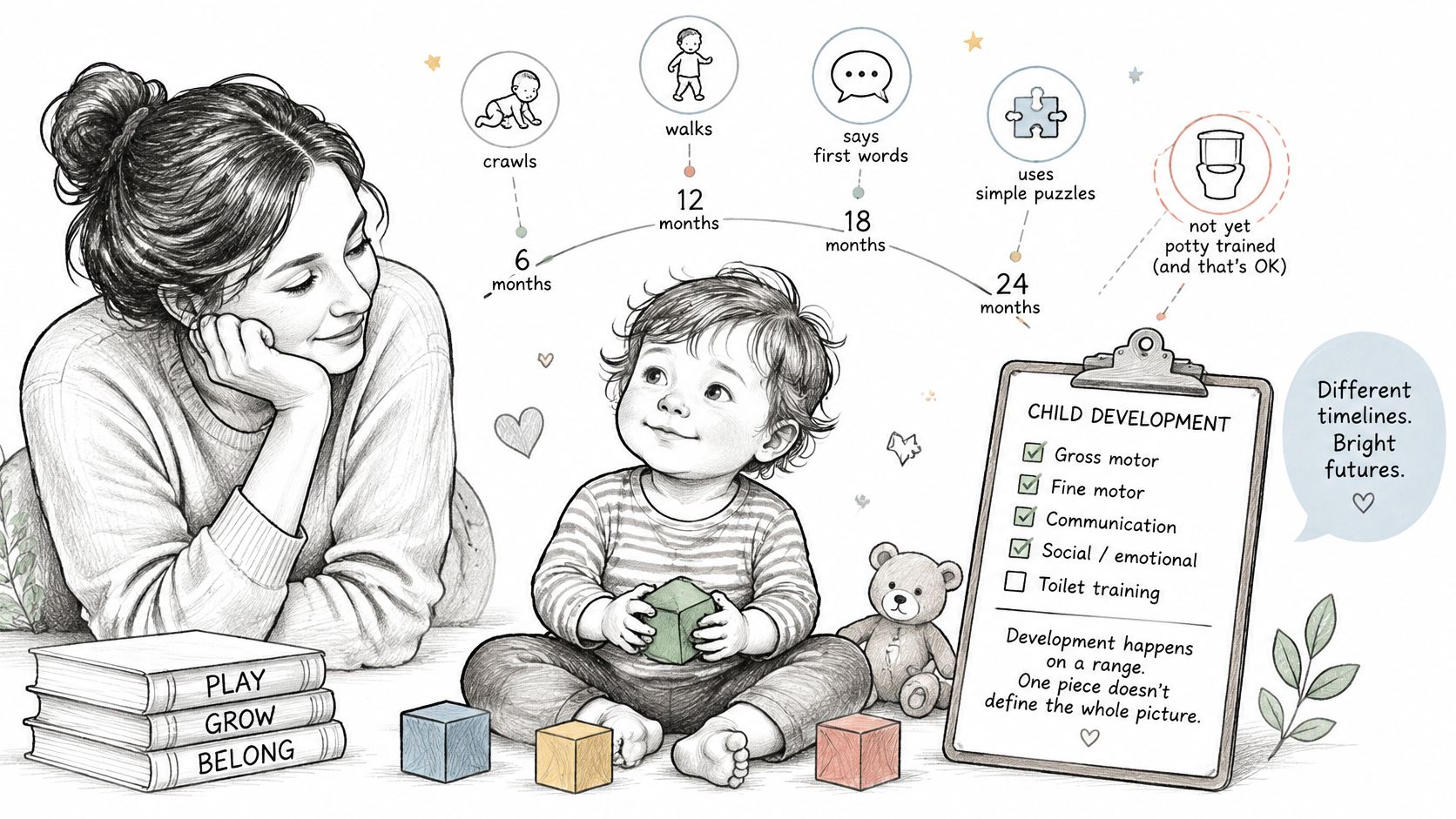
Think about first steps. Some babies walk early and others a few months later, and both can fit the usual range. The same uneven timing shows up at two. A child may use short phrases at home while still climbing stairs holding a rail, and both observations can be typical.
Three Ways to Read Any Skill
When you look at a skill from the table, it helps to sort it into one of three buckets.
- Present and steady: You see it repeatedly, in more than one setting, without much prompting.
- Emerging but not yet steady: It appears sometimes, with help, modeling, or only with a familiar person.
- Lost after it was present: Your child used to do it regularly and no longer does.
Say a toddler says "more milk" on Monday at breakfast and again on Thursday at daycare. That's steadier evidence than a phrase heard once at a birthday party, when an older cousin may have modeled it. Neither example is a grade. Together over time, they show a pattern.
A checklist gives you observations to discuss, not a diagnosis.
That distinction matters because a single checked or unchecked box can't capture context. Was your child asked without a gesture cue? Did a nanny see the skill while you were at work? Did it happen once or across a whole week? Dated notes answer those questions in a way memory alone can't.
For a fuller look at why comparison between children so often misleads, see our piece on why milestones are not a race between toddlers. Your practical step here is small. Keep a short running list of what you see, mark each skill as steady, emerging, or not yet seen, and bring that list to the next visit as a conversation starter. It describes your child. It doesn't verdict them.
Language at 24 Months in Everyday Moments
Picture a typical morning. Your toddler holds up an empty cup and says, "more milk." In the hallway, it's "daddy go" as a partner leaves. At snack time, a clear request for crackers, or the name of a favorite animal from last night's book. Language at two lives inside routines like these.
Vocabulary grows quickly at this age and varies widely between healthy children. A child who still uses mostly single words isn't automatically behind, and a chatty child isn't automatically ahead in every other area. What helps is watching how words are used, not only counting them.
What Understanding Looks Like
Listening skills often show before speaking skills feel solid. A two-step instruction is a helpful everyday check. You might ask your child to bring a shoe and then hand it to you, without pointing. Following both parts suggests your child is holding language in mind and acting on it.
Pointing to pictures and body parts belongs here too. During bath time you can ask, "Where's your nose? Where's your knee?" During story time, you can ask your child to find the dog or the truck. Keep it playful and brief. If your child wanders off, you've still learned something about that moment, and you can try again another day.
A large study gives some sense of how common these skills are. A 2025 study using the Van Wiechen milestone scale found that 85.4% of 46,584 children attained the ability to say two-word sentences at 24 months, while 89.1% could point to six body parts on a doll. Those figures also mean a meaningful share of children reached those skills a little later.
Simple Ways to Invite Language
You don't need drills. Small pauses inside familiar moments do the work.
- Pause in a familiar sentence: Start a favorite line from a book or song and wait, so your child can fill in the last word.
- Name and wait: Label a picture once, then look expectantly rather than immediately repeating yourself.
- Offer a choice in words: Ask "apple or banana?" while holding both where your child can see them.
The same skill may look different at home, at daycare, and at grandma's house. Some toddlers talk freely with one caregiver and go quiet in a busy room. Some use family words from Spanish at home and different words at daycare, and both count as communication worth recording.
Write down the exact phrase, the setting, and who was there. "Said 'more milk,' breakfast, with partner, no prompting" is far more useful at a checkup than "talking more lately." Over a few weeks, those small entries show whether phrases are repeating, growing, and showing up with different people.
Movement, Play and Self-Care Skills to Notice
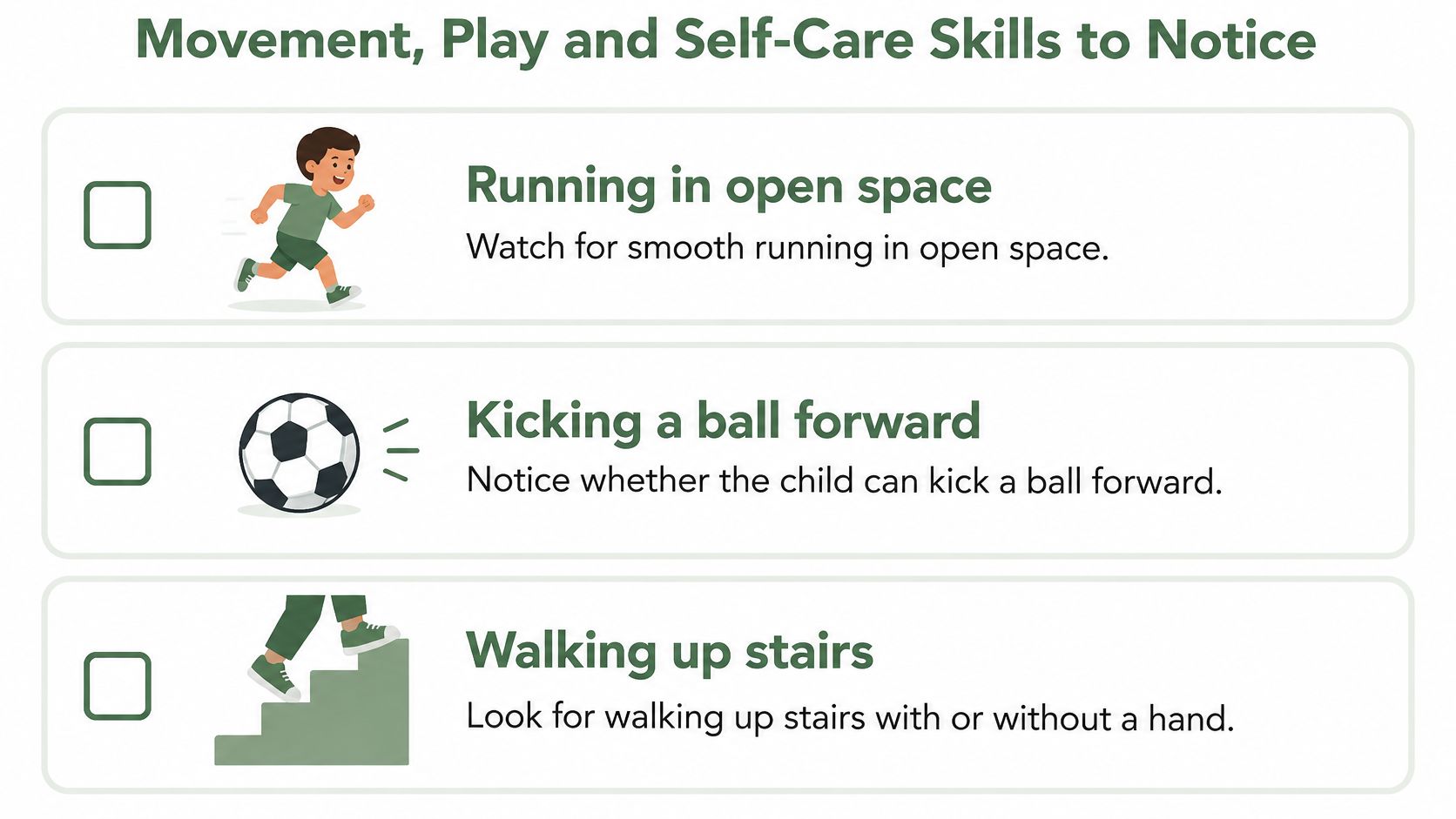
Movement is often what caregivers notice first, because it's visible across a room. Watch for running in open space, kicking a ball forward, and walking up a few stairs with or without a hand. Skills can look different on a flat playground than on carpeted stairs at home, so note where you saw them.
Movement You Can See Every Day
MedlinePlus, the U.S. National Library of Medicine consumer health resource, lists physical achievements at this age including improved running coordination, kicking a ball without losing balance, turning a doorknob, and turning book pages one at a time. It also notes that many children are ready to begin toilet training around this period, but readiness is individual rather than a fixed deadline.
Normal variation is wide here. One toddler climbs stairs holding a rail with both feet on each step. Another prefers to crawl up. Both can fit the typical range, especially if strength and confidence are building week by week. What you're watching for is progress and practice, not polish.
Play That Shows Problem-Solving
Play skills deserve the same attention as running. Pressing a switch to see what happens, turning pages one at a time, feeding a doll, or putting a stuffed animal to bed all show planning and imitation. Using two toys together, like pouring from a teapot into a cup, is a step beyond holding one object alone.
Try setting out simple invitations rather than instructions.
- Low step at the playground: Lets your child practice stepping up where a fall is short and the surface is forgiving.
- Spoon at every meal: Gives repeated, low-pressure practice even when fingers still do half the work.
- Bucket of cups for pretend tea: Encourages two-handed play, pouring, and offering to others.
Self-Care Without a Deadline
Let your child choose a sock or shirt to put on, even if you finish the job. Notice interest in bathroom routines, requests for a diaper change, or attempts to wash hands with help. Record what your child did without help that day, because a skill used at grandma's house or at daycare still counts, even if you didn't see it yourself.
Social and Emotional Skills and How to Encourage Them
At the playground, a toddler pauses mid-run because another child has fallen and started crying. She looks at her parent, then back at the child, then toddles over with a blanket dragged behind her. Nothing dramatic happens, but that pause holds two social-emotional skills at once.
At two, children typically notice when another person is hurt or upset and look to an adult's face for cues in unfamiliar situations. You might see the second one before your child approaches a new dog, enters a busy room, or hears a loud noise. That quick glance is your child asking, without words, whether things are safe.
Three Things That Are Easy to Confuse
Keeping these separate can lower a lot of worry.
- A skill that appears unevenly: Your child comforts a sibling at home but ignores a crying child at a noisy park. Context matters.
- A skill that has disappeared: Your child used to check your face and respond to others, and no longer does. That's different, and worth raising with your pediatrician.
- A temperament trait: A shy child who watches before joining, an intense toddler with big reactions, or a child who plays next to peers rather than with them can all be within the typical range.
Practical rule: Describe what happened, where, and with whom, before deciding what it means.
Small Ways to Encourage Growth
Name feelings in plain words during real moments. "You're frustrated, the block fell," gives your child language for an experience they're already having. Offering two choices, such as the red cup or the blue cup, can reduce power struggles and invite a response.
Books about feelings, a short playdate with just one other child, and watching a grandparent or nanny respond calmly to a fall all give your child models to copy. In Spanish-speaking families, feelings and care may be shared through songs, family words, and several relatives, so recording what each caregiver sees gives a fuller picture than any one person's view.
Try not to measure your child against a neighbor's toddler at the same park. Children show connection in different ways and on different days. A few dated examples of noticing, checking in, and comforting will tell you, and your clinician, far more than a single afternoon comparison.
When a Gap Calls for a Pediatrician Visit
Sorting a concern calmly starts with separating a single missing item from a broader pattern. A single missed item is a reason to observe and note, not a diagnosis.
| Situation | What to record | Who to contact |
|---|---|---|
| A skill present earlier is no longer seen | Date last seen, setting, how often it appeared | Pediatrician, without waiting for the next visit |
| Several skills missing across language, play and motor areas | Dated examples from each caregiver and setting | Pediatrician, to ask about further assessment |
| One item not yet present, other skills typical | Date, context, and whether it is emerging | Mention at the next health-supervision visit |
| Positive questionnaire at an 18 or 24 month visit | Questions and observations to bring along | Clinician who reviews the results; screening is not a diagnosis |
| Any concern at any time | Specific examples with date and setting | Pediatrician; a scheduled visit is not required to raise it |
How Screening Fits In
A home checklist and a clinical screening aren't the same thing. Screening uses structured questionnaires, interpreted by a qualified clinician, to decide whether further evaluation may help. A positive result opens a conversation. It doesn't establish a diagnosis on its own.
Timing also helps explain why the two-year visit gets attention. The CDC page on developmental monitoring and screening notes that the American Academy of Pediatrics recommends general developmental screening at 9, 18, and 30 months, and autism-specific screening at both 18 and 24 months. It also says screening should occur when a clinician, parent, or early-childhood professional has concerns at another time.
That last point is worth holding onto. You don't need to wait for a scheduled visit to raise a question, and you don't need certainty before you call. Loss of a skill your child once had, or difficulty showing up across communication, play, and motor areas together, are both good reasons to reach out sooner.
Your question is useful information for your pediatrician, especially when you bring dates and examples. Calling early is never an overreaction. It's how clinicians get the clearest picture while support options are widest.
Track Milestones in One Shared Record and Prepare for the Checkup
A shared record turns scattered memories into something a clinician can use. These steps keep it simple enough that every caregiver will stick with it.
A Five-Step Routine That Fits Real Life
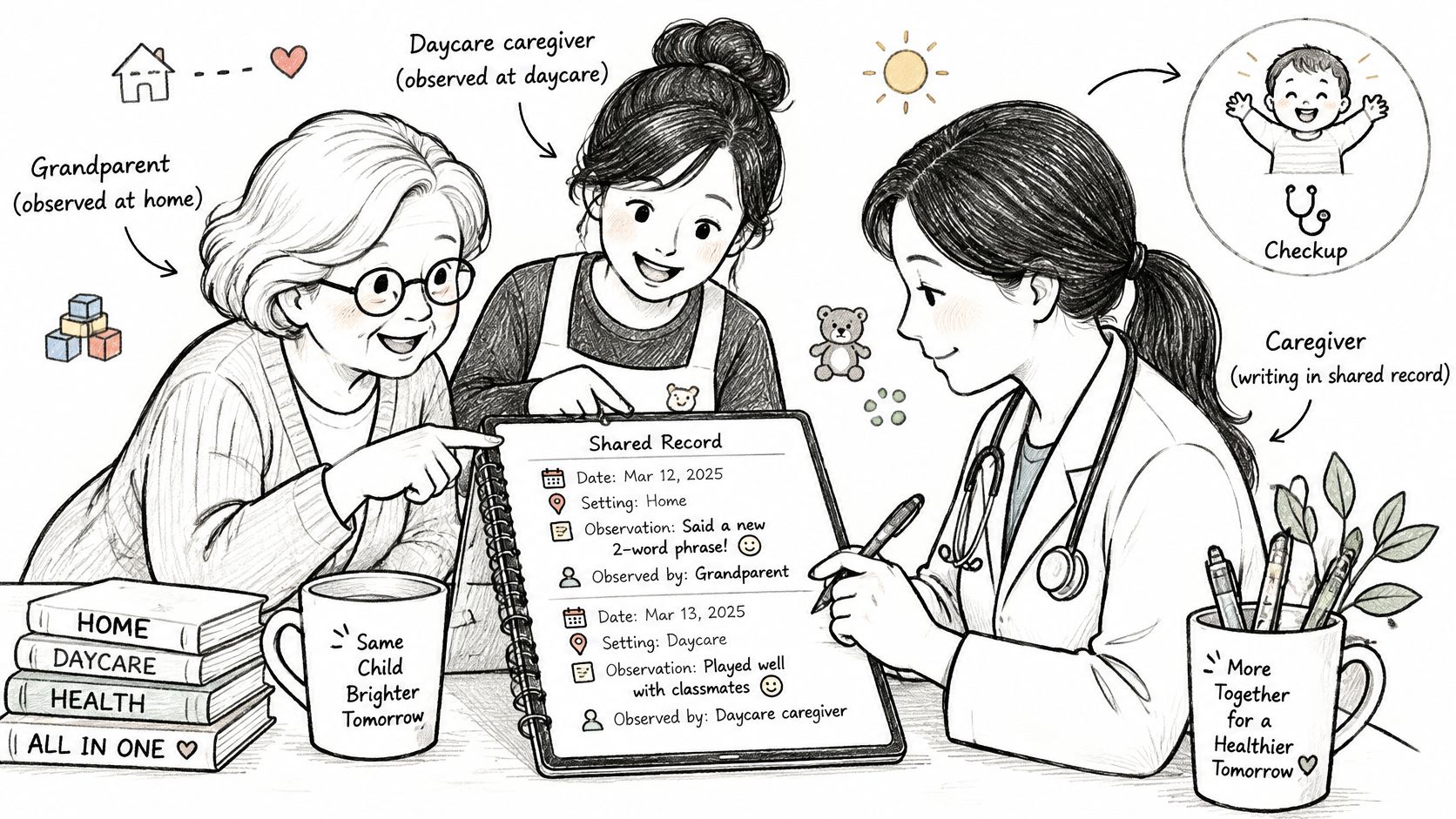
- Choose one shared place for notes so a grandparent's observation and a daycare report land in the same record, not in separate text threads.
- Write each observation with context. Add the date, setting, who prompted it, and whether the skill repeats with another caregiver.
- Review once a month. Mark each skill as steady, emerging, or not yet seen, and notice whether emerging skills are appearing more often.
- Bring the dated list to the 24-month visit and ask the clinician which items to keep watching. If you'd like a clean copy to hand over, our notes on how to export a summary for your pediatrician walk through preparing one.
- Call rather than wait if a skill is lost. A missed item isn't itself a diagnosis, but loss or a persistent cluster of concerns warrants a conversation with your clinician.
Sharing only works when logging is easy for everyone. Daycare uses one browser link that they bookmark on their iPad, and their logs flow to the parent's phone in real time, so a new phrase heard at lunch doesn't have to wait for pickup to reach you.
If a shared tracker helps your family, Cradlo is a baby tracker built for families, nannies, and daycares, and it offers a 7-day free trial on its monthly plan. Whatever tool you choose, keep the goal in view. You're building a clear picture for the clinician, not a grade for your child.
If your family's milestone notes are split between texts, pickup chats, and memory, Cradlo gives parents, partners, grandparents, nannies, and daycare one shared timeline for dated observations alongside sleep, meals, and diapers. Every entry syncs in real time, so the record you bring to the 24-month checkup reflects what each caregiver saw. Visit us to start your 7-day free trial on the monthly plan and build that clearer picture together.