Seven Month Milestones to Watch and Note
At pickup, the daycare caregiver says your baby sat and played with a soft block. At home, you sit beside the blanket, offer the same kind of toy, and watch your baby tip sideways into your hand. You're tired, your partner has questions, and suddenly you're searching seven month milestones before you've even unpacked the diaper bag.
Those observations don't cancel each other out. A useful record starts with what happened around the skill, not a verdict about whether your baby is on schedule.
Table of Contents
- Why Two Caregivers Can See Seven Months Differently
- Skills Families Often See Around Seven Months
- What Those Skills Look Like on an Ordinary Day
- Simple Play That Supports Each Domain
- Milk Solids and What to Pass Along
- When to Keep Watching and When to Call
Why Two Caregivers Can See Seven Months Differently
Say a grandparent reports that the baby sat during an afternoon visit. A parent tries again after pickup and sees mostly wobbling. Before deciding that someone misunderstood, ask what sitting looked like: Were the baby's hands on the floor? Was an adult supporting the hips? Was the toy close enough to reach without leaning?
Both adults may have described the same developing ability under different conditions. Neither needs to prove their version.
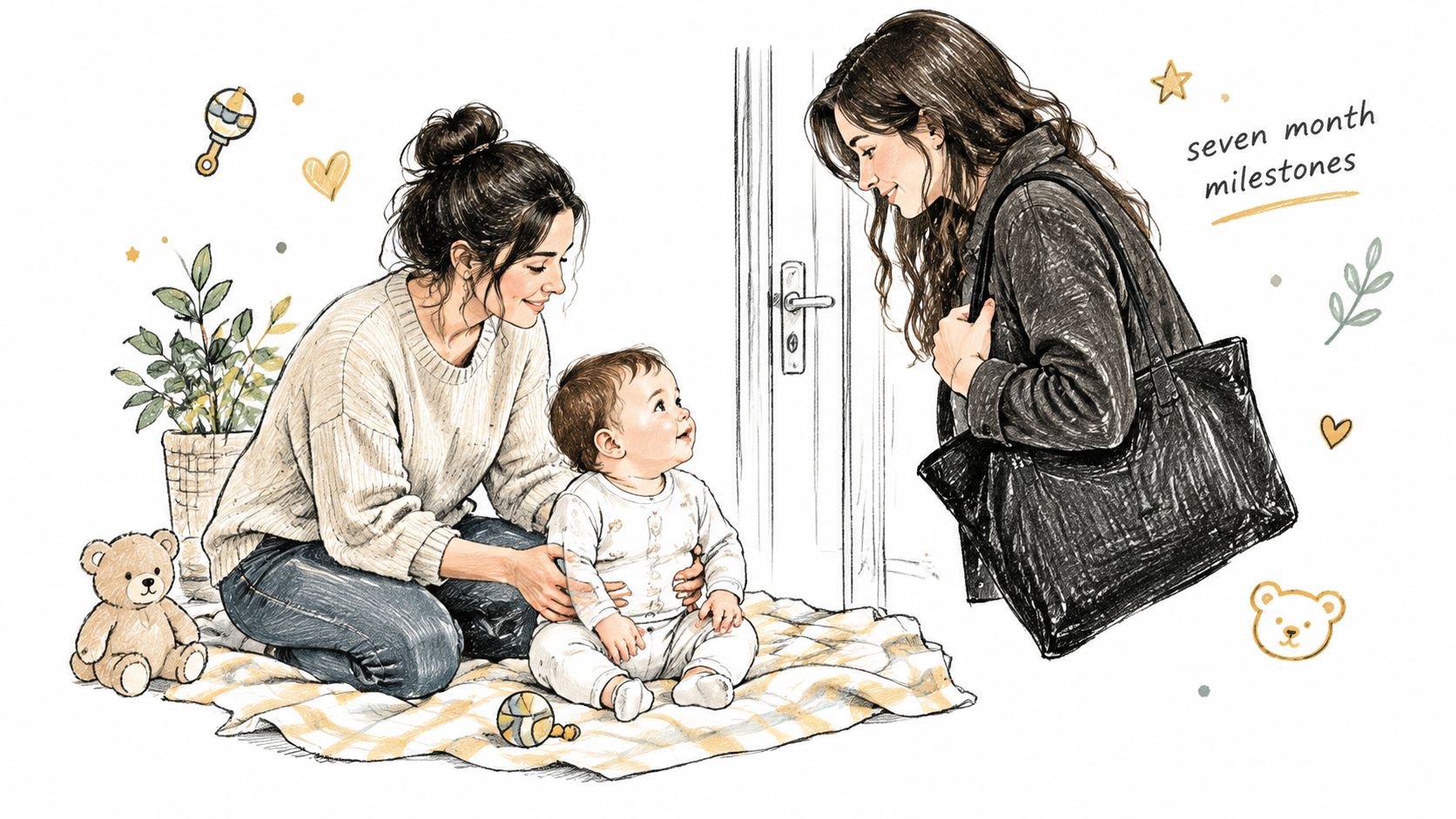
Different settings reveal different things
At this age, babies are connecting what they see, hear, and touch with new ways of moving. That broader developmental stretch is a window for noticing change, rather than a deadline attached to the calendar.
Skills also arrive in different sequences. A baby may pass a toy between hands all week and still tip while sitting. A quiet afternoon, a shy hour with a newer caregiver, or a behavior seen at home but not at daycare gives you context.
Parents, partners, grandparents, nannies, and daycare each see a slice of the same child. The nanny may hear sound play during a relaxed diaper change. A parent may notice reaching during breakfast, while daycare sees more movement on the floor.
Useful distinction: Not seeing a skill during your time together isn't the same as knowing the baby can't do it.
Why the calendar leaves a gap
The CDC milestone checklists move from 6 months to 9 months rather than providing a universal seven-month checklist, and recommend routine developmental screening at 9 months. That gap can make families feel they're missing a page when they're between broader observation points.
The answer isn't a tighter weekly schedule. It's a shared watch-and-note record: describe what happened, keep the setting attached, and notice changes over time.
Instead of writing that sitting is complete, a caregiver might record that the baby leaned on their hands while reaching for a block, with an adult close beside them. Another caregiver can add what happened later without erasing that earlier observation.
Our explanation of why milestones aren't a race offers another way to step away from comparisons. You don't need to recreate daycare's afternoon at home or turn a grandparent's visit into a demonstration.
Use the following reference to recognize commonly observed abilities. Read across the ranges, not down a scorecard.
Skills Families Often See Around Seven Months
Commonly observed skills around seven months
| Domain | Often noticed | Still within a range |
|---|---|---|
| Gross motor | Rolls front to back and back; sits with less hand support; bears weight on legs when supported | Skills can arrive in any order; hands-on support is still ordinary |
| Fine motor | Reaches with one hand; passes a toy between hands; uses a raking grasp | A mature pincer grip is a later skill |
| Communication | Chains of consonant-like babbling; sounds for pleasure or displeasure | The exact syllables differ from baby to baby |
| Social | Responds to own name; reacts to the tone of voice | May be quieter with a newer caregiver or in a busy room |
| Cognitive | Searches for a partly hidden object | A brief look is worth noting; sustained play isn't required for an observation |
| Vision | Color and distance vision have matured; tracking of moving objects improves | This is observation, not a vision exam |
The American Academy of Pediatrics' developmental milestone guide describes the four-to-seven-month period as a time when perception and motor control increasingly work together, including the commonly observed abilities above. They're useful prompts for family notes, not a pass-or-fail test.
Movement and hands work together
Rolling, sitting, and supported weight-bearing don't have to become steady at the same moment. Record the help involved: sitting with hands planted is different from sitting while both hands hold a toy. Bearing weight while an adult supports the baby isn't a reason to expect independent standing.
Reaching adds another layer. A baby may look at a ring, reach with a hand, grasp it, and eventually transfer it. A raking grasp uses the fingers more broadly to draw something toward the palm; it isn't the precise thumb-and-finger pickup of a mature pincer grip.
Use large, baby-safe objects for observation and play, not tiny objects chosen to test precision. If crawling is the comparison that keeps coming up in family conversations, our article on crawling age for babies can help you frame that separate question without overlooking the movement you're already seeing.
Connection, thinking, and seeing belong in the record
Communication includes more than recognizable syllables. Chains of consonant-like babbling matter, but so do sounds of delight or protest. Write what you heard rather than translating every sound into a word.
Social responses need their setting, too. Turning toward a familiar voice, responding to the baby's own name, or reacting to a warm versus serious tone gives caregivers something concrete to describe. Repeatedly calling the baby's name to produce a response can turn an ordinary interaction into an uncomfortable test.
Thinking and seeing often appear within the same small action. A baby watches a moving toy, notices part of it beneath a cloth, and looks toward the visible edge. Improved tracking and more mature color and distance vision help explain why ordinary surroundings can hold their attention.
For a baby born early, ask the pediatrician how to think about age rather than treating the calendar month as the only clock. Whatever the family's situation, each caregiver's job is modest: note what they saw, where it happened, and who was present.
What Those Skills Look Like on an Ordinary Day
During floor time, a parent lies beside the baby and talks about the soft book nearby. The baby pushes up on straight arms, looks toward the voice, and rolls from tummy to back. Later, with the parent supporting them on a lap, the baby leans forward onto their hands.
These examples appear on the CDC's 6-month milestone checklist and may still be emerging during the seventh month. Milestones describe what most children can do by an age, not a test due on a particular day.
Small moments count as observations
At a grandparent's house, the baby reaches toward a baby-safe cup. The grandparent holds it while the baby gets a grip, then releases it. The baby brings the rim toward their mouth and eventually moves the cup to the other hand.
The useful detail is that the grandparent helped begin the exchange. Without that detail, another adult might assume the baby picked up and transferred the cup independently.
During a diaper change, a parent makes a soft sound and pauses. The baby answers with a squeal, then a wet raspberry. The parent answers back, and the baby laughs.
A short exchange can tell you more than a request to perform a sound on demand.
Familiar people change the scene
At daycare, the baby brightens when a familiar nanny arrives for pickup. When a newer adult leans close, the baby studies the face instead. The note can describe both responses without deciding that the quieter moment was a problem.
In a Spanish-speaking household, sound play during a song at home may look different from an English-language exchange at daycare. Both belong in the same child's record. Caregivers can name the song or language used without judging which interaction sounded more advanced.
At lunch, the baby closes their lips when the spoon approaches. The caregiver pauses instead of trying to coax another mouthful. That's a communication moment as well as a feeding observation.
Later, a parent slips a cloth partly over a toy. The baby looks toward the uncovered piece, reaches, then loses interest when someone walks past. The note doesn't need to turn that brief search into a long activity.
Write the scene in a sentence: the grandparent held the cup while the baby grasped it, then the baby moved it between hands. Include who was there, and leave the day unscored.
Simple Play That Supports Each Domain
Play doesn't need special equipment or a crowded schedule. A clear floor space, a baby-safe toy, and a familiar adult are enough to offer movement, conversation, and discovery.
Stay close and keep the invitation easy to leave. If the baby turns away, fusses, or seems tired, stop rather than finishing the activity for the sake of completion.
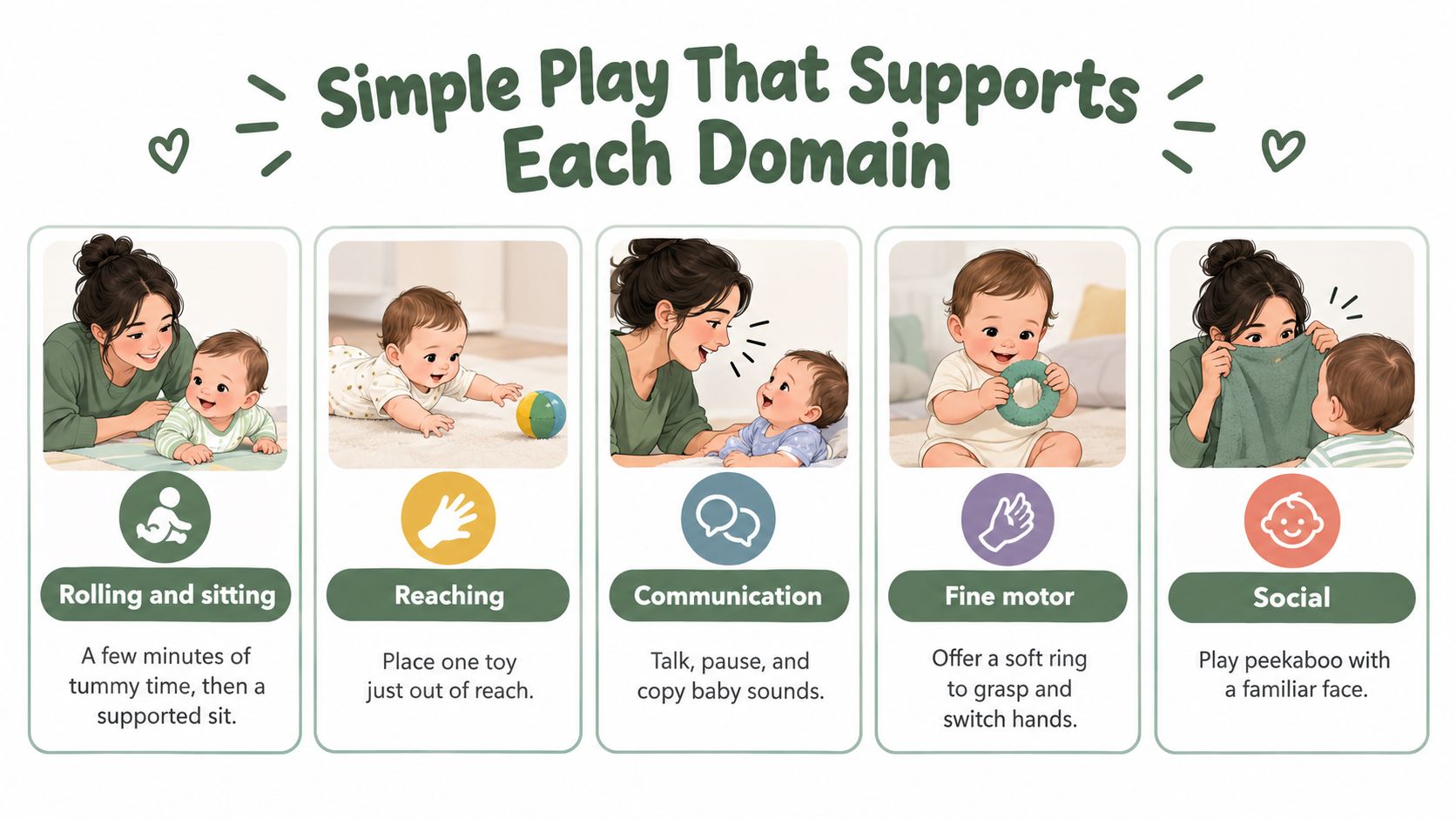
Offer an invitation, then follow the baby
-
Rolling and sitting. Start with a few minutes of supervised tummy time while the baby is awake, then offer sitting with your hands supporting them as needed. Place a toy slightly to the side so they can try reaching with a hand. Keep it close enough that the attempt doesn't become a struggle, and stop when they tire.
-
Hand skills with a light object. Offer a lightweight baby-safe cup, soft block, or ring from your hand. Let the baby grasp it, explore it, and switch hands if they choose; you don't need to arrange their fingers. The purpose is comfortable exploration, not drilling a pincer grasp.
-
A conversation made of sounds. Say the baby's name warmly, then wait. Answer whatever comes back, whether it's a squeal, raspberry, or quiet vowel sound, and leave room for another turn. Silence is allowed, too; you can enjoy being together without getting a response.
-
A familiar face game. Repeat a simple smile-and-hide game with someone the baby knows well. If the baby enjoys it, another familiar adult can take a turn while the first stays nearby. Let the baby watch before expecting a smile or laugh.
-
A partly hidden toy. Place a favorite toy halfway beneath a cloth while sitting beside the baby. Welcome a glance or reach without pulling their hand toward the answer. If they move on, uncover the toy and let the game end.
Keep the language and expectations comfortable
Sing or name the toy in the language that caregiver uses most naturally. A grandparent can sing in Spanish while a partner uses English during a different playtime. There's no need to correct the baby's sounds or ask adults to make their interactions identical.
Skip flash-card drills, propping a baby into unsupported sitting, and treating a missed game as falling behind. Supporting the baby with your hands during shared play is different from wedging them into a position and expecting them to stay there. Ask the pediatrician about positioning if you're unsure what fits your baby.
A busy afternoon doesn't create a play debt. The next caregiver needs a helpful detail, not an assignment to catch up.
Leave a note such as: the face game with Grandma got a laugh today, but the baby turned away from the hidden toy.
Milk Solids and What to Pass Along
Milk still anchors the day while complementary foods add nutrition and new eating experiences. The World Health Organization's infant and young child feeding guidance explains that complementary foods generally begin around 6 months because milk alone no longer meets all energy and nutrient needs, recommends complementary foods 2–3 times daily for 6–8-month-olds, and supports continued breastfeeding to 2 years or beyond.
Alongside breast milk or the milk feeds already discussed with the pediatrician, caregivers can offer food patiently and follow the baby's cues. Responsive feeding means noticing interest and fullness, going slowly, and not pushing the next spoon. It's a recommended practice, not a promise about any individual child's eating behavior.
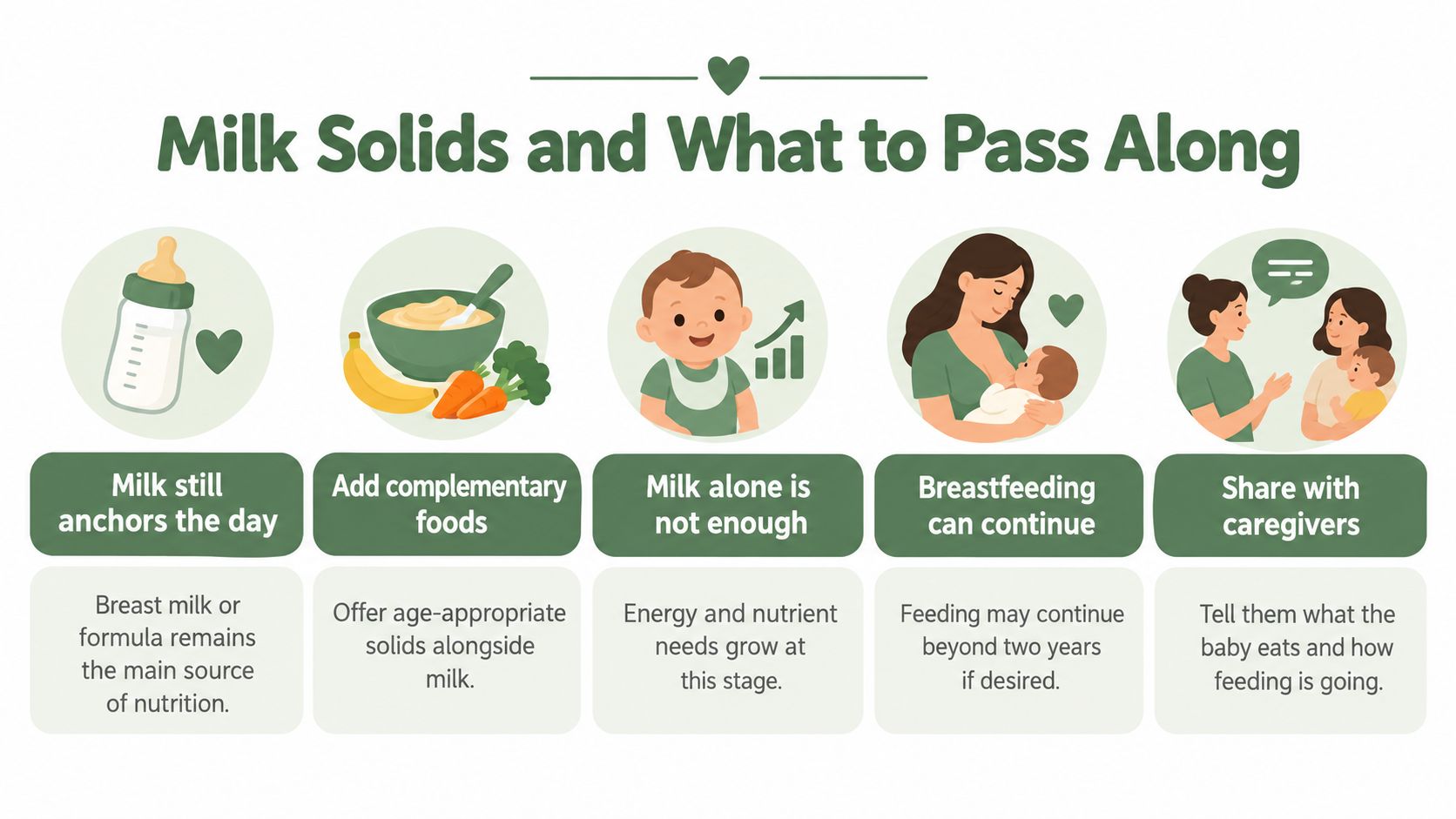
Write preparation, not just the ingredient
An entry that says fruit leaves the next caregiver guessing. Soft mashed fruit describes the preparation and gives a clearer picture of what happened.
What to pass along after a seven-month meal
| What to write | Example note | How the next person uses it |
|---|---|---|
| Food and texture | Soft mashed fruit, not firm pieces | Offer a similar texture later in the day |
| Offered versus eaten | A few spoons offered, two eaten | Treat a small portion as information, not failure |
| Milk feed | Breast or bottle, and about when | Avoid guessing whether milk already happened |
| Hunger or fullness | Leaned in, then turned away | Stop without pressing another bite |
| Reaction | One cough on a lumpier spoon, then fine | Mention it if the same reaction repeats |
| Who fed the baby | Daycare at lunch | Keep the history on the child, not in one memory |
These are example notes, not suggested portions or a way to decide whether a reaction is harmless. Record what happened without diagnosing it, and contact the pediatrician about feeding concerns.
Don't make the next meal a correction
Appetite fluctuates. An unfinished bowl isn't a failed meal, and another caregiver doesn't need to make up the difference by persuading the baby to eat.
Handoff habit: Separate what you offered from what the baby actually ate.
For help organizing the day rather than prescribing intake, use our explanation of a feeding schedule for a seven-month-old. Take questions about amounts, allergens, or feeding worries to the pediatrician or an appropriate lactation professional.
Repeated patterns across days are more useful for that conversation than a judgment about lunch. Keep the preparation, cues, and reactions attached to the meal so everyone can describe the same history.
When to Keep Watching and When to Call
At home, a baby may try a new movement again and again. At daycare, the same baby may be busy watching other children. Different observations can both be useful. Keep noting skills that appear unevenly or only sometimes, and contact the pediatrician if a concern persists across settings, a skill the baby used fades, or you want help interpreting a pattern.
You don't have to wait for everyone to agree. If something worries your family, an earlier call is reasonable. You don't need a perfect list before asking for help.
Bring observations, not a case to prove
A pediatrician can consider your notes alongside a conversation and examination. A planned developmental screening visit is another chance to raise questions, not a reason to put off a concern.
A few dated notes can help you describe what you've seen:
- What happened. Describe the movement, sound, or response without labeling it advanced or delayed.
- Who observed it. Note whether a parent, partner, grandparent, nanny, or daycare caregiver was present.
- Where it happens. Record whether you've seen it at home, during childcare, or in both places.
- What changed. Distinguish a skill you haven't seen yet from one the baby used before and no longer seems to use.
There's no need to test the baby repeatedly. If you already have a short video of an ordinary moment, ask whether it would help. You don't need to stage another attempt.
Keep the history together
Texts about bottles, naps, and new skills can scatter details across several people's phones. A shared log keeps each observation in the child's timeline, ready to review without relying on anyone's memory.
Cradlo is a shared tracker for families with children ages 0–5. Partners, nannies, grandparents, and daycare each have their own identity, and daycare can bookmark one browser link on an iPad so its logs reach parents' phones in real time. Cradlo starts with a 7-day free trial, then Plus is $4.99 a month or $49.99 a year, or Lifetime is $99.99 once.
Some days will have little to report. A brief, accurate note is more useful than filling every category just to make the page look complete. The notes support a conversation; the pediatrician interprets health questions and helps your family decide what comes next.
Cradlo brings feeds, naps, and milestone observations into one shared record, so the next caregiver can see what happened. Visit Cradlo to explore a watch-and-note approach that keeps caregivers connected without scoring a baby's progress.