3 Month Feeding Schedule: How Often Babies Really Eat
Your baby fed before the nap, your partner remembers offering a bottle afterward, and Grandma wants to know when the next feed should happen. Meanwhile, the schedule you found online looks nothing like yesterday. A 3 month feeding schedule is most useful when it helps everyone understand what happened, not when it tells a hungry baby to wait.
Think of it as typical ranges plus a shared record. Published feeding guides offer starting points, while your baby's cues and your pediatrician's guidance help you interpret the pattern without turning every feed into a test.
Table of Contents
- Typical Feed Counts and Amounts at 3 Months
- A Flexible Sample Day for a 3 Month Old
- Reading Hunger and Fullness Cues Before Each Feed
- What to Record So Every Caregiver Stays in Sync
- Normal Changes Versus Signs to Call the Pediatrician
- Share the Plan and Confirm It With Your Pediatrician
Typical Feed Counts and Amounts at 3 Months
Typical feeds and amounts at 3 months by feeding method
| Feeding method | Feeds per 24 hours | Amount per feed | Reference |
|---|---|---|---|
| Breastfed | 8 to 12, with many feeding every 2 to 3 hours | Not reliably measured in ounces | American Academy of Pediatrics |
| Bottle, formula or expressed milk, 3 to 6 months | 4 to 5 | 6 to 8 oz (180 to 240 ml) | KidsHealth |
| Formula, 3 to 5 months | 5 to 6 | 6 to 7 oz | Stanford Medicine Children's Health |
| Bottle, birth to 3 months | 6 to 8 | 3 to 4 oz | Alabama WIC nutrition guidance |
These references don't describe identical groups. A table that ends at this age includes younger infants, while a table that begins here also includes older babies. Feeding practices and individual needs differ, too.
That's why the larger bottle in one row doesn't mean your baby should suddenly drink more. Nor does the smaller bottle in another row mean a baby who comfortably takes more is doing something wrong. Each table describes general guidance, not an individual prescription.
How to read the ranges without creating quotas
Use the row that matches your baby's feeding method as a conversation starter, not a requirement. Don't combine the largest bottle amount from one guide with the highest feeding count from another to create a daily goal. Those figures weren't presented as a single plan.
Direct nursing also needs a different kind of interpretation. You can record when nursing started, how long it lasted, and what you observed, but duration doesn't reliably tell you how many ounces transferred. A shorter nursing session isn't automatically a smaller feed.
For combination feeding, resist the urge to make every session equivalent. Nursing followed by a bottle is a different event from a bottle alone, and pumping output isn't a measurement of what the baby took directly at the breast.
Practical rule: Use published ranges to understand the possibilities, not to decide whether a feed passed or failed.
A useful everyday check is whether your baby feeds regularly, seems satisfied after most feeds, and has steady growth at checkups. Those observations belong together. If you're unsure how to interpret them, a pediatrician or lactation professional can assess your baby's individual feeding pattern rather than asking you to fit a chart.
A Flexible Sample Day for a 3 Month Old
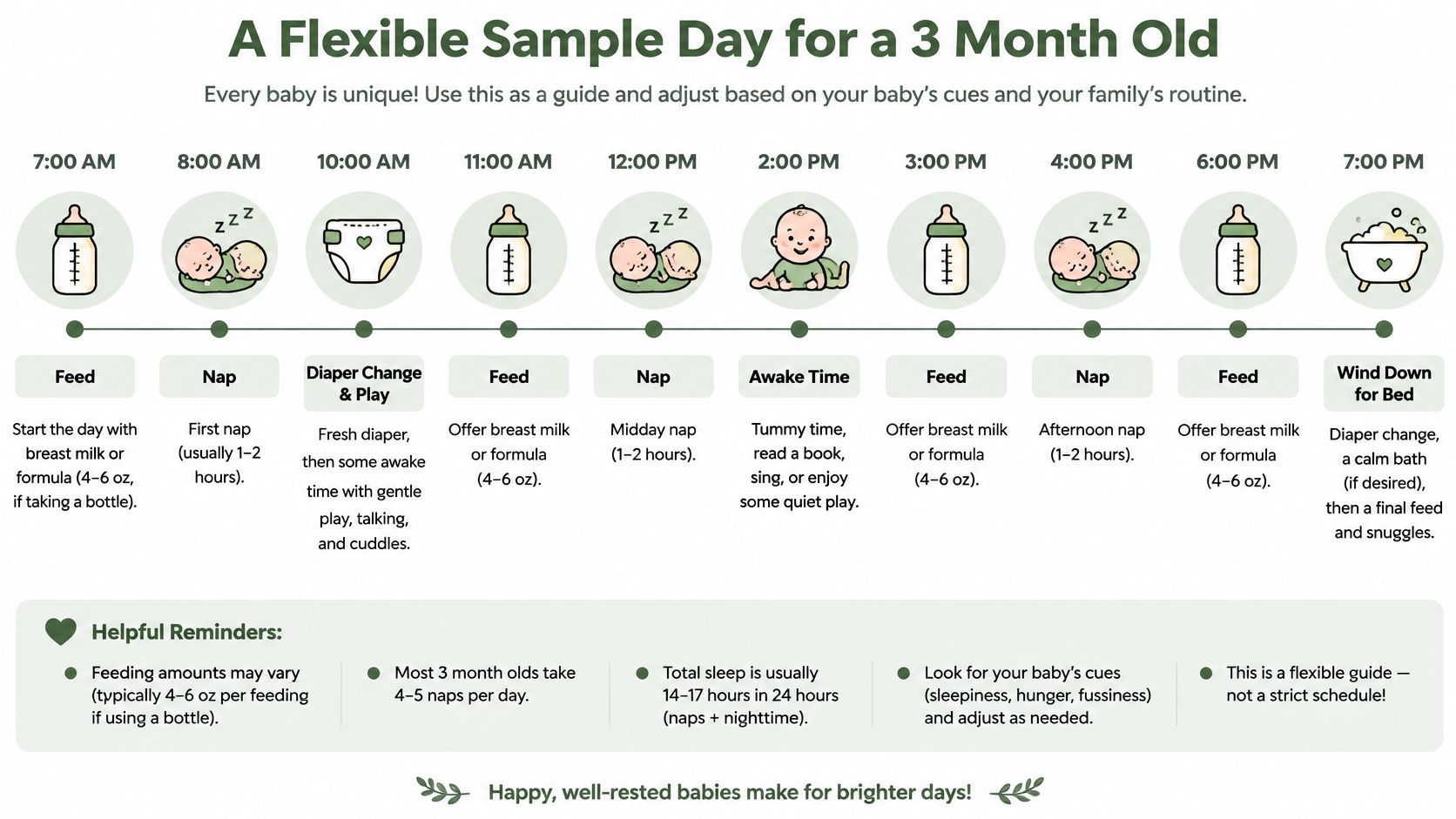
The following is a hypothetical day, not a timetable your baby needs to follow. The clock times make it easier to picture how feeding, naps, and family routines might fit together.
- About 6:30 a.m. Wake and feed. If your baby wakes hungry earlier, the day starts earlier.
- Around 9:00 a.m. Feed after the morning nap, or sooner if hunger appears before the nap.
- About 11:30 a.m. A short feed might fit here. Its length doesn't have to match the morning session.
- About 2:00 p.m. Feed after the early afternoon nap.
- About 4:30 p.m. Feed, with room for additional close-together feeds during the late afternoon or evening.
- About 7:00 p.m. Offer the bedtime feed as part of your family's evening routine.
- About 10:30 p.m. An optional dream feed might appear in some families' plans. It isn't a required step, and questions about whether it fits your baby belong with your clinician.
- Overnight, as needed. Leave space for night feeds rather than assuming the daytime list completes the day. Some babies may have a longer stretch, but that isn't a scheduling achievement.
This timeline illustrates the general idea of fitting feeds around the baby's day.
Adapt the same day for bottles
A hypothetical bottle-fed variation might have five bottles around 7 a.m., 11 a.m., 3 p.m., 6 p.m., and bedtime, plus a night feed if the baby wakes hungry. That's an illustration of a possible pattern, not a recommendation to limit feeding opportunities or stretch the gaps.
If your baby needs more frequent bottles, the example should change. If bedtime shifts, there's no reason to preserve a clock time just because it appears on the list.
Choose anchors from several days of observations, not from an unusually tidy day. Perhaps the first morning feed and the feed before bedtime repeat, while everything between them moves with naps. Those repeating moments can help caregivers plan without treating the whole day as fixed.
An early day, a late day, and a day with extra feeds can all be workable days.
The purpose of an anchor is to help adults prepare. It shouldn't require the baby to wait through hunger or eat without interest.
Reading Hunger and Fullness Cues Before Each Feed
A caregiver needs to answer two different questions: Does the baby want to start feeding, and does the baby want to continue? The clock can't answer either question on its own.
The CDC's guidance on hunger and fullness signs identifies hands moving toward the mouth, turning toward the breast or bottle, and lip smacking as hunger signals. Closing the mouth, turning away, and relaxing the hands can signal fullness, and caregivers shouldn't require a baby to finish a bottle.
| What you notice | What it may communicate | Caregiver response |
|---|---|---|
| Hands move toward the mouth, with searching or lip movements | Interest in feeding | Offer a feeding opportunity |
| Baby turns toward the breast or bottle | Readiness to begin | Respond rather than waiting for a scheduled time |
| Baby closes the mouth or turns away | A wish to pause or stop | Stop offering and observe |
| Hands relax as active feeding ends | Possible satisfaction | Allow the feed to end without pursuing an empty bottle |
Read the whole interaction
A single movement doesn't tell the whole story. A baby who briefly pulls off, looks around, and calmly returns may be distracted rather than finished. A baby who repeatedly turns away and closes their mouth is communicating something different.
Give yourself room to observe instead of deciding immediately that the feed was too short. If uncertainty keeps recurring or feeding becomes difficult, a lactation professional or pediatrician can help interpret what you're seeing.
Cluster feeding means feeds bunch together rather than staying evenly spaced. It can happen during the evening or a growth stretch, and frequent requests don't automatically mean the routine has failed. Understanding infant feeding patterns can help caregivers distinguish a flexible rhythm from an expectation that every gap should look alike.
The challenge during shared care is consistency of response. A grandparent shouldn't feel obliged to finish a bottle because a parent prepared it, and a partner doesn't need to postpone a feed to preserve the next planned time.
Use a short decision list:
- Offer at early hunger cues. Treat the planned time as context, not permission.
- Respect fullness cues. An unfinished bottle can be an appropriate ending.
- Avoid fixed-gap rules. Leave room for clustered feeds, changing sleep, and a different kind of day.
What to Record So Every Caregiver Stays in Sync
Fields to record for each feed
These are hypothetical entries showing how a shared record might look.
| Field | Example entry | Why it matters |
|---|---|---|
| Time started | 6:40 a.m. | Shows the gap since the last feed |
| Method | Breastfed, expressed milk or formula | Keeps nursing separate from bottles |
| Amount offered | 4 oz bottle, or left breast for 15 minutes | Records what was prepared or offered |
| Amount taken | 2.5 oz | Shows intake without treating leftovers as failure |
| End cue | Turned away, hands relaxed | Helps distinguish fullness from distraction |
| Caregiver | Grandma | Tells the next person who to ask |
Time, method, and caregiver answer the first handoff questions: Was there a feed, what kind was it, and who knows what happened? A blank entry doesn't necessarily mean the baby hasn't eaten. If a log seems incomplete, check with the previous caregiver rather than automatically offering another bottle.
Amount offered and amount taken answer different questions. The Alabama Department of Public Health's WIC nutrition guide emphasizes that feeding size and frequency reflect individual needs. Recording what was prepared separately from what was drunk keeps an unfinished bottle from looking like a failure.
Keep nursing and bottle details distinct
For direct breastfeeding, record timing and side without converting minutes into ounces. For expressed milk or formula, record the milk type and the observed bottle amounts. When a feed combines nursing with a bottle, put each part on its own line so the next caregiver sees both.
A handoff should be readable even by a daycare worker who doesn't know the baby's usual routine.
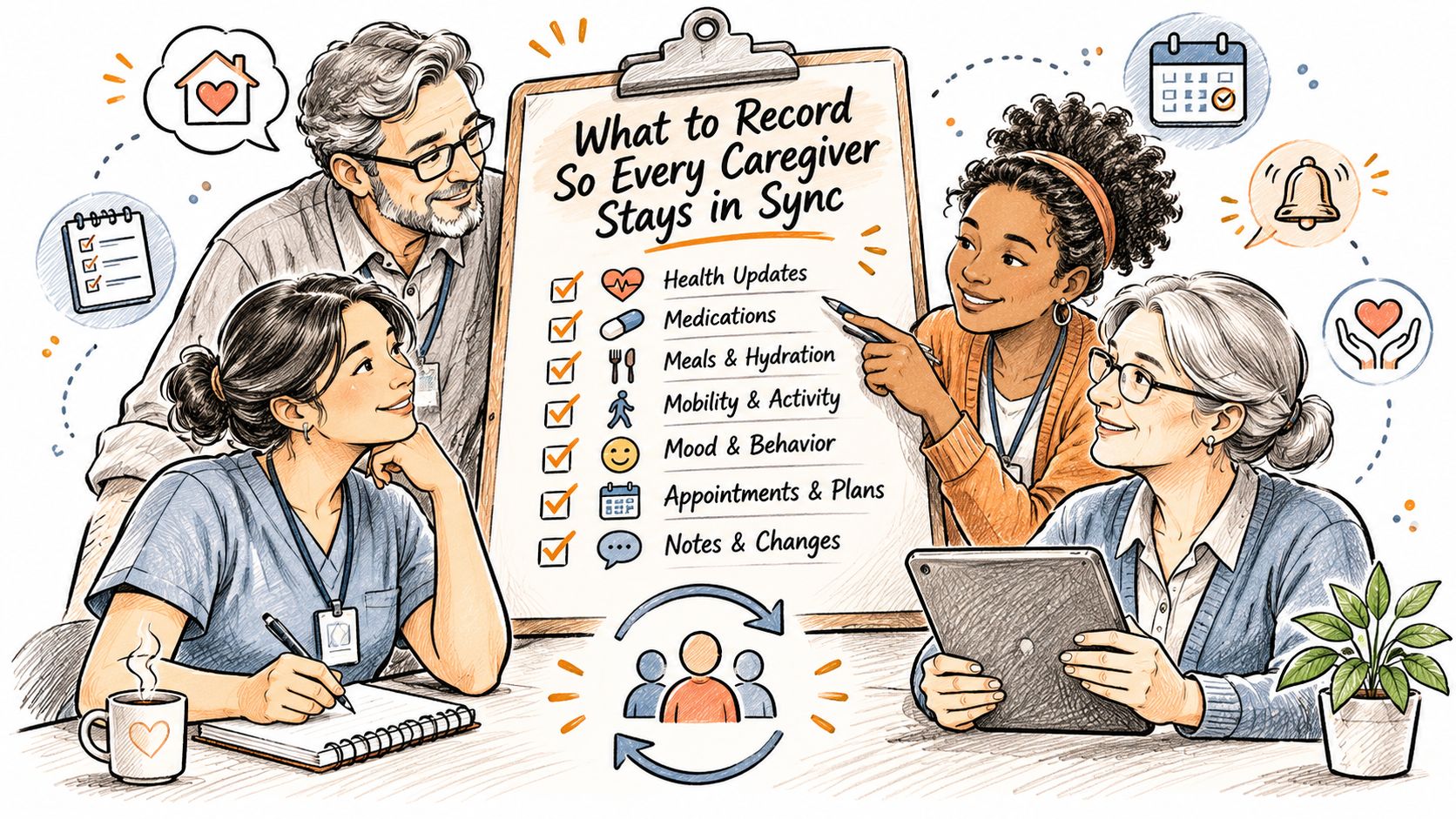
Use the same fields each time, whether a parent, partner, grandparent, nanny, or daycare worker makes the entry. A baby feeding log template can help everyone agree on those fields before care changes hands.
A useful handoff includes the last feed's time, method, approximate amount or duration, observed cues, and anything unusual.
For Spanish-speaking families, the same fields can use familiar terms such as pecho, biberón, and onzas. Agree on labels everyone understands so a Spanish-reading grandparent or nanny can use the record without translating each entry.
Normal Changes Versus Signs to Call the Pediatrician
A common worry is that a baby has reached this age and should now follow a more predictable timetable. There isn't a birthday switch that changes feeding overnight.
The American Academy of Pediatrics' HealthyChildren guidance emphasizes feeding in response to hunger and contacting the pediatrician when a baby is difficult to feed, isn't feeding as usual, or a caregiver is worried about intake. The transition between feeding patterns is gradual, not a deadline.
Normal changes and signs to call about
| Pattern | Usually a normal change | Contact the pediatrician if |
|---|---|---|
| Cluster feeding in the evening | Frequent short feeds that settle | Feeding is refused most of the time |
| Shorter gaps during a growth stretch | Hungrier for a few days | Intake drops sharply with no clear reason |
| One longer overnight stretch | Happens for some babies | The baby is hard to wake for feeds or seems unusually sleepy |
| Bottle left unfinished | Baby showed fullness cues | Repeated refusal of most bottles |
| Wet diapers | Regular wet diapers | Fewer wet diapers than usual |
| Vomiting | Small spit-up after feeds | Vomiting is forceful |
| Weight at checkups | Steady growth | Poor weight gain is noted at a visit |
Persistent refusal, unusual sleepiness, dehydration concerns, forceful vomiting, and poor weight gain are reasons to seek medical guidance, as discussed in KidsHealth's infant feeding guidance. These comparisons aren't a diagnosis or a reason to dismiss a caregiver's concern.
Bring observations, not a verdict
Describe what changed in concrete terms. A note that the baby repeatedly turned away during feeds gives a clinician more context than a label such as bad feeding day. The same applies to a change in wet diapers or alertness.
Several days of records can show whether an unusual feed was isolated or part of a broader change. Don't delay contacting the pediatrician to collect a complete log, though. You can call with the information you already have.
Questions about whether you're overfeeding your baby can also become easier to discuss when you can describe the offering, the baby's response, and how the feed ended. That's more useful than judging intake from an empty or partly full bottle alone.
A pediatrician can interpret feeding alongside growth and health. A lactation professional can help with breastfeeding questions, including concerns about milk transfer. The record supports those conversations; it doesn't replace professional assessment.
Share the Plan and Confirm It With Your Pediatrician
A shared plan works best when it gives caregivers the same useful information without turning a flexible routine into a fixed schedule. Start by keeping a brief record, then agree on what to pass along.
- Log feeds for three days as a starting exercise. Note the feeding method, amount offered, amount taken when known, and how the feed ended. For nursing, record timing and observations rather than estimating volume.
- Look for repeating times. Use them as loose anchors, with room for the baby's cues to shift the day.
- Agree on one record. Make sure your partner, grandparent, nanny, or daycare uses the same labels and knows how to mark an incomplete note.
- Bring the log to the next well-baby visit. Contact the pediatrician sooner if you have questions about intake, growth, or feeding changes.
Cradlo is a shared baby and child care tracker for parents and invited caregivers. Every feed, nap, and diaper logged appears in real time for everyone. Daycare can bookmark one browser link on its iPad, without installing an app or creating a login, and its entries flow to the parent's phone. Cradlo offers a 7-day free trial, then Plus at $4.99/month or $49.99/year, or Lifetime at $99.99 one time.
The schedule is a starting point, not a standard to meet. Your baby's cues and your pediatrician's guidance come first.
A clear record helps the next caregiver understand what happened without piecing the day together through texts. Visit Cradlo to explore a shared tracker for nursing, bottles, and feeding handoffs.