Pumping at Work Schedule: Plan Breaks That Fit Your Day
The 10:15 block on your calendar says Pump. At 10:12 your manager adds a call to the same slot, and you're in the hallway doing arithmetic: push the session to 11:00, squeeze it in now, or skip it and hope the afternoon opens up.
That decision, repeated across a week, is the whole job. A pumping at work schedule that survives real workdays isn't a stricter calendar. It's a plan where every session has a next viable window, a room you can reach, and a route for the milk once it leaves the pump.
You don't need a perfect routine. You need one you can renegotiate at 10:12 without guilt, and a record that shows whether anything slipped.
Table of Contents
- Sample Pumping Times for Common Workdays
- How to Build Your Workday Pumping Schedule
- Storage Limits and Milk Handling Routine
- When Meetings or Missed Sessions Disrupt the Plan
- Share the Schedule With Caregivers Before Day One
Sample Pumping Times for Common Workdays
Pick the row that matches your shift, then move the times to fit your baby rather than the other way around. These are templates, not targets.
| Workday length | Example session times | Sessions | Adjust when |
|---|---|---|---|
| 6 hours (9 a.m. to 3 p.m.) | 11:30 a.m., 2:00 p.m. | 2 | A late morning meeting moves the first session to 12:00 p.m. |
| 8 hours (8 a.m. to 4:30 p.m.) | 10:30 a.m., 1:00 p.m., 3:30 p.m. | 3 | The baby's direct feed runs late, so the first session shifts 30 minutes later |
| 10 hours (7 a.m. to 5:30 p.m.) | 9:30 a.m., 12:00 p.m., 2:30 p.m., 4:30 p.m. | 4 | The last session falls before the commute so milk has time to cool |
| Split home and office day | Blocks at home and at the office, timed to the same intervals | 2 to 3 | Note the location for each session so the milk route is planned in advance |
Where the example times come from
Three inputs set every row. Your baby's usual feeding pattern while you're together, because that rhythm is what your body expects. Your direct feeds before you leave and after pickup, since a 7:00 a.m. nurse changes what the 10:30 session needs to be. And your own output and comfort, which decide how much slack a given row can take.
Take a parent working 9 a.m. to 4:30 p.m. That's a 7.5-hour shift sitting between the 6-hour and 8-hour rows, so two or three sessions fit. In practice: 10:30 a.m., 1:00 p.m., 3:30 p.m.
When a meeting runs from 12:30 to 1:40, the midday session moves earlier, to 12:15, rather than later. Pushing it to 1:45 crowds the 3:30 session, and the 3:30 session needs its full gap so the milk has time to cool and pack before the 4:30 exit. Move the middle, protect the ends.
Signs the plan is holding
- The week's volume stays level: what you pump across the day looks roughly like your first week back, and you're not sending more than your baby drinks.
- Every session has a window: a time and a room you can name out loud, not "sometime after lunch."
- No session drifts far past its slot: twenty minutes late is a meeting. Two hours late means nobody but you is protecting the block.
CDC's return-to-work guidance suggests adding an extra session when your planned schedule isn't producing enough milk for the day apart, which is a useful reminder that the row is a template and your output gets the final say, as CDC's guidance on returning to work and breastfeeding sets out.
The times are only half of it. A session also needs a room, a backup, and somewhere cold for the milk.
How to Build Your Workday Pumping Schedule
Confirm what you're entitled to ask for before you place a single block. Under the federal Fair Labor Standards Act, most covered employers must provide reasonable break time to express breast milk whenever the need arises, for up to one year after the child's birth, in a space that is private, shielded from view, free from intrusion, and not a bathroom, as the Department of Labor's nursing mothers FAQ explains. The standard is tied to your need rather than a fixed number of daily breaks, which is exactly why the shape of the plan belongs to you.
The order below keeps the plan realistic:
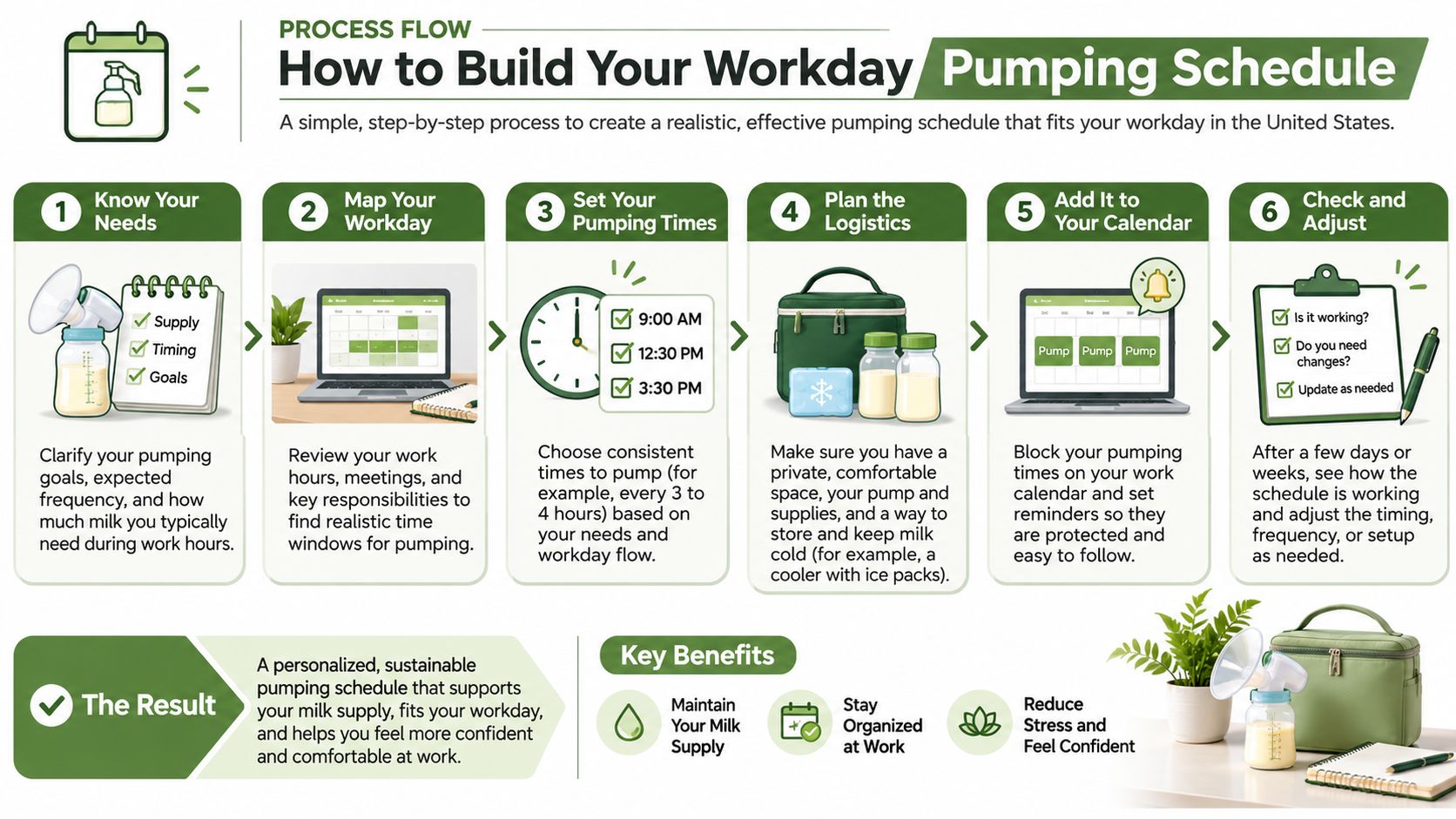
Six steps from feeding pattern to calendar
- Write down your baby's feeding times for a normal day at home, including the feeds before work and after pickup. Those two direct feeds anchor the rest, because your body will expect milk at those hours whether or not you're in the building.
- Estimate sessions from the gaps between feeds, then give each one a fixed start time. A baby who eats every three hours during the day points to three sessions in an eight-hour shift. A block labeled "pump, flexible" is the first thing a full calendar eats.
- Add a buffer after each block for travel, labeling, and storage. Ten to fifteen minutes covers the walk to the fridge, the date and time on the container, and washing your hands. Without it, the session runs over on paper every single day.
- Choose a backup room and a backup time for every block. Check that the alternate space is free at the hour you'd need it. A session with no fallback is the one that gets dropped when a meeting runs long.
- Pack a clean set of parts for each session you'll pump. One kit guarantees a rinse-and-hope moment by mid-afternoon. Two or three sets, or an approved steam-cleaning method on site, takes that decision off a busy day.
- Run the plan for three workdays, then fix whichever session slipped first. Adjust one block rather than rebuilding the whole schedule. You're looking for the block that keeps losing, not for a perfect week.
The rule I'd keep: if a session only happens when a meeting ends early, it isn't on the calendar yet.
A plan that works on paper shows every session with a time, a room, and a place for the milk. Then the record does the rest. Log actual start and end times, because a delayed session tells you more about your week than the planned one did, and a breast pumping log laid out that way makes the pattern visible within a few days.
Storage Limits and Milk Handling Routine
Storage limits decide the route home as much as the session decides the timing. The CDC's guidance on handling breast milk sets the windows below.
| Storage condition | CDC limit | Practical note |
|---|---|---|
| Room temperature, 77°F or colder | Up to 4 hours | Plan the route to a fridge or cooler inside this window |
| Refrigerated, 40°F or colder | Up to 4 days | Use the oldest milk first |
| Frozen, 0°F or colder | Best within 6 months; up to 12 months is acceptable | Label containers with the date expressed |
| Thawed, previously frozen milk kept in the refrigerator | Up to 1 day | Do not refreeze after thawing |
The 3:30 p.m. session and the four-hour clock
Say your last session of the day is at 3:30 and there's no fridge on your floor. The four-hour room-temperature limit means the milk has to be cold by 7:30 p.m. That sounds generous until you count the commute, the daycare pickup, and the stop for groceries. A cooler with frozen ice packs covers the gap, but only if the packs are still frozen when you pack it, which is a morning decision, not an afternoon one.
Freshly expressed milk and thawed milk run on different clocks, and thawed milk shouldn't be refrozen. That single rule changes how you rotate the stash: what comes out of the freezer on Monday is spoken for, so the fresh milk from Tuesday goes to the back of the fridge queue.
A handling routine any caregiver can follow
The CDC's guidance for returning to your workplace treats the trip from pump to baby as one loop rather than a series of separate tasks. The loop looks like this:
- Wash your hands before you touch parts or containers.
- Use clean, dry pump parts for the session.
- Label every container with the date and time, plus your child's name if the fridge is shared with other families.
- Refrigerate promptly or place it in an insulated cooler with frozen ice packs.
- Put refrigerated milk toward the back of the fridge, not in the door, where the temperature swings every time someone opens it.
- Take used parts home for washing, or use an approved steam-cleaning method if your workplace has one.
Milk can sit in the employee refrigerator alongside everyone's lunch. It isn't a biohazard, and treating it like one is how it ends up in a bag on your desk instead.
What to write down and what gets missed
The failures are predictable. Milk stored in the fridge door. Containers swapped between caregivers, so nobody knows which bottle is from Tuesday. A missed session that never gets recorded, leaving a supply question with no evidence behind it. And the assumption that one daily total explains a change, when the total hides three very different sessions.
Record these six things: start and end time, duration, side or mode, volume by container, cooler or refrigerator status, and when the baby was fed. Six fields answer almost every question a partner, nanny, or daycare will ask you at 6 p.m.
Reconciling what you sent with what your baby drank is the step most families skip, and it's the one that tells you whether tomorrow needs three sessions or two. For containers, thawing, and combining, this walkthrough on how to store pumped breast milk covers the handling details.
Any question about your baby's feeding or health belongs with a pediatrician or a lactation professional. Storage is logistics. Intake is clinical.
When Meetings or Missed Sessions Disrupt the Plan
The 1:00 session is on the calendar. The meeting that started at 12:30 is still going at 1:45, and the person running it has no idea your afternoon has a shape.
The situation is common enough to plan for:

Question the assumption underneath most scheduling advice, which is that a missed slot is a failure of discipline. A 2025 peer-reviewed study on breastfeeding and employment reports that inflexible schedules, short leave, stigma, and inconsistent caregiving remain barriers, and that few workplaces provide structured pumping breaks, so employees often fit pumping around meetings and tasks, potentially at the expense of health or milk supply, according to the study published in BMC Public Health. The plan that lasts isn't the strictest one. It's the one that knows what to do at 1:45.
Three responses, smallest first
- Shift the session to the next real gap. If your baby's next feed has room, moving a session by half an hour costs you very little. Move it earlier when you can, so the session behind it keeps its spacing.
- Rearrange the day's shape. When two sessions collapse into a shorter gap, a brief session plus a longer one later covers the day better than dropping one entirely.
- Use the backup block and the backup room. This is what they exist for. A badly disrupted day is not the day to improvise a storage plan in a supply closet.
Log the session you missed, including how late it ran. That entry is what lets a partner or daycare see whether a delay needs action tomorrow or reflects your baby's intake pattern this week. Without it, everyone is guessing.
When the room is the problem
An occupied room is a logistics problem, not a legal one. Find two alternate spaces before your first week and check they're free at the hours you'd need them. Carry a small kit with a cooler, spare containers, and cleaning supplies so a change of room doesn't end the session. Record the access failures as they happen, because a pattern of missed access is a conversation with HR, and the right to a private, functional space is separate from whatever booking system your building uses.
What to protect on a bad day: the next viable window, a clean kit, and a cold place for the milk. The clock can bend.
Asking for that leeway is mainstream. In a 2024 CDC survey of 4,339 respondents, 76.61% agreed that breastfeeding employees should be allowed flexible work schedules to feed their babies or pump breast milk, with 18.83% neither agreeing nor disagreeing, according to the CDC's public opinion data on breastfeeding.
If your output seems to drop across a week of disrupted sessions, take that to a pediatrician or a lactation professional rather than trying to solve it in a spreadsheet.
Share the Schedule With Caregivers Before Day One
Before your first workday back, agree on the session times and the log with everyone who handles your baby's day.
Send the sample timing and the storage limits to your partner, your nanny, your mother, and the daycare. Name who logs each session and where the milk goes, and the "did you pump, where's the bottle" texts stop arriving at the worst moment.
Cradlo keeps that record in one place: a shared baby tracker for families, nannies, and daycares where each caregiver logs under their own identity through a QR-code invite, with no shared login. The AI coach drafts daycare summaries, predicts nap windows, and fills gaps when a caregiver forgets to log, and the app starts with a 7-day free trial on the monthly plan. A day care summary written once in the evening saves repeating the same story three times.
If a grandparent or nanny reads Spanish more comfortably than English, write the shared plan and the log in the language they'll use at 4 p.m.
Then set a check-in at the end of the first week, with one question: which session slipped, and why? Feeding and health questions still belong with a pediatrician or lactation professional, not with the group chat.
Cradlo puts your pumping sessions, milk status, and bottle handoffs on one shared timeline, so your partner, nanny, grandparent, and daycare all see the same day without asking you to repeat it. Invite each caregiver with their own QR code and the record stays clear, in English or Spanish, on iPhone, Android, or the web. Start the 7-day free trial on the monthly plan at Cradlo and give next Monday's schedule something to hold onto.