2 Week Old Sleep Schedule: Why It Looks Random
You've just finished a feed, changed a diaper, and settled your baby, only to wonder whether the next wake-up counts as morning or still part of the night. A 2 week old sleep schedule is better understood as a pattern of sleep and wake periods than a bedtime, even though many parents arrive expecting a clock their newborn doesn't yet have.
You don't need to turn those scattered moments into a tidy timetable. A more useful starting point is noticing how feeds, brief awake periods, and sleep fit together, then making those details easy for the next caregiver to find.
Table of Contents
- Realistic Sleep Windows for a Two-Week-Old
- Why Sleep Looks Scattered at Two Weeks
- A Flexible Sample Day That Bends With Your Baby
- Feeding, Waking and When to Call the Pediatrician
- Safe Sleep for Every Nap and Night
- Start One Shared Sleep Log Before Tonight
Realistic Sleep Windows for a Two-Week-Old
A newborn sleep schedule describes what's happening, not what your baby should accomplish. The reference values below come from a peer-reviewed review of early circadian development, which describes about 16–17 hours of sleep in a 24-hour period and sleep occurring in intervals of about 4 hours around this age.
Typical sleep measures at two weeks
| Measure | Typical at two weeks | What it means for planning |
|---|---|---|
| Total sleep in 24 hours | About 16–17 hours on average | Sleep is spread across day and night |
| Interval between sleep periods | About 4 hours | Expect several sleep-wake cycles each day |
| Day-night rhythm | Not yet established | Track patterns, not a fixed bedtime |
| Individual variation | Babies may sleep more or less | Compare your baby with their own pattern |
Total sleep includes every sleep period across the whole day, not just nighttime. A parent who remembers a restless night may overlook the sleep that happened between daytime feeds.
The interval between sleep periods describes a broad pattern of recurring sleep and waking. It isn't a recommended awake window, a promise of uninterrupted sleep, or permission to delay a feed.
An unsettled day-night rhythm means you can't yet organize the day around a dependable bedtime. Your baby may finish feeding, need a diaper change, have a brief fussy stretch, and be ready for sleep without much separate playtime.
Individual variation matters because an average isn't a daily requirement. Some babies sleep more and others less, and a total alone can't tell you whether feeding or health needs are being met.
Record what happens without grading it
For three days, record when sleep starts and ends, then total each day's entries. This is an observation exercise, not a reason to wait if you're concerned about your baby.
Keep feeding context beside the sleep entries. For example, noting that your baby woke, fed, needed changing, and settled again tells you more than labeling the whole stretch a difficult nap.
Practical rule: Use a sleep chart to describe your baby's day, not to decide whether you're doing a good job.
Compare the totals with the reference range gently, and look at your baby's own pattern rather than chasing an exact number. A persistent concern belongs with a pediatrician, not with a sleep chart.
Why Sleep Looks Scattered at Two Weeks
After a feed, your baby may sleep briefly, wake for a diaper change, then seem ready to feed again. That uneven sequence is common at two weeks. Sleep follows repeated cycles of feeding, waking, and settling more than a dependable clock-based schedule.
A longitudinal infant study indexed by PubMed found that temperature rhythm became statistically significant within the first week. Wake rhythm reached significance around day 45, while sleep rhythm appeared after day 56. These findings describe developing patterns across a group; they do not set a date when an individual baby should sleep through the night.
When early body rhythms usually appear
| Rhythm | Reported timing | Planning meaning |
|---|---|---|
| Temperature rhythm | Statistically significant within the first week | A measurable rhythm does not set bedtime |
| Wake rhythm | About day 45 | Daytime waking may not yet follow a regular pattern |
| Sleep rhythm | After day 56 | A stable night-sleep pattern may still be developing |
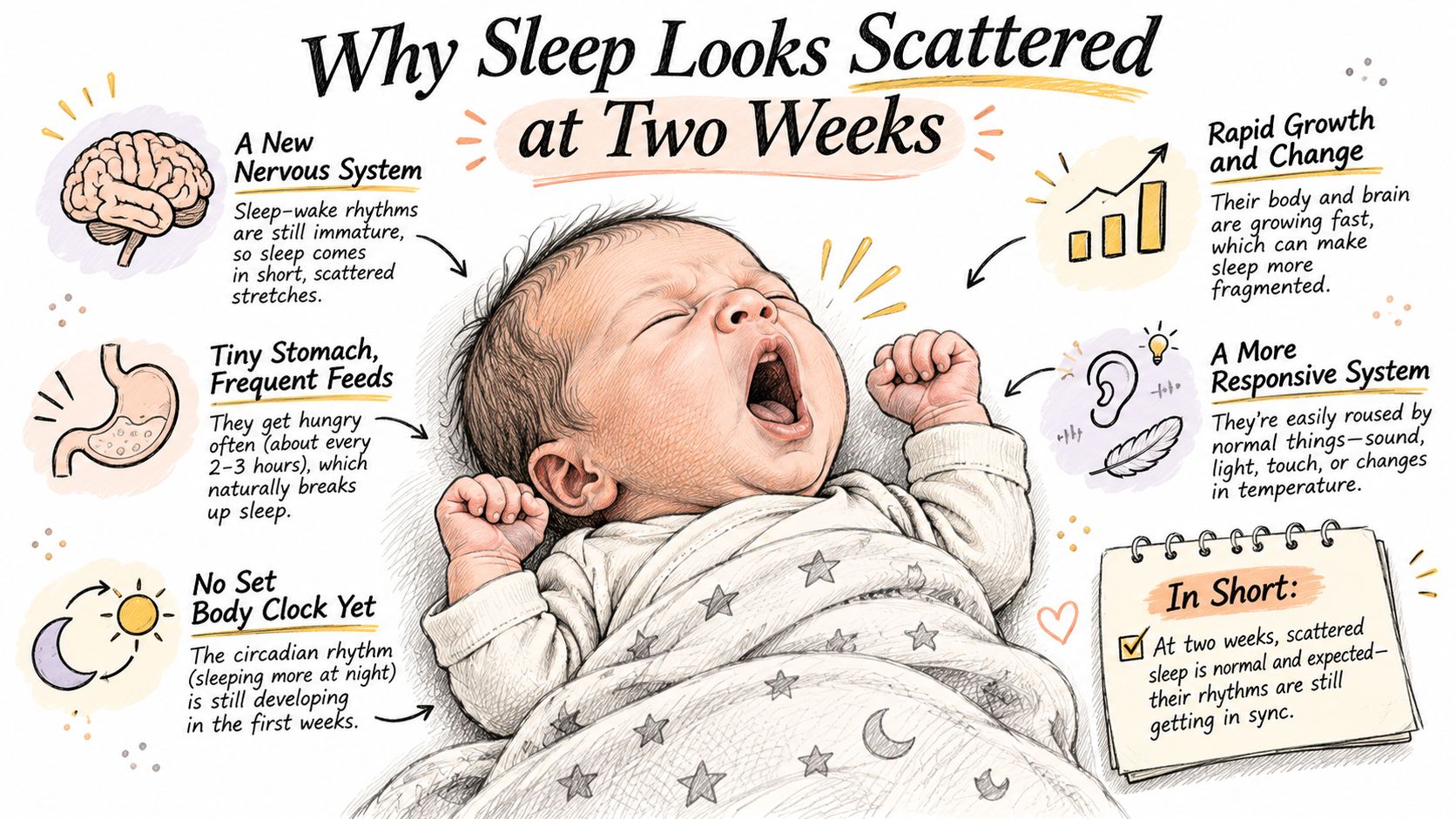
An early body rhythm is not the same as a reliable bedtime. At this age, a baby's sleep can be scattered across day and night, with feeding and waking shaping each stretch.
An irregular pattern at two weeks is a developmental stage, not a failed routine.
Observe rather than train
Use each sleep period as part of a repeating sequence, not as a cue to start the day at a fixed hour. Notice what tends to happen before your baby settles and what follows waking. A shared log can help parents and caregivers see that sequence instead of guessing from memory.
For broader context, read about how many hours babies sleep. The range changes with age, and it is not a timetable a newborn needs to meet.
A relative's baby may have developed a recognizable nighttime pattern earlier or later. Each baby's pattern differs, and your clinician's feeding instructions take priority over generalized milestones.
A Flexible Sample Day That Bends With Your Baby
Adapt each row to your baby before using this template. Start wherever your baby is in the sequence, rather than choosing a morning start time and trying to make everything fit.
A sample day in blocks, with ways to flex each one
| Block | What usually happens | How to flex it |
|---|---|---|
| Waking and first feed | Feeding on hunger cues, followed by burping and a diaper change as needed | Follow cues and the clinician's feeding plan rather than the clock |
| Short awake period | Brief alert time, sometimes with eye contact or fussiness | Watch for yawning, staring, or reduced engagement |
| Sleep block | A short or longer stretch within a recurring sleep-wake pattern | Don't reset the whole day around one stretch or treat spacing as a feeding target |
| Daytime light and activity | Brief awake time in natural daylight | Keep voices and lights low during overnight care |
| Evening stretch | Clustered feeding and fussiness can arrive | Pass feed and sleep details to the next caregiver |
The sequence is a planning aid, not a requirement to complete every activity. Your baby doesn't need to stay awake for interaction just because a template includes an awake block.
A polysomnography study of early infant sleep describes rapidly developing sleep organization in the early weeks. For everyday care, watching cues and repeated feed-wake-sleep sequences is more useful than enforcing set nap times.
Let cues reshape the next block
Begin with waking and feeding needs. Once feeding, burping, and diapering are finished, your baby may have some quiet alert time, or may already be showing signs that they're ready to settle.
If your baby looks away, stares, yawns, or becomes fussy, reduce stimulation rather than trying to complete a planned activity. Those observations are useful to record, but they aren't a diagnosis of why a baby is unsettled.
During daytime awake moments, ordinary natural light can help distinguish the surroundings from nighttime care. Overnight, use enough light to care for your baby safely while keeping conversation and activity quiet.
A longer sleep stretch doesn't automatically mean something is wrong, and a shorter one doesn't mean your baby is off schedule. Neither observation overrides a feeding plan or settles a question about health.
Make the evening handoff concrete
Say a partner is taking over after an unsettled evening. Instead of asking the resting caregiver to reconstruct everything, they should be able to see the last feed, the most recent sleep period, and any unfinished care task without disturbing the baby.
At the end of the day, ask:
- Feeding: Did the baby feed as expected under their feeding plan?
- Sleep: Were sleep periods recorded, including the brief ones?
- Handoff: Can the next caregiver understand what happened without guessing?
These questions help organize care without turning the day into a performance score.
Feeding, Waking and When to Call the Pediatrician
Waking to feed is normal, and long uninterrupted nights aren't a scheduling target at this age. According to Ireland's Health Service Executive guidance for newborn sleep, newborns may sleep only 1–3 hours between feeds, and a cot in the caregiver's room is the safest sleeping location.
That makes feeding context central to understanding a sleepy day. A sleep total can't answer whether your particular baby should be awakened, whether milk intake is adequate, or whether weight gain is on track.
Bring specific questions to the conversation
Ask your pediatrician or a lactation professional:
- Waking for feeds: Does this baby need to be awakened, and what feeding plan should every caregiver follow?
- Weight gain: Is their growth progressing as expected?
- Diaper output: What should we watch for with this baby's feeding situation?
- Feeding effectiveness: What observations would help you assess how feeds are going?
These questions are more useful than asking whether a sleep pattern is good or bad. They connect what you're seeing at home with the information a clinician needs.
The distinction between ordinary sleepiness and difficulty feeding deserves individual attention. Our discussion of whether a newborn sleeps too much can help you organize questions, but it can't assess your baby.
Describe concerns plainly
Contact your pediatrician when your baby is unusually hard to wake for feeds, repeatedly misses feeds, or has diaper output that seems low. Describe what changed and what you observed rather than trying to name the cause.
If your baby seems unusually unresponsive or you think something is urgently wrong, use your local emergency or urgent-care pathway. Don't wait to complete a log or compare a sleep total.
For the clinician conversation: Bring sleep start and end times, feeds, diapers, and the identity of the caregiver who recorded each event.
A clear summary can reduce the work of remembering events while you're tired. Spanish-speaking families can ask the pediatric office about interpreter support before the visit so questions and instructions are understood.
Keeping your baby nearby on a separate sleep surface supports responding to feeds. Room-sharing is a caregiving arrangement, not a bedtime.
If your pediatrician or lactation professional has already said to wake this baby for feeds, that instruction outranks the sample day. This framework is educational and doesn't replace individualized medical advice.
Safe Sleep for Every Nap and Night
The sleep environment is the part of the routine that stays consistent, even when sleep timing changes. A brief nap and a longer nighttime stretch use the same setup.
The NIH Safe to Sleep recommendations, drawing on American Academy of Pediatrics guidance, recommend placing babies on their backs for all sleep until age one, including babies born preterm or with reflux. The guidance also calls for a firm, flat, level sleep surface covered only by a fitted sheet.
Use the same checklist every time
- Position: Place your baby on their back for every nap and nighttime sleep.
- Surface: Use a separate, firm, flat, level infant sleep surface.
- Bedding: Cover the mattress only with its fitted sheet.
- Clear space: Keep pillows, loose blankets, toys, and other loose items out.
- Consistency: Don't use side or stomach sleeping as an alternative for a short nap.
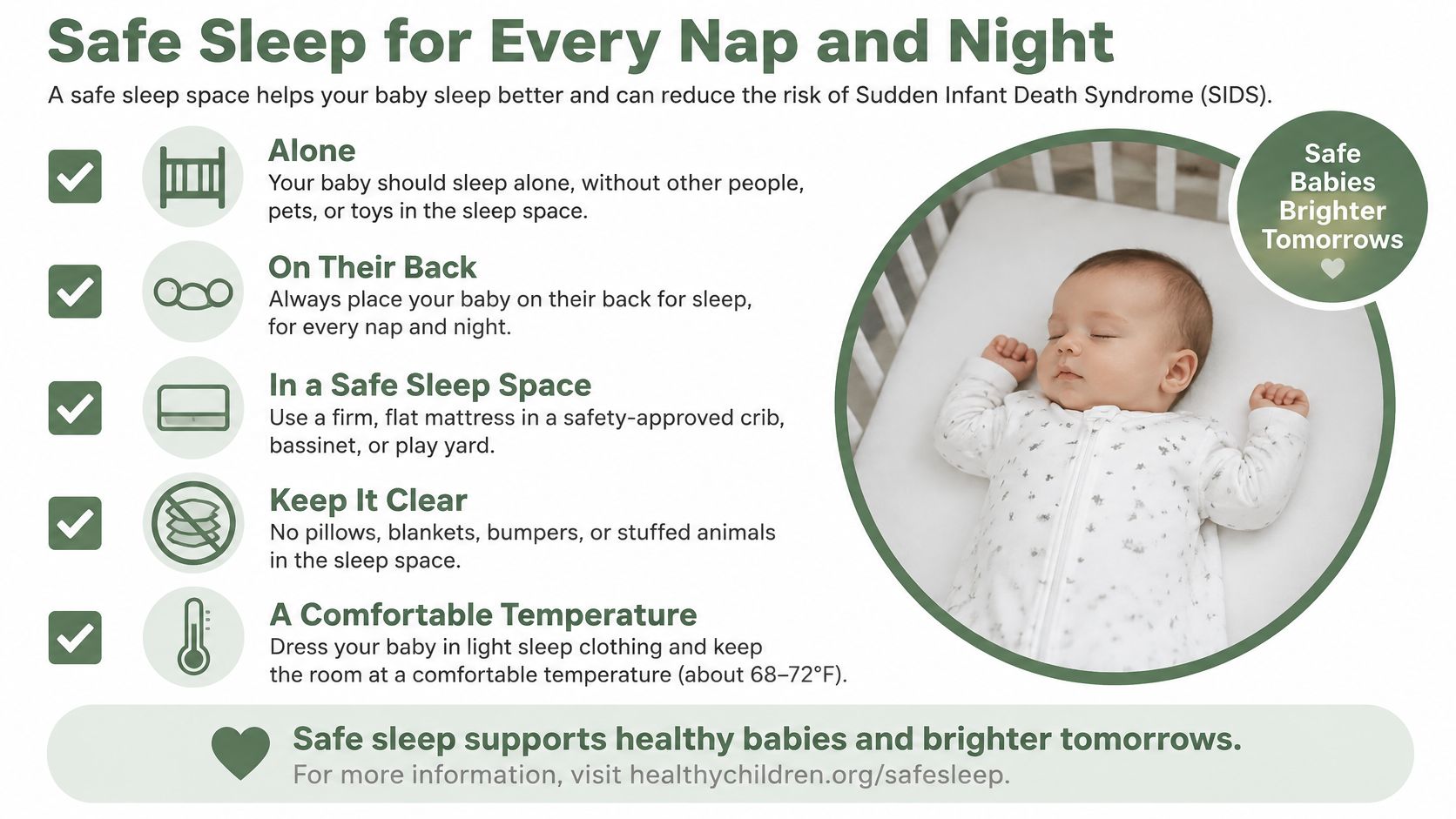
A sofa, car seat, or bouncer isn't a substitute for the appropriate flat sleep surface. When your baby falls asleep in a sitting device outside travel, move them to their designated sleep space rather than treating the device as the nap location.
These are sleep-environment rules, not instructions to make naps longer or establish an earlier bedtime. You can respond flexibly to your baby while keeping the sleep setup unchanged.
Write the arrangement into caregiver instructions
Parents, partners, grandparents, nannies, and daycare staff should all receive the same instructions. Don't assume that someone who has cared for babies before knows which setup your household uses.
Use a short handoff phrase: back, flat, fitted sheet, nothing else. Then show the caregiver the actual sleep space so the phrase connects to a concrete arrangement.
Include the sleep environment in shared care instructions alongside feeding information and contact details. That way, a caregiver arriving for an evening shift doesn't have to decide whether a different setup is acceptable.
Consistency here isn't about being a more organized parent. It's about making the established safe-sleep guidance easy for everyone to follow, including when they're tired.
Start One Shared Sleep Log Before Tonight
At two in the morning, one parent may be trying to remember the last feed while the other wonders whether it already happened. A shared timeline gives each caregiver the same record, so the next handoff starts with what was logged rather than a guess.
Cradlo started at 2am, over repeated texts between two tired parents asking whether the other had already fed the baby. It is a shared baby and child care tracker where parents and invited caregivers log sleep, feeds, diapers, growth, and health events. Every feed, nap, and diaper logged by any caregiver appears instantly for everyone. Daycare can bookmark one browser link on an iPad, with its logs flowing to the parent's phone in real time. New users get a 7-day free trial before choosing Plus monthly, Plus yearly, or Lifetime.

Keep the logging routine small
- Choose one timeline before the night shift starts. Separate notes and messages make it harder to see the pattern.
- Record care as it happens. Log sleep, feeds, and diapers, with the caregiver identified. A baby feeding log template can help organize feeding details.
- Review after a few days. Look at sleep periods and feed timing as a record of your baby's changing pattern, not a score or a strict schedule.
- Bring questions to a professional. Share concerns about waking, weight, or diaper output with your pediatrician or lactation professional.
A log can help caregivers stay on the same page, but it cannot determine whether a baby is medically well. Before the next handoff, enter the most recent sleep periods and feeds so the person taking over knows what has happened.
Cradlo gives parents and invited caregivers one shared place to log a newborn's sleep, feeds, and diapers. Start with the next handoff, and use the entries to follow your baby's pattern without trying to make the day fit a clock.