Feeding Schedule for 9 Month Old: What to Offer and When
It's twenty past six. There's avocado on the wall, three peas on the tray, and a baby reaching for something you can't identify. Your mother-in-law texts to ask whether she ate. Your partner asks the same thing ten minutes later. You're fairly sure lunch happened, but you can't remember what went into it or how much of it went in, and the question lands like a small failure.
That's not a feeding problem. It's a record-keeping problem, and it appears the moment more than one person feeds the baby. The feeding schedule for a 9 month old is less about exact ounces and clock times than about a rhythm several people can recognize and follow on a tired Tuesday.
What follows is the version worth building: the reference numbers you can plan around, a sample day that bends, and the handoff habits that keep a grandparent, a nanny and a daycare teacher doing roughly the same thing you do.
Table of Contents
- Milk and Meal Targets at Nine Months
- A Flexible Sample Day You Can Adapt
- Building Iron and Safe Textures Into Every Meal
- Reading Hunger and Fullness Cues Instead of the Clock
- Keeping Parents, Caregivers and Daycare on One Schedule
- When Eating Drops Off or a Baby Refuses Food
- Start the Routine This Week and Review It
Milk and Meal Targets at Nine Months
Nine months is when feeding starts to feel like a shared family activity rather than something you do to a baby. Before you plan a single day, it helps to know the reference points. The World Health Organization's complementary feeding guidance recommends introducing complementary foods at about 6 months, or roughly 180 days, while breastfeeding continues, and it raises meal frequency as the baby grows. For infants aged 6 to 8 months the recommended frequency is 2 to 3 meals daily; from 9 to 11 months it increases to 3 to 4 meals daily.
| Element | 9-month reference | What it means in practice |
|---|---|---|
| Solid meals | 3 to 4 meals daily | Breakfast, lunch and dinner, with an optional fourth meal or snack |
| Portion reference | About one-half of a 250 mL cup or bowl per meal (about 125 mL when fully eaten) | Appetite sets the real amount, which varies from meal to meal |
| Optional snacks | 1 to 2 nutritious snacks | Offer only when the baby seems hungry between meals |
| Milk feeds | Continue alongside solids | Breast milk or iron-fortified formula, with the amount set by the baby's needs |
| Textures | Finely chopped, mashed or soft pieces the baby can pick up | No honey before 12 months |
What Each Row Looks Like on a Real Day
The anchor meals are breakfast, lunch and dinner, and they work best when they land near the times the adults in the house already eat. The fourth opportunity is the flexible one. It can be a small meal in the late afternoon or a snack mid morning, and it can vanish entirely on a day when a nap runs long. Nothing about the routine breaks when that slot moves.
Snacks are the row parents overthink. They're optional. Offer one when the baby seems hungry between meals, and skip it when the baby is content, because a snack nobody needed tends to displace the milk feed that follows it.
Milk keeps its place in the day. Solids at this age sit alongside breast milk or iron-fortified formula rather than replacing it, so a day of big meals with steady milk feeds is not better than a day of lighter meals with the same milk. Textures do the developmental work now. Food should mash between your thumb and forefinger, and pieces should be small enough for a thumb and finger to pick up.
Practical rule: Judge the week, not the meal. A baby who picks at lunch and eats well at dinner is on track.
The takeaway for this age is to match the pattern rather than an ounce count. A schedule is doing its job when the baby gets regular chances to eat, manages the texture, and keeps taking milk, even if one afternoon looks nothing like the plan you wrote down.
A Flexible Sample Day You Can Adapt
Say your baby wakes near 7, naps twice, and is asleep for the night around 7:30. Here's the shape of a day that bends without breaking.
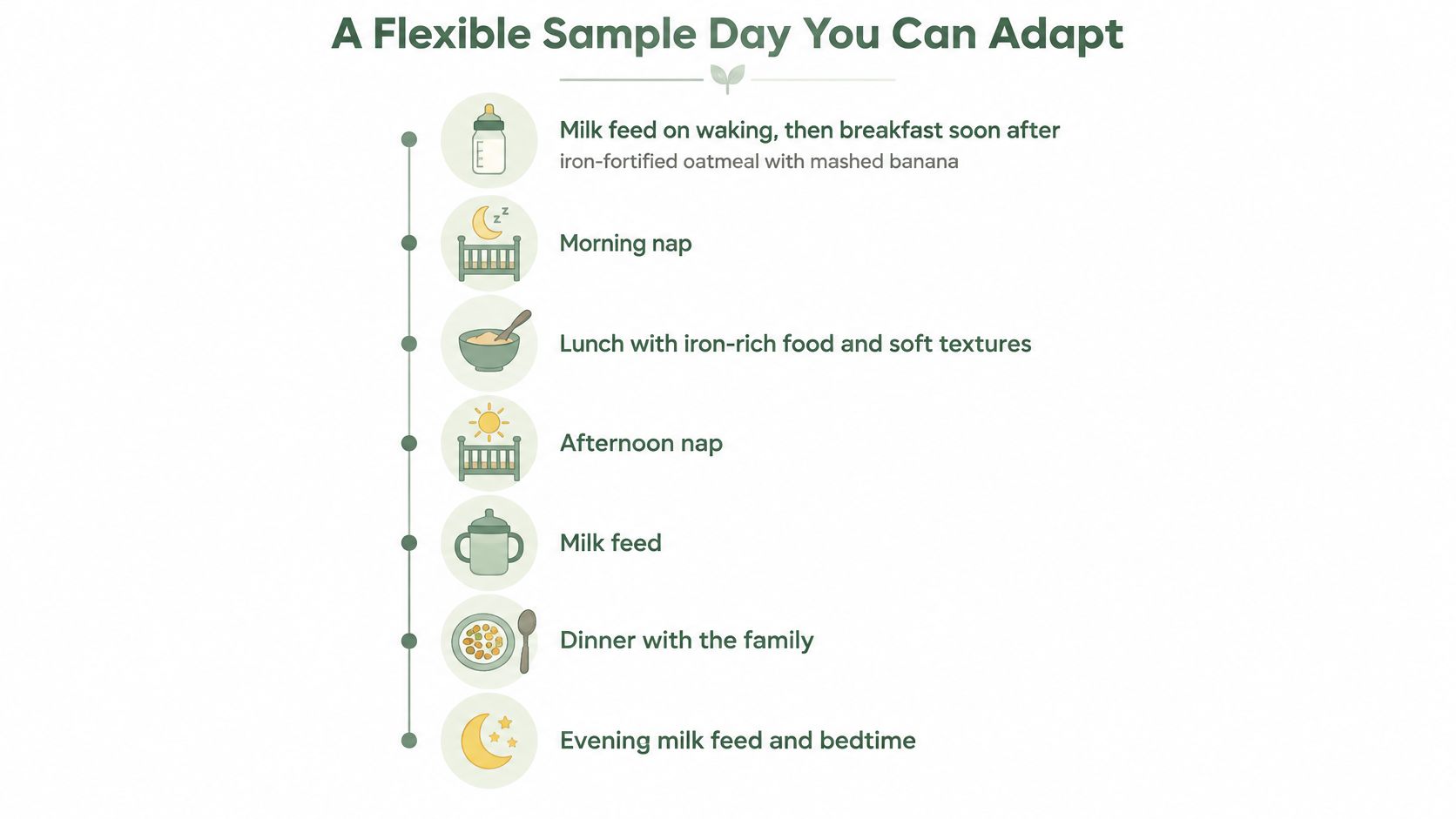
The first milk feed happens on waking, before anyone has found socks. Breakfast follows soon after, close enough that the baby is still interested: iron-fortified oatmeal loosened with expressed milk or formula, mashed banana stirred through, and a few soft pieces of banana on the tray to grab.
The morning nap comes next, and the milk feed lands either before sleep or after waking, whichever your baby prefers. Some babies nurse better in a quiet room beforehand. Others want it the moment they open their eyes. Both work, and neither is a habit you're creating.
Lunch around midday looks like shredded chicken soft enough to pull apart, mashed sweet potato, and peas cooked until they squash under a fork. Then the afternoon nap, and afterwards an optional snack if the baby seems hungry: soft pear, a strip of soft toast, a few pieces of ripe avocado.
Dinner arrives in the early evening, at the table with everyone else where that's possible. Lentils cooked down with a little tomato, soft rice, steamed carrot sticks. Then a milk feed before bed, and whatever overnight feeds your baby still wants.
The Same Rhythm With Different Hands
That sequence survives a change of caregiver. On a day with a nanny, the nanny offers the same kinds of food in the same order and logs what went in. On a daycare day, the teachers run their own version of it and send back what was eaten, which you fold into the evening rather than trying to reconstruct the whole day from memory. The food can change. The order shouldn't.
Familiar Food, Familiar Words
In Spanish-speaking households, the anchors are desayuno, almuerzo and cena, and the iron-rich rotation may look like mashed frijoles, soft plantain, well-cooked egg, or shredded chicken from a family pot. A baby doesn't need a separate menu. A lightly mashed version of what the household already eats, minus the salt and the choking hazards, does the job and keeps the routine familiar to everyone at the table.
The order matters more than the exact minute. A day with a skipped snack, a late lunch and a short nap is still a day on track.
Building Iron and Safe Textures Into Every Meal
Of everything that lands on the tray, iron deserves the most planning. The American Academy of Pediatrics guidance for the 9-month health supervision visit reports that complementary foods fail to meet iron requirements for more than 50% of U.S. infants and for more than 95% of breastfed infants, and notes that clinicians may continue iron supplementation at 1 mg/kg/day when dietary intake is inadequate. Supplement decisions belong to your pediatrician. The meal plan is still yours to shape.
One Iron Food Per Meal, Every Meal
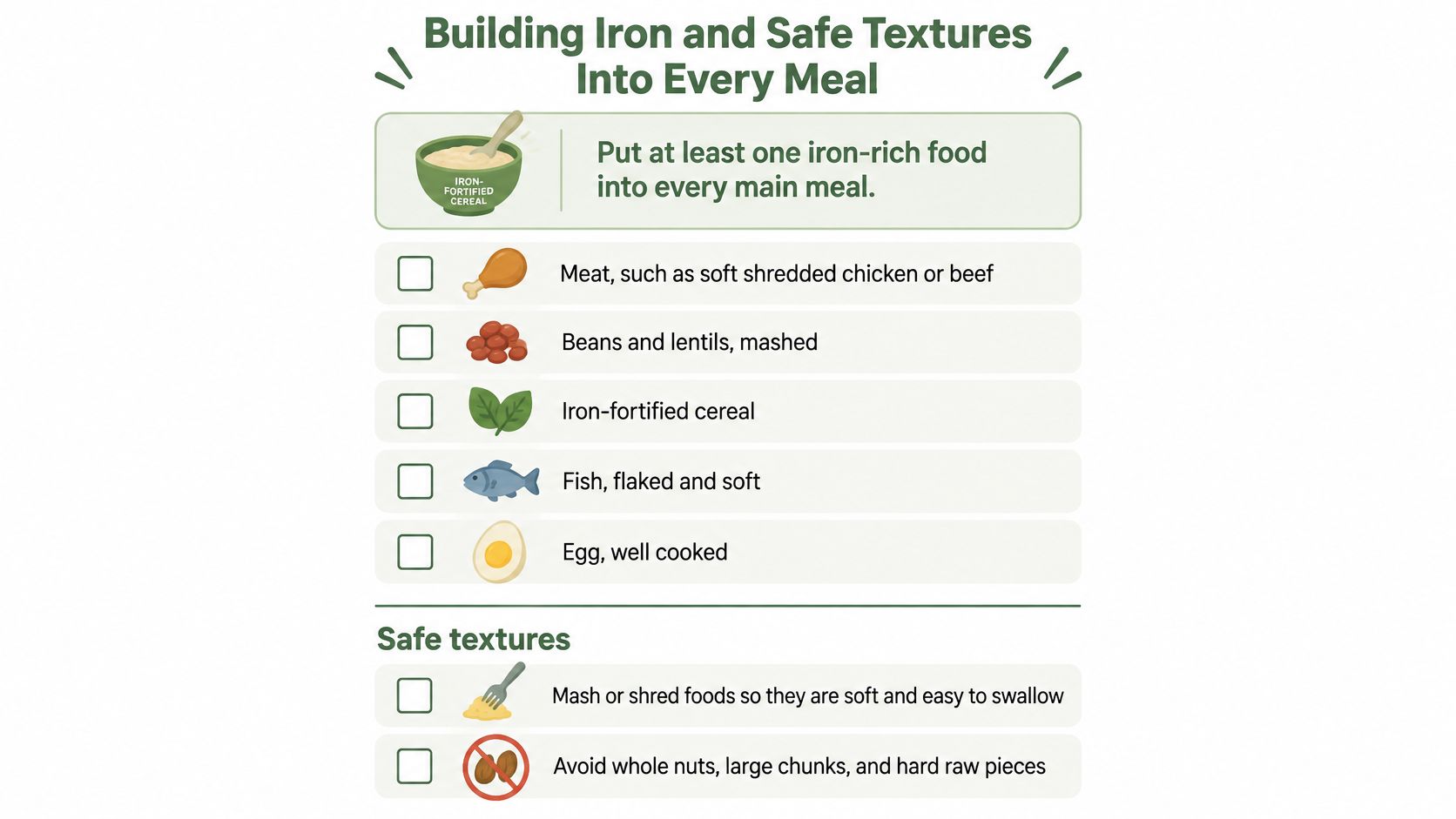
Build a single iron-rich food into each main meal: meat, poultry, fish, iron-fortified infant cereal, beans, lentils, tofu, or egg. Pair plant sources with vitamin-C-rich produce, such as berries, tomato or bell pepper, to improve absorption of non-heme iron. A workable pattern puts fortified cereal or egg at breakfast, beans or shredded meat at lunch, and fish, poultry, tofu or lentils at dinner. If your baby wants to do the work themselves, baby-led weaning meals follow the same iron-first rule with soft strips instead of spoonfuls.
The Four-Point Check Before Every Meal
- Iron present. One iron-rich food is on the tray, not planned for later.
- Texture soft. It mashes under thumb pressure and pulls apart without a knife.
- Size safe. Pieces are small enough to pass a pincer grip, and there are no whole nuts, hard raw vegetables or whole grapes.
- Milk planned. You know when the next breast or formula feed lands, so the meal and the feed aren't competing.
Run that check in your head while you're plating, and the rest of the meal tends to look after itself.
Reading Hunger and Fullness Cues Instead of the Clock
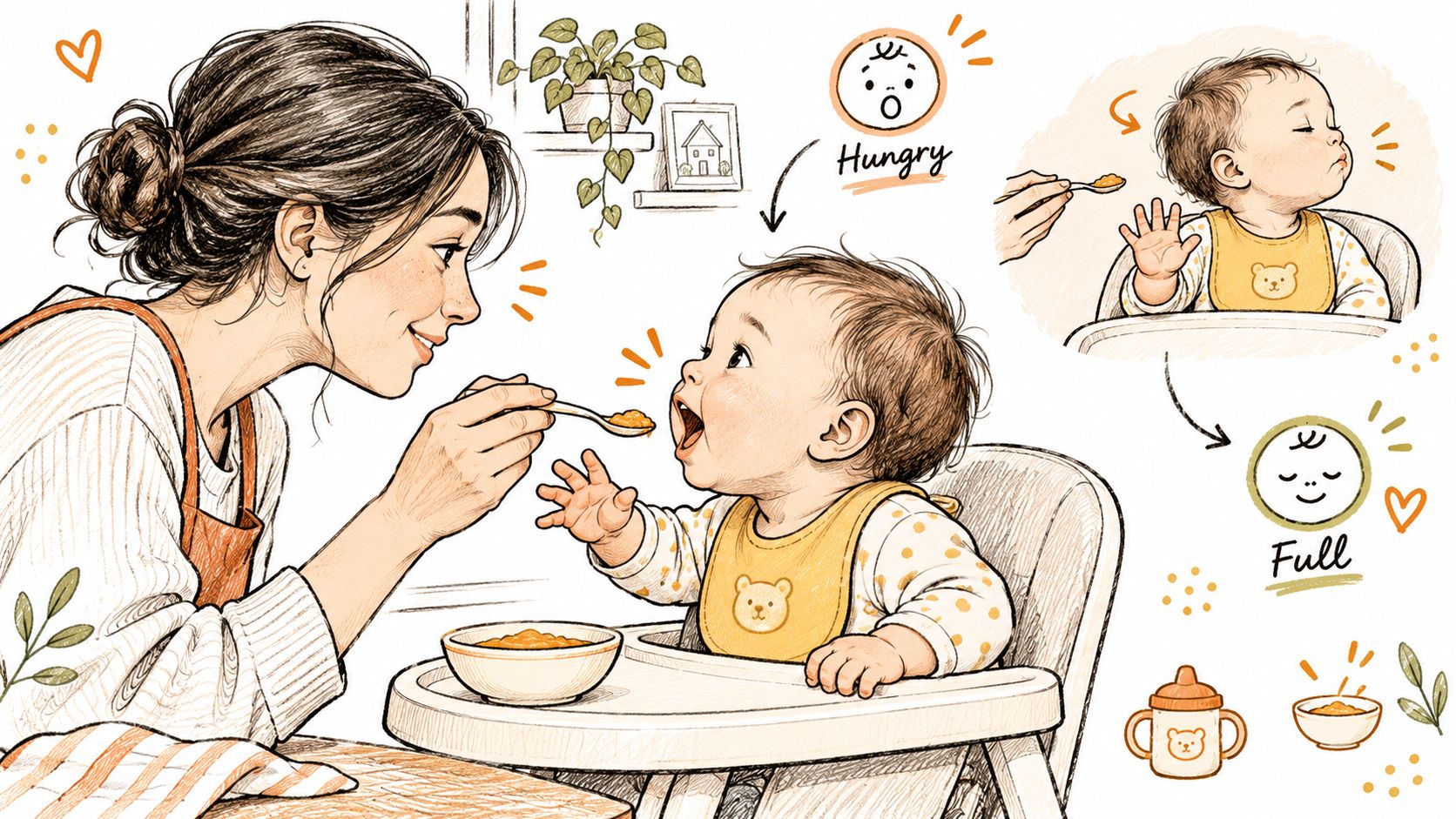
At lunch, the baby reaches toward the spoon, then turns away after a few bites. A flexible routine leaves room to respond to both signals. The World Health Organization's answers on child health and development describe responsive feeding as following an infant's appetite while amounts and meal frequency increase gradually as the child grows. Keep offering breastfeeds, and let the baby's cues guide how much they eat rather than aiming for a fixed portion. Snacks are optional: offer one when the baby seems hungry between meals, not because the clock says it is time.
Hunger Cues Worth Answering
- Reaching for the spoon or opening the mouth as food approaches.
- Leaning forward in the high chair and watching the plate.
- Settling and quieting when food arrives, which can signal interest in eating.
Fullness Cues That Mean Pause
- Turning away, closing the mouth, or batting the spoon.
- Slowing down, or holding food without bringing it to the mouth.
- Losing interest in favor of the tray, the dog, or the ceiling fan.
Your role is to decide what and when to offer; the baby's cues help show whether to continue. Pause when interest fades, and let the meal end without coaxing another bite. This keeps the routine responsive while still giving caregivers a clear, consistent approach.
One lighter meal does not establish a pattern. Appetite can vary from one meal to another, so consider what you observe across several days rather than judging by a single plate. A simple log can help: note the time, food or milk offered, approximate amount, and the baby's response. Reviewing infant feeding patterns can help caregivers compare observations instead of relying on memory, especially when more than one person shares feeding duties.
The habit to practice: Offer, watch, pause. Offer the food, watch the face and hands, then pause before the next spoonful.
Keeping Parents, Caregivers and Daycare on One Schedule
Tuesday morning, you hand the baby to your mother at 8:15 and say, "She had a bottle at seven but no breakfast yet." By 8:20 she's texting to ask how much of a bottle, whether it was formula, and whether the baby seemed hungry after. Multiply that by a nanny, a partner and a daycare teacher and you have the reason schedules fall apart. It isn't the food. It's the handoff.
Milk doesn't have to leave the picture to make room for this. Breast milk can continue alongside complementary foods after 6 months, and the WHO's infant and young child feeding fact sheet describes breastfeeding as continuing up to 2 years or beyond while appropriate solid foods are introduced. For a 9-month-old, that means the routine doesn't need to replace nursing sessions with a rigid solids timetable. Families using formula, combination feeding or expressed milk may want an individualized plan for volume and timing, and questions about whether a baby is taking enough milk belong with a pediatrician or lactation professional.
Where a Feeding Schedule for 9 Month Olds Usually Breaks
The break almost always happens at a transition: a nanny arriving mid morning, a grandparent taking over after a nap, a daycare drop-off right when breakfast would normally land. Each person has a partial picture and no easy way to fill it in.
That's the gap Cradlo fills. It's a shared baby and child care tracker where every feed, nap and diaper logged by any caregiver shows up instantly for everyone, so nobody has to ask who did the last bottle. Daycare uses one browser link that they bookmark on their iPad, and their logs flow to the parent's phone in real time, with no install and no shared login.
The handoff in three lines: the last meal, the next expected offer, and the cues you saw.
If you want a structure to copy, a daycare daily report template gives you the fields worth keeping. Whichever format you use, the point is a calm handoff, not a scoreboard. Nobody needs a performance rating on how much oatmeal a baby ate at 9:40.
When Eating Drops Off or a Baby Refuses Food
Most dips in appetite don't need a new schedule. They need a few days of patience and someone watching the trend. A baby who eats very little at several meals in a row, refuses most solids, or seems to take less milk is usually going through something ordinary: a tooth, a low-grade bug, a new daycare room, a growth stretch where milk matters more again.
Breastfeeding on unpredictable timing complicates the picture, because there's no ounce count to check. That's where the log earns its keep. For a few days, note what was offered, what was eaten, how milk feeds went, and how the baby seemed afterwards.
A gentle first step beats a new plan. Offer the same food again later in the week without pressure, keep the milk feeds going, and resist the urge to replace a refused meal with a favorite snack, which teaches the routine to wait out the lentils. Teething and illness stretches pass. So does the week after a new daycare start.
Signs to Bring to a Pediatrician Sooner
- Slow or stalled weight gain, or a growth curve that has changed direction.
- Signs of dehydration, such as fewer wet diapers, a dry mouth, or crying without tears.
- Vomiting, ongoing diarrhea, or distress during feeds.
- Refusal that lasts well beyond a week or comes with lethargy.
The difference between one hard day and a pattern worth discussing is usually duration plus growth. One rough afternoon with a sore gum is normal. Ten days of little interest in food, or a baby who seems unwell alongside it, is a reason to call. Most variation is normal, and a question is always a good enough reason to ring the pediatrician or a lactation professional. Nothing here replaces the individual advice they can give you about your baby's growth and hydration.
Start the Routine This Week and Review It
Keep the change small. Add one solid meal, or an optional fourth opportunity if three are already steady, while leaving milk feeds where they are. At each meal, offer food, watch your baby's cues, and pause when needed.
After several days, review the routine with the other caregivers. Cradlo lets parents and invited caregivers log sleep, feeds, diapers, growth, and health events in a shared tracker, so everyone can check the same timeline instead of piecing together group texts. Every entry appears for everyone in real time. There's a 7-day free trial, then Plus at $4.99/month or $49.99/year, or Lifetime at $99.99 one time, so you can test whether a shared log fits your household before committing.
If the review raises a concern, bring the log to your pediatrician. A week of entries can make it easier to discuss what was offered and how the routine went.
Before the dishes tonight, choose the first meal to add or shift. Write down the food, a time window, and who will offer it, then share that plan with the other caregivers. Keep it simple, and adjust together as you see how the routine works.
A shared view can help partners, grandparents, nannies, and daycare stay aligned without relying on memory. Start a 7-day free trial at Cradlo and log the first meal together tonight.