12 Month Sleep Regression: Why Nights Shift and What Helps
Your baby had been sleeping comfortably, and now you're back beside the crib in the middle of the night. The afternoon nap has shortened, bedtime takes longer, and different caregivers have different theories about what changed.
The 12 month sleep regression is a familiar name for this experience, but it doesn't explain every waking. Before tightening the schedule, start with shared observation: what happened, when it happened, and how your child seemed afterward. You haven't failed, and you don't need to solve the whole pattern tonight.
Table of Contents
- What the 12 Month Sleep Regression Is and Isn't
- Teething, Separation Anxiety and Milestones as Causes
- Telling a Normal Dip From Something to Check
- How to Track One Week Across Every Caregiver
- Telling Refusal From Readiness
- Soothing Steps and Sample Routines That Hold Up
- Agree on One Response Plan and Start Tracking
What the 12 Month Sleep Regression Is and Isn't
A baby who slept well for weeks may suddenly need reassurance overnight, while naps become shorter or harder to start. Caregivers often use sleep regression as shorthand for this cluster of changes around the first birthday.
It isn't a formal medical diagnosis or an event every child experiences on a set schedule. More waking, resisted naps, and bedtime protests describe what caregivers observe; they don't, by themselves, explain why it is happening.
Sleep develops gradually, not by birthday
Longitudinal studies describe a general shift toward more consolidated nighttime sleep and less daytime sleep. Children can still have unsettled nights, and sleep patterns vary among children of the same age.
Typical sleep measures at 3 months and 12 months
| Measure | Around 3 months | Around 12 months |
|---|---|---|
| Median nighttime sleep | 9.9 hours (longitudinal infant sleep study using actigraphy) | 10.6 hours (longitudinal infant sleep study using actigraphy) |
| Average daytime sleep | About 200 minutes (separate longitudinal study of infant sleep development) | 121 minutes (separate longitudinal study of infant sleep development) |
| Total daily sleep | 766 minutes, or 12.8 hours (separate longitudinal study of infant sleep development) | 710 minutes, or 11.8 hours (separate longitudinal study of infant sleep development) |
These figures come from different studies and describe observed sleep, not a schedule every child should follow. Recommended sleep ranges answer a separate question: the American Academy of Pediatrics sleep document gives 12 to 16 hours, including naps, for ages 4 to 12 months, and 11 to 14 hours for ages 1 to 2 years. An observed average is not automatically a target.
Missouri's Early Connections sleep guidance describes about two daytime naps at 9–12 months. Nap resistance alone doesn't mean daytime sleep should disappear.
Use these ranges as context, not as a reason to tighten the schedule first. A shared record of sleep over a week can help caregivers compare the child's pattern with their recent baseline, including daytime behavior and changes in naps or nights. That picture is more useful than expecting sleep to change on a birthday.
Teething, Separation Anxiety and Milestones as Causes
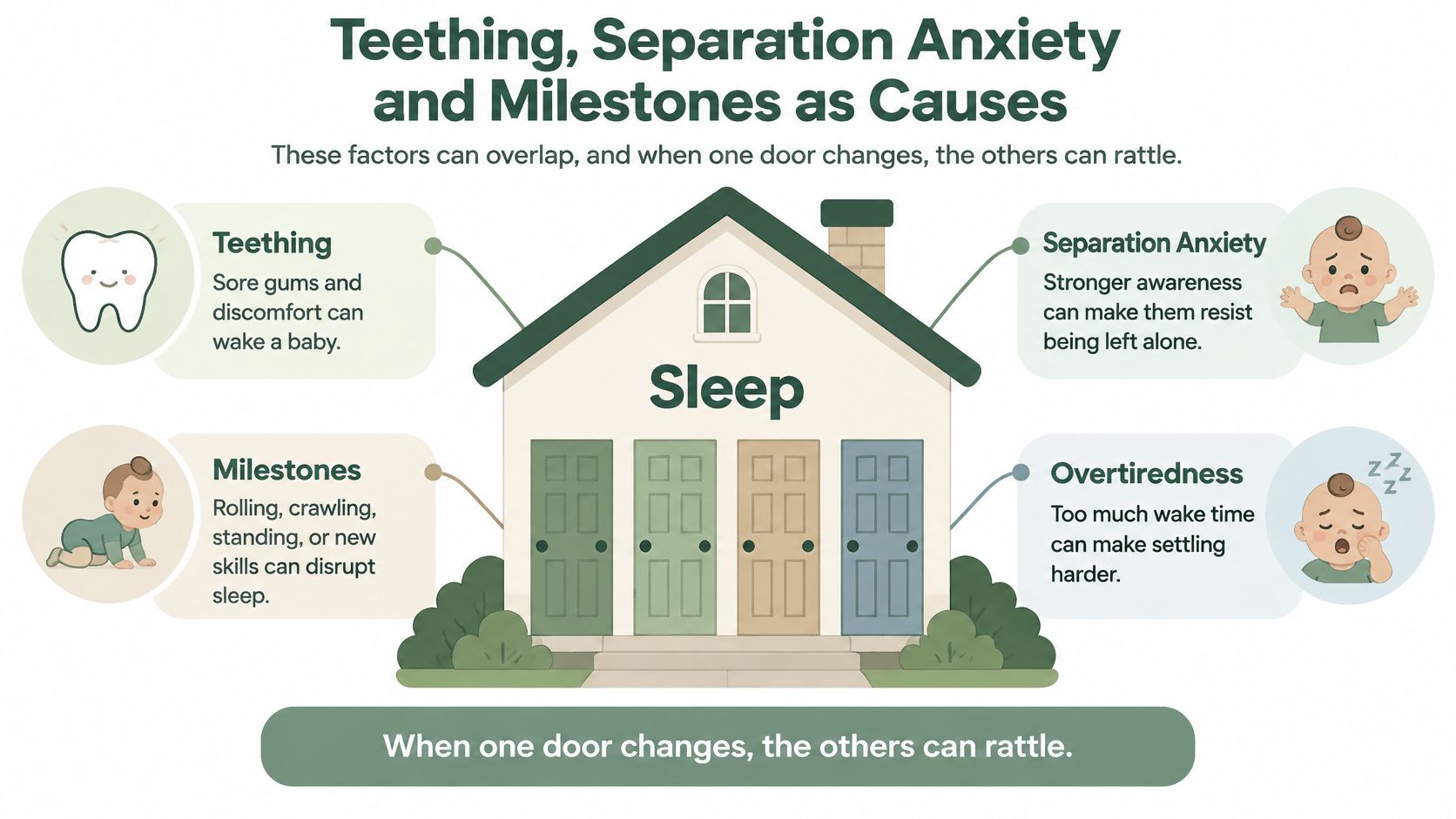
Think of sleep as a house with several doors. A change at one door can rattle the others: discomfort may interrupt a nap, the shorter nap may leave a child overtired, and bedtime may become harder. There doesn't have to be a single cause.
Discomfort and wanting someone nearby
Teething discomfort can make settling harder for some children. A child might seem tired but repeatedly pull away from their usual bedtime routine or wake appearing uncomfortable. Record what you observe rather than deciding that every waking is teething, and ask the pediatrician about appropriate comfort measures.
Separation anxiety can look different. A child may settle in a familiar caregiver's arms, then protest when that person moves toward the door. The practical distinction is whether the difficulty seems connected to separation, discomfort, or something else. A guide to toddler separation anxiety at bedtime can help caregivers recognize separation-related patterns without treating them as misbehavior.
New skills and changing timing
Milestones can change what happens in the crib. A child who has recently learned to pull up may stand instead of settling, or call for help getting back down. New sounds and words may also become part of the bedtime scene. Offer relaxed opportunities to practice emerging skills while awake, without turning the day into a campaign to exhaust your child.
Schedule changes deserve equal attention. A new daycare routine, travel, or a missed afternoon nap can change how tired your child is when bedtime arrives. What looks like resistance may reflect a mismatch between the day they had and the bedtime adults expected.
Observation first: Write down the behavior you saw before adding your explanation.
For example, “stood and called when Grandma left” is more useful than “bad regression.” Add a tentative explanation separately, such as possible separation difficulty. That leaves the next caregiver room to notice something different and helps you choose a response that fits, rather than treating every waking as the same problem.
Telling a Normal Dip From Something to Check
Not every sleep change needs a schedule fix. A brief, manageable disruption may be something to observe, while signs of illness, feeding difficulty, or breathing problems call for a clinician's guidance.
Children's Health guidance on sleep regressions describes temporary sleep disruption and encourages medical advice for persistent concerns. Many short disruptions settle within days. If the problem keeps going or keeps getting worse, call the pediatrician rather than assuming you need to wait out a developmental phase.
Match the next step to the signal
Sleep signals, what to log, and when to contact a clinician
| Signal | What to log | Next step |
|---|---|---|
| Quick settling after a night waking | Time, duration, who responded | Keep logging and watch the weekly pattern |
| Mild cold with brief night waking | Symptoms, timing, daytime mood | Observe and ask the pediatrician if symptoms persist |
| Persistent snoring, gasping, or breathing pauses | Frequency, positions, times | Contact a clinician |
| Fever or signs of dehydration | Temperature readings, wet diapers, fluid intake | Contact a clinician promptly |
| Poor feeding or fewer wet diapers | Feeds, amounts, diaper count | Contact a clinician |
| Disruption that lasts beyond a reasonable adjustment period | Weekly summary across all caregivers | Discuss with the pediatrician |
This table supports communication; it doesn't replace medical advice or determine how urgent an individual child's symptoms are. Questions about your child's health belong with a pediatrician or another qualified health professional. If your child is struggling to breathe or appears acutely unwell, seek urgent medical help rather than spending time completing a log.
Unusual movements, poor growth, or significant daytime impairment also deserve pediatric evaluation. Don't assume that a sleep-regression label explains these changes.
Share the whole picture
A child who wakes briefly, settles comfortably, and returns to their usual daytime behavior presents a different picture from a child who is feeding poorly and seems persistently unwell. Daytime mood that improves after a restorative nap is useful context, but it doesn't rule out a health concern.
Ask everyone caring for the child what they noticed. A parent may see the night waking, a nanny may notice reduced interest in feeds, and daycare may record fewer wet diapers. Separate observations can look unrelated until someone brings them together.
You don't need to diagnose the pattern yourself. A concise timeline of sleep, symptoms, feeding, and behavior gives the clinician a clearer account than the word regression alone. Contact them whenever something concerns you, even if your notes are incomplete.
How to Track One Week Across Every Caregiver
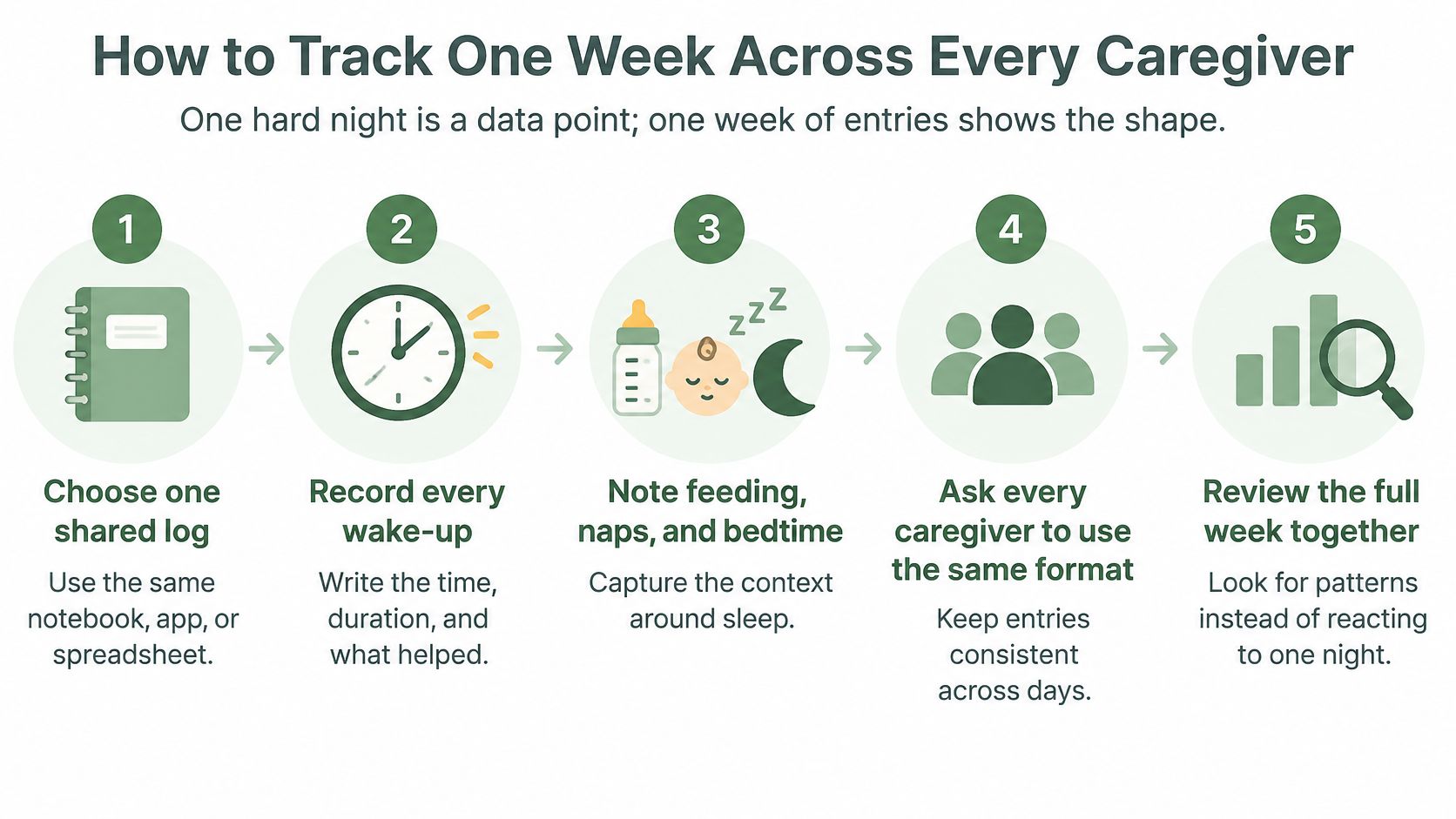
A hard night is a data point. A week of entries helps you see whether the same difficulty repeats after particular naps, routines, or care settings.
The useful benchmark is total sleep and daytime functioning, not an uninterrupted night. The University of Pennsylvania pediatric sleep presentation emphasizes age-appropriate sleep opportunity and cautions against prematurely removing a nap.
Make the entries easy to compare
-
Choose a shared place. Use a notebook, spreadsheet, or a consistent baby daily log template. Record sleep onset, each waking, nap starts and ends, and morning wake time; separate notes in different homes make comparison harder.
-
Record events soon afterward. Memory during an overnight waking is unreliable, so enter what happened while it's fresh. Include brief wakings as well as difficult ones, and mark an estimated time as an estimate rather than presenting it as exact.
-
Add the surrounding context. Note possible teething discomfort, cold symptoms, travel, feeds, or a daycare day. Cradlo is an optional shared tracker whose nap predictions and daily briefs help caregivers work from the same timeline; predictions are planning aids, not proof of what a child needs.
-
Keep the daily anchors reasonably steady. Aim for a familiar morning start and bedtime rhythm within the limits of your week. Moving bedtime substantially each evening can make it harder to understand which change helped.
-
Review the rolling weekly pattern together. Look for repeated connections, such as bedtime resistance after a late nap, rather than judging everything by the hardest night. Include how your child behaved while awake, not just how long they slept.
-
Change a single schedule element if needed. If nap timing consistently seems mismatched, shift it gradually over several days rather than removing the nap abruptly. Avoid changing both naps and bedtime simultaneously, because you won't know which adjustment made a difference.
-
Compare care settings. Check whether the pattern occurs at home, with grandparents, with the nanny, and at daycare. A problem limited to a particular setting may warrant a conversation about timing or the sleep environment rather than a complete routine change.
A useful log is complete enough to reveal a pattern, not perfect enough to earn a grade.
This procedure is for understanding schedule patterns. Health concerns take priority over finishing the observation period, and no caregiver needs permission from the log to contact the pediatrician.
Telling Refusal From Readiness
Does a refused nap mean your child no longer needs it, or that something made that particular nap difficult? Those possibilities can look identical during an unsettled afternoon.
Many children near their first birthday still use a morning and afternoon nap, while others begin consolidating daytime sleep. Ireland's Health Service Executive nap guidance describes children aged 12–15 months as usually having a midday nap. That's a general pattern, not a deadline or a reason to eliminate a nap that still helps your child.
Look beyond the refused nap
Patterns that suggest refusal or readiness for one nap
| Pattern across several days | What it may suggest | Practical next move |
|---|---|---|
| One nap refused while the other stays steady | Isolated nap resistance | Keep both naps and log for several more days |
| Content through the morning on a one-nap day | Possible readiness | Watch for a few more consistent days |
| Second nap runs late or is very short | Overtiredness or timing mismatch | Move the morning nap later in small steps |
| Night waking increases and early waking grows | Schedule not yet settled | Protect total sleep and avoid an abrupt change |
| Total 24-hour sleep stays steady over several days | Gradual transition likely | Alternate one- and two-nap days |
These are observation prompts, not a readiness test. A late nap alone doesn't tell you whether the child needs less sleep, a different nap time, or recovery from an unusual day.
For example, a child who refuses the afternoon nap but becomes distressed before dinner may not be coping comfortably with the longer stretch awake. A child who remains content, maintains overall sleep, and has no deterioration overnight presents a different pattern.
Use a bridge instead of a sudden switch
A transition doesn't need to happen identically every day. Some days may still need both naps; others may work with a consolidated nap and a bedtime that reflects the sleep obtained.
Protect an opportunity for a short restorative nap when your child needs it. If the morning nap moves later, make the change gradually and watch what happens afterward, rather than treating the later time as a success by itself.
Differences between home, daycare, nanny care, and weekends can make readiness difficult to judge. Ask about actual sleep, including accidental car naps, before concluding that a child comfortably managed the day without rest. Keep both nap opportunities until several consistent days suggest a transition is working across daytime behavior and nighttime sleep.
Soothing Steps and Sample Routines That Hold Up
Predictable structure is a more manageable starting point than dramatic fixes. The aim is to make sleep familiar and comfortable, not to enforce an exact timetable despite what happened during the day.
Choose steps your caregivers can repeat without turning bedtime into a complicated project:
- Keep a familiar morning start. Open the curtains, offer the usual morning care, and begin the day in a recognizable way.
- Repeat the wind-down order. A diaper change, pajamas, a book, and a familiar song can provide a simple sequence. Different caregivers can use the same order without copying each other's voice or style.
- Make the room restful. Keep the environment dim and quiet. White noise is optional if your family finds it helpful, not a requirement for good sleep.
- Offer responsive reassurance. Use familiar, gentle comfort when your child needs help settling. Self-soothing develops gradually with adult support; it isn't something to force during an uncomfortable or unsettled night.
Not every change calls for sleep training. Comforting your child isn't a failure, and you can choose an approach that respects both their needs and your family's capacity.
An example to adapt, not follow by the clock
Sample two-nap and transition day structure
| Time | Two-nap day (example) | Transition day (example) |
|---|---|---|
| 9:00 a.m. | Nap 1 in a dim, quiet room | Nap 1 in a dim, quiet room |
| 2:00 p.m. | Nap 2, usually shorter | Nap 2 offered, sometimes skipped |
| Evening wind-down | Familiar care, book, song, and bedtime | Same sequence, with bedtime adjusted to actual daytime sleep |
The clock times are illustrative, not recommended nap appointments. This transition-day example shows a variable day while you observe readiness, not an established midday-nap schedule. If the morning nap gradually moves later, the rest of the day needs to reflect that.
For more ways to organize the day, use a 12-month-old sleep schedule as a starting framework, then adapt it to your child's baseline.
Keep comfort separate from loose crib items
The American Academy of Pediatrics recommendations summarized by Missouri's Safe Sleep program say to place babies on their backs for every sleep until their first birthday, using a separate, firm, flat sleep surface without pillows, blankets, stuffed animals, or bumpers.
An unsettled night isn't a reason to add loose comfort items. The birthday doesn't settle every individual safety question, either; ask the pediatrician about your child's sleep space and circumstances.
Agree on One Response Plan and Start Tracking
A care-team agreement can make an unsettled night easier to handle. Decide who responds, what they will try, and when they should call for help. Caregivers can follow the same broad plan without soothing in exactly the same way.
Write the agreement somewhere parents, partners, grandparents, nannies, and daycare can find the parts relevant to them. Keep it simple enough to use when everyone is tired.
Answer the questions before bedtime
- Who responds overnight? Assign an on-duty caregiver where possible, and agree how to request a handoff if that person needs help.
- What prompts a medical call? Follow the pediatrician's guidance for your child. Make sure every caregiver knows how to reach the family and seek help.
- How will daytime caregivers get updates? Choose a predictable handoff, such as checking a shared record before drop-off or reading a short written summary.
- What will you log? Record sleep, wakings, settling responses, feeds, and relevant symptoms, including approaches that did not help.
The on-duty caregiver can record what happened while it is still clear, so the next person does not have to reconstruct the night through messages. If an entry is missed, add what you remember and mark what is uncertain. The record supports care; it is not a way to judge the person who was awake.
Leave room for different caregivers
A partner might use a quiet song while a grandparent offers gentle spoken reassurance. Both can follow the same broad response plan. Agree on the safety and continuity steps, then leave room for each caregiver's familiar, caring approach.
For Spanish-speaking households, a short written version in Spanish can help grandparents and other family members take part. Use plain language for the response steps and medical-contact instructions, and check that everyone understands them.
A shared baby tracker can keep the timeline and daily brief together, but the agreement matters more than the tool. Paper works too, as long as it stays with the child or caregivers reliably share the relevant entries.
Choose a seven-day window starting tonight. Agree on responsibilities, record events in the same place, and review the pattern together on day seven before changing the routine. If a health concern appears, contact the pediatrician sooner rather than waiting for the review. A week of consistent notes can show what is happening across caregivers more clearly than a stricter schedule imposed before you understand the pattern.
Cradlo offers families, nannies, and daycares a shared care timeline and daily brief, so sleep changes are easier to discuss from the same record. Visit Cradlo to start the 7-day free trial; afterward, Plus costs $4.99 per month or $49.99 per year, and Lifetime costs $99.99 once.