Why Your Baby Wakes at Night: The 9 Month Sleep Regression
It's 3 a.m. and you're standing by the crib again, wondering what happened to the baby who settled so well last month. You're not alone in that moment, and you haven't done something wrong. What many families call the 9 month sleep regression is usually a variable developmental phase, not a fixed event you caused or need to undo overnight.
Table of Contents
- Why Nights Often Change Around 9 Months
- How the 9 Month Sleep Regression Fits the First-Year Timeline
- Common Signs and What Might Be Behind Them
- Gentle Routine Changes That Help During This Phase
- Keeping Nights Safe When You Are Exhausted
- Comparing Ways to Track Sleep Across Caregivers
- When to Call a Pediatrician and What to Do Next
Why Nights Often Change Around 9 Months
For months, bedtime may have felt predictable. Your baby fed, settled, and slept for a longer stretch, and you started to trust the night again. Then the pattern shifts. There's more protest at bedtime, a waking that turns into two or three, and a nap that ends sooner than you expected.
It can feel sudden, even when the change has been building without much notice. A new skill, a slightly later nap, and stronger feelings about being apart from you can arrive in the same week. By the time you notice a pattern, it already feels like everything changed at once.
A phase to observe, not a label to fear
A 2020 prospective longitudinal study following 52 typically developing infants with six-day sleep diaries at 1, 3, 6, 9, and 12 months didn't identify a medically defined condition with this name. It measured how sleep regulation changes across the first year. That distinction matters because it moves you away from asking whether you've hit a named regression on schedule, and toward asking what your baby's pattern really looks like.
In that same research, babies differed a lot from one another. Some settled into more self-regulated sleep earlier, and others took longer, with parental presence at sleep onset, total sleep time, and night waking all linked to later patterns. Your baby's neighbor, cousin, or daycare friend may show no clear break at all, and that doesn't make either baby's path wrong.
One difficult night is information, not a verdict on you or your baby.
Why several nights tell a truer story
When you're tired, last night looms large. It's natural to search your memory for the one thing you did differently, the later bottle, the shorter nap, the grandparent visit. Sometimes one of those details matters. Often, a single night is too small a sample to judge.
Picture it as learning a new skill during the day. A baby practicing pulling up doesn't master it in one smooth line. There are wobbles, good attempts, and frustrated ones, and sleep can wobble in a similar way while development moves forward underneath.
- Look for repetition: Does the same waking happen across several nights, or was it one unsettled evening?
- Notice timing: Is the hard part falling asleep, staying asleep, or waking too early?
- Include the day: Naps, feeds, illness, and new mobility belong in the same picture as the night.
You don't need a perfect explanation before tonight. You need a calmer starting point, a way to notice what's repeating, and permission to respond to the baby in front of you rather than to a label. If something about breathing, feeding, growth, or distress worries you, that question belongs with your baby's pediatrician, not with guesswork at home.
How the 9 Month Sleep Regression Fits the First-Year Timeline
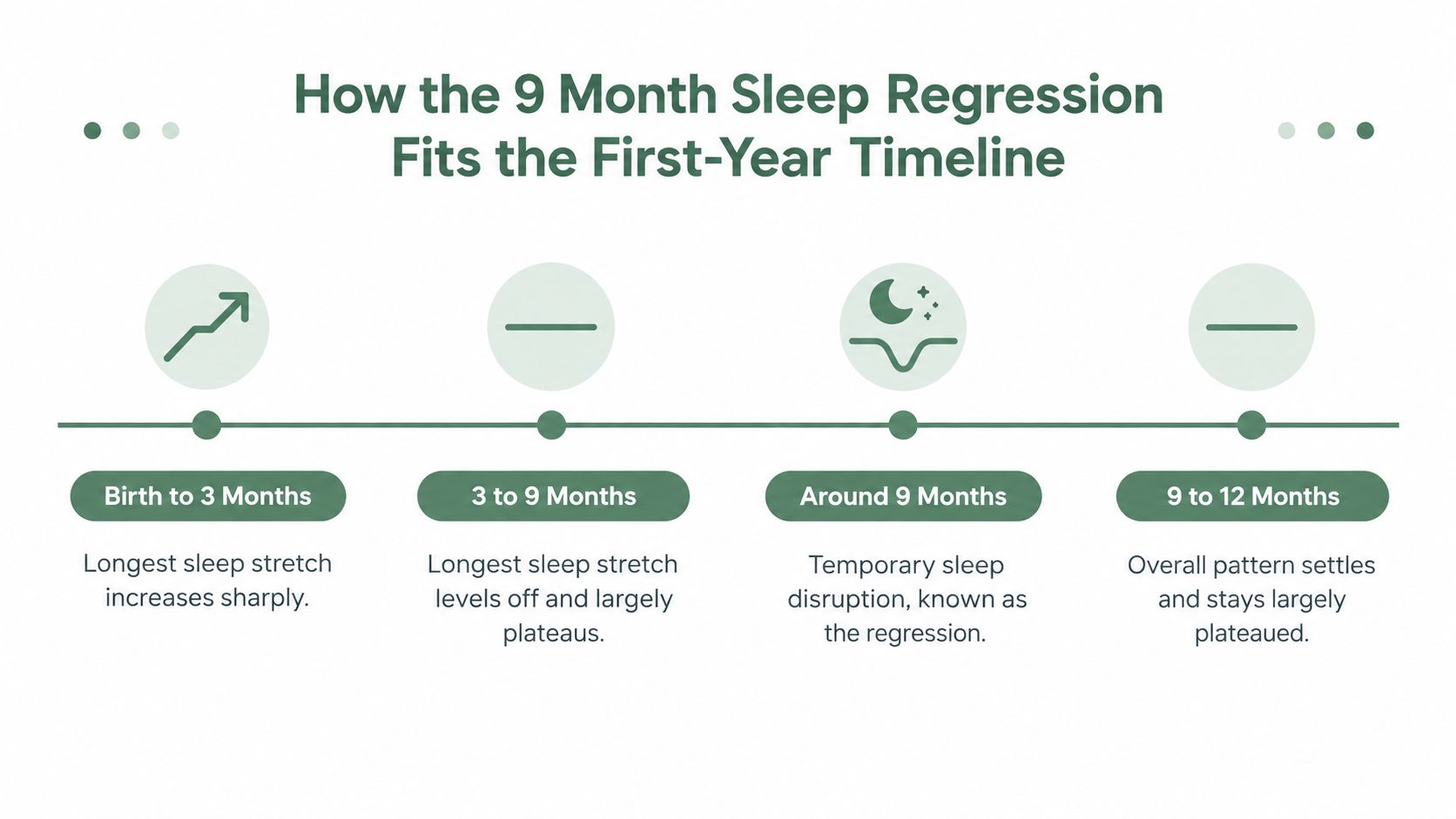
Babies don't move toward longer nights in a steady staircase. A helpful image is a dimmer switch. Brightness changes gradually, sometimes it flickers, and two rooms don't reach the same setting at the same moment. Sleep in the first year often works that way, with progress, plateaus, and temporary fragmentation sitting side by side.
Research following infants across the first year found that nighttime awakenings decline sharply from 1 to 3 months but remain relatively stable from 3 to 12 months. At 9 months, some babies had more awakenings and shorter longest sleep periods than others. That's substantial individual variation, not a single age-defined event arriving for every family on the same week.
The plateau that confuses many families
The longest sleep period tends to grow quickly early on, then largely levels off through much of the rest of the first year. That plateau can feel disappointing if you expected each month to bring a longer stretch. A baby who previously consolidated sleep may show more broken nights for a while without having lost the underlying capacity for longer sleep.
Parents often blame a recent choice at this point. You may wonder whether a feed, a cuddle, or a different bedtime undid months of progress. A temporary change doesn't automatically mean a caregiver caused it, and it doesn't mean the earlier progress was imagined. Development can make sleep lighter or more interrupted even while overall regulation is still maturing.
Look at the full day, not only the night
At 9 months, your baby is still within the infant range described in guidance from the American Academy of Sleep Medicine. The organization recommends 12 to 16 hours of sleep in a 24-hour period, including naps, for infants aged 4 to 12 months. That's a population-level range, not a promise that every healthy baby will follow one schedule or sleep through without waking.
| What to notice | Why it helps |
|---|---|
| Total sleep across day and night | A rough night looks different if daytime sleep was also short |
| Longest stretch | Shows whether consolidation is still present, even if wakings increased |
| Nap timing | A late or missed nap can change bedtime pressure |
| How your baby functions | Feeding, mood, and alertness add context beyond the clock |
Two healthy babies can sit at different ends of that broad range and distribute sleep differently between naps and nights. Comparing only night waking can hide the more useful story. A sleep regression chart that places this period within the wider first year can help you see the pattern as overlapping changes rather than isolated bad nights, especially when several caregivers are sharing what they noticed.
Common Signs and What Might Be Behind Them
After a difficult night, one caregiver may remember a long bedtime struggle while another recalls several wakings after midnight. Both observations matter. Sleep can shift in different ways from day to day, so look across several nights and caregivers before deciding what the pattern might mean.

Bedtime resistance occurs before sleep begins. Your baby might fuss when the routine starts, cry when placed down, or take longer to settle. Night waking occurs after a stretch of sleep, when your baby may need feeding, comfort, or help settling again. Naming which one you see gives each caregiver a clearer way to describe the night.
Several possibilities can overlap
Separation, new motor skills, and teething may be part of what a family notices, though these possibilities vary between babies and do not explain every waking. A baby becoming more aware when a caregiver leaves may protest at bedtime or when waking alone. That can be one clue, not proof of a cause.
New movement can add another piece. A baby learning to crawl, roll, sit, or pull up may practice while drowsy or become frustrated after changing position. If a new skill and more waking appear around the same time, record both. Their timing can help you see a pattern without assuming one caused the other.
Other changes may overlap too. Cleveland Clinic notes that many babies begin sleeping for a five- to six-hour stretch by about 6 months, while patterns can vary. Teething, illness, growth spurts, and new skills are also possible reasons sleep may change temporarily. These are possibilities, not diagnoses. Teething need not be the default explanation for every waking, and signs of illness or pain deserve attention rather than being dismissed as a phase.
- Separation cue: Calm during the routine, then upset when a caregiver steps away
- Schedule cue: A late last nap, a short nap day, or a long stretch before bedtime
- Physical cue: Fever, poor feeding, unusual fussiness, or symptoms that are new for your baby
- Development cue: Repeatedly practicing a new skill in the crib
A clear description is more useful than a guessed cause: note when the change began, what happens at bedtime, how often your baby wakes, and what helps them settle.
Use a shared log, with each caregiver noting what they saw in plain words. For example, bedtime may be calm, followed by waking after midnight, or protests may happen on days when the afternoon nap ends late. A few days of consistent notes can turn a hard week into evidence you can read together. Try one change at a time, so the pattern remains easier to understand. If you have concerns about symptoms, pain, or feeding, ask your pediatrician for guidance.
Gentle Routine Changes That Help During This Phase
A routine isn't a rigid clock. It's a short sequence of familiar cues that tells your baby sleep is coming, even if the exact time shifts a little with the day. Predictability can make transitions easier, although it doesn't guarantee an uninterrupted night, and you haven't failed if waking continues.
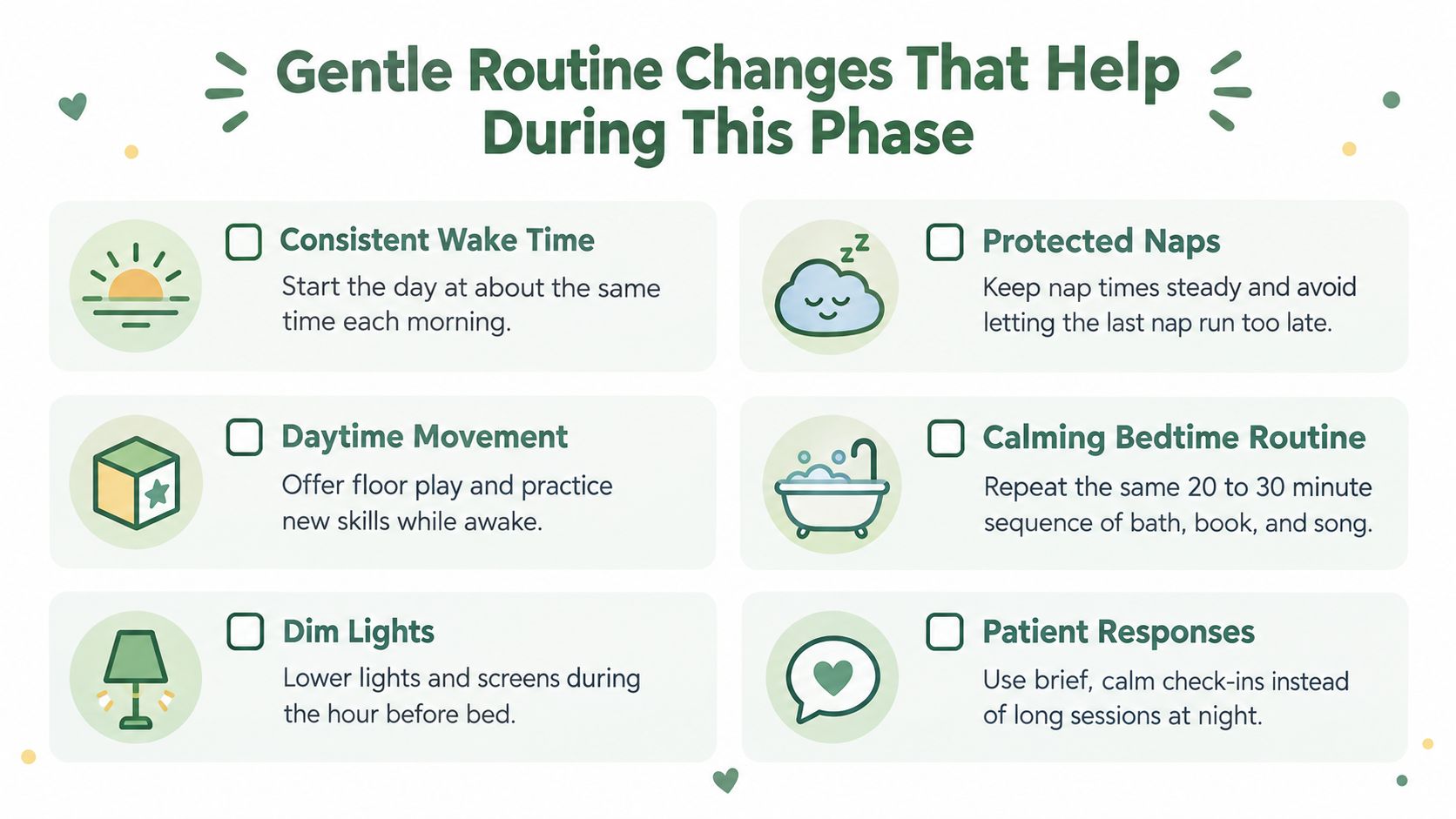
The Centers for Disease Control and Prevention includes having routines for sleeping and feeding in its 9-month milestone guidance. That supports repeatable cues rather than chasing a perfect minute-by-minute schedule. A sequence might be feeding, diapering, dimming lights, a short book, and then the crib, in the same order most nights.
A simple sequence every caregiver can repeat
- Start with the same signal: Lower lights and move to a quieter activity so the transition doesn't feel abrupt.
- Keep the steps short: Feed, diaper, pajamas, book, and a calm goodnight phrase are enough for many families.
- Use the same sleep place: Familiar surroundings reduce the number of new things your baby has to process.
- End the same way: A consistent final cue helps partners, grandparents, and nannies hand off without reinventing bedtime.
Daytime matters too. Floor play gives a mobile baby time to practice new skills while awake, and protecting naps from running too late can make evenings less wired or overtired. If you're reviewing the whole day, a sample 9 month old sleep schedule can be a reference point, not a rule your baby must match exactly.
Match the response to your baby's distress
Not every baby needs the same nighttime approach. In a randomized trial of 91 infants aged 9 to 18 months with pediatric insomnia, sleep improved with both graduated check-ins and a parent-presence approach, and babies with higher separation anxiety benefited more from the gentler parent-presence method. The lesson isn't that one protocol wins for everyone. It's to notice your child's arousal and choose a response you can repeat calmly and consistently.
For a highly distressed baby, a predictable sequence with calm verbal reassurance and gradually reduced physical presence may feel more workable. For a baby who protests briefly and then settles, brief check-ins may be enough. Either way, avoid changing the plan every night out of exhaustion alone, because then you can't tell what helped.
Give one adjustment several nights before judging it. Ask daycare and other caregivers to use the same nap cues where practical, and share what bedtime looked like rather than only whether it worked. Small, steady changes are easier for babies to learn and easier for tired adults to sustain.
Keeping Nights Safe When You Are Exhausted
When waking repeats night after night, safety planning matters more, not less. You're more likely to doze during a feed, carry your baby to the couch because it feels comfortable, or assume your partner already returned the baby to the crib. Preparing while you're awake protects everyone during the hardest part of the night.

Current clinical guidance continues to recommend a firm, flat infant sleep surface, placing babies on their backs, and keeping the sleep area free of loose bedding and soft objects, as summarized in the Safe Sleep NC hospital toolkit on current safe-sleep guidance. Room-sharing without bed-sharing remains advised. An older baby who rolls, crawls, or seeks you out still needs that clear, flat space to return to after comfort or feeding.
Prepare before the first waking
Set up the crib before bedtime, not at 2 a.m. Remove loose bedding and soft objects, check that the surface is firm and flat, and decide where you'll feed or soothe. Avoid couches and adult beds for soothing when you're likely to fall asleep, and plan a chair and lighting arrangement that helps you stay awake long enough to place your baby back safely.
- Agree on responders: Decide who takes the first waking and who takes the next, so no one assumes the other person went.
- Say the handoff out loud: A simple confirmation prevents two tired adults from missing that the baby is still being held.
- Reset the crib each time: Return your baby to the same clear surface after feeding or comfort.
- Lower expectations for conversation: Keep nighttime care calm, brief, and focused on safety rather than problem-solving.
Preparation is a kindness to your future tired self, not a test of how careful a parent you are.
If you notice breathing problems, fever, pain, poor feeding, or unusual lethargy, contact a medical professional rather than treating those signs as part of a sleep phase. The same applies if you feel so exhausted that nighttime care doesn't feel safe. Ask a partner, grandparent, or trusted adult for relief, and discuss ongoing concerns with your pediatrician. Safe sleep isn't a score to earn. It's a steady set of conditions you can prepare in advance, even during a disruptive week.
Comparing Ways to Track Sleep Across Caregivers
One caregiver remembers a long night; another recalls a late nap or a feed. Neither is wrong. Sleep changes around nine months can vary from day to day, and details get lost when care moves between parents, grandparents, a nanny, or daycare. Looking across several days gives you a clearer picture than trying to label the week from one difficult night.
Three common ways families keep track
Memory and verbal handoffs cost nothing and can work when one person handles most care. With several caregivers, though, details often shrink to “she napped okay” or “he was up a lot.” The next caregiver may not know when sleep began or what happened before a waking.
Paper notes make times and events easier to check. A sheet at home can record naps, feeds, and wakings, and some families prefer writing things down. The limitation is access: daycare may not be able to update it, the sheet can be out of reach, and reviewing several days may mean copying entries elsewhere.
A shared synced log gives caregivers one place to record what happened. Each person can check the latest entry before taking over, making it easier to spot whether a change appears at home, at daycare, or with a particular caregiver. It does take a little setup, and brief entries are more likely to become a lasting habit. If you're comparing phone-based options, this guide to a sleep tracking app for iPhone and shared caregiver use can help you consider what supports clear handoffs.
| Approach | Best for | Watch out for |
|---|---|---|
| Memory | One main caregiver, settled nights | Lost timing and unclear handoffs |
| Paper sheet | Home-only care and simple notes | No remote access and harder long-term review |
| Shared log | Partners, nannies, grandparents, and daycare | Needs setup and a shared habit |
What details are worth recording
Keep the record focused. Note bedtime, when sleep started, each waking, nap length, feeds, illness or symptoms, who responded, and whether that caregiver stayed in the room. These details can help you compare several nights and notice whether changes tend to follow a late nap, a feed, or a particular handoff. They are clues, not a score of how well anyone cared for your baby.
Choose a shared log based on how your family really hands over care. Check whether caregivers can be invited, whether entries sync across the devices they use, and whether daycare staff can view or add notes. A simple tool that everyone can access and keep up with is more useful than one with features your family won't use. The aim is to make a changing week easier to read together, not to force every night into a fixed pattern.
When to Call a Pediatrician and What to Do Next
Most temporary sleep changes don't need a diagnosis at home. Some signs do need medical input, and it's better to ask early than to keep labeling everything a regression. Trust the difference between a familiar hard night and something that looks or feels unlike your baby.
Reasons to contact your baby's pediatrician
- Breathing concerns: Breathing pauses, persistent snoring, or labored breathing during sleep
- Unusual movements or distress: Movements that worry you, prolonged distress, or pain you can't explain
- Feeding and growth concerns: Poor feeding, poor growth, unusual sleepiness, or lethargy
- Illness signs: Fever or symptoms that make sleep disruption seem secondary to being unwell
- Development concerns: Missed milestones or loss of a skill your baby already had
Research on infant sleep patterns advises tracking bedtime, sleep onset, each waking, nap duration, feeding, illness, and caregiver response for 7 to 14 days, rather than judging from one difficult night. That record can show whether change coincides with a late nap, new mobility, inconsistent sleep-onset conditions, or symptoms. Bring it to the appointment so you're describing a pattern, not trying to reconstruct two tired weeks from memory.
If development is part of your concern, ask the doctor directly and discuss developmental screening. Spanish-speaking families can request medical information or interpretation in their preferred language, and every family can ask for explanations in plain words. A pediatrician or lactation professional should guide health and feeding questions. A log supports that conversation, it doesn't replace it.
Start tonight with one shared place for the facts, then review the week together instead of reliving each waking separately.
Your next step for this week
Choose the tracking method your whole caregiving team will actually use, paper by the crib or a shared app everyone can update. Keep entries short, use the same routine cues, and note who responded overnight. After several days, read the record together and pick one gentle adjustment to test, such as protecting the last nap from ending too late or making bedtime responses more consistent.
You don't have to solve the whole pattern tonight. You only have to make the next night observable, safe, and a little more predictable for your baby and for each adult who loves them.
When nights start changing around 9 months, Cradlo gives parents, partners, grandparents, nannies, and daycare one shared log for sleep, feeds, naps, and nighttime responses, so the pattern is visible without anyone relying on tired memory. Each caregiver joins with their own identity and entries sync across phone and web, making handoffs calmer during a hard week. Visit Cradlo to start the 7-day free trial on the monthly plan and turn the next several nights into a clear record you can review together.