Baby Hates Swaddle
You've changed the diaper, dimmed the lights, and started wrapping your baby for sleep. Then the kicking begins, followed by crying that gets louder as you finish. If you're searching for “baby hates swaddle” while holding an unsettled newborn, you don't need another reason to question yourself. You need a manageable way to decide whether to adjust the wrap or leave it behind.
Resistance is useful feedback, not a challenge you have to overcome. A comfortable sleep arrangement doesn't have to include a swaddle. You can pay attention to your baby's response, keep clear safety boundaries, and help every caregiver follow the same plan.
Table of Contents
- Why Your Baby May Resist Swaddling
- Check Safety and Readiness Before Retrying
- Improve Swaddle Technique and Fit
- Change the Fabric Before Changing Everything
- Choose a Safer Alternative for Sleep
- Plan the Transition Across Caregivers
- Use a Shared Swaddle Trial Log
Why Your Baby May Resist Swaddling
A familiar bedtime might go like this: your baby protests as you tuck their arms inside, so you pause, remove the wrap, and choose arms-free sleep clothing. Their body relaxes, and settling feels less difficult. That's an observation worth keeping, not evidence that you gave up too soon.
Swaddling limits movement. A baby who wants to stretch, kick, or bring their hands toward their face may object to that restriction. Arching or crying can be a reason to reconsider the arrangement, though those behaviors alone don't tell you exactly what's uncomfortable.
Different responses don't mean someone wrapped incorrectly
Suppose your partner reports an easy bedtime with a snug wrap, but your attempt ends with louder crying. Both experiences can be genuine. Rather than deciding who has the better technique, compare what happened before, during, and after wrapping.
The evidence also shows differing responses. A 2022 systematic review of swaddling research found that studies involving infants new to swaddling generally reported more quiet sleep, fewer sleep-state changes, and reduced arousal, while other studies found no difference in crying or sleep duration. The review didn't establish swaddling as a reliable solution for crying or sleep problems, and it cautioned that reduced arousability may have safety implications.
Your baby doesn't need to learn to like a swaddle for you to provide thoughtful sleep care.
Try describing what you see rather than assigning a permanent label:
- During wrapping: Did crying begin or become more intense?
- After removal: Did your baby appear more comfortable with free arms?
- Across caregivers: Does the same response happen in different settings?
Comfort preferences can guide your choices. Developmental safety milestones set boundaries that apply regardless of preference.
Check Safety and Readiness Before Retrying
Before another attempt, separate two questions: Is swaddling still appropriate, and does your baby seem comfortable with it? A wrap can meet fit guidelines and still be something your baby dislikes. There's no need to keep testing an optional arrangement that consistently makes settling harder.
The American Academy of Pediatrics' swaddling guidance says to stop when a baby shows signs of trying to roll, warns against weighted swaddles, and states that swaddling doesn't reduce sudden infant death syndrome risk. A birthday alone isn't the cutoff. Watch your baby's movement rather than waiting for a calendar reminder.
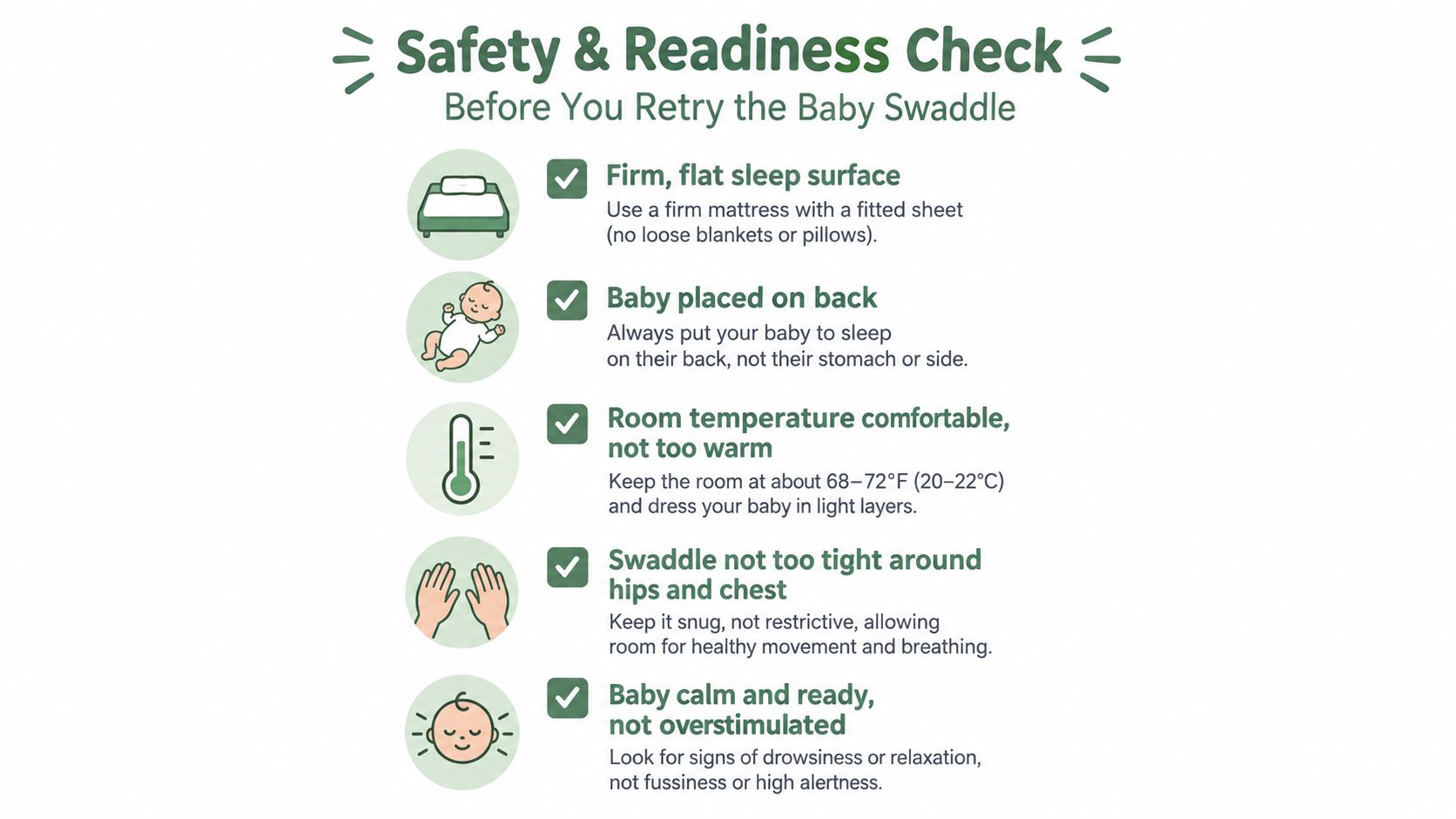
Make the setup predictable
Use the same basic check whether a parent, partner, grandparent, nanny, or daycare caregiver is handling sleep:
- Sleep space: Place your baby on their back on a firm, flat sleep surface, without loose bedding.
- Movement: The chest must have breathing room, and the hips and knees must remain able to bend.
- Product choice: Exclude weighted swaddles, even if they're marketed for settling.
- Practical removal: Know how to open the wrap promptly. Don't continue a trial just because unfastening it feels inconvenient.
If caregivers disagree about whether a movement looks like an attempted roll, pause arms-in swaddling and ask your pediatrician for clarification. A guide to when babies start rolling can help you organize observations, but it shouldn't become a reason to wait for a particular age.
Permission to stop: Swaddling is optional. If crying escalates, stop the attempt rather than tightening the wrap.
You don't need to reach a certain level of protest before choosing another arrangement. Safety checks establish what's acceptable to try, not what your baby has to tolerate.
Improve Swaddle Technique and Fit
A fit check is an inspection, not a contest to make the wrap stay on. If arms-in swaddling remains appropriate and you choose to retry it, use a routine another tired caregiver can repeat without guessing. Check your baby's whole body, not just whether the top of the wrap looks tidy.
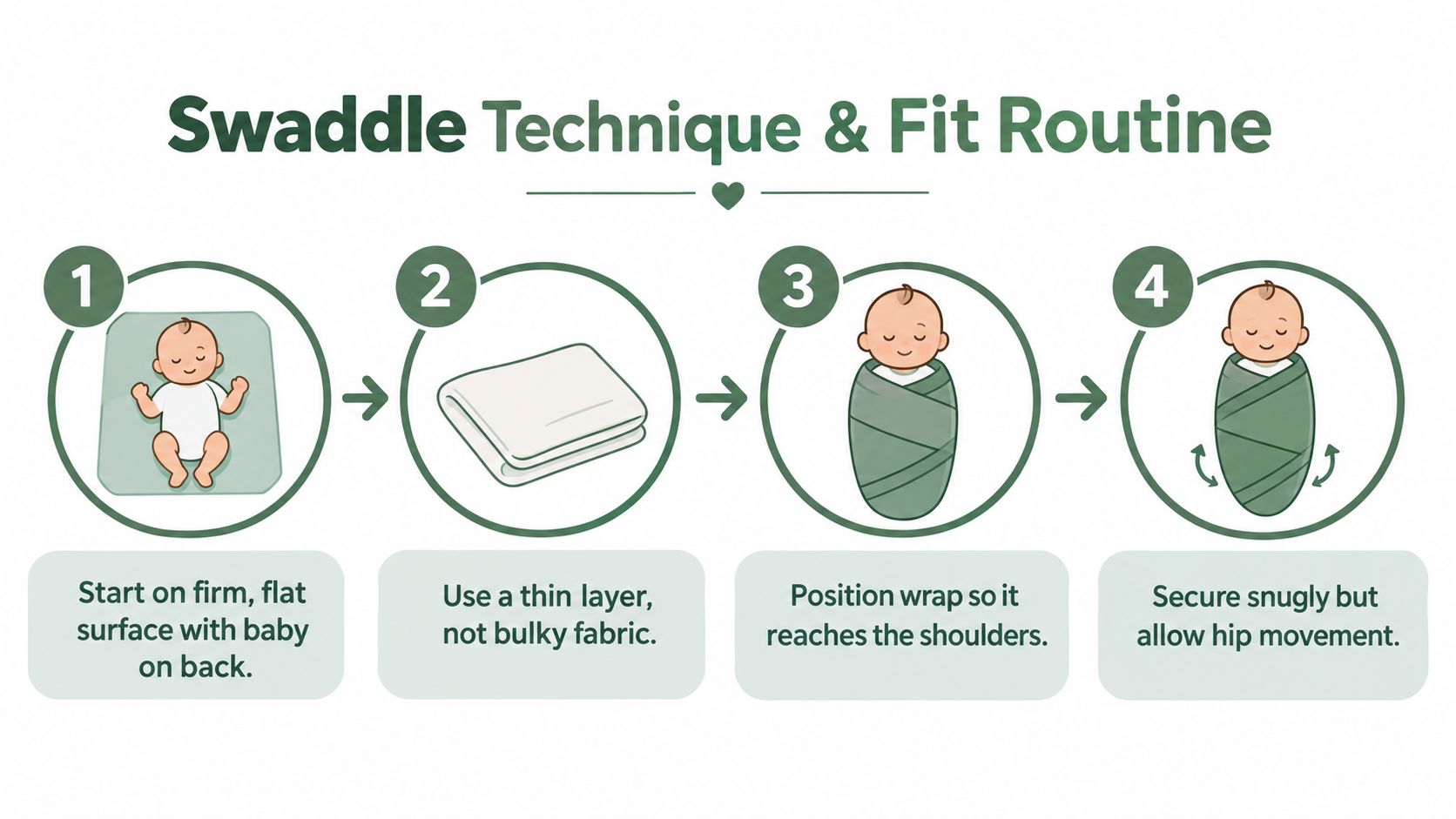
Check placement before tension
Start with your baby on their back on a firm, flat surface. Follow the wrap's instructions and keep its upper edge at the shoulders, with the face and head uncovered. Don't pull fabric higher to compensate for a poor fit.
Work through the checks deliberately:
- Choose a thin layer: Avoid bulky fabric and account for the clothing underneath.
- Inspect the chest: Secure doesn't mean compressed. The wrap shouldn't restrict breathing.
- Check below the waist: Leave substantial space for the hips and knees to bend rather than holding the legs straight together.
- Inspect the edges: Look for fabric that could loosen or move toward the face. Don't leave a partly undone wrap in the sleep space.
NHS guidance on safe sleeping and swaddling recommends thin muslin or a thin cotton sheet rather than a blanket, keeping the head uncovered, and avoiding extra bedding. It also advises checking the back of the neck: hot or sweaty skin means layers should be removed.
Finish by watching the response
After checking the fit, give your baby a brief opportunity to settle with your usual reassurance. You're looking for whether the arrangement seems acceptable, not waiting for exhaustion to end the protest. If crying intensifies, remove the swaddle and choose ordinary sleep clothing or an appropriate arms-free sleep sack.
Repeated loosening isn't a reason to wrap more tightly. Likewise, persistent arching or distress isn't something you can diagnose from the fit alone. Ask your pediatrician about ongoing discomfort or health concerns.
For handoffs, use concrete descriptions: “The fabric loosened near the shoulder,” or “Crying increased after the arms went in.” Those details help the next caregiver understand what happened without assuming they should repeat the attempt.
Change the Fabric Before Changing Everything
A different fabric is a reasonable comfort adjustment when the current wrap feels bulky or warm, provided swaddling remains appropriate. It's also reasonable to skip that experiment and choose free-arm clothing. You don't owe the swaddle an exhaustive trial.
When you do compare options, change a single feature where practical. Replacing the wrap, clothing underneath, bedtime routine, and sleep location together makes it harder to tell which difference mattered. Keep the established sleep setup and notice your baby's response to the clothing change.
Compare arrangements, not promises
| Arrangement | What you're observing | What to avoid concluding |
|---|---|---|
| A thinner swaddle | Whether less bulk seems more comfortable | That different fabric will resolve all resistance |
| An arms-free sleep sack | Whether free arm movement suits your baby | That every wearable layer fits alike |
| Ordinary unswaddled clothing | How settling goes without a wrap | That a difficult sleep proves swaddling is necessary |
For a sleep sack, correct sizing matters more than choosing a smaller one. Follow its sizing and use instructions rather than downsizing to recreate tightness. A replacement should provide an appropriate fit, not a new form of restraint.
A parent might prefer a thin wrap at home, while a grandparent notices easier settling in ordinary pajamas. A daycare caregiver might describe a comfortable arms-free nap. Treat these as observations to compare, not competing recommendations that someone has to win.
- Record the change: Name the fabric or clothing arrangement clearly.
- Describe the response: Note whether crying increased, eased, or stayed similar.
- Keep uncertainty visible: Write “seemed more comfortable” rather than declaring a cause.
You're looking for a practical arrangement your baby accepts, not proof that a particular material is best. If the lighter wrap still causes distress, there's no need to keep changing fabrics before moving on.
Choose a Safer Alternative for Sleep
An alternative doesn't need to imitate a swaddle. Ordinary fitted sleep clothing or a correctly fitted, nonweighted, arms-free sleep sack can be the next arrangement. Choose clothing suited to the room conditions and your baby's needs rather than trying to reproduce the feeling of restraint.
The AAP's safe-sleep guidance emphasizes back placement, unrestricted breathing, room for hip movement, and stopping arms-in swaddling at the first sign of attempted rolling. When that cutoff applies, move to free arms rather than extending an arms-in transition. A wearable product's name doesn't override those boundaries.
Use the observation, not the sales description
Consider a family who keeps retrying the wrap at bedtime. Their daycare caregiver sends a note that the baby settled more calmly in an arms-free sleep sack. That doesn't prove the sack will improve every night, but it gives the family a concrete alternative to consider.
Build the choice around these questions:
- What can change? The wearable layer, its fabric, and the clothing underneath.
- What stays consistent? The established back-sleep placement, firm and flat surface, and clear sleep space.
- What needs professional input? Persistent discomfort, questions about breathing or temperature, or concerns that aren't limited to wrapping.
Don't add a loose blanket to compensate for removing the swaddle, and don't substitute a weighted product. Check that the replacement allows the movement your baby needs rather than choosing something designed to hold them still.
Make the replacement easy to use
Put the agreed clothing where caregivers already prepare for sleep. Share its fit instructions and show how it fastens, especially if someone hasn't used that style before. Keep broader newborn sleep preparations familiar so the handoff doesn't become an entirely new routine.
A clothing change isn't a diagnosis or a treatment plan. Bring health questions to your pediatrician, and feeding-related concerns to a pediatrician or lactation professional. You can choose not to swaddle while you seek that guidance.
Plan the Transition Across Caregivers
“We're trying to wean from it” leaves too much room for interpretation. A partner may hear “use it if necessary,” while a grandparent assumes naps are different from bedtime. A useful transition plan states what everyone should do at the next sleep.
NICHD's Safe to Sleep materials advise avoiding swaddling once a baby starts to roll. Share rolling observations promptly rather than leaving them for the next routine update. A caregiver shouldn't have to discover the change by finding the swaddle missing.
Agree on the action before the handoff
| Observation | Shared response |
|---|---|
| Fit or fabric seems uncomfortable, with no rolling concerns | Consider a permitted adjustment or choose arms-free clothing |
| Distress increases during the attempt | End the attempt and use the agreed alternative |
| Baby settles comfortably in an appropriate swaddle trial | Record the observation without treating it as a requirement |
| Attempted rolling is observed | Stop arms-in swaddling and notify every caregiver |
Prepare the replacement layer in advance. Then give parents, partners, grandparents, nannies, and daycare staff the same plain-language instruction.
Handoff wording: “Arms-in swaddling has stopped. Please use the agreed arms-free sleep clothing for every sleep.”
A useful note describes the observation and action separately: “During floor time, I noticed movement that appeared to be an attempted roll. Arms-in swaddling stopped after that observation. The arms-free sleep sack is ready with the sleep clothes.”
Include when the change began and ask caregivers to acknowledge it. In a household where some adults prefer Spanish, share an agreed translation of the same instruction rather than relying on informal summaries.
The record supports communication, not medical judgment. If someone is uncertain about the movement or the replacement's suitability, contact the pediatrician rather than restarting the previous arrangement.
Use a Shared Swaddle Trial Log
A caregiver who ends a hard shift will often report only that nothing worked. A shared log replaces that blur with something specific: what each person tried, how your baby responded, and whether the safety plan changed. The purpose is coordination, not scoring your baby's sleep or your caregiving.
Treat each entry as a note to the next adult, not a verdict on the last one. A baby daily log template can help organize observations alongside the rest of the day's care. You don't need to document every movement or turn bedtime into an experiment.
Record what another caregiver needs to know
Use a small set of repeatable fields:
- Date and time: When the attempt or sleep happened.
- Sleep clothing: Whether swaddling was attempted or an arms-free option was used.
- Adjustment: The specific fit, fabric, or clothing change.
- Baby's response: What you observed during wrapping and after any removal.
- Sleep length: The recorded sleep period, without treating longer sleep as proof of safety.
- Movement observations: Any possible rolling attempt and the action taken.
A sample entry might read: "Tried the thinner wrap. Baby settled without increased crying. No rolling attempt observed during this care period." Another caregiver might write: "Crying increased during wrapping. Removed it and used the arms-free sleep sack. Baby appeared more comfortable afterward."
Those notes don't cancel each other out. They describe different care periods, and resistance itself is useful information: a baby who fusses during wrapping on Tuesday but settles on Thursday may be reacting to the wrap's warmth rather than to swaddling in general. If rolling signs appear, the shared safety cutoff takes priority over any earlier successful trial.
Review patterns without making a diagnosis
Compare home notes with observations from a nanny or daycare, but don't assume the clothing caused every difference. An isolated entry can suggest something worth noticing, not establish a medical explanation. Keep language factual and leave room for uncertainty.
A tracker should make the handoff easier, not add pressure to keep testing. Watch your baby's cues, change a single variable when appropriate, and stop when distress escalates. For health questions, ask your pediatrician or lactation professional rather than relying on a pattern in the log.
Cradlo provides a shared baby and toddler care log for families, nannies, and daycare, with caregiver-specific QR-code invitations so adults don't need to share a login. Parents, partners, grandparents, and daycare staff can keep swaddle observations and transition decisions in one place. Its plans and pricing include a seven-day free trial on the monthly plan only, followed by Plus at $4.99/month or $49.99/year, or Lifetime at $99.99 one time. There's no free plan. Visit Cradlo to explore a shared log and give every caregiver the same clear plan for your baby's next sleep.