8 Month Sleep Regression: What It Looks Like and What Helps
You're up again at 1 a.m., then 2:30, then just before dawn, wondering what happened to the baby who used to settle with a short feed and drift back to sleep. When you seek answers about the 8 month sleep regression at that hour, you're not looking for a perfect schedule. You need a clear way to read what's changed, respond consistently tonight, and make sure every caregiver in your baby's day is working from the same information.
Table of Contents
- When the Easy Baby Suddenly Isn't
- What the Eight-Month Phase Actually Is
- Signs Your Baby May Be in This Window
- Sample Two-Nap Schedules That Flex With Real Life
- What to Do When Your Baby Wakes at Night
- Keeping Caregivers on the Same Page
- When to Call the Pediatrician
- What to Start Tracking Tonight
When the Easy Baby Suddenly Isn't
It often starts. One night your baby wakes and needs a little longer to resettle. The next night, they're standing in the crib, wide awake and upset, and the nap that used to be predictable ends after one short cycle. By the third night, you and your partner are comparing notes in the hallway, trying to remember when the last nap ended and whether this waking looked like hunger, frustration, or a need to practice crawling.
That confusion doesn't mean you've broken your baby's sleep. It usually means several normal changes have arrived at once, and your usual cues don't fit as neatly as they did a month ago. A grandparent may report a long morning nap that you never see at home. Daycare may log a skipped afternoon nap that explains a rough bedtime. Without shared notes, each adult sees only part of the pattern and fills in the rest with a guess.
A rough patch is information, not a verdict on your caregiving.
It's also worth letting go of the calendar promise that comes with the popular label. An 8-month sleep regression is not a formally diagnosed medical condition or a universally timed biological event. Research describes it as a common parent label for a temporary deterioration in sleep during rapid developmental change, as summarized in research on infant sleep and development at 4 and 8 months. Some babies show a clear shift near this age. Others don't. Some wobble earlier or later, and some move through the same milestones with only a few disrupted nights.
That reframe changes the job. You're not trying to force your baby back to last month's pattern or prove that a regression has officially started. You're watching your own baby's sleep onset, nap timing, night wakings, and settling needs over several days, then adjusting the day and the nighttime response to match. Keep the response calm, repeatable, and shared. That's easier for your baby to learn, and it's far kinder to the adults taking turns in the dark.
What the Eight-Month Phase Actually Is
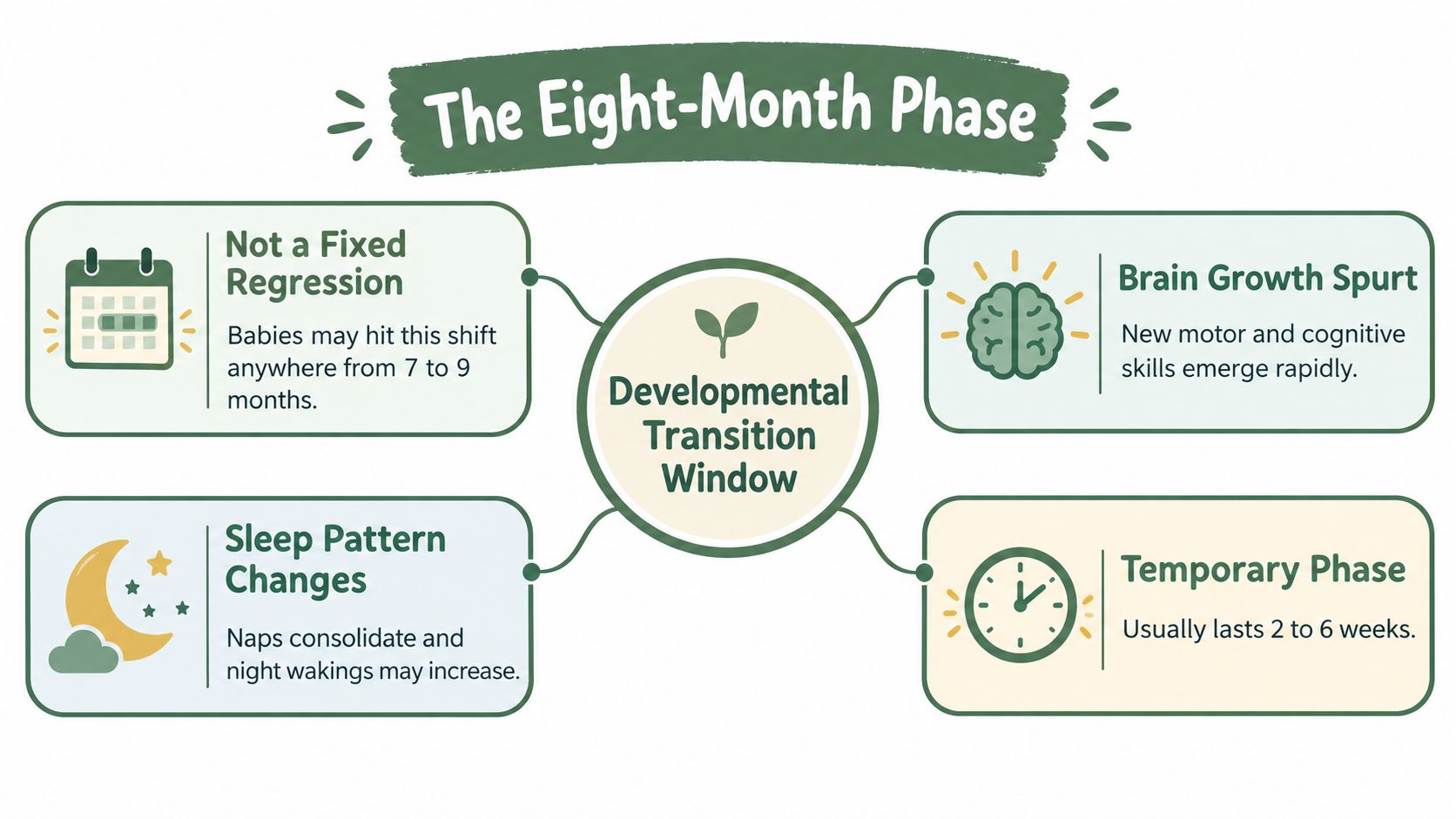
Think of this period as a developmental transition window, not a fixed event every baby hits on the same week. Cleveland Clinic notes that regressions vary by child and aren't shown by research to occur at fixed ages, as explained in Cleveland Clinic guidance on sleep regressions and fixed ages. Your baby's timing may cluster around new skills, a change in care, illness, travel, or a nap pattern that no longer matches their daytime sleep need.
Several developments tend to overlap here. Many babies are crawling, sitting more confidently, pulling to stand, or working hard to move from one position to another. Social awareness is also sharper. Your baby notices when a familiar caregiver leaves, protests more at separations, and wants a specific person at bedtime. At the same time, daytime sleep often consolidates toward two naps, so a missed or short nap has a bigger effect on the evening than it did when there was a third chance to catch up.
Why total sleep can look better than the night feels
Night waking varies a lot at this age. In one study of 8-month-old infants, parent reports showed an average of 3.8 nighttime awakenings in the waking group compared with 0.9 in the nonwaking group, while total sleep differed by only about 24 minutes across 24 hours, according to Hong Kong Family Health Service material summarizing infant night waking research. That gap matters. A baby can get broadly typical total sleep and still leave caregivers exhausted because the sleep is fragmented and resettling takes longer.
Motor development may be part of that fragmentation. A small study of 59 infants assessed at 8 months found greater nocturnal fragmentation alongside better gross-motor ability, though the broader evidence doesn't establish a conclusive causal relationship between infant sleep and development, as described in a systematic review of infant sleep and developmental outcomes. Don't read a busy night as proof of harm, and don't assume every waking is developmental. Feeding changes, illness, discomfort, and the sleep environment still deserve attention.
The label is shorthand. It doesn't tell you how long your baby's shift will last, which wake window is correct, or whether a clinician should be involved. Your own log over several days tells you more than the calendar does.
Signs Your Baby May Be in This Window
Look for a cluster of changes, not one bad night. A baby in this transition often wakes more often, takes longer to fall asleep, or needs a kind of help they hadn't needed for a while. The pattern is usually inconsistent at first. One nap stretches normally, the next ends early, and bedtime becomes the hardest settle of the day.
- More night wakings with harder resettling: Your baby may wake between sleep cycles and call out instead of drifting back to sleep. If this happens once after a busy day, it's ordinary variability. If it's paired with short naps and bedtime protest for several nights, you're likely seeing a broader shift.
- Short, skipped, or fought naps: A baby who's ready to consolidate daytime sleep may resist a late third nap or wake early from the second one. The clue is the rest of the day. Persistent fussiness before bedtime suggests the current spacing isn't giving enough daytime rest.
- Separation protest at bedtime or drop-off: Crying when you leave the room, reaching for one caregiver, or settling only when a familiar voice stays nearby can reflect growing social awareness. It's not manipulation, and it doesn't mean independent settling is gone for good.
- Skill practice in the crib: Rolling, crawling in place, sitting up, or pulling to stand when they should be winding down often means the body wants daytime practice. Floor time during awake periods helps more than trying to stop every movement at night.
- Feeding shifts around sleep: Some babies feed more distractedly in the day and seem hungrier at night. Note the timing rather than guessing. Questions about growth, feeding adequacy, or a sudden change belong with your pediatrician or a lactation professional.
Keep expectations realistic about resettling. By eight months, 60% to 70% of infants are able to settle themselves back to sleep, according to a pediatric review of infant sleep patterns and self-settling. That also means a substantial share still need help at least some of the time. Needing a hand on the chest, a feed, or a brief cuddle isn't a parenting failure. What helps is noticing whether help is occasional and brief, or whether every waking now needs a longer, different response from each caregiver.
Sample Two-Nap Schedules That Flex With Real Life
Most families do better with a flexible two-nap framework than with exact clock times. Aim to protect two solid daytime sleep periods, one mid-morning and one early afternoon, and watch the awake stretch before bedtime closely. If your baby wakes early and can't resettle, shift the whole day earlier rather than stretching the first awake window until they're overtired. If they wake later, let the naps move later with them.
The examples below are starting points, not rules. Use them to see spacing, then adjust based on sleepy cues, nap length, and how your baby settles at night. Families who want more detail on building the day can use this guide to an 8-month-old nap schedule alongside their own notes.
| Time of day | Earlier riser example | Later riser example |
|---|---|---|
| Wake for the day | 6:00 a.m. | 7:00 a.m. |
| First nap | 8:45 to 10:15 a.m. | 9:45 to 11:15 a.m. |
| Second nap | 1:15 to 2:45 p.m. | 2:15 to 3:45 p.m. |
| Bedtime routine starts | 6:15 p.m. | 7:15 p.m. |
| Asleep for the night | Around 6:45 p.m. | Around 7:45 p.m. |
When a nap goes sideways
A short first nap doesn't ruin the day. Offer the second nap a bit earlier, based on sleepiness rather than the planned time, and protect a calm wind-down before it. A short second nap is trickier because it leaves a long stretch before bed. In that case, bring bedtime earlier. Don't add a late catnap that leaves your baby alert at the usual bedtime and then overtired an hour later.
Practical rule: When daytime sleep falls short, move bedtime earlier. Don't borrow sleep from the evening with a late nap.
Watch the pattern across 5 to 7 days before making a bigger change. One early waking after a skipped daycare nap is a scheduling clue, not a reason to rebuild the whole routine. If naps are consistently short, bedtime settling is getting longer, and mornings are creeping earlier, adjust one piece at a time. Move the first nap slightly later, cap an overly long morning nap if the afternoon nap keeps failing, or bring bedtime forward on low-sleep days. Record each change so partners, grandparents, nannies, and daycare aren't testing different schedules on different days without knowing it.
What to Do When Your Baby Wakes at Night
Pick a response you can repeat when you're half awake, and make sure every adult uses the same first steps. The method matters less than the consistency across shifts. If one caregiver picks up and rocks for twenty minutes, another pats in the crib, and a third offers a feed at the first cry, your baby has to solve a new puzzle at every waking. A shared plan gives them one predictable pattern to learn.
| Approach | How it works | Best fit | Watch out for |
|---|---|---|---|
| Pick up and resettle | Lift, soothe until calm, then place back in the crib drowsy | Babies who escalate quickly and calm with contact | Can become the only way they resettle if you hold until fully asleep every time |
| Hands-on help in the crib | Pat, shush, or rest a hand on the chest without lifting | Babies who settle with closeness but don't need to be held | May frustrate a baby who's standing and can't get down yet |
| Chair reassurance that fades | Sit nearby with a calm voice, then move farther away over nights | Families who want presence without picking up at every waking | Needs patience and the same steps from each caregiver |
| Brief check and pause | Check safety and comfort, offer short reassurance, then give space to resettle | Babies who fuss briefly between cycles and often drift back | Not a fit if your baby is ill, in pain, or inconsolable |
My recommendation is simple. Choose one short routine for the first response: dim light, same phrase, same order of checks, then the settling help you've agreed on. For example, check that your baby is safe and not stuck, offer a hand and a quiet phrase, help them lie down if needed, and give them a brief chance to resettle before escalating help. If a feed is part of your plan, note the time and how settling went afterward so you can see patterns instead of debating them at 3 a.m.
Families dealing with very frequent wakings can also read this guide to a baby waking up every hour at night for troubleshooting ideas to discuss as a household. Whatever you choose, keep the sleep space the same. Don't add pillows, loose blankets, positioners, or incline to solve a waking. Comfort your baby, but put them back on a firm, flat surface on their back in an empty sleep space.
During the day, give new skills plenty of practice on the floor. A baby who can pull up but can't get down needs supervised chances to learn the way back. That practice won't fix every night, but it removes one common reason for a loud, stuck waking.
Keeping Caregivers on the Same Page
Shared care is where good sleep plans often fall apart. A partner handles the first waking one way, a grandparent rocks through the second nap, a nanny uses different words at put-down, and daycare sends home a paper sheet that never reaches the parent doing bedtime. Nobody's doing anything wrong. They're working with incomplete information.
Write the handoff down where everyone can see it. The note doesn't need to be long. Record the last nap end time, the last feed, any illness symptoms, new skills practiced, and the exact bedtime steps you're using this week. At night, add wake times and what helped. By morning, the next caregiver can see whether the early bedtime worked or whether the second nap needs to move.
Research on caregiver separation anxiety also points to why continuity matters. Higher maternal separation anxiety at eight months predicted later sleep onset and more night waking at 12 months in one study, as described in research on maternal separation anxiety and infant sleep. That's not blame, and it doesn't prove causation. It does support calm, predictable handoffs and shared cues so separations feel consistent rather than uncertain.

Cradlo is one example of a shared tracker built for that handoff. Parents, partners, grandparents, and nannies can each log from their own device, daycare can use a browser bookmark on an iPad without installing an app, and entries for sleep, feeds, and diapers sync into one timeline across iPhone, Android, and the web. It also offers English and Spanish, which helps when a Spanish-speaking grandparent or caregiver is part of the daily routine. A 7-day free trial is available on the monthly plan only, and there's no free plan, so decide after you've seen whether the shared log fits your household. Families comparing record-keeping approaches may find this overview of using a baby diary app useful.
Keep the shared language short. Same goodnight phrase, same first response at wakings, same place to check the last nap. Consistency across people teaches your baby what to expect, and it spares adults the whispered reconstruction of the day while a baby cries in the next room.
When to Call the Pediatrician
Call your pediatrician promptly if sleep disruption comes with signs that don't fit a normal rough patch. Trust a sudden change in your baby's behavior more than any label. A tracker can show patterns, but it can't diagnose illness or decide whether a feeding change is safe.
- Breathing concerns: Pauses in breathing, noisy or labored breathing, blue color, or unusual limpness need urgent medical advice.
- Illness signs: Fever, vomiting, poor feeding, fewer wet diapers, a rash that worries you, or persistent inconsolable crying should be discussed with a clinician.
- Growth or feeding worries: Poor weight gain, a sharp drop in intake, or pain with feeding belongs with your pediatrician or a lactation professional.
- A dramatic, persistent change: Sleep that keeps worsening, extreme distress at every put-down, or daytime behavior that feels markedly different deserves a professional conversation.
Keep safe sleep practices firm during hard weeks. The American Academy of Pediatrics recommends back sleeping on a firm, flat, noninclined surface, with soft bedding and loose objects out of the sleep area, and room-sharing without bed-sharing, as summarized in American Academy of Pediatrics safe sleep recommendations. At eight months, don't restart swaddling to reduce waking, since babies who can roll shouldn't be swaddled. If you're so tired you might fall asleep while holding your baby, put them down in their safe sleep space and ask another adult to take over if one is available.
What to Start Tracking Tonight
Start with three entries tonight. Log when your baby falls asleep, when each waking happens and what response you used, and when each nap ends tomorrow. Add the last feed before bed and one short note about the day, such as a new skill, a daycare transition, or possible illness symptoms.
After several days, read the pattern before changing the plan. You may see that early bedtimes follow short second naps, that one caregiver's phrase settles faster, or that wakings cluster after days with little floor practice. That's the useful information. Variability is normal at this age, and a confusing night doesn't erase the progress around it. Put the log where your whole care team can see it, keep the response steady, and give the pattern time to show itself.
If tonight's handoffs are living in text threads, paper daycare sheets, and tired memories, Cradlo gives parents, partners, grandparents, nannies, and daycare one shared timeline for sleep, naps, feeds, and the response that helped at each waking. Start by logging tonight's sleep onset, wakings, and nap end times in one place, then use that shared record to keep bedtime consistent across every caregiver.