Best Night Light for Feeding Baby: A Practical Guide
You're awake at 2 a.m., holding a hungry baby in one arm and trying to find a light with the other. The overhead fixture feels far too bright, your phone throws an uneven glare across the room, and you still need enough visibility to feed safely, check a latch or bottle, and settle everyone again. The best night light for feeding baby isn't the brightest lamp in the nursery. It's the one that gives caregivers usable visibility while keeping the room as close to nighttime as possible.
That choice also affects the whole care routine. A partner may take the next feed, a grandparent may need to change a diaper, or a nanny may prepare a bottle before sunrise. A simple light setup reduces guesswork, while a shared record such as a newborn wake-window guide can help caregivers understand the rhythm around those wake-ups without turning sleep into a source of guilt.
Table of Contents
- Why the Right Night Light Changes Feeds
- Understanding Brightness and Color Temperature
- How to Position and Dim Night Lighting
- Portable, Plug-In, and Hands-Free Options
- Night Lighting and Sleep Health for Babies
- Common Mistakes Parents Make With Night Lights
- How to Choose a Night Light for Your Routine
Why the Right Night Light Changes Feeds
A night feed usually starts without much sound. The baby stirs, you reach for them before the crying builds, and then you need to see what you're doing without announcing that morning has arrived. A bright ceiling light can wake the caregiver fully and make the baby more alert, while a phone screen may be awkward to hold and difficult to direct evenly.

The useful question isn't “How bright can this light be?” It's “What's the least light I need to complete this task safely?” Independent pediatric guidance recommends keeping nighttime light low. Alberta Health advises caregivers to keep the light low during nighttime care, and Australian parenting guidance notes that a dim night-light can help with feeding or settling without stimulating a child through the Academy of Breastfeeding Medicine's clinical protocol.
Visibility without a full reset
A warm, indirect glow can let you see the baby's face, feeding position, bottle or pump parts, and diaper area. It doesn't need to illuminate every corner of the room. In practice, a low-output light positioned away from the crib often works better than a lamp placed beside the baby's head.
The same principle supports shared caregiving. If the light has a simple control and stays in one predictable place, a partner, grandparent, nanny or daycare caregiver can use it without searching for a switch or turning on the main fixture.
Practical rule: Use enough light for safe care, then reduce it or switch it off as soon as the task is finished.
Night lighting isn't a sleep-training tool, and a carefully chosen lamp won't prevent every wake-up. It's a small environmental adjustment that can make feeding, pumping and diaper changes less stimulating for everyone.
Understanding Brightness and Color Temperature
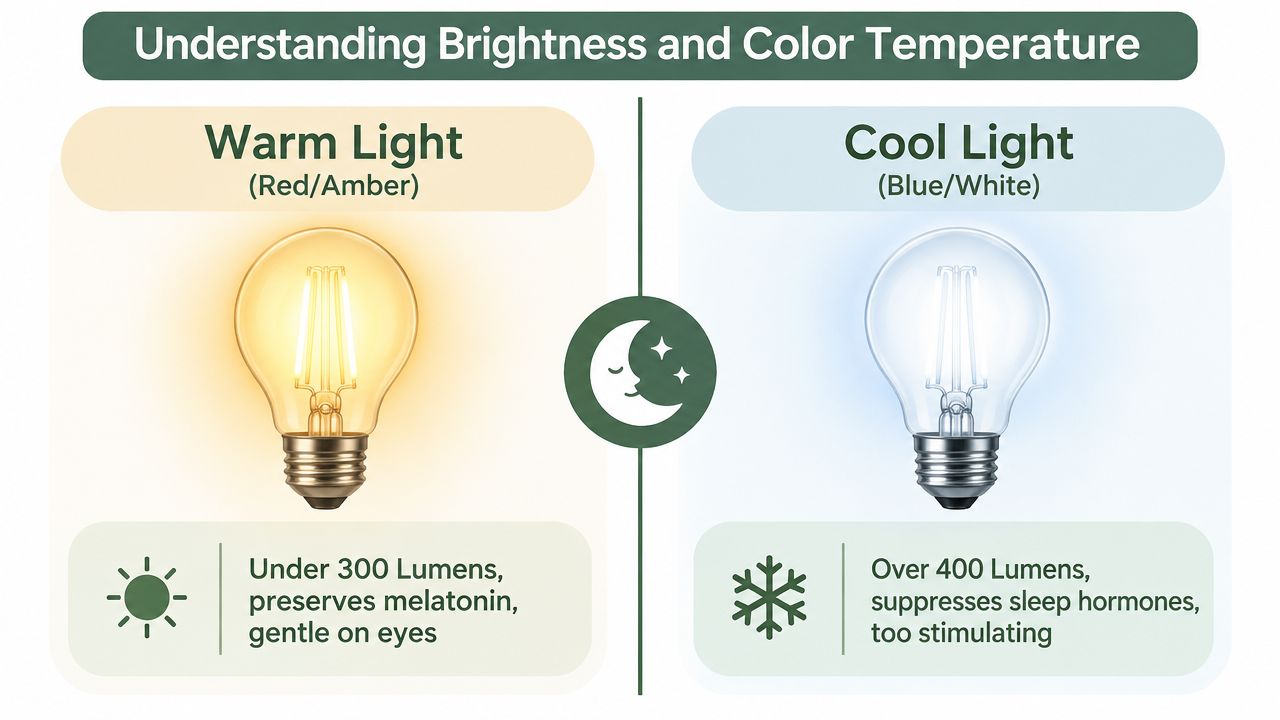
Brightness and color temperature solve different problems. A warm light can still feel harsh if its output is high, while a dim blue-rich light may keep the room visually alert. The useful target is enough illumination to check the latch, bottle, pump parts, or diaper without turning the feed into a full wake period.
Blue-rich light suppresses melatonin more strongly than warm wavelengths, as summarized in this guidance on infant light exposure. For overnight care, a low-output red, amber, or warm light is therefore generally a better fit than a bright white bulb.
Reading the color specification
Color temperature is measured in Kelvin. A warm low-CCT option around 2200K to 2700K is a practical starting point for feeds, set as low as possible while you can still see safely according to guidance on newborn nightlights. Higher temperatures, roughly 3500K and above, contain more blue content and may provide a stronger circadian signal.
Red and amber occupy the warmer end of the spectrum. Red may feel less intrusive for some families, while amber or orange can be easier to tolerate if red seems too stark.
What the room should feel like
The room should remain calm enough for both caregiver and baby to return to sleep. Look for:
- A very low minimum brightness: Several dimming levels are more useful than a simple on/off switch.
- A warm, amber, or red mode: “Warm white” can still look brighter or cooler than expected, so review product images carefully.
- No unnecessary light features: Color changes, projections, and animated effects add stimulation without helping you finish a feed.
- A soft or shielded source: Diffusion prevents a bare LED from shining directly into anyone's eyes.
Your eyesight, room layout, and feeding position will determine the final setting. Start dim, then raise the output only enough to see the task clearly. Shared caregivers should also be able to identify the correct mode quickly, especially during a feed when searching through colors or controls would add unnecessary light.
How to Position and Dim Night Lighting
A good bulb can become irritating if it's pointed straight at the crib. Placement often matters as much as the product specification because direct glare reaches the baby's eyes and can reflect off pale walls, sheets or crib surfaces.
Place the light low and to the side, such as on a stable dresser or shelf away from the crib. Aim it toward a wall or nearby surface rather than toward the baby's face. An indirect pool of light gives you enough contrast to see without making the entire room bright.
A simple setup
- Choose a stable location. Keep the light on furniture that won't tip and outside the baby's reach. Never put a lamp, cable or loose device inside or on the crib.
- Point the glow away. A wall, floor or shaded surface can soften the output. Avoid a bare bulb at eye level.
- Test from the feeding position. Sit where you normally nurse, bottle-feed or pump. If you can see the baby and your hands without squinting, the setting may be sufficient.
- Dim before switching off. If the light has gradual controls, lower it once feeding is complete, then turn it off when you no longer need it.
The medical guidance on nighttime care and infant sleep recommends minimizing nighttime tasks and using low-intensity red light when illumination is needed. That supports treating the lamp as a task light, not as permanent room décor.
Leaving even a dim light on all night may be unnecessary. If your baby settles comfortably in darkness, use the light only for feeding, pumping, diaper changes or a quick check.
Portable, Plug-In, and Hands-Free Options
The right form factor depends on where care happens. A fixed nursery light may work beautifully for a crib-side change, but it won't help much when someone feeds in a living-room chair or moves between bedrooms.
Plug-in lights
A plug-in model suits a stable nursery corner. It doesn't need charging, and its fixed location can make handoffs simple. The trade-off is limited flexibility. It may be too far from a feeding chair, and its lowest setting may still be brighter than you want.
Keep any plug-in unit and its cable well away from the crib. A permanent location is helpful only if it remains safe as the baby becomes more mobile.
Portable rechargeable lights
A rechargeable light is more useful for families who feed in different rooms, travel, or share nighttime duties. You can move it from the bedside to a nursing chair, then carry it to a changing area without trailing a cable.
Its weakness is maintenance. It needs charging, and a small portable lamp can become tempting for a curious toddler. Store it out of reach after the feed rather than leaving it beside the crib.
Clip-on and wearable options
Hands-free lights can help during pumping, burping or bottle preparation because both arms remain available. They're convenient, but the light's direction matters. A beam aimed down at your hands may be useful, while one aimed toward the baby's face can be unnecessarily stimulating.
For shared care, choose the option people will use correctly when tired. A simple touch control may be more practical than an app, voice command or complicated sequence of color modes.
Night Lighting and Sleep Health for Babies
A feed at 2 a.m. should let you see your baby's latch, skin color and surroundings without turning the room into daytime. That balance matters because infants learn day and night through repeated cues: daylight and normal daytime activity contrast with a darker, quieter night.
Research on preterm infants has linked exposure to a light-dark cycle with physiological development, including timely weight gain and shorter hospital stays, according to a 2022 multicenter review of infant light exposure. The finding does not show that a night light determines sleep for every baby. It supports keeping daytime brighter and nighttime care brief and dim.
In neonatal intensive care, cycled lighting from 20 to 250 lx has been used to represent day and night and support circadian entrainment. Home lighting does not need to reproduce those clinical conditions. The practical goal is a clear difference between daytime and nighttime, with enough light for safe care.
Brief care is different from an illuminated room
A short feed under warm or red light creates a different exposure from leaving a bright lamp on continuously. In one study of hospitalized preterm infants, brief nighttime exposure to red or white light showed no significant difference in rest-activity patterns, nighttime crying or weight gain. Care lasted less than 15 minutes at 3- to 4-hour intervals in the study of red and white nighttime lighting.
The result is reassuring, but brightness and timing still deserve attention. The American Academy of Pediatrics advises avoiding bright light near bedtime because cool-toned artificial light can suppress melatonin and make it harder for children to fall asleep in its guidance on infant light projectors and screens.
If night feeds are clustering into frequent wake-ups, our guide to why your baby wakes every hour at night explains patterns that may be contributing. Persistent sleep difficulty or feeding concerns warrant advice from a pediatrician or lactation professional. Lighting can support care, but it cannot diagnose or resolve a medical problem.
Common Mistakes Parents Make With Night Lights
Sleep-deprived caregivers usually choose convenience for understandable reasons. The problem is that a setup that works during the first week may become too bright, too exposed or too complicated once feeds happen in different rooms.
The first common mistake is leaving the light on continuously because switching it off feels like one more task. A better approach is a timer, a reachable but safe switch, or a portable light that you can turn off immediately after the feed.
Another is choosing a cool white bulb because it makes everything easy to see. It does make the task clearer, but the extra brightness and blue content can make the room feel more like daytime. The NIH review of nightlights reported that only 3 of 25 products consistently stayed below 5 lx melanopic EDI, a level linked in the review to circadian phase shifting and melatonin suppression in children. Only 2 products also met the under-1 lx nighttime recommendation for adults.
Small changes that help
- Move the beam away from the crib: Bounce light off a wall or floor instead of aiming it at the baby.
- Replace novelty with function: Rainbow colors, star projectors and animated effects may entertain an older child, but they aren't necessary for feeding.
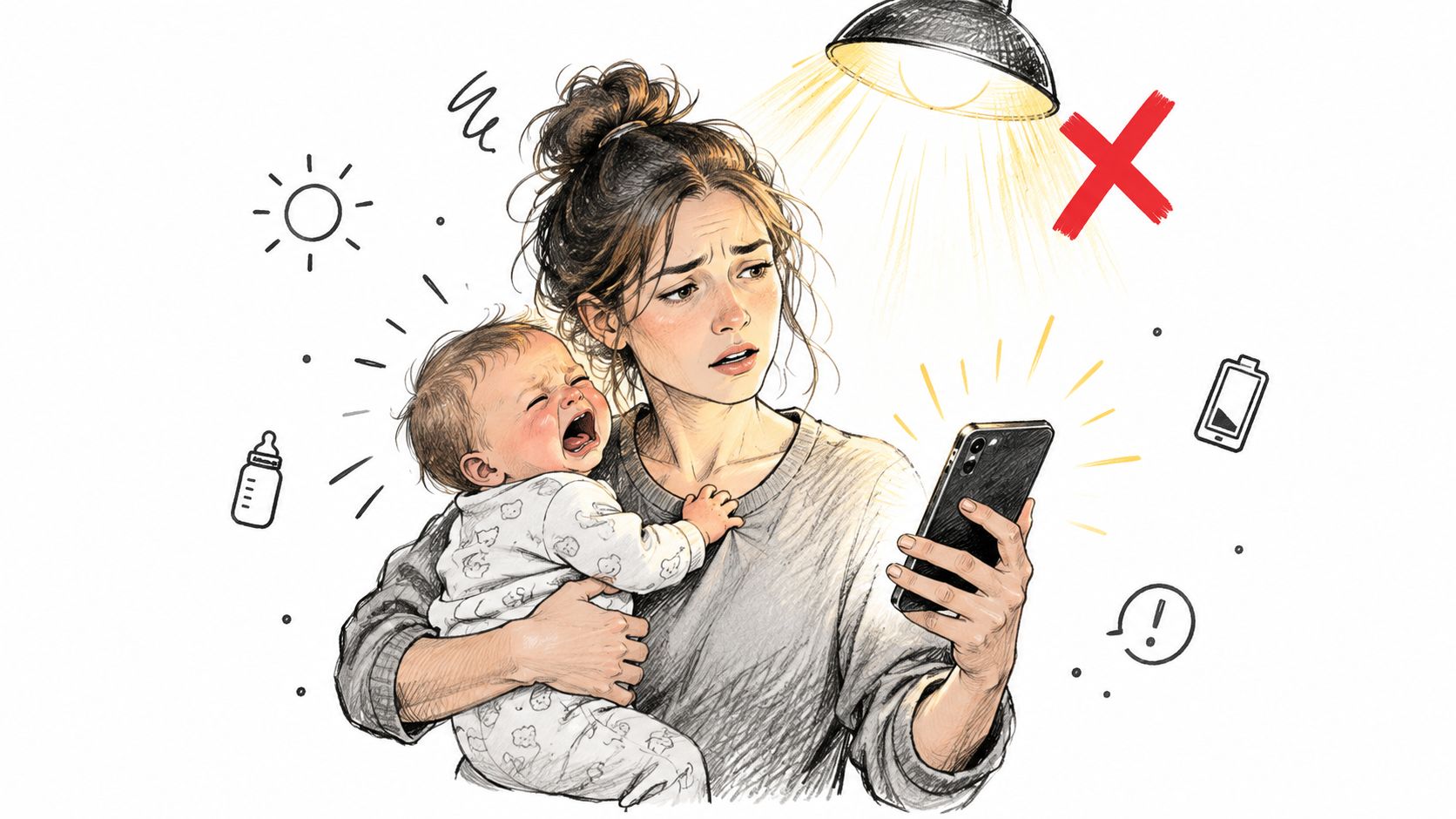
- Don't rely on the phone: A phone screen can be uneven, distracting and difficult to hold while caring for a baby.
- Check the lowest setting at night: A lamp that looks gentle in a bright store can feel harsh in a dark bedroom.
- Keep cords and devices out of reach: Fixed lights need careful cable routing, and portable lights need a safe storage place.
None of these adjustments requires perfection. Start with the most disruptive feature, usually direct glare or excessive brightness, and change that first.
How to Choose a Night Light for Your Routine
Choose the light around the caregiving task, not around nursery aesthetics. Ask who feeds, where feeds happen, whether pumping or diaper changes need extra visibility, and whether the same setup will work for a partner, grandparent, nanny or Spanish-speaking caregiver sharing the routine.
Match the light to the room
A fixed warm light can suit a crib-side nursery. A rechargeable amber light is more useful if feeds happen in a bedroom, living room or travel space. A hands-free option may help with pumping or burping, while a dimmable lamp offers the most control when one room serves several purposes.
Use this quick test before keeping a light:
- Color: Does it stay warm, amber or red at the setting you'll use?
- Brightness: Can you see the baby and complete the task without lighting the whole room?
- Position: Can it sit low, indirect and safely away from the crib?
- Control: Can a tired caregiver switch it on and off without an app?
- Handoffs: Will another caregiver know where it is and how dim it should be?
- Power: If rechargeable, will someone remember to charge it? If plugged in, can the cable stay out of reach?
A shared log can make those handoffs clearer too. Families coordinating feeds, pumping, diapers and sleep may find a baby feeding log template useful for recording what happened without waking another caregiver to ask.
The best night light for feeding baby is the one your household can position safely, dim reliably and switch off consistently. If you're unsure about feeding, latch, pumping, or your baby's sleep or health, contact a pediatrician or lactation professional rather than trying to solve the concern with lighting.
Cradlo gives families, nannies, grandparents and daycare caregivers one shared place to log feeds, pumping, diapers and sleep, with real-time syncing across iPhone, Android and the web. Visit Cradlo to try the monthly plan's 7-day free trial and make nighttime care handoffs easier without sharing logins.