Breast Pumping Log: A Calm Tracker for Working Parents
At 10 p.m., you're standing in front of the refrigerator with a bag of milk in your hand, trying to remember whether you pumped it after lunch or before the morning commute. Your partner has already packed tomorrow's bottles, daycare sent one home without a clear date, and nobody wants to guess which bag should be used first.
That's where a breast pumping log earns its place. It isn't a scoreboard for your milk supply. It's a shared record that answers practical questions: When was this expressed? Where is it stored? Who handled it? What happens next? For parents, partners, grandparents, nannies, and daycare staff, that information can prevent small gaps from becoming late-night confusion.
Table of Contents
- Why a Pumping Log Feels Pointless Until 10 p.m.
- What to Record in Every Pumping Session
- Storage Fields That Make Your Fridge Make Sense
- A Day in the Life of a Shared Pumping Log
- Sample Templates You Can Copy Tonight
- Reading the Numbers Without Spiraling
- Keeping the Log Going When Everyone Is Tired
Why a Pumping Log Feels Pointless Until 10 p.m.
The log often feels unnecessary while everything is happening. You pump, pour the milk into a bag, write a date if you have a pen nearby, and move on to the next task. The trouble appears later, when several containers look alike and your memory has to reconstruct a full day of pumping, transporting, feeding, and washing parts.
A daycare bottle comes home with no time on it. Your partner defrosts a bag that was meant for tomorrow. The morning's milk gets poured into the same pitcher as last night's milk, and suddenly nobody knows which expression date belongs to the combined supply. None of these mistakes means anyone is careless. They mean the system depends on too much invisible memory.
The useful question isn't “How much did I pump?” It's “Can the next caregiver understand this milk in ten seconds?”
Expressing milk has long been part of everyday infant feeding. In the U.S. Infant Feeding Practices Study II, conducted from 2005 to 2007, 85% of breastfeeding mothers with infants aged approximately 1.5 to 4.5 months reported expressing milk at least once since birth, while 5.6% never fed directly at the breast and instead fed expressed milk exclusively. The FDA summary of the infant feeding research helps put the routine in context. Pumping isn't an occasional emergency for many families. It's a recurring part of how milk moves between a parent, a container, and a baby.
Turn invisible work into a handoff
A personal note can tell you that you pumped at work. A handoff record tells your partner that the milk was labeled, placed in the cooler, and moved to the refrigerator. It tells daycare which bottle belongs to today and tells a grandparent whether the evening bottle is prepared or still needs to be thawed.
That distinction matters most in homes where several people share care. The record should follow the milk, not just the person who expressed it. Once you treat the log as a continuity tool, the fields become less about measuring yourself and more about helping the next person make a safe, informed decision.
What to Record in Every Pumping Session
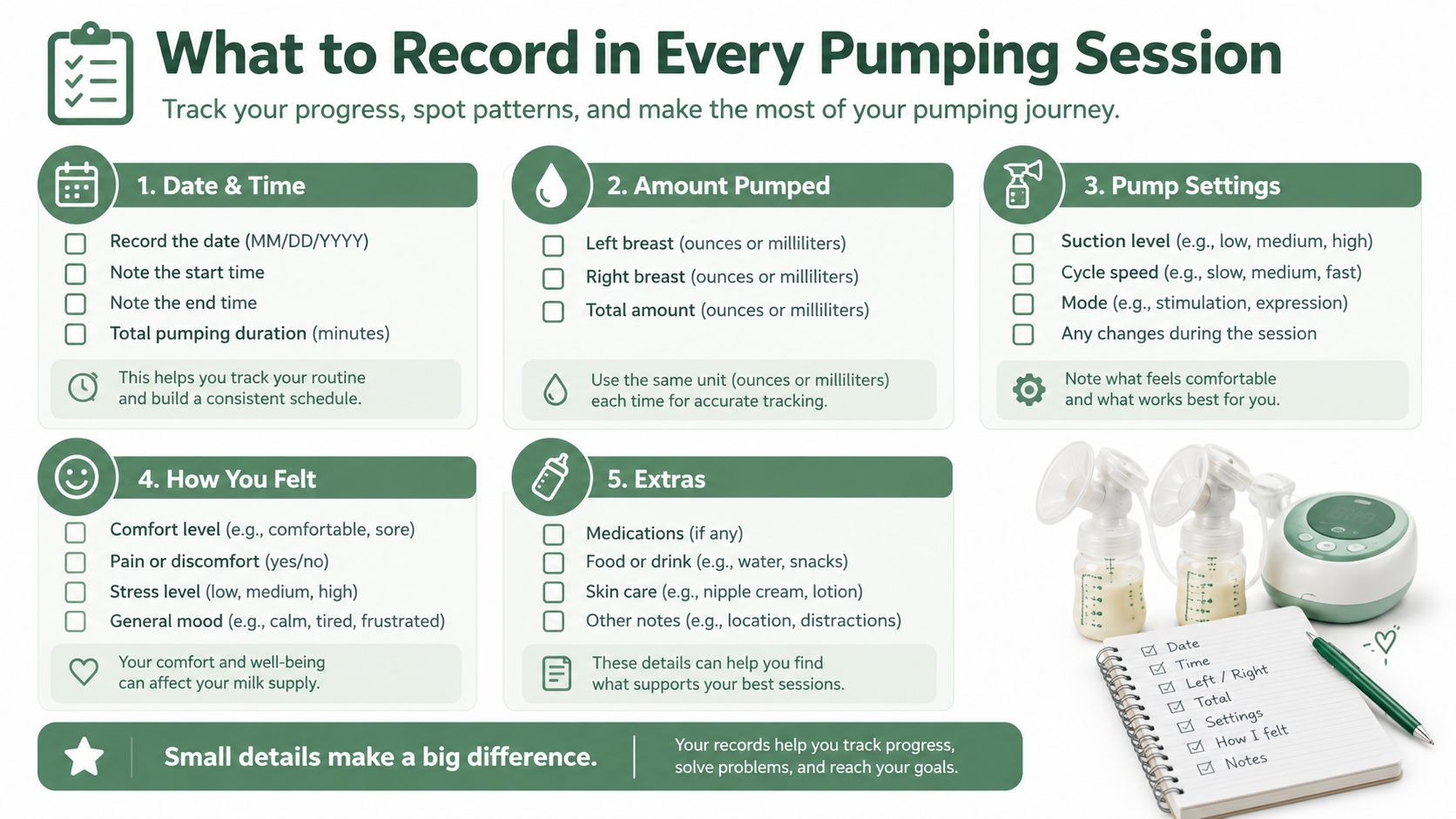
Start with the facts that make a session identifiable. Record the date, start time, end time, breast or breasts expressed, pumping method, flange or shield size, duration, volume from each breast, and total volume. These details let you compare sessions fairly instead of treating every number as if it came from identical conditions.
The side matters because one breast may produce differently from the other. Recording each side separately can help you notice a change that may relate to fit, comfort, or equipment rather than immediately interpreting it as a whole-body supply problem. The method matters too. A manual pump, single electric pump, and double electric pump create different contexts, so switching equipment midweek shouldn't make your notes impossible to interpret.
Add context, not pressure
Optional fields can explain why two similar sessions produced different amounts:
- Technique: Note warmth, massage, relaxation, or a change in settings.
- Timing: Record how long it had been since the previous pump or direct feed.
- Comfort: Add a short note about discomfort, shield fit, or a part that felt loose.
- Equipment: Mark whether you used a different pump, bottle, flange, or insert.
These notes aren't soft extras. They keep the number connected to the circumstances around it. WHO evidence describes one trial of 25 women in which pumping at least 4 times daily produced a higher mean expressed volume than pumping 3 or fewer times daily, 342 mL compared with 221 mL. The WHO evidence summary on methods of milk expression also identifies factors such as warming, massage, relaxation, appropriate shield size, earlier initiation, and greater expression frequency as helpful interventions, while noting that the evidence base was limited.
A practical row might look like this:
| Date | Start to end | Side | Method and fit | Volume | Storage | Notes |
|---|---|---|---|---|---|---|
| Tuesday | 10:15 to 10:32 a.m. | Left and right | Double electric, 24 mm shields | 90 mL total | Refrigerated | Meeting shortened session, no discomfort |
Keep the session record separate from the container record. The session explains what happened at the pump. The container record explains where the milk went after you sealed it.
Storage Fields That Make Your Fridge Make Sense
A pumping log also works as a food-safety record. Each container should have an expression date and time, volume, storage location, and status. Useful status labels include fresh, chilled, frozen, thawed, warmed, fed, and discarded.
For healthy full-term infants, the CDC breast milk handling guidance states that freshly expressed milk can stay at room temperature of 77°F (25°C) or colder for up to 4 hours, in a refrigerator at 40°F (4°C) or colder for up to 4 days, and in a freezer for about 6 months as best practice, with up to 12 months acceptable. Milk transported in an insulated cooler with frozen ice packs can remain there for up to 24 hours.
| Storage location | Temperature | Time window |
|---|---|---|
| Room temperature | 77°F (25°C) or colder | Up to 4 hours |
| Refrigerator | 40°F (4°C) or colder | Up to 4 days |
| Freezer | Best used within about 6 months | Up to 12 months acceptable |
| Insulated cooler with frozen ice packs | Kept cold with frozen packs | Up to 24 hours |
Label for the next person
Once frozen milk is completely thawed in the refrigerator, it should be used within 24 hours. Milk brought to room temperature or warmed should be used within 2 hours, and leftover milk should be used within 2 hours after feeding ends. Previously thawed milk shouldn't be refrozen.
That's why “in the fridge” isn't detailed enough. A caregiver needs to know whether the milk is newly expressed, chilled, thawed, warmed, or leftover. Use small 2 to 4 oz portions to reduce waste when a baby doesn't finish a bottle, and store containers toward the back of the refrigerator rather than in the door. Label the bag as soon as it's sealed, before the next task interrupts you.
Common logging failures are predictable. A pitcher may combine milk from different expression dates without preserving the oldest date. Someone may enter the amount left after feeding instead of the amount pumped. Leftover milk may be recorded as if it were newly expressed. A traceable record prevents those categories from blending together. For a practical overview of session planning and pumping details, see this guide to breast pumping.
A Day in the Life of a Shared Pumping Log
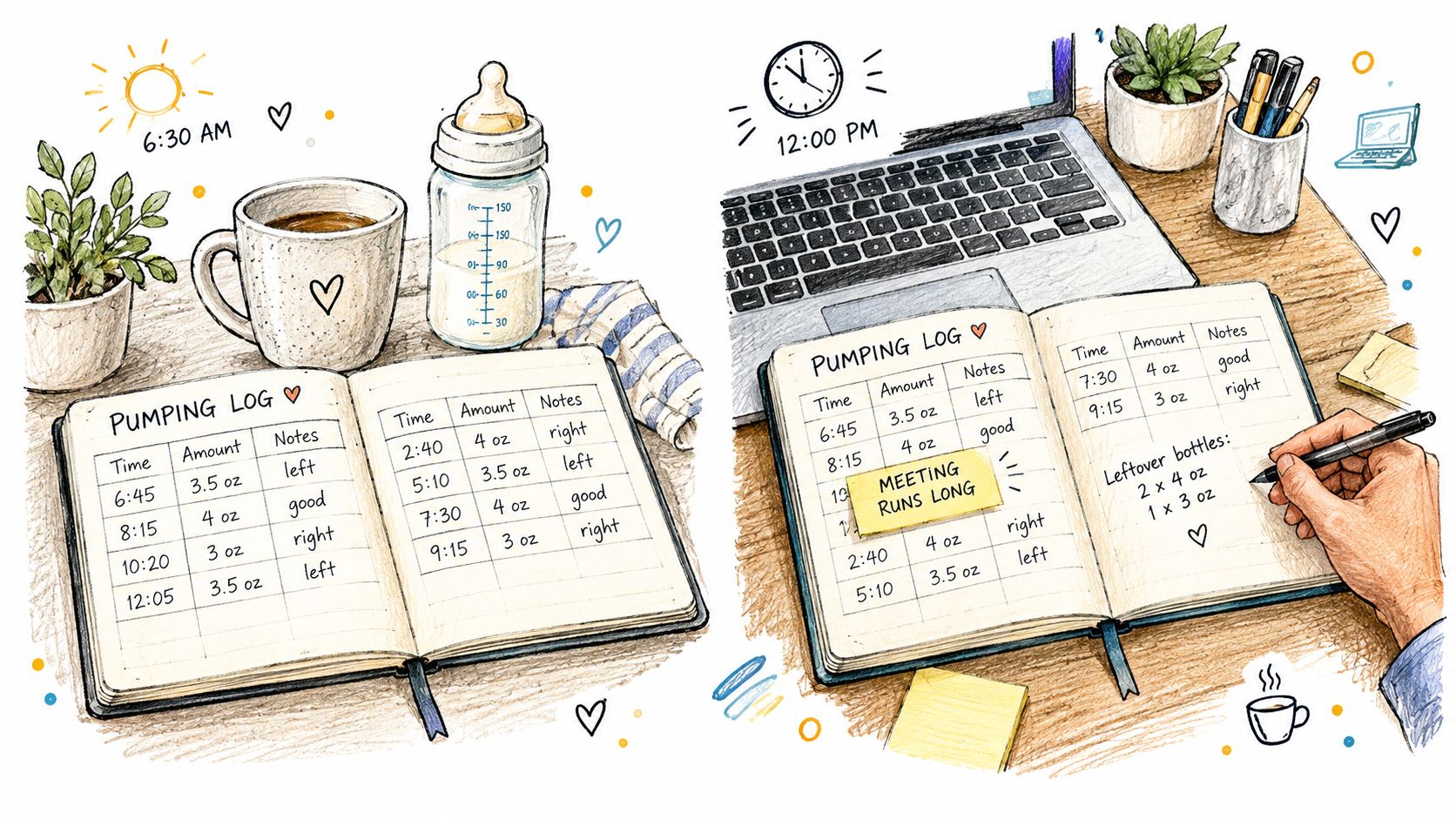
Wednesday starts before drop-off. The parent pumps at home, records the start and end time, enters the amount from each breast, and labels the container before packing it in the cooler. The partner checks the clean pump parts, marks the morning bottle as prepared, and records that yesterday's leftover milk was discarded rather than returning it to the refrigerator.
At the office, a meeting runs long. The parent manages a shorter session, records the partial duration and collected volume, and adds a note that the usual routine was interrupted. That note prevents tomorrow's review from turning one low session into a dramatic conclusion. The milk is labeled at the desk, placed in the insulated cooler, and marked for refrigeration when it reaches home.
The handoff is the point
The partner sees the shared entry and knows which container belongs to the evening feed. When grandparents arrive, they don't need to send a string of messages asking whether the bottle is ready. The log shows the milk's status, its location, and who last handled it.
A shared baby feeding log becomes more useful than a private note. The session fields still matter, but the operational fields carry the day: clean parts packed, next pumping location, container labeled, milk transported, bottle prepared, caregiver notified.
No workday follows the ideal schedule. A commute stretches, a meeting cuts a session short, or a clean flange stays on the kitchen counter. A useful record can hold a partial session without turning it into a failure. It documents what happened so the next person can work with reality.
Sample Templates You Can Copy Tonight
Start with a handoff log that someone can use at a glance. Tape it inside a kitchen cabinet or place it beside the refrigerator, where the next caregiver will see it. A useful template records the milk's movement, not just the amount expressed.
| Date | Started | Ended | Side | Volume | Storage | Status |
|---|---|---|---|---|---|---|
| Wed. | 7:05 a.m. | 7:21 a.m. | Both | 100 mL | Refrigerator shelf | Chilled |
| Wed. | 1:10 p.m. | 1:19 p.m. | Both | 55 mL | Office cooler | Transporting |
Add a notes line for details that affect the next handoff: “meeting cut this short,” “left shield at home,” “partner packed clean parts,” or “daycare received labeled bottle.” Choose paper if every caregiver passes the same kitchen counter daily. Choose a shared digital log the moment a bottle leaves the house.
A shared digital version
A shared digital log keeps the same fields available across phones and a web browser. Use separate identities for the parent, partner, nanny, grandparent, or daycare instead of one shared password. The timeline then shows who logged the session, who packed the bottle, and who recorded intake. If you want the same fields in a shared format, this baby feeding log template shows how the columns translate to a shared timeline.
A QR-code invite keeps setup simple. The parent generates the invite, each caregiver scans it once, and that person signs in under their own name. A Spanish-speaking family can choose a tool that supports both English and Spanish, so everyone caring for the baby can read the record.
Here's a worked example:
- Parent: Logs a 7:05 a.m. session, records 100 mL, labels the container, and marks it chilled.
- Partner: Logs that the bottle was packed for daycare and notes that clean pump parts are in the drying rack.
- Daycare: Records that the labeled bottle was received and later notes how much the baby drank.
A tool such as Cradlo can put pumping sessions, storage status, bottles, cleaning notes, and caregiver handoffs on one shared timeline. The useful feature is accountability: the next person can see where the milk is, what has been done, and what still needs attention without reconstructing the day from texts.
Reading the Numbers Without Spiraling
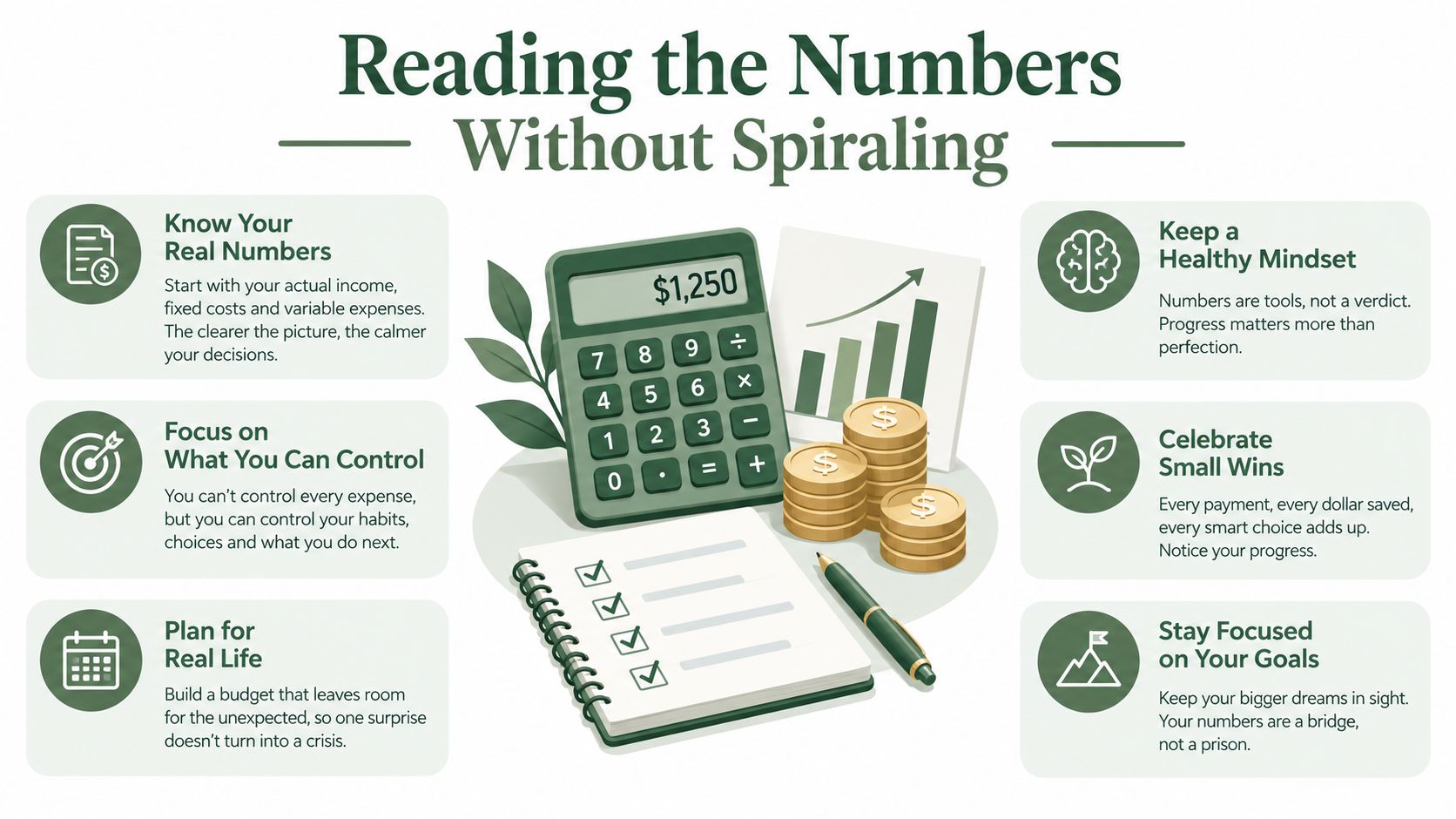
A lower session output doesn't automatically mean your supply has declined. It may follow a missed pump, a long meeting, uncomfortable equipment, a stressful day, or a baby who nursed more overnight. Treat the log as a pattern tool, not a daily verdict.
Current lactation guidance describes expressed volumes rising from drops to a few ounces per feed after the early postpartum period, with full production commonly reached around five weeks and a cited typical daily range of approximately 750 to 1,035 mL. The breast milk expressing and storage protocol gives that context, but a single session can't be judged fairly against a daily range.
Compare like with like
Look at your own baseline across comparable sessions. A morning double-pump session should not be casually compared with a rushed afternoon session after a long gap. Keep three categories separate:
- Milk expressed: What came out during pumping.
- Milk fed: What the baby consumed.
- Milk stored: What remains available for later.
Those totals answer different questions. A parent may express less because the baby fed directly more often, or store less because the baby drank more. A good log makes those relationships visible without turning them into a pass-or-fail test.
Persistent changes deserve a conversation with a lactation professional or pediatrician. Don't diagnose low supply from a single entry, and don't change a feeding routine based only on a chart. This log is for coordination and context, not medical advice.
Keeping the Log Going When Everyone Is Tired
The system has to survive ordinary exhaustion. Log at the pump instead of trusting yourself to remember an hour later. Label the container when you seal it. Record the storage status before you put the milk away. If the app calculates elapsed time and storage windows, let it handle the date math instead of doing it in your head.
Review the pattern weekly, not after every session. A daily check can make normal variation feel louder than it is, while a weekly review gives you enough context to notice repeated equipment issues, missed handoffs, or containers that keep coming home unlabeled. Health questions belong with a lactation professional or pediatrician, not a late-night search spiral.
A working log isn't a perfect log. It's one the next caregiver can understand quickly.
Keep the minimum routine visible:
- Log the session: Start, end, side, method, and volume.
- Label the container: Date, time, amount, and destination.
- Update the status: Fresh, chilled, frozen, thawed, warmed, fed, or discarded.
- Record the handoff: Who packed it, received it, or prepared the bottle.
- Review calmly: Look for patterns and context, not a daily score.
Cradlo offers a shared timeline for pumping, storage, feeding, cleaning notes, and caregiver handoffs across parents, partners, grandparents, nannies, and daycare. It includes a 7-day free trial, then Plus at $4.99 a month or $49.99 a year, or Lifetime at $99.99. There's no free plan, so the trial is the period to decide whether the shared workflow fits your household.
The log should reduce mental load, not add another standard you can fail.
If you want one shared place for pumping sessions, milk status, bottles, and caregiver handoffs, try Cradlo's 7-day free trial and invite the people who handle feeding. Visit Cradlo to see how the shared tracker can keep parents, nannies, grandparents, and daycare aligned.