Breast Pumping How to: A Calm Guide for Work and Home
Pumping works best when it follows the baby's usual feeding rhythm, and established routines commonly reach about 700 to 980 milliliters per day by days 10 to 14. Individual targets vary, so questions about supply, pain, or your baby's health belong with a pediatrician or lactation professional.
You may be pumping beside a sleeping baby, in a workplace room between meetings, or at a kitchen table while your partner gets the next bottle ready. The pump itself is only one part of the job. Milk also needs to be labeled, chilled, cleaned up, handed over, and matched to the right baby and caregiver.
Good breast pumping how-to advice should therefore cover both technique and coordination. A routine can be medically sound and still feel impossible if nobody knows which bottle was pumped first, whether the parts were washed, or what happened during the last feeding.
Table of Contents
- What Effective Breast Pumping Actually Looks Like
- Choosing a Pump and Getting Flange Fit Right
- A Practical Pumping Session from Start to Finish
- Storage, Cleaning, and Caregiver Handoffs
- Pumping at Work, While Traveling, and During Common Setbacks
- When to Adjust Your Routine and Seek Support
What Effective Breast Pumping Actually Looks Like
A parent may pump before work, leave labeled milk in the refrigerator, and hand the next task to a partner or nanny. The pump is only one part of that routine. Milk must also be identified, chilled, cleaned up, offered to the right baby, and recorded so daycare or another caregiver can continue without guessing.
Effective pumping supports lactation and shared feeding when a parent and infant are not feeding directly at the same time. The World Health Organization recommends guidance on expressing milk, including manual expression and pump use, within breastfeeding support. Its breastfeeding support guidance recognizes manual and mechanical expression as valid approaches.
A workable routine belongs to the whole care network. One person may express the milk, another may refrigerate it, and someone else may prepare the bottle or note what the baby drank. Clear communication matters as much as the equipment.
Start with a shared record
Keep the record short enough for every caregiver to use:
- Session time: Note when expression started, particularly when responsibility changes during the day.
- Method and breast side: Record whether the session used an electric pump, manual pump, or hand expression, and which side was used.
- Volume: Log what was expressed without treating the amount as a score.
- Milk status: Mark whether the container was refrigerated, frozen, thawed, or offered.
- Caregiver identity: Record who handled the milk or prepared the bottle.
This log prevents duplicate entries and reduces questions during handoffs. It can also give a lactation professional useful context about output, pain, or breast comfort. Families tracking direct feeds may use infant feeding patterns for context, without turning every entry into a performance measure.
Practical rule: Record enough to make the next handoff clear, but not so much that logging becomes another task nobody can maintain.
Pumping can change with the setting. A parent might use an electric pump at home, hand expression during a difficult commute, or a manual pump during a power outage. A sound routine combines comfort, a rhythm suited to the feeding situation, safe handling, and instructions another caregiver can follow.
Choosing a Pump and Getting Flange Fit Right
The right pump is the one that fits the job you have. A double electric pump may suit frequent sessions or exclusive expressing, while a manual pump can be quieter and easier to carry. A wearable-style pump may help during movement or a busy day, but convenience doesn't guarantee effective milk removal for every parent.
Ask practical questions before focusing on features:
- Will this be your main pump or a backup?
- Can you clean its milk-contact parts where you plan to use it?
- Do you have reliable access to power?
- Can you adjust stimulation and expression settings?
- Is replacement tubing, a valve, or a membrane easy to obtain?
- Does the pump allow a comfortable flange size or insert?
A lactation professional can help assess the setup, particularly if pumping is replacing direct feeds, output is repeatedly low, or the breast feels poorly drained. A pump that works well for one parent may not suit another, and the best arrangement can change as the body and routine change.
Use comfort as a technical signal
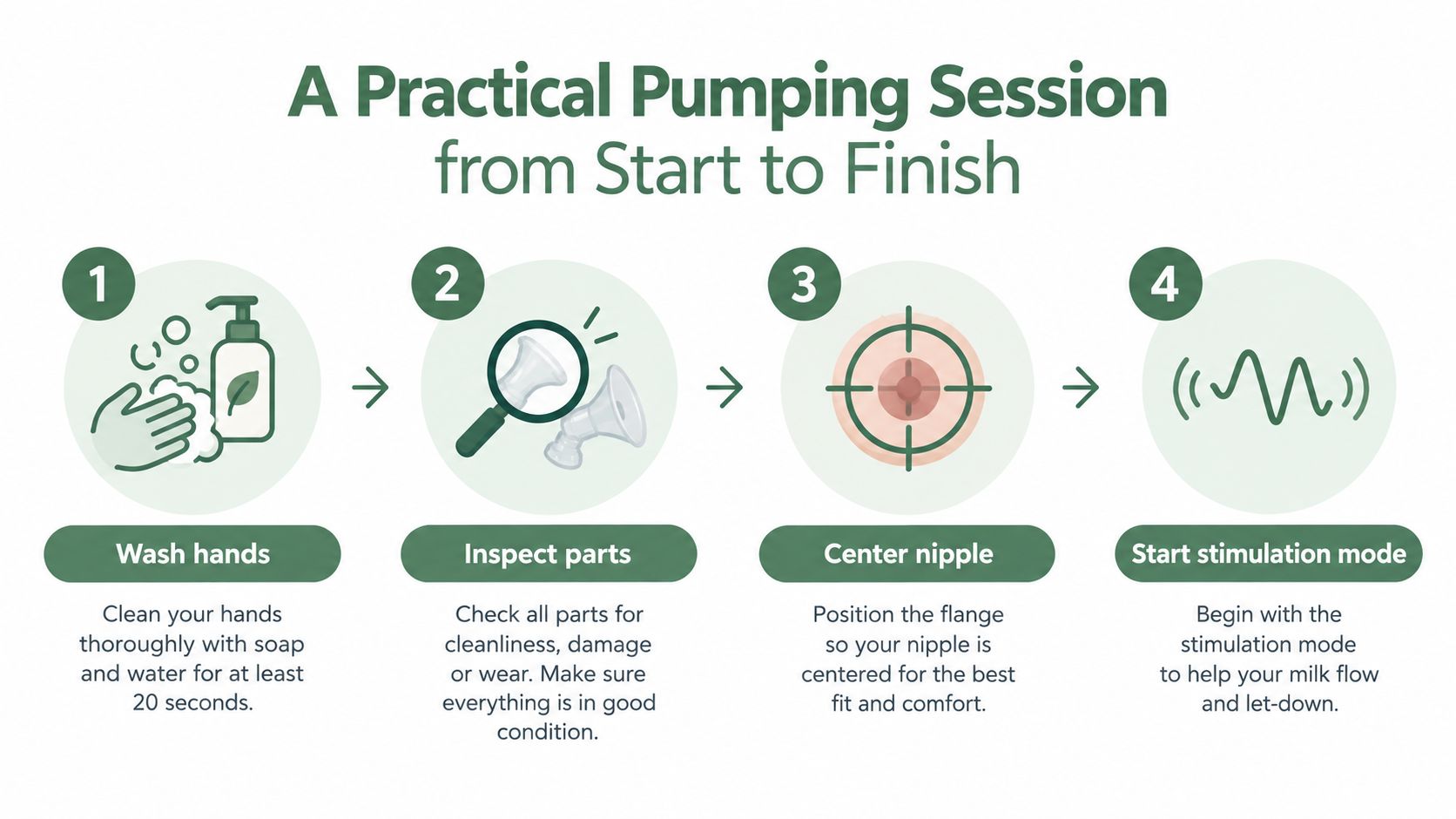
Before pumping, center the nipple in the flange rather than pulling the breast toward the tunnel. The nipple should move freely, with limited rubbing against the sides. A flange that is too large or too small can make the session uncomfortable and may interfere with milk removal.
Pay attention to these signals:
- Pain: Pumping shouldn't feel like something you have to endure. Pain suggests that fit, vacuum, position, or another part of the setup needs review.
- Blanching: A nipple that turns pale during suction may be experiencing excessive pressure.
- Rubbing: Persistent contact with the flange tunnel can irritate the nipple.
- Swelling: Ongoing edema or a visibly compressed nipple can indicate that the setting or fit isn't working.
- Repeated poor removal: If the breast still feels full after many sessions, discuss the pattern with a lactation professional.
The Academy of Breastfeeding Medicine describes a sequence that starts with low-suction stimulation, moves to the highest comfortable vacuum, and uses compression or hand expression at the end. It also notes that comfort is an important endpoint, not a luxury. Keep a brief record of the flange, settings, session duration, and result so you can identify a pattern instead of changing several variables at once.
A Practical Pumping Session from Start to Finish
A parent returning to work may settle into a quiet room, connect the bottles, and notice that one membrane is not seated correctly. That small inspection can prevent a frustrating session and gives the parent a clear detail to share with a partner, nanny, or daycare if milk removal changes.
Wash your hands first. Check the tubing, valves, membranes, flanges, connectors, and collection bottles for damage, residue, or incorrect assembly. Center the nipple in the flange, then begin in stimulation or let-down mode with low suction.
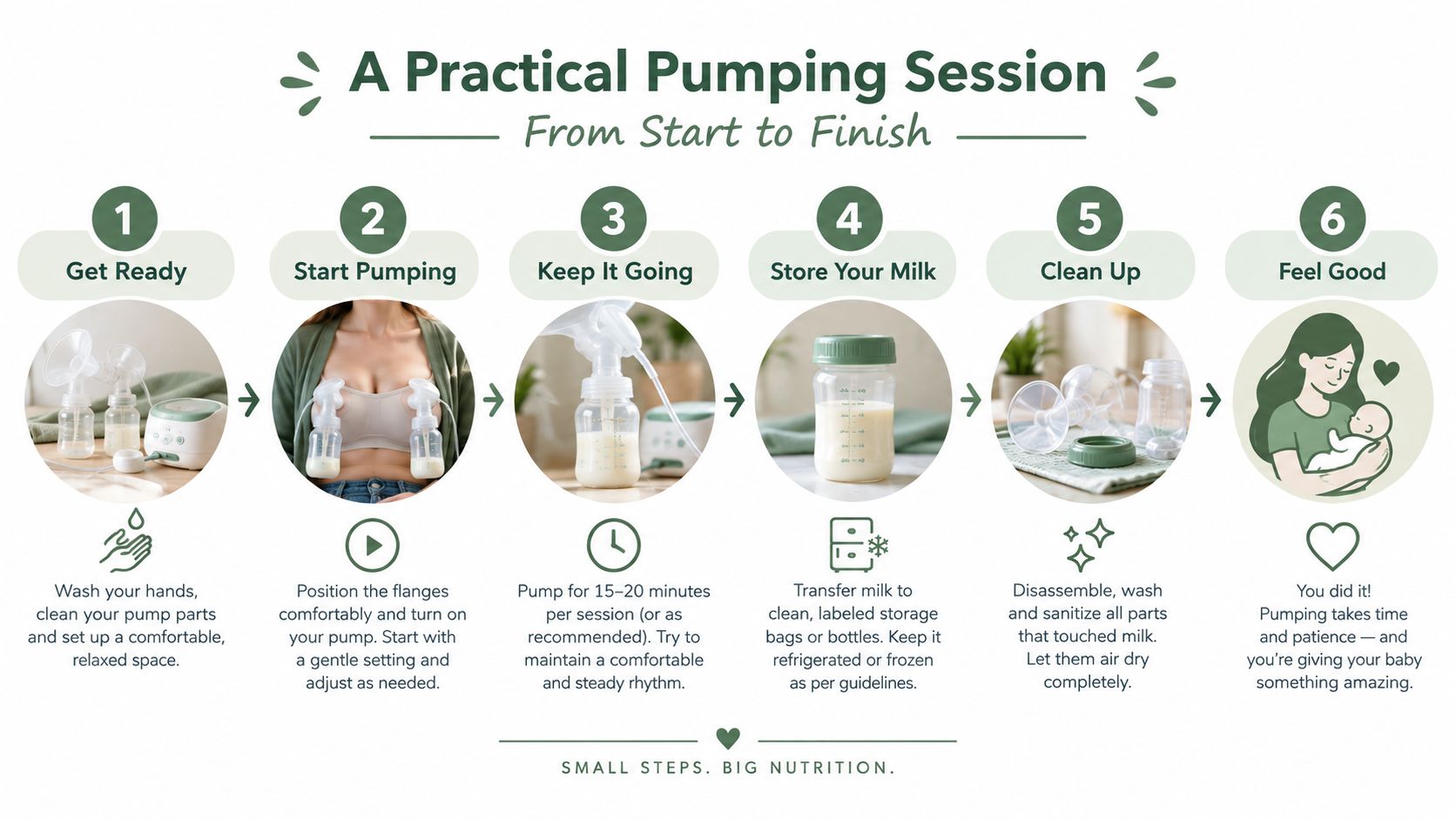
When milk starts flowing, change to expression mode. Raise the vacuum only to the highest level that remains comfortable. Stronger suction does not automatically remove more milk. Pain, blanching, rubbing, or continuing swelling indicate that the vacuum should be lowered and the flange position or fit checked again.
Let the session follow the flow
WHO training guidance describes sessions of approximately 10 to 15 minutes per breast, repeated about every three hours when regular expression is needed. Use those figures as starting points, not fixed instructions. Milk flow, the infant's age, time apart, comfort, and medical circumstances all influence the right pattern.
A shared log can make those adjustments easier. Record the time, side or sides pumped, approximate result, settings, and any discomfort. A partner or daycare caregiver can then understand the plan without relying on memory or asking the pumping parent to troubleshoot the same detail repeatedly.
As flow slows, gentle breast compression or hand expression may help complete the session. To express by hand, massage gently, place the fingers back toward the chest, then compress and release the breast tissue. Avoid pulling or sliding the nipple. The pressure should come from the breast, not from tugging the nipple.
WHO training materials also describe hand expression as a process that may take 20 to 30 minutes, particularly during the first few days when volumes are small. One suggested sequence is to express each breast for at least 3 to 5 minutes until flow slows, switch sides, and repeat. Treat this as a practical pattern rather than a required duration. Stop when milk flow, comfort, and the feeding plan indicate that the session is complete.
A session that feels comfortable and can be repeated tomorrow is usually more useful than a strenuous session that leaves you sore.
When pumping replaces direct feeds, a frequency that broadly resembles the infant's usual pattern may support production better than occasional, high-intensity sessions. For parents who exclusively express, established daily volume targets vary between individuals. Use the log to identify changes and bring useful information to a lactation professional, rather than treating one session or one day as a pass-or-fail score.
Storage, Cleaning, and Caregiver Handoffs
A caregiver opens the refrigerator and finds three unlabeled containers. Nobody knows which was expressed first, whether one has been thawed, or who should offer it. Clear storage and handoff habits prevent that uncertainty from landing on the pumping parent.
After each session, cap the container, label it with the date and time, and move it to the refrigerator, freezer, or an iced cooler. Store portions close to one feed, so a partner, nanny, or daycare caregiver does not thaw more milk than the baby is likely to take.
The WHO provides these temperature-based reference points:
| Storage condition | Guidance |
|---|---|
| Room temperature of 16 to 29°C, or 60 to 85°F | Four hours is optimal. Six to eight hours may be acceptable under very clean conditions. |
| Refrigerator at approximately 4°C, or 39.2°F | Four to eight days is described as optimal. |
| Freezer below −4°C, or 24.8°F | Six months is optimal, while 12 months may be acceptable. |
These limits appear in the WHO breast milk storage guidance. The CDC uses a more conservative routine framework: up to four hours at room temperature of 77°F or colder, up to four days refrigerated, and about six months in a freezer for best quality, as described in its breast milk handling recommendations. Choose the guidance that fits the storage conditions, and ask a pediatrician or lactation professional about a temperature interruption or a baby with specific health needs.
Make every handoff visible
A shared record should answer five questions without requiring a text exchange:
- When was the milk expressed?
- Where is the container now?
- When was it thawed?
- Who prepared or offered it?
- What remains after the feeding?
Use the oldest milk first. Frozen milk can thaw gradually in the refrigerator and be used within 24 hours, or thaw in warm water and be used within one hour, according to the WHO guidance. Do not boil milk or heat it in a microwave. A microwave can create dangerously hot spots, while boiling can affect some milk properties. The handoff note should also state whether milk needs warming and how to handle leftovers according to the family's agreed plan.
Cleaning needs an equally visible routine. Separate every part that touches milk or the breast, including flanges, connectors, valves, membranes, and bottles. Rinse away residue under running water, then wash the parts as soon as possible with hot water and soap in a dedicated basin. A dishwasher is another option when the manufacturer allows it.
The CDC recommends a clean kit for each workplace session. If full washing cannot happen immediately, rinse the parts, place them in a sealed bag, and refrigerate them for a few hours as a temporary fallback. Refrigeration does not replace washing. Let every part air-dry fully on a clean, protected surface before reassembly. The CDC pump hygiene guidance covers this process and the need to clean each milk-contact component.
A dishwasher with hot water and heated drying or sanitize settings, boiling cleaned parts for 5 minutes, or a microwave or plug-in steam system may also work when used according to the manufacturer's instructions, as described in the CDC breast milk preparation guide. A shared tracker can record cleaning completion and caregiver identity alongside pumping and feeding entries. Use this baby feeding log template for a consistent handoff record, and keep a paper note on the refrigerator as a backup.
Pumping at Work, While Traveling, and During Common Setbacks
Many pumping problems aren't technique problems. A parent may understand flange fit perfectly and still lack a private space, a sink, dependable refrigeration, predictable breaks, or a supportive supervisor. Workplace and childcare arrangements can either make a routine manageable or force the parent to improvise every day.
A realistic plan compares options rather than assuming ideal conditions:
| Challenge | Practical alternative |
|---|---|
| No electricity | Use hand expression or a manual pump. |
| No refrigerator | Use an insulated cooler with frozen packs and record when the milk entered it. |
| Unpredictable breaks | Keep the equipment assembled according to manufacturer guidance and prepare a short, repeatable setup. |
| Travel or commuting | Carry labeled containers, cooling supplies, and a clear handoff note. |
| Meeting-heavy days | Tell the relevant supervisor or coworker what break is needed instead of relying on last-minute explanations. |
| Parts cannot be washed immediately | Rinse them when possible, refrigerate them temporarily, and complete thorough cleaning as soon as you can. |
CDC pumping guidance for work and emergencies specifically identifies hand expression and a manual pump as options when electricity isn't available. It also encourages families to identify clean washing and storage locations before an emergency occurs.

A cooler is not just a container. It becomes part of the chain of custody. Note when milk was pumped, when it was placed in the cooler, who transported it, and when it reached a refrigerator. The same approach works for shift work, airport travel, a long train journey, or a day when the planned break disappears.
A shared app can keep those notes connected to the feeding record. Cradlo lets parents, partners, grandparents, nannies, and daycare caregivers log pumping and feeding activity under their own identities, with English and Spanish support and offline entry that reconciles when a connection returns. Its pumping schedule guidance can sit alongside the actual record, rather than forcing a parent to pretend every day follows the original plan.
When to Adjust Your Routine and Seek Support
A routine deserves review when pumping causes persistent pain, milk removal remains poor, low-output sessions happen repeatedly, or caregivers keep losing track of containers and feedings. A log can show whether the difficulty relates to fit, settings, timing, cleaning, storage, or handoffs, but it can't diagnose the cause.
Bring session times, breast sides, settings, volumes, and comfort notes to a lactation professional. Bring questions about your baby's intake, health, or feeding needs to a pediatrician or lactation professional. The numbers are context for a conversation, not a score you need to pass.
Successful pumping is steady, coordinated care. Comfortable equipment, a repeatable rhythm, safe storage, clean parts, and clear communication matter more than achieving a perfect day.
Cradlo gives families one shared place to record pumping sessions, milk status, bottles, cleaning notes, and caregiver handoffs across parents, nannies, grandparents, and daycare. Start the 7-day free trial on the monthly plan by visiting Cradlo, then see whether a shared timeline makes your next pumping day easier to manage.