Day Care Summary: A Practical Guide for Parents and Teachers
It's 5 p.m. Your child is tired, pickup is quick, and you're already trying to work out dinner and bedtime. The answer to whether the evening needs a change may be buried in a rushed handoff: a nap ended later than usual, lunch barely got started, or your child seemed unsettled after pickup.
A useful day care summary gives parents, partners, grandparents, nannies, and daycare staff the same clear account of the day. It isn't paperwork for its own sake. It's a practical handoff that helps everyone respond to what happened, without making families feel they need to reconstruct the day from memory.
Table of Contents
- Why the Day Care Summary Matters More Than Parents Realize
- What Every Day Care Summary Should Cover
- Two Filled-In Day Care Summary Examples
- When and How to Write the Day Care Summary
- Sharing the Summary Across Every Caregiver
- Tone, Wording, and What to Leave to the Pediatrician
- A Quick Printable Day Care Summary Template
Why the Day Care Summary Matters More Than Parents Realize
At pickup, "ate lunch and took a nap" sounds like an update, but it leaves the evening's most useful questions unanswered. How much did your child eat? When did the nap end? Were they cheerful afterward, or did they need extra help settling? Those details can shape whether you offer a snack, start bedtime early, or expect a tired stretch before dinner.
A good summary does three things: reassures, informs, and coordinates. It reassures by showing that the day was noticed and recorded. It informs with specific events rather than a general impression. And it coordinates the next handoff, whether that's from daycare to a parent, from one parent to a partner, or from a parent to a nanny or grandparent.
That matters because a child may spend a substantial part of the week in organized care. Across OECD countries, enrolled children aged 0–2 spent about 31 hours per week in formal early-childhood education and care on average in 2023, according to the OECD's cross-country data on early-childhood education and care. The handoff isn't a small administrative detail when it's the main account of hours parents didn't see.
The details that change the evening
Consider two versions of the same pickup. One says, “She slept well.” The other says, “Nap was 12:40–2:05; woke calmly. Ate a few bites of lunch at 11:45 and had yogurt at 3:10.” The second gives the parent a better starting point without claiming to explain why the child is tired or hungry.
The most helpful summary isn't necessarily long. It's selective: it captures the details that help the next caregiver make a sensible decision. That's especially useful in working households where several adults share care and nobody should have to repeat the whole story at every transition.
Practical rule: Write down what the next caregiver would otherwise have to guess.
A few consistent fields can make a short handoff feel complete. They also give parents a calmer way to understand the day, without treating every ordinary change in mood or appetite as a reason to worry.
What Every Day Care Summary Should Cover
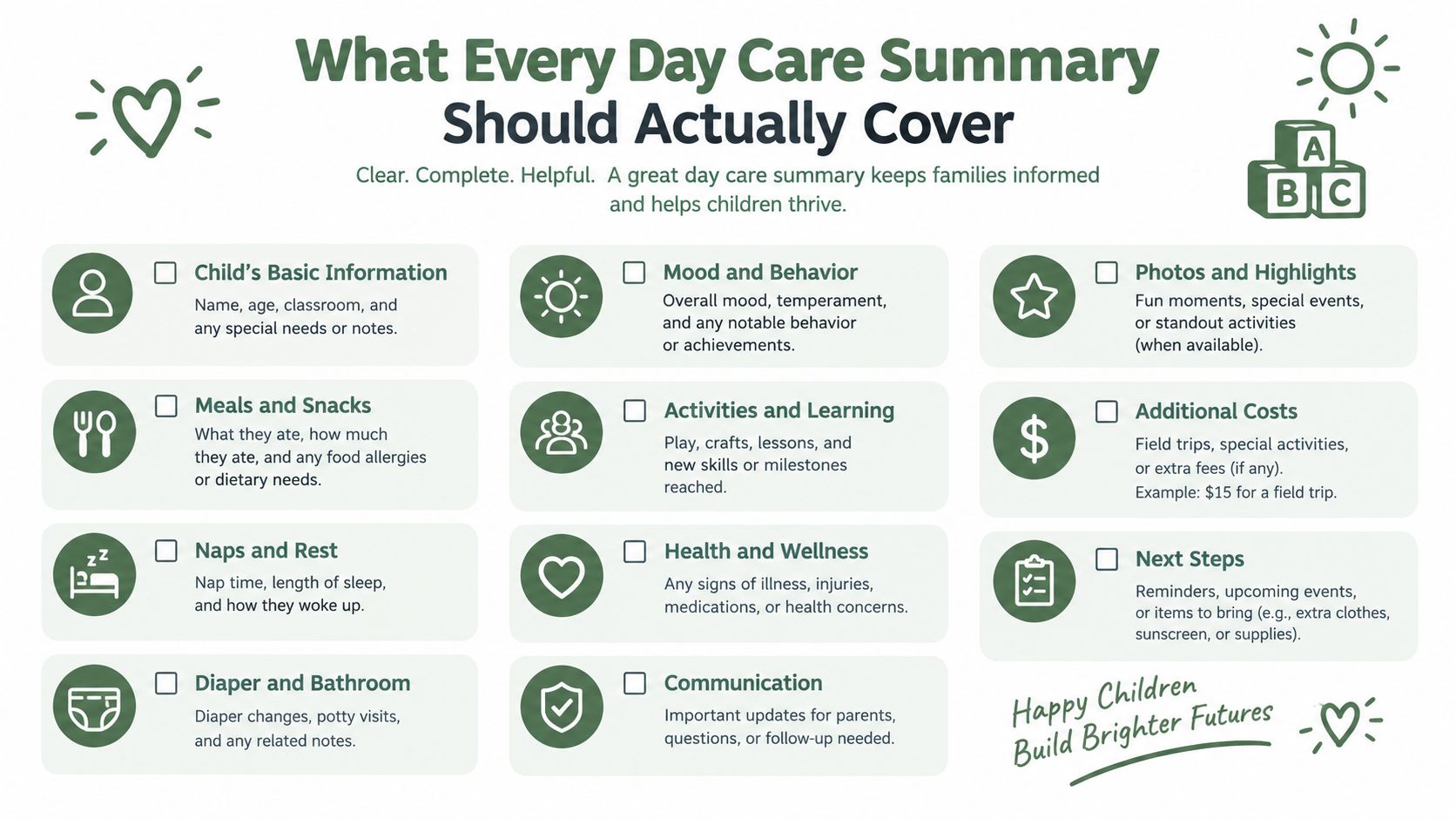
At pickup, one adult may take over from a teacher, then pass care to a nanny or grandparent before bedtime. A useful summary gives each person the same clear account of the day. Keep it to repeatable fields that are quick to fill in and easy to scan.
Use fields that answer practical questions
- Arrival and drop-off mood: Record the time and a brief observation, such as “arrived smiling” or “held parent's hand and needed a few minutes to settle.” Describe what you saw, not a judgment about the child.
- Meals and bottles: Note the time, what was offered, and how much the child ate or drank, if known. For infants, distinguish breast milk, formula, and solids. The CDC advises caregivers to follow infants' hunger cues, let them stop when full, and record feeding type and timing in shared records. See the early-care infant-feeding guidance.
- Sleep: Write down nap start and end times, plus a short note about waking. “Slept well” leaves more to guess than “slept 12:40–2:05; woke calmly.”
- Diapering or potty: Record the time and result, including any change or potty attempt the next caregiver should know about.
- Mood and energy: Use observable details, such as “quiet after nap” or “joined play after snack.” Avoid explanations no one can confirm.
- Notable moments: Include a meaningful activity, peer interaction, or developmental observation. Keep it factual and brief.
- Supplies and pickup: Flag items running low and any pickup detail the next adult needs.
Use the same compact checklist across caregivers:
Arrival • time and mood
Food and bottles • type, time, amount or response
Sleep • start, end, waking observation
Diaper or potty • time and result
Mood and activities • observable notes
Handoff • supplies and follow-up
For families tracking feeds beyond daycare, this baby feeding log template can provide a shared record to adapt.
Clear fields help when communication varies between families and providers. In the 2025 Connecticut parent and caregiver survey, 27% of respondents said providers communicated about their child's day at the highest reported level, while 21% reported communication about learning and growth at that level. A consistent summary gives parents, teachers, nannies, and grandparents a practical shared record, including the few details that can shape the evening routine.
Two Filled-In Day Care Summary Examples
At pickup, one adult may know about lunch while another is planning bedtime. A useful summary gives parents, teachers, nannies, and grandparents the same brief record, so each can pick up where the last caregiver left off. These illustrative templates show the details that can change the evening. Adjust the fields to fit your daycare's process and your child's needs.
Infant on bottles and purees
Child: Maya
Caregiver: JT
Arrival: 8:35 a.m., calm; reached for a toy after drop-off.
Bottle: 9:10 a.m., 4 oz formula offered; finished about 3 oz.
Nap: 10:15–11:05 a.m., woke.
Food: 11:35 a.m., puree offered; ate several spoonfuls.
Diaper: 12:05 p.m., wet diaper.
Follow-up: Remaining bottle amount is approximate. No second nap entry recorded before this handoff.
That follow-up helps the next adult plan without treating a missing entry as proof that nothing happened. The amount is marked approximate, and the nap gap stays unknown.
Toddler practicing potty routines
Child: Leo
Caregiver: AM
Arrival: 8:20 a.m., waved goodbye; joined blocks.
Breakfast: 9:00 a.m., ate half a banana and some oatmeal.
Potty: 10:05 a.m., sat on potty; no result recorded.
Nap: 12:50–2:00 p.m., woke slowly and sat with a book.
Afternoon activity: 3:15 p.m., played beside two children in the garden area.
Supplies: Spare pants needed.
Handoff: Potty result after lunch unknown. Would you like us to keep offering the same routine tomorrow?
The question gives the next caregiver a clear point to confirm with the family, rather than leaving them to guess about the routine. Across both examples, each line separates a recorded fact from an observation and marks gaps as unknown.
When and How to Write the Day Care Summary
Don't save the whole summary for pickup. A teacher who has to recall every meal, nap, and diaper change at the end of a busy day is more likely to leave a gap or mix up the order. A quick note at the transition preserves the detail while it's fresh.
Record events as they happen
Use the same basic rhythm each day:
- At arrival: Record the time and a brief, observable mood note.
- After a meal or bottle: Add the time, food or feeding type, and amount or response when known.
- After sleep or a diaper change: Enter the start and end times for sleep, or the time and result of the change.
- Midday check: Scan the entries for missing times, unclear amounts, or a note that needs a parent's attention.
- At pickup: Summarize the day and flag unresolved items or supplies.
Keep individual entries short. “1:05 p.m., down for nap; woke at 2:10 p.m.; settled after story” is clearer than a long explanation written from memory. If something unusual happens, record what was observed and when, then make sure the right adult receives the information. A serious health or safety issue belongs in direct communication, not just a daily digest.
This routine supports a dependable end-of-day handoff without asking staff to compose an essay. OECD research on early-childhood centres found that more than two-thirds of centre leaders across the countries represented reported frequent communication practices with parents and guardians, as described in the OECD report on engaging families in early-childhood centres.
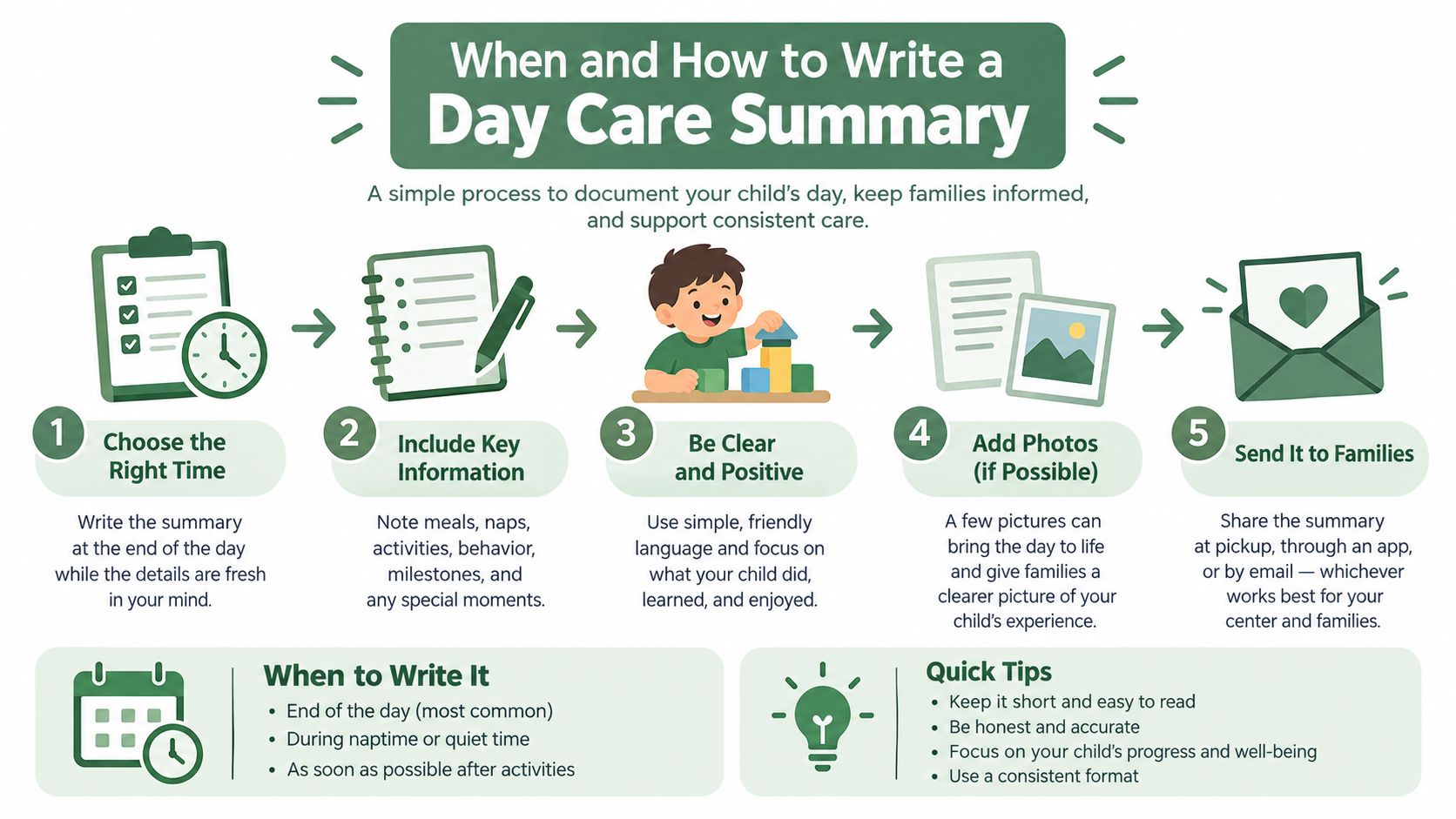
The aim isn't to add another task to a teacher's day. It's to spread brief entries across natural transitions so the pickup note is a clean summary of recorded events, not a scramble to reconstruct them.
Sharing the Summary Across Every Caregiver
A handoff shouldn't depend on one parent remembering every detail and passing it along at the door. If daycare tells one adult about a short nap, that adult may have to relay it to a partner, nanny, or grandparent later. Every retelling adds a chance for a useful detail to disappear.
A single shared timeline gives each caregiver the same record. It might be a notebook on the fridge, a shared phone note, or a tracker where everyone enters events under their own identity. The important part isn't the technology. It's having one dependable place to see what happened, who recorded it, and what still needs attention.
| What parents get | Patchwork handoff | One shared record |
|---|---|---|
| Daily events | Scattered across paper, verbal updates, and separate apps | Meals, sleep, diapering, and activities together |
| Who entered a note | May be unclear after several retellings | Each caregiver can be identified |
| What needs follow-up | Can get lost between pickup and home | Unresolved items stay visible |
| Daycare access | May require a separate account or repeated messages | Can fit a center's existing device and routine |
Choose a setup people will actually use
Look for a workflow that respects the way each caregiver works. Daycare staff may prefer a browser page bookmarked on a center iPad, while parents may want updates on their phones. Separate caregiver identities help clarify who logged the last bottle or nap, and offline entry is useful when a caregiver's connection drops during a commute.
English and Spanish support can also make the record easier to share across bilingual households. That's not a decorative extra: families need to understand the same basic information, whether they're reading about a nap, a bottle, or a supply request.
If you're weighing paper against a digital workflow, this overview of a daycare daily report app can help clarify what to look for. Cradlo is one option: it gives parents, partners, nannies, grandparents, and daycare separate identities, offers a browser-based daycare entry point, and syncs shared care logs.
A shared record doesn't mean every small event needs to interrupt a parent's workday. Keep routine details in the end-of-day summary, and contact the family directly when something needs prompt attention. The result is a handoff that's complete without turning every observation into an alert.
Tone, Wording, and What to Leave to the Pediatrician
Use language that describes what a caregiver saw, heard, measured, or recorded. “Drank about 3 oz of formula at 10:15 a.m.” is more useful than “ate well.” “Fussier than usual after nap” is an observation; “seems to be teething” is an interpretation.
| Use | Avoid |
|---|---|
| “Woke at 2:10 p.m. and cried briefly.” | “Had a bad nap.” |
| “Red patch observed on left cheek at pickup.” | “Probably an allergy.” |
| “Ate a few bites of lunch.” | “Wasn't hungry.” |
| “No potty result recorded.” | “Didn't need to go.” |
For bilingual handoffs, agree on plain, familiar wording across languages. For example, “wet diaper” can be recorded as “pañal mojado,” and “nap” as “siesta.” Keep names, times, and amounts consistent so different caregivers can interpret the same record without guessing.
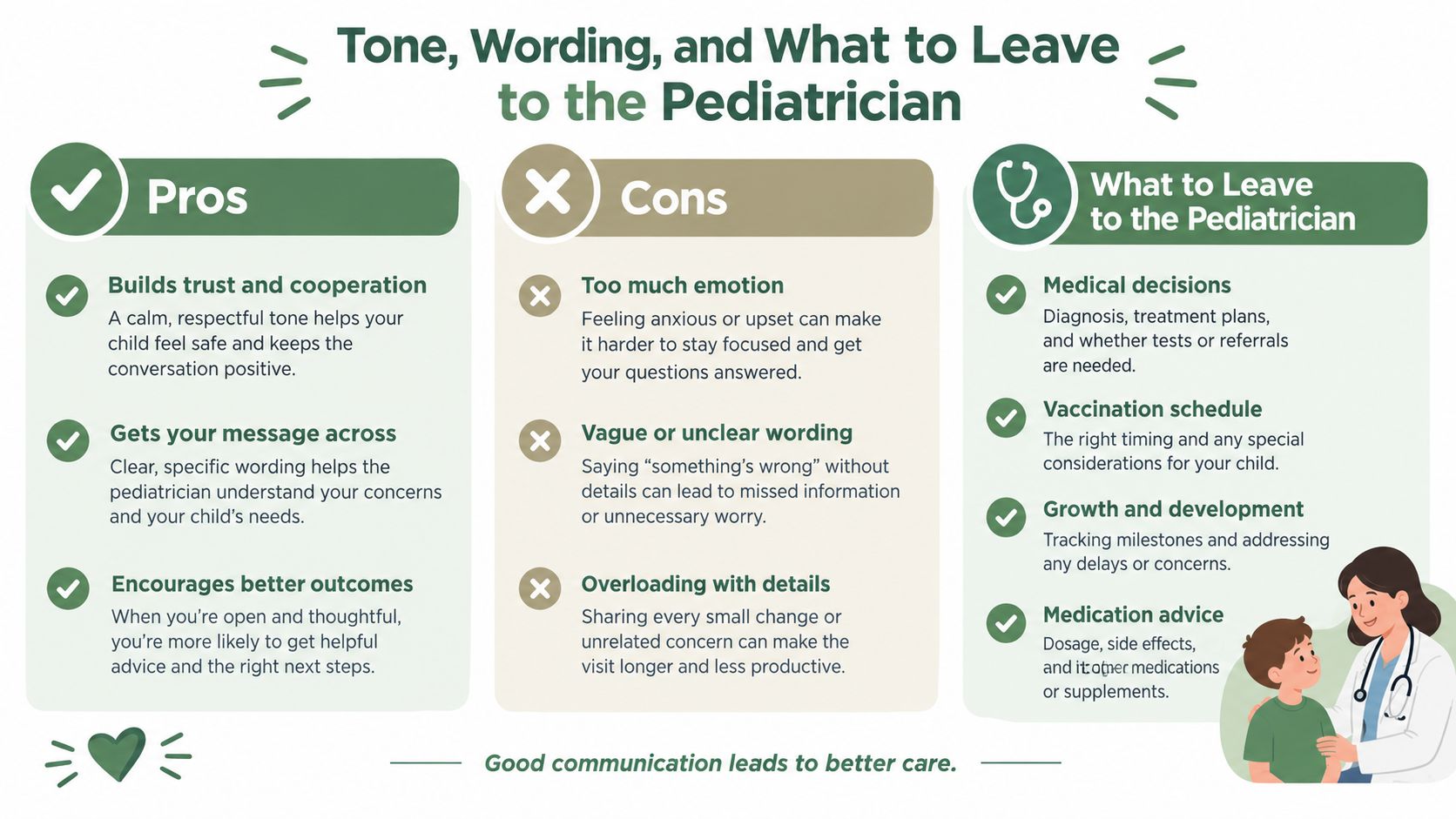
Health questions belong with the child's pediatrician or, for breastfeeding and lactation questions, a lactation professional. Record concerns neutrally and promptly share them with the family; don't use the summary to diagnose a fever, rash, feeding change, or unusual sleepiness. For infant sleep, the CDC's safe-sleep guidance recommends placing babies on their backs for every sleep on a firm, flat surface with only a fitted sheet. A care record can document what the caregiver observed and did, while health questions go to the family's pediatrician. If a family needs to share records with a clinician, this guide to exporting information for a pediatrician outlines that kind of handoff.
A Quick Printable Day Care Summary Template
Copy this into a notebook, print it, or share it with the caregivers who look after your child.
Morning
Arrival time: ______ Mood at drop-off: ______
Items brought / supplies running low: ______
During the day
Meals or bottles, with time and response: ______
Nap start and end times: ______
Diaper or potty notes: ______
Mood, activities, or notable moments: ______
Handoff
What's still unknown or needs follow-up: ______
Question or note for the next caregiver: ______
Caregiver name or initials: ______
The habits that make this useful are simple: write entries as you go, use timestamps, separate facts from interpretations, share one record across caregivers, and leave medical questions to a professional.
Cradlo brings sleep, feeds, diapers, solids, milestones, and daycare notes into a shared log for families and caregivers, with separate caregiver identities and a browser-based daycare option. It offers a 7-day free trial on the monthly plan, followed by a paid plan, with no free plan. If a shared handoff would make tonight easier, visit Cradlo.