When Do Toddlers Stop Napping? Ages, Signs and What to Do
Most toddlers still nap at age 2. The change is gradual, the largest shift happens between ages 3 and 5, and roughly 94% of children have stopped daytime naps by age 5.
If you've been asking when do toddlers stop napping, a birthday is a weak answer. Plenty of families hear that naps "should" be gone by three, then feel behind when a four-year-old still sleeps after lunch. The more useful question is whether the whole day of sleep still holds together when parents, a partner, grandparents, a nanny, and daycare each see a different slice of it. Stopping a nap is a slow dimmer, not a switch you flip on a Monday.
Table of Contents
- When Toddlers Usually Stop Napping, by Age
- Signs a Toddler Is Ready to Drop a Nap
- Tracking Nap Decline Across Every Caregiver
- How to Ease Out a Nap Over Two to Four Weeks
- Common Problems After a Nap Drops and How to Fix Them
- Decide on the Next Nap Change This Month
When Toddlers Usually Stop Napping, by Age
The shift away from daytime sleep usually unfolds over several years. A systematic review and meta-analysis found that fewer than 2.5% of children had stopped napping before age 2, and about 33% had stopped by age 3. On a cumulative basis, the share was about 57% by age 4 and roughly 94% by age 5. These figures describe a broad pattern, not a deadline for an individual child.
Study results also varied widely. At 36 months, the reported share who had stopped ranged from 4.8% to 65%. At 48 months, it ranged from 26.5% to 78.2%, and at 60 months, from 36.9% to 96%. That spread helps explain why a child who still naps at 3 or 4 can fall within the range seen across studies.
| Age | Reported share who have stopped | Range across studies |
|---|---|---|
| Before age 2 | fewer than 2.5% | Not broken out as its own range |
| By age 3 (36 months) | about 33% | 4.8% to 65% |
| By age 4 (48 months) | about 57% | 26.5% to 78.2% |
| By age 5 (60 months) | about 94% | 36.9% to 96% |
Why the percentages don't line up
Studies use different definitions of “napping.” Some count any daytime sleep; others count regular naps or rest at childcare. Results may also come from parent reports or sleep diaries. Childcare routines, family schedules, and a child's sleep needs can all shape whether a nap happens and how it is recorded.
Consider two three-year-olds who sleep well at night. One attends daycare with a set rest period, while the other is at home with a more flexible afternoon. The daycare routine may offer a regular chance to sleep; at home, the child may skip sleep on a quiet day but need rest after a busy one. Their different nap patterns do not necessarily mean one is unusual.
A Canadian longitudinal study followed 5,504 children from around their first year into the toddler years. At follow-up, the group averaged 30.83 months, and 10.9% had stopped napping. The study defined stopping before the third birthday as “early nap cessation.” In that sample, most children were still napping around the end of their second year or the start of their third.
| Reading the age figures | What they can show |
|---|---|
| The cumulative figure | The share who had stopped by that age |
| The study range | How much results differed across studies |
A child's nap pattern can also look different to each caregiver. A shared log of sleep at home and in care can make it easier to see whether the change is building over time or reflects a short stretch with fewer chances to sleep. For families earlier in the transition, this guide to moving from two naps to one covers that separate step.
Signs a Toddler Is Ready to Drop a Nap
The single test is simple. Can this child skip the nap for several weeks without late-day irritability, unplanned dozing, or behavior that slips? Age alone doesn't answer that.
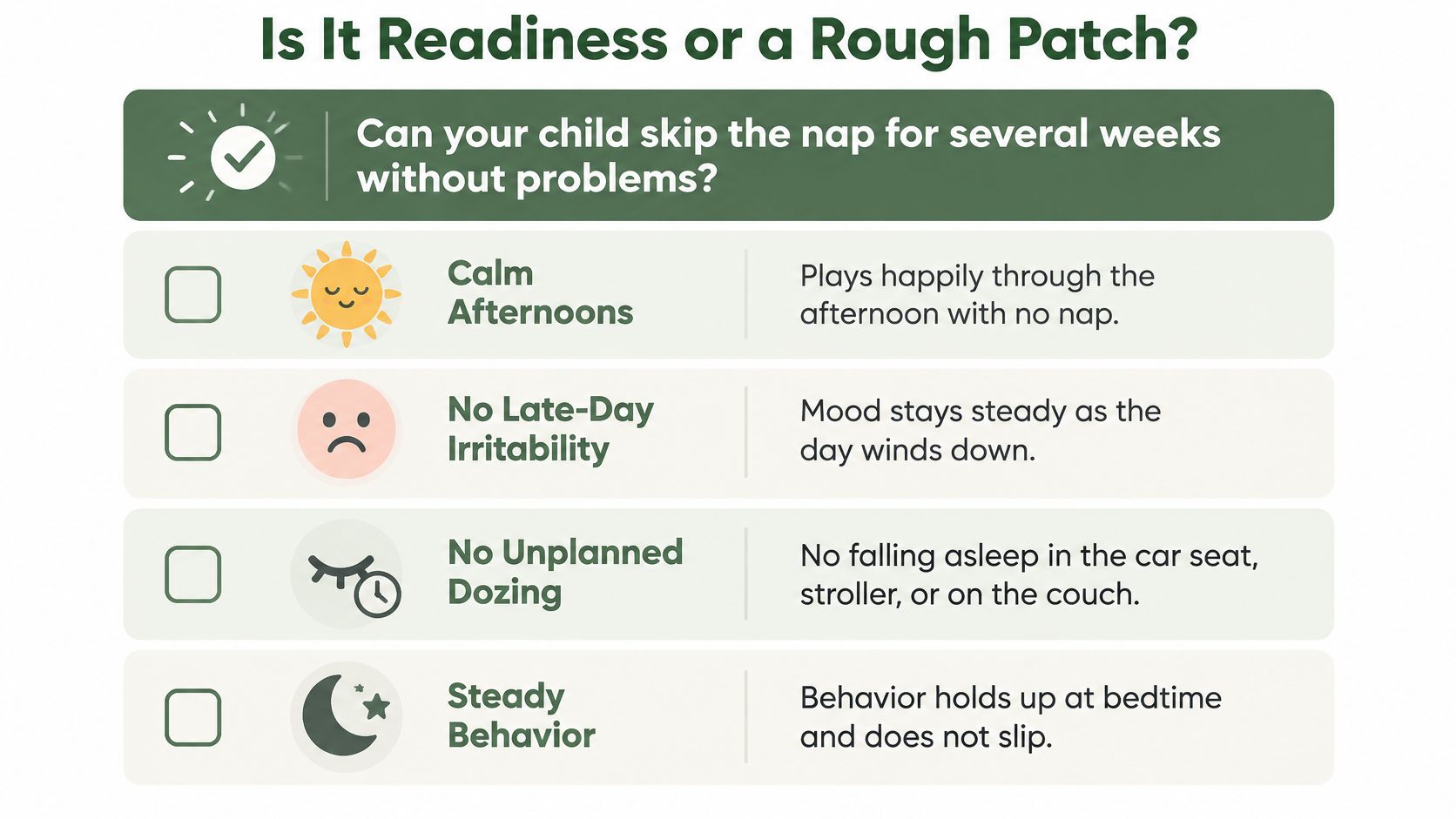
In a sample of 1,498 French preschoolers ages 3 to 5, regular napping fell from 65% at 36 to 39 months to nearly 0% at 63 to 66 months, according to research on preschool nap patterns. Non-napping became more common across those years. That slide took many months, not one afternoon. Sleep pressure builds more slowly as children grow, and the day-night clock matures, but a childcare rest hour still shapes what you see.
Watch for two to three weeks before you decide. A yes on most of these, held steady, points toward readiness.
- Settling without sleep: The child still accepts rest but takes a long time to fall asleep, or wakes from naps on their own with little fuss.
- Steady nights: Bedtime and night sleep stay even on days without a nap.
- Calm afternoon energy: Play holds up through the late day instead of collapsing.
- A long stretch, not a few days: The refusal has lasted weeks.
Illness, travel, a new sibling, or a changed routine can look the same for a short time, then pass. Mixed results mean more time, not a failed plan. Keep offering the rest window while you watch.
Tracking Nap Decline Across Every Caregiver
A nap that ends at 2:15 can decide whether a 7 p.m. bedtime goes smoothly. Each adult often remembers that end time differently. One person was at work. Another did pickup. Daycare saw the cot. Memory fills the gaps with a guess.
| Signal | What to record | Why it matters |
|---|---|---|
| Nap start and end | Clock times for each nap | Shows whether the rest window is drifting later or shorter |
| Nap length | Minutes asleep | Reveals gradual shortening before a nap disappears |
| Time to fall asleep | Minutes of settling | Often rises before a nap is ready to go |
| Late-afternoon mood | Calm, clingy, or wired around 4 p.m. | Shows whether the day is still well balanced |
| Bedtime and night waking | Times of bedtime, first sleep, and any waking | Tracks total sleep, not just naps |
| Caregiver who logged it | Parent, partner, grandparent, nanny, or daycare | Lets everyone see the same pattern |
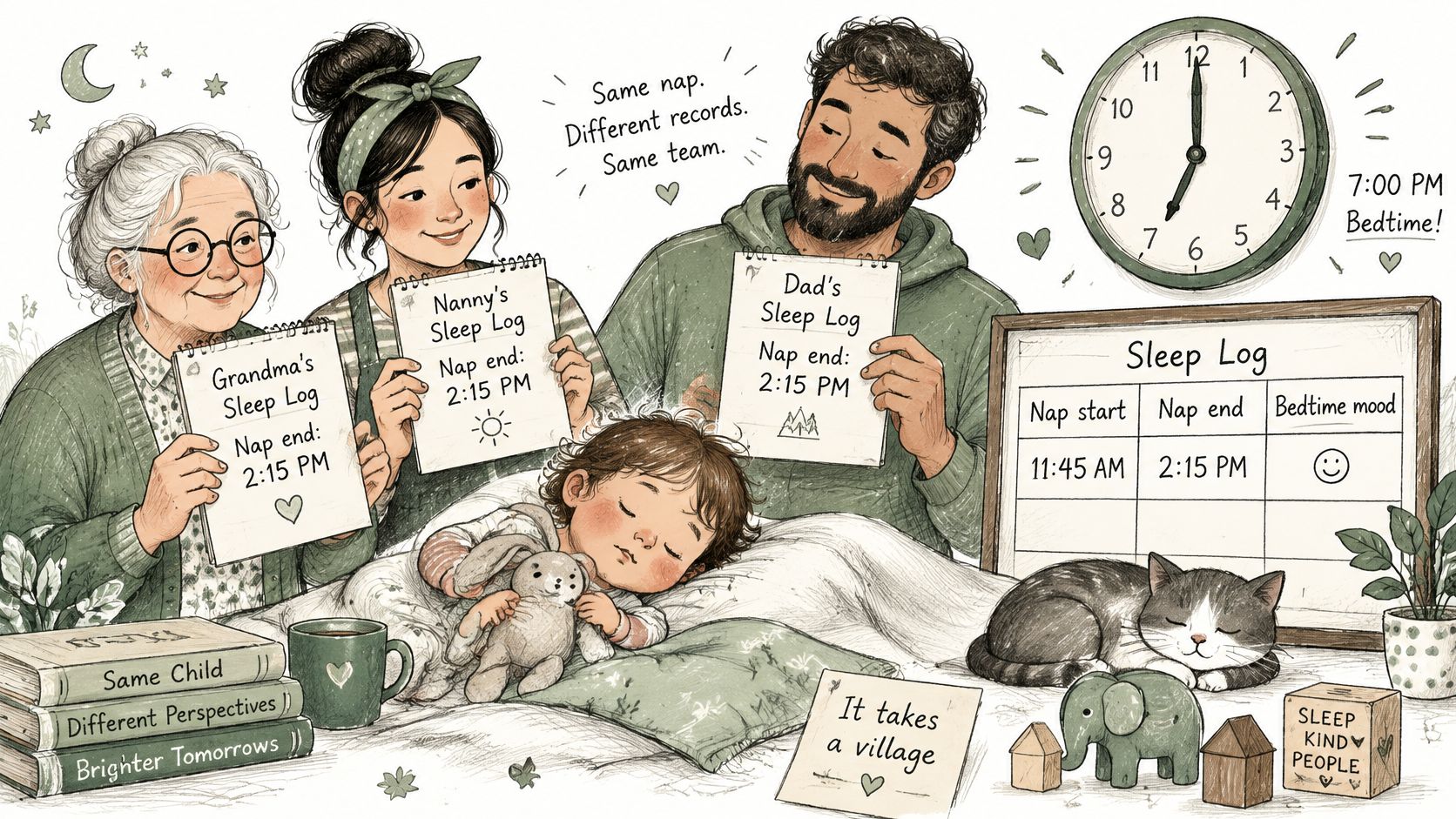
A paper notebook works if it lives where every adult can write in it. Cradlo (cradlo.app) is one shared baby and toddler tracker for parents, partners, grandparents, nannies, and daycare, so each person can add an entry and see the same day. It records patterns. It doesn't diagnose sleep. If you're worried about health, a pediatrician is the right person to ask.
Read two to three weeks, not one cranky Thursday. Compare how each caregiver describes the same afternoon. Notice whether nap length is drifting shorter, or the rest window is sliding later. A nanny or daycare working from that same log helps the child hear one plan instead of three. Keeping naps consistent across caregivers is easier when the times are written down.
How to Ease Out a Nap Over Two to Four Weeks
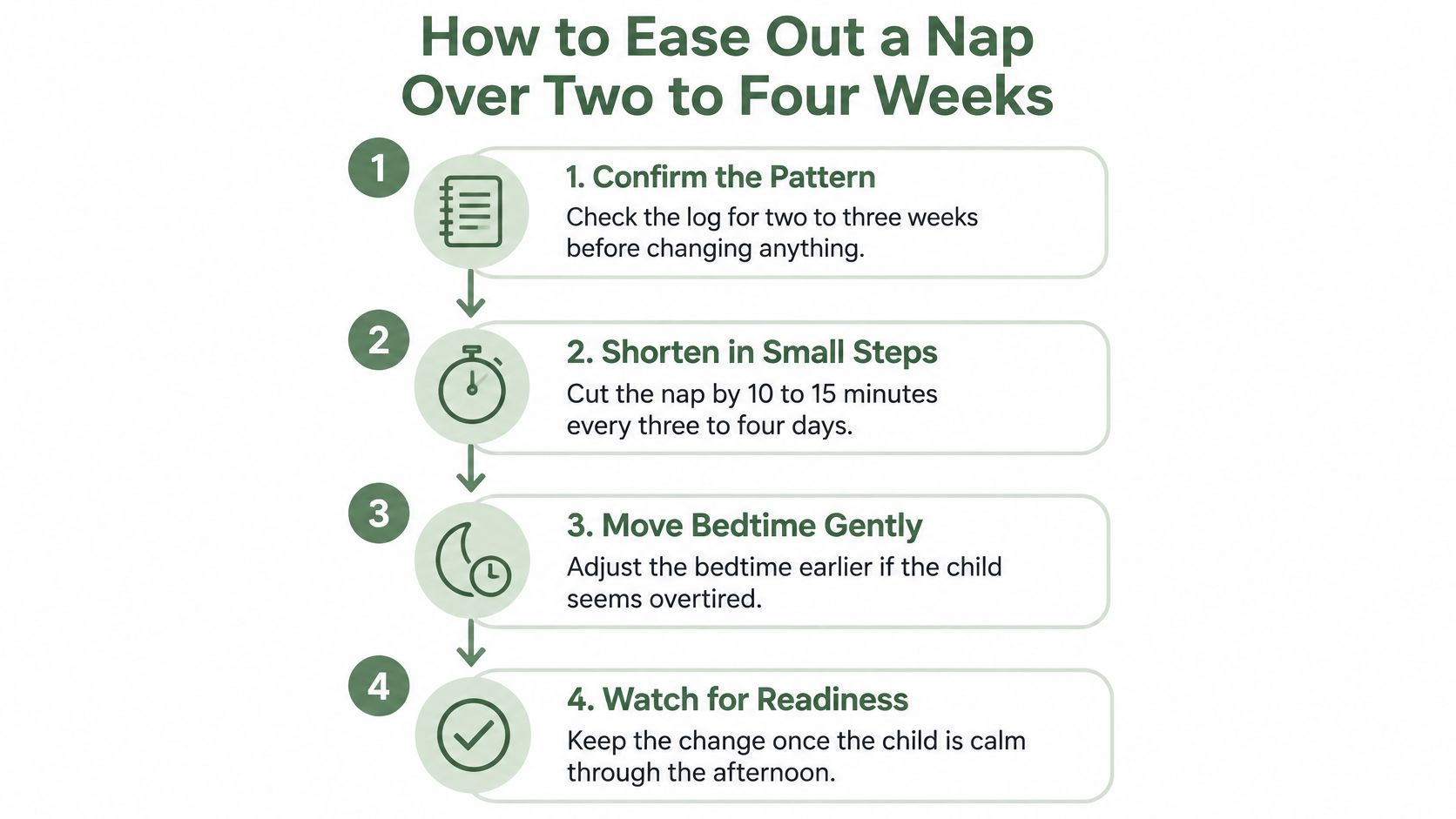
A nap can fade in stages rather than disappear all at once. Keep the change gradual and protect enough sleep across the whole day. The American Academy of Sleep Medicine consensus recommends 11–14 hours per 24 hours for children ages 1–2 and 10–13 hours for ages 3–5, naps included. These ranges help you judge the whole day, not just whether your toddler slept at nap time.
-
Confirm the pattern first. Check two to three weeks of shared notes before changing the schedule. A difficult stretch during a cold or trip may be temporary, rather than a sign the nap is no longer needed.
-
Shorten in small steps. Reduce the nap by about 10 to 15 minutes every three or four days, or move its start a little later. Smaller changes give you time to see how your child responds; a big cut can make late afternoons harder.
-
Swap in quiet rest. When the nap is short, offer about 20 to 30 minutes of books, floor puzzles, soft music, or lying down in a dim room. Rest still gives the day a pause, even if sleep doesn't come.
-
Hold the morning wake time. Keeping it steady gives the day one reliable anchor while the middle of the day changes.
-
Watch the 24-hour total. Dropping a group nap usually means less daytime sleep. Check whether nighttime sleep seems to make up enough of the difference. If your child seems tired or total sleep falls, try an earlier bedtime.
-
Step back if a week goes badly. Return to the previous step and give that routine another try. There is no need to finish quickly.
A nap may shrink without the night fully replacing it. Compare nighttime length, morning wake time, and the feel of late afternoon in the shared log, so every caregiver can follow the same gradual plan. The transition often takes weeks, and may take longer during busy stretches.
Common Problems After a Nap Drops and How to Fix Them
The first trouble most families meet is the late-day slump, often near 4 p.m. Other snags follow the same shape: a likely cause, then one change to try before you rewrite the whole day.
| Symptom | Likely cause | First fix to try |
|---|---|---|
| Meltdowns or clinginess around 4 p.m. | Overtired late in the day | Short quiet-rest block earlier, plus a snack before the slump |
| Bedtime takes much longer | Stimulating activity after rest ends | Calmer wind-down with dimmer lights and the same order each night |
| Early-morning waking | Total sleep has dropped | Check nighttime length against the age range before changing anything else |
| Refuses rest, then cannot settle | Rest window too long or too late | Shorten the window and move it earlier |
| Hard days only at daycare | Different schedules across caregivers | Share the log so every caregiver follows the same rest plan |
| Weeks of irritability | Nap dropped too early | Bring back the nap for a while and discuss the pattern with a pediatrician |
Ending the nap isn't the goal by itself. The question is whether sleep across the whole day still fits the child and the day still goes reasonably well. The National Heart, Lung, and Blood Institute reproduces American Academy of Sleep Medicine guidance endorsed by the American Academy of Pediatrics: babies 4–12 months are advised 12–16 hours daily, including naps, and children 1–2 years are advised a daily total in a similar all-day frame, also including naps. A preschooler who has just lost a nap may need an earlier bedtime so the night can carry more of that total. A sample day for this age is in this 3-year-old sleep schedule.
If sleep or behavior worries keep going, talk with a pediatrician. This article can't assess a child's health.
Decide on the Next Nap Change This Month
You don't need a perfect week to choose a next step. You need a short, shared plan.
- Review the log. Set the last two to three weeks next to the readiness signs. Look for a steady pattern, not one easy Friday.
- If most signs are present, pick one change. Shorten the nap, or start the quiet-rest swap. Don't do both at once.
- If the signs are mixed, keep the nap. Log again. A rough week is common with illness, travel, or a new routine.
- Tell every caregiver before the first changed day. Write it down if you can, so home and care match. In a Spanish-speaking household, a short Spanish version of the same steps lets grandparents and other caregivers read one plan. Cradlo offers a 7-day free trial on its monthly plan and has no free plan.
- Ask a pediatrician if concerns persist. A lactation professional is the right referral for feeding questions. This guide can't judge health.
Stopping a nap is a change to plan for, not a test to pass. A shared log keeps the pattern visible to everyone who holds the day.
Cradlo is a shared tracker where parents, partners, grandparents, nannies, and daycare can log the same naps, bedtimes, and late-day moods while a toddler's rest is changing. A 7-day free trial is available on the monthly plan, and there is no free plan. When you're ready to put one nap record in front of every caregiver, visit Cradlo.