How Many Wet Diapers Is Normal by Age?
Expect at least 1 wet diaper on day 1, 2 on day 2, 5 on day 3, 6 on day 4, and 6 per day on days 5 to 7, with about 6 or more per day from week two. These are benchmarks rather than quotas, and early-day guidance differs between organizations.
But what does a daily total tell you if a grandparent changed a diaper that never made it into the log? When you're asking how many wet diapers are normal, the useful answer includes your baby's age, how the diapers feel, and whether every caregiver is counting the same way.
You don't need a perfect record. You need enough shared information to describe what's happening and ask for help when something changes. This is general education, not medical advice; a pediatrician or lactation professional can interpret your baby's pattern.
Table of Contents
- Typical Wet Diaper Counts for Each Age
- Why Counts Climb During the First Week
- Judging Hydration Beyond the Diaper Count
- Warning Signs of Low Output and Dehydration
- How to Log Each Diaper So the Trend Is Clear
- When to Call a Pediatrician and What to Bring
Typical Wet Diaper Counts for Each Age
A single wet diaper tells you very little on its own. The count becomes meaningful when you compare each day with the one before it, which is why age sits at the top of every reference chart.
The CDC's newborn breastfeeding guidance notes that wet diaper counts rise across the first week and reach about six a day by day five. The ranges below reflect that general pattern.
Typical wet diaper counts by age
| Age | Typical wet diapers | What to notice |
|---|---|---|
| Day 1 | At least 1 | Small amounts can make a lightly damp diaper easy to miss. |
| Day 2 | At least 2 | Read the count across the whole day, not an individual change. |
| Day 3 | About 3 to 5 | Notice whether diapers are starting to feel heavier. |
| Day 4 | About 4 to 6 | Look for the upward pattern to continue. |
| Days 5 to 7 | At least 6 per day | Diapers should feel noticeably heavier as intake increases. |
| Week 2 to week 4 | 6 or more per day | Look for a steady pattern alongside feeding and growth. |
| 1 to 6 months | Compare with the baby's recent baseline | Watch for a sustained drop rather than chasing a fixed number. |
The table only works when everyone counts the same way. If a grandparent changes three diapers and writes down none, the day's total reflects memory gaps rather than the baby's pattern. A shared log turns scattered observations into the trend the chart is meant to show.
For the later newborn period, Leicester's Hospitals' new-baby guidance describes 6 or more wet diapers daily from day 7 through the first several weeks.
Why another chart might look different
Early benchmarks differ between organizations. The American Academy of Pediatrics' newborn assessment guidance describes at least 3 wet diapers on day 3, while Dartford and Gravesham NHS Trust's nappy-changing guidance uses at least 4 on day 4.
Two parents can compare notes, cite different numbers, and both be right. Use your baby's discharge instructions and ask their clinician which benchmark to follow.
These general references assume a healthy, full-term baby. Prematurity, health conditions, and feeding difficulties can change how a pediatrician interprets the record.
Practical rule: Read the count as an age-specific reference, a shared picture for everyone who changes diapers, never a score your baby or family has to earn.
A rising pattern across several days tells you more than any isolated total. Still, don't average away a concerning drop or wait for a trend to develop when your baby seems unwell.
Why Counts Climb During the First Week
A parent opens a diaper during the early days and wonders whether the faint dampness counts at all. The previous change felt light too, and a partner remembers hearing that newborns should produce much wetter diapers.
Both observations can make sense. Newborns initially take in small amounts of milk, so they pass small amounts of urine; as intake increases, urine output generally increases too.
Think of a tap being turned up gradually rather than switched straight to full flow. The comparison explains the direction of change, not a schedule every baby follows exactly.
Small early amounts become more noticeable
The NHS's milk-supply guidance says babies commonly have only 2 or 3 wet diapers during the first 48 hours, followed by at least 6 in every 24-hour period from the fifth day onward. It also emphasizes that wet diapers should become more frequent as the days progress.
That's why comparing a newly born baby with a baby approaching the end of the week can create unnecessary confusion. Recording age alongside each day's observations keeps the comparison fair.
For feeding context, a newborn feeding chart can help you organize questions about intake. It shouldn't become a reason to change feeding amounts without individualized guidance.
The useful early question is whether output is increasing as feeding gets established, not whether every diaper feels identical.
Some babies pass urate crystals early on, leaving pink or orange staining. Don't assume every unusual color has that explanation; persistent staining or uncertainty belongs in a conversation with a clinician.
A parent or nanny can make a helpful note without interpreting it: “Lightly wet, orange mark, feeding recorded.” Plain observations give a professional more to work with than a guess about the cause.
Judging Hydration Beyond the Diaper Count
A diaper count is like a fuel gauge: useful, but more meaningful alongside how the car is running. For a baby, the accompanying information includes diaper heaviness, feeding, growth, and behavior.
Context that helps a clinician interpret the count
Diaper heaviness. Light, moderate, and heavy are practical descriptions, not laboratory measurements. Notice whether a diaper feels different from an unused diaper of the same brand, and record uncertainty rather than forcing a confident label.
Feeding. Note whether feeds are happening regularly and whether anything has changed. Difficulty staying engaged during feeds, repeated struggles to latch, or a change in bottle intake are useful observations to share.
Growth. Weight measurements at checkups help a clinician assess feeding over time. A reassuring-looking diaper total doesn't replace those measurements or a feeding assessment.
Alertness and comfort. Describe what your baby does between feeds, such as waking for care, looking around, or being harder to engage than usual. Contentment alone isn't proof that intake is adequate.
Why counting isn't measuring
Modern super-absorbent diapers can hold urine while feeling dry on the surface. Brand, fit, and how long the diaper has been worn can all affect what a caregiver notices.
Clinicians may assess urine output by body weight over time. At home, counting changes is an approximation, not a measurement of how much urine the baby produced.
- Combine observations: Bring feeding notes, recent weights, and behavior changes alongside the diaper record.
- Describe uncertainty: “Slightly damp” is more useful than silently excluding a questionable diaper.
- Ask for interpretation: A sustained change from your baby's baseline belongs with a pediatrician or lactation professional.
The warning signs below are reasons to contact a professional sooner, without waiting to collect a longer record.
Warning Signs of Low Output and Dehydration
Some changes in diaper counts reflect ordinary variation or incomplete logging. Certain accompanying signs deserve a call, however, because a count alone can't explain what's happening.
The AAP's newborn assessment guidance emphasizes assessing hydration and feeding together. NHS guidance also identifies dark urine, few or no tears, a sunken soft spot, and unusual drowsiness as dehydration warning signs.
Signs that call for a professional response
| Sign | What it can suggest | Response level |
|---|---|---|
| Fewer wet diapers than the age pattern for a day | Intake may be lower than the baby needs. | Contact a pediatrician or lactation professional the same day. |
| A long stretch with no wet diaper | Urine output may be very low. | Contact a clinician promptly; seek urgent care if you can't obtain timely guidance. |
| Urine that looks dark or strong-smelling | Urine may be concentrated, though appearance or odor alone can't establish why. | Contact a pediatrician the same day. |
| Few or no tears when crying | Possible dehydration in the context of other observations. | Contact a pediatrician the same day. |
| A sunken soft spot on the head | Possible dehydration requiring prompt assessment. | Seek urgent or emergency care now. |
| Unusual sleepiness, limpness, or poor feeding | Possible illness or low intake. | Seek urgent or emergency care now. |
How to read the response column
These signs are reasons to ask for assessment, not proof of a diagnosis. A clinician considers the baby's age, feeding, medical history, and overall condition before deciding what the signs mean.
“Same day” doesn't mean waiting until bedtime to see whether the total improves. Contact the practice when you notice the concern and explain that you're calling about a young baby's feeding or urine output.
Urgent signs shouldn't wait while someone finishes the log or checks every caregiver's messages. If a baby is limp or difficult to wake, seek emergency help.
You don't need to prove that something is wrong before asking a professional to assess your baby.
If you're unsure how long it's been since a wet diaper, say that clearly rather than inventing a time. For a newborn, a midwife, health visitor, or pediatrician is an appropriate contact; a lactation professional can help with feeding concerns, but shouldn't delay urgent medical assessment.
How to Log Each Diaper So the Trend Is Clear
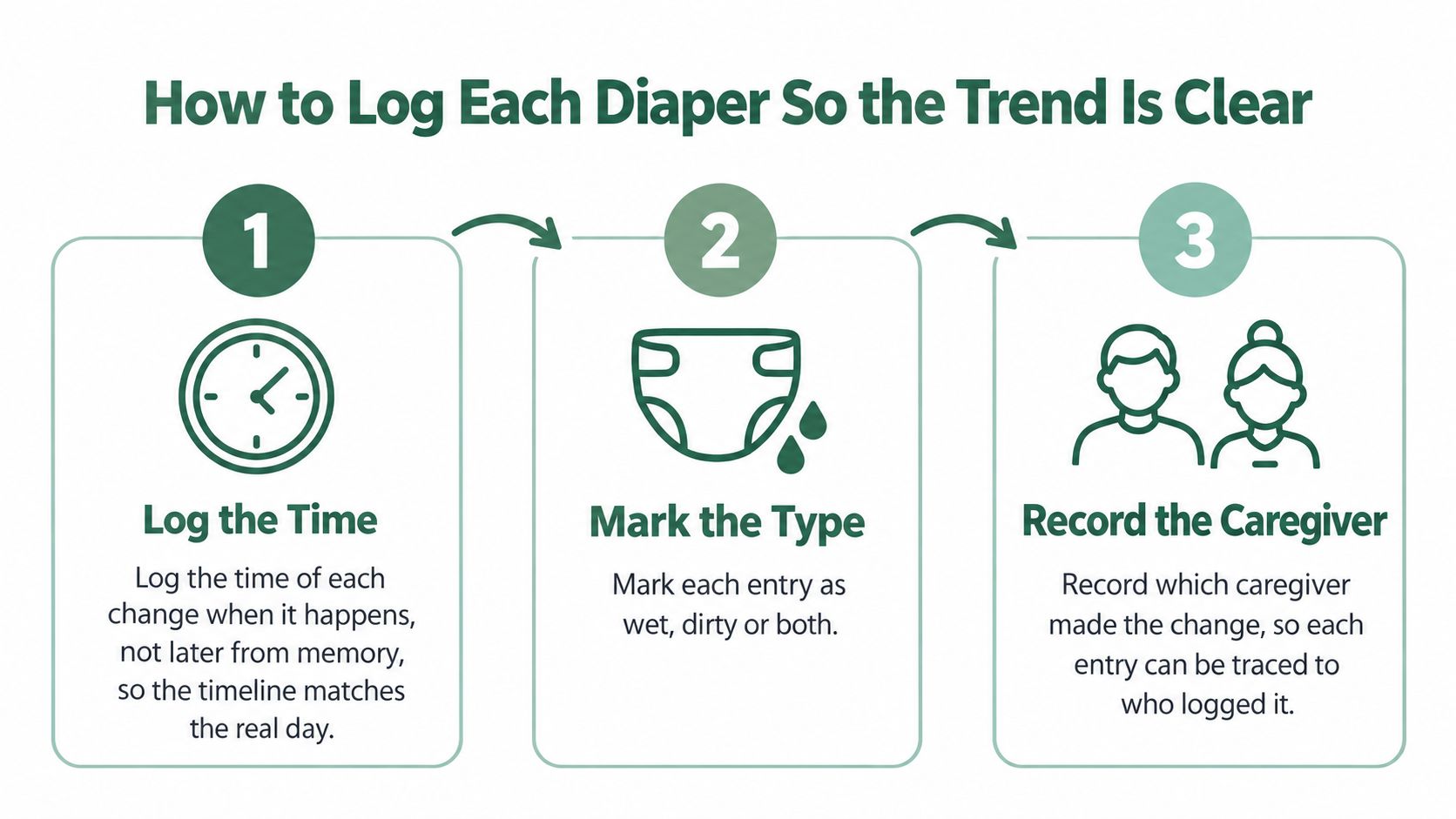
A clear log turns separate changes into a trend everyone can read: what happened, when it happened, who saw it, and how it fits the baby's age in days. A notebook, shared note, or tracker can work when every caregiver writes in the same place.
Make each entry easy to understand
-
Write down the change time. If you enter it later, use the time of the change and mark it as approximate, so the record reflects care as it happened.
-
Mark wet, dirty, or both. A stool should not automatically count as urine, and if you could not tell, say so in the entry.
-
Name the caregiver. Parents, partners, grandparents, nannies, and daycare staff need to know who observed the change; the person who changed the diaper should normally log it.
-
Describe heaviness in plain words. Light, moderate, or heavy is enough to show a shift over several days; even a barely damp diaper belongs in the record.
-
Add nearby feeding context. Feed time, nursing side, or a recorded bottle amount lets intake sit beside output. Record what was offered and observed, not a judgment about whether a target was met.
-
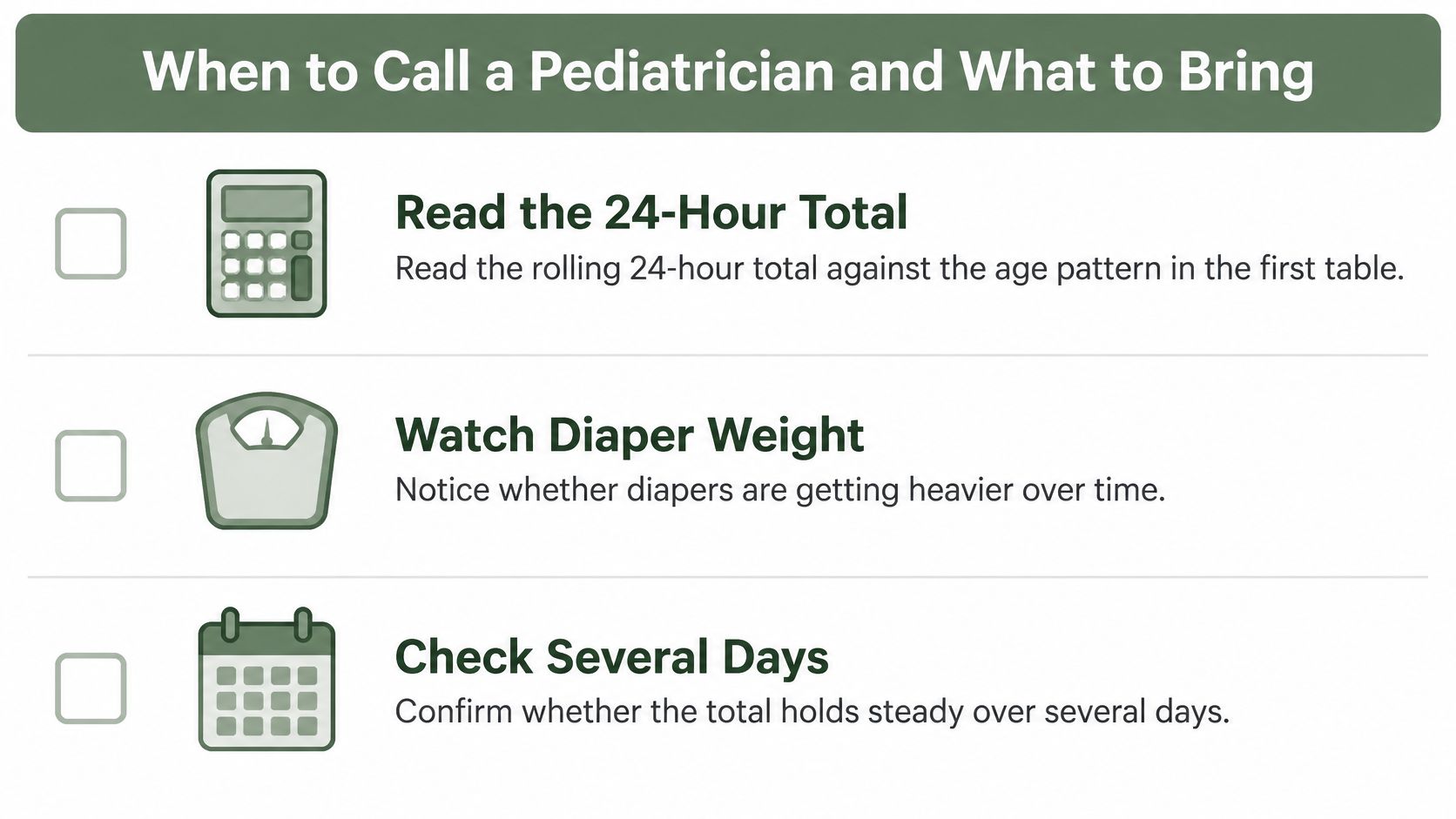
Review one complete day at a time. Check the rolling 24-hour total, a recording window described in NHS maternity feeding guidance, each morning and write the baby's age in days beside it. During the first week, age keeps an early total from being compared with a later pattern as if they meant the same thing.
Agree on the household's counting rule
Decide that clearly wet diapers count, questionable dampness gets a note, and reviewing an old entry never creates a second one. Do not leave a baby in a wet diaper to make the next change easier to classify.
For English- and Spanish-speaking caregivers, agree labels such as wet/mojado and dirty/sucio before the first handoff. The words stay boring on purpose: everyone should mean the same thing.
A shared diaper-tracking routine keeps those entries in one timeline when care moves between home, nanny, and daycare, so the trend is visible without turning the log into a scorecard. Alongside a notebook or shared note, Cradlo is a shared baby tracker for families, nannies, and daycares, with a 7-day free trial before you choose a paid plan.
When to Call a Pediatrician and What to Bring
Call when output is below the expected age pattern, a reduction persists, or your baby's feeding or behavior concerns you. You don't need to finish a perfect chart before contacting the pediatrician.
When reviewing a log, compare a complete rolling day with the age pattern rather than comparing a morning's entries with a full previous day. Notice whether diapers are becoming heavier and whether recent totals look steady, rising, or lower than usual.
Check the handoff without dismissing the concern
Say the record looks unusually sparse during a daycare day. Ask the caregiver whether changes were recorded elsewhere, whether the device was offline, or whether an entry was marked dirty without noting that it was also wet.
An apparent gap may be a recording problem rather than a true reduction in output. But don't assume that explanation, especially if your baby also seems unwell.
The same approach helps during a nanny-to-parent handoff: confirm the last observed change and who entered it. Keep that check brief so it doesn't delay a call when you're concerned.
Prepare a short, useful account
The pediatrician is the first contact for health questions. A midwife or health visitor may also be an appropriate contact for a newborn, while a lactation professional can assess feeding concerns alongside medical care.
Bring or have available:
- Your baby's age: Give their age in days or weeks and mention prematurity or relevant medical conditions.
- The recent diaper record: Have the complete recent-day view and the preceding days available, including uncertain or missing entries.
- Feeding times and method: Describe nursing, expressed milk, formula, or combination feeding, plus anything that's changed.
- Recent weights: Use measurements you have rather than trying to estimate growth from appearance.
- When the change began: Explain whether you noticed fewer changes, lighter diapers, unusual color, or a behavior change first.
- Your main question: Ask plainly whether your baby needs an examination or feeding assessment and how soon.
A log summary for the pediatrician can help you organize those observations before a call or visit. Keep the summary factual; it doesn't need a diagnosis attached.
Choose who will make the call
Agree in advance which caregiver will contact the practice and who can answer follow-up questions. That helps the clinician hear a consistent account without making another caregiver feel excluded.
If the caller didn't observe the concerning change, include the original caregiver's wording. “The nanny reported a much lighter diaper than usual” is clearer than presenting a secondhand observation as certain.
Calling is a normal part of caring for a baby, and asking early isn't an overreaction. Bring a few days of the log summary to the next visit or call, and let the pediatrician or lactation professional interpret the trend.
Cradlo offers a shared record of diaper changes and feeds so parents, partners, grandparents, nannies, and daycare can contribute to the same care timeline. Visit Cradlo to explore a tracker that helps you bring clearer observations, rather than guesses, to caregiver handoffs and conversations with your baby's clinician.