How to Transition to One Nap: A Calm Day-by-Day Plan
You've finally found a rhythm that mostly works, and then the second nap starts falling apart. Your toddler refuses it, sleeps too late, or takes just long enough to make bedtime miserable. By late afternoon, everyone is tired, dinner is rushed, and you're wondering whether dropping a nap will help or make the whole day worse.
Learning how to transition to one nap is less about choosing a perfect age and more about reading the pattern across several days. The change also affects everyone who cares for your child, from a partner or grandparent to a nanny or daycare team. A shared view of naps can prevent one short sleep from turning into a confusing evening of guesses.
Table of Contents
- The Late-Afternoon Struggle Is Actually a Good Sign
- What Is Actually Happening During the Transition
- A Gentle Day-by-Day Adjustment Plan
- Coordinating Naps Across Caregivers and Daycare
- Which Transition Path Fits Your Child
- Troubleshooting the Most Common Setbacks
- When the One-Nap Schedule Finally Sticks
The Late-Afternoon Struggle Is Actually a Good Sign
At 4:30 p.m., the day can feel like it's unraveling. Your toddler fought the afternoon nap, fell asleep briefly in the car, and now looks exhausted but refuses dinner. Your partner remembers a different nap time than you do, daycare has sent home a quick note, and bedtime keeps drifting later.
That friction often means the old two-nap pattern is losing its usefulness. A child may still need daytime sleep but no longer have enough sleep pressure for the second nap after a solid morning nap. The result is an awkward middle period. The first nap works, the second nap fails, and the late afternoon becomes harder to manage.

Look for a pattern, not one difficult day
One refused nap doesn't prove that your child is ready. Toddlers may resist sleep during a developmental leap, after a stimulating day, or because the timing has shifted slightly. The more useful question is whether the same disruption keeps appearing across the day.
You might notice that your child:
- Resists the second nap repeatedly: The struggle lasts beyond a short spell rather than appearing once.
- Takes longer to settle: Nap or bedtime becomes drawn out even though the routine hasn't changed.
- Pushes bedtime later: Keeping both naps forces the evening later than your household can manage.
- Wakes earlier or more often: A late or poorly timed second nap may affect the night pattern.
Readiness varies widely. Some children move smoothly, while others need a flexible mix of two-nap and one-nap days. The aim isn't to make the transition happen quickly. It's to protect enough sleep while your child's schedule catches up with changing needs.
Practical rule: Treat nap refusal as information, not a deadline.
For families who speak Spanish at home, it can help to use the same simple sleep words across caregivers, such as siesta, hora de dormir, and despertó. Clear language matters when several adults are trying to describe the same unsettled day.
What Is Actually Happening During the Transition
The two-nap-to-one-nap shift usually happens in toddlerhood, not during early infancy. A systematic review found that stopping naps before age 2 is rare, occurring in less than 2.5% of children, while 94% stop napping by age 5. See the systematic review of childhood napping patterns for the broader age pattern.
Population data also show why the first birthday shouldn't automatically become a deadline. Cleveland Clinic reports that children may move to one nap between 18 and 24 months, while pediatric data indicate that children at 12 months typically take one or two naps. More detailed age distributions show that 17% of 12-month-olds have one nap, rising to 56% by 15 months and 95% by 24 months, as summarized by Cleveland Clinic's guidance on when children stop napping.
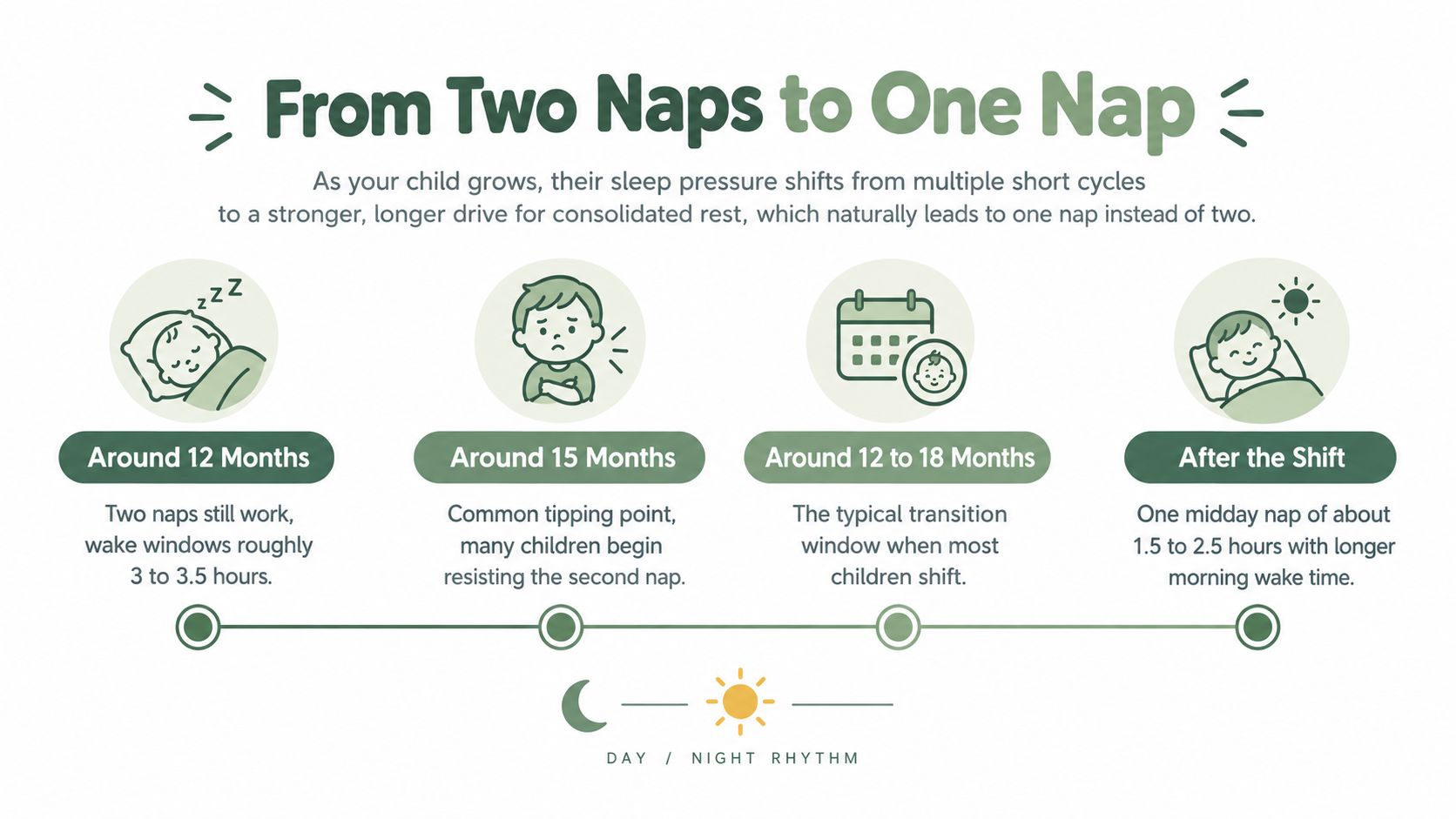
Sleep pressure changes across the day
With two naps, the first wake period is relatively manageable, and the morning nap releases some sleep pressure. After that rest, the child can often manage another period awake before the afternoon nap. As the child matures, that first nap may reduce the need for the second one.
The transition shifts sleep toward the middle of the day. Your child stays awake longer in the morning, then takes one more substantial nap before continuing through the afternoon. That doesn't mean every day will immediately fit a clean timetable. The new nap may begin earlier than you expect and may not last as long at first.
A wake window guide for families can help you think in terms of the time your child comfortably stays awake, rather than treating the clock as the only measure. Watch behavior alongside timing. A child who can tolerate a longer morning but collapses before lunch may need a slower change, not a forced schedule.
The age data support patience. Most children make the shift after their first birthday and before age 2, but the transition window is broad. If a child is struggling at the younger end, preserving a second nap on some days can be more sensible than insisting on one nap every day.
A Gentle Day-by-Day Adjustment Plan
Begin by observing rather than changing everything at once. Write down when your child wakes, when each nap begins and ends, how long settling takes, and when bedtime happens. Include naps from daycare, the stroller, and the car. A schedule can look fine at home while a short childcare nap is quietly driving the evening struggle.
Most children move from two naps to one somewhere between 12 and 18 months, and many families see the change around 14 to 18 months, according to Healthline's overview of the one-nap transition. That range is a reference point, not a target date.
Shift the useful nap gradually
If the morning nap is still the stronger one, move it later in small increments. A shift of 15 to 30 minutes every few days gives your child time to build sleep pressure without creating an unnecessarily long morning. Keep the familiar wind-down routine, even as the clock moves.
Some families first aim for a nap around late morning, then gradually move it toward midday. The exact timing depends on morning wake-up, meals, childcare, and how well your child manages the longer stretch. The remaining nap may be short at first. That isn't automatically a sign that the plan has failed.
A persistent nap struggle is more meaningful than a single refusal. One source identifies 10 to 14 consecutive days of fighting one nap as a possible readiness sign, as described by The Bump's transition guidance. Combine that pattern with bedtime resistance, short naps, or a child who comfortably manages the longer morning.

Protect the evening while the middle of the day changes
Keep bedtime steady when the nap goes well, but don't defend the usual bedtime at all costs after a short nap. An earlier bedtime can prevent an overtired evening while your child learns to stay awake longer in the morning. On another day, a late or unusually long nap may require a different evening rhythm.
The schedule should bend without becoming random. If your toddler has a difficult morning, offer a shorter recovery nap or return temporarily to two naps rather than pushing through repeated exhaustion. If the same pattern continues for many days, reassess whether the transition has started too early.
A successful adjustment often looks uneven before it looks predictable. The useful question is whether the overall pattern is improving, not whether every nap matches the plan.
Coordinating Naps Across Caregivers and Daycare
A one-nap transition becomes operationally difficult when no single adult sees the whole day. Daycare may record a nap on paper, a nanny may send a text, and a grandparent may remember only that the child “slept for a while.” By bedtime, parents are making decisions with partial information.
A shared log gives each caregiver the same timeline. Record the start and end of sleep, where it happened, and whether your child settled easily or needed extra support. The point isn't to create a perfect record. It's to answer practical questions before the evening begins.
Did the nap end unusually early? Was the child already asleep during the car ride? Did daycare offer one nap while the weekend still included two? Those details help the next caregiver choose between a normal bedtime, a quieter afternoon, or an earlier night.
Use predictions as planning support
A tracker that predicts the next likely nap window can help a nanny plan a walk before tiredness peaks or help a parent arrange a handoff around rest. Predictions should support observation, not override it. If your child is clearly tired earlier than expected, the adult caring for them still needs permission to adjust.
For a child in daycare, agree on a simple shared policy:
- Log actual sleep: Record when sleep happened, not only when the child was placed down.
- Mark short naps: A brief nap can change the rest of the afternoon even if the routine looked normal.
- Share bedtime changes: Let every caregiver know when an earlier bedtime is being used and why.
- Keep the plan visible: A single shared timeline is easier to follow than separate messages and notebooks.
A daycare-friendly tracker can also reduce handoff friction when staff use a browser rather than another installed app. Parents, partners, nannies, and grandparents should each have their own access rather than passing around one login. For more ideas on keeping naps consistent across caregivers, focus on shared records and agreed responses instead of demanding identical routines.

The best system is the one caregivers will use. If one person logs every detail and everyone else relies on memory, the household still lacks a shared picture. A short, consistent record is more useful than an elaborate system that gets abandoned during a busy afternoon.
Which Transition Path Fits Your Child
There are two practical ways to move from two naps to one. The first is a gradual fade. The second is a clearer switch to one midday nap once readiness is strong. Neither approach wins for every child, and the choice should account for temperament, sleep stability, and who controls the daytime schedule.
Gradual fading
With a gradual fade, you shorten or delay the first nap while preserving some two-nap days. The child gets practice staying awake longer, but the household has a recovery option when the morning becomes too difficult. This can suit a younger toddler, a child who becomes overtired quickly, or a family moving between home and daycare schedules.
The trade-off is coordination. A rotating pattern can confuse caregivers if nobody knows whether that day is meant to include two naps. Use a shared note that states the current plan, the latest acceptable morning nap, and what to do if the child falls asleep unexpectedly.
A direct midday switch
A direct switch removes the first nap and places one nap around the middle of the day. It can be simpler for an older toddler who regularly refuses the second nap and manages a longer morning without falling apart. It also fits some daycare routines better because everyone follows one clear rest period.
The cost is a harder adjustment when the child isn't ready. A short midday nap can leave a long afternoon, and bedtime may need to move earlier. If late-day meltdowns and poor nights build rather than settle, return to a more flexible pattern instead of treating difficulty as something to push through.
Use your child's response as the deciding evidence. A 14-month-old nap schedule guide can provide a starting framework, but your household's handoffs and your child's actual sleep matter more than a sample timetable.
Choose the simplest plan that protects sleep and that every caregiver can follow consistently.
Troubleshooting the Most Common Setbacks
A short nap can make the afternoon feel impossible. Your child wakes sooner than expected, becomes tearful during dinner preparation, and cannot reasonably reach the usual bedtime. On that day, an earlier bedtime is often more useful than trying to stretch the final wake period to preserve the clock.
The opposite problem also occurs. A late nap can reduce bedtime sleep pressure, particularly when the child is still partly attached to the two-nap pattern. Avoid solving that one evening by making a major permanent change. Log what happened and look for repetition.
When to hold steady
Hold the current plan when your child is tired but generally functioning, the nap is gradually becoming easier, and nighttime sleep remains reasonably settled. A transition can contain awkward days without requiring a complete reset.
Ease back when your child repeatedly cannot manage the morning, the midday nap stays very short, or late-afternoon distress is increasing. A mixed schedule can give the child recovery sleep while you wait for stronger readiness. Nap refusal by itself isn't enough if it disappears after a few days or appears alongside an obvious developmental change.
Guidance from Plunket on sleep from 1 to 2 years notes that the change is often gradual. It describes moving nap time later in 30-minute steps every few days, with the remaining nap sometimes shorter before settling into a midday nap that can last a couple of hours.
When the day goes off script
- Short nap: Bring bedtime earlier instead of adding a late rescue nap that interferes with the night.
- Car sleep: Record it accurately, then decide whether the child needs a shorter formal nap or an earlier night.
- Nap refusal: Keep the routine calm and check whether the pattern persists before changing the entire schedule.
- Caregiver disagreement: Agree on one response to short naps so your child doesn't receive a different schedule at every handoff.
This is routine guidance, not medical care. Speak with your pediatrician about persistent sleep disruption, unusual tiredness, breathing concerns, feeding questions, or anything that worries you. A lactation professional can help with breastfeeding or pumping concerns that happen alongside schedule changes.
When the One-Nap Schedule Finally Sticks
The settled schedule usually feels less like a dramatic finish and more like a quieter series of ordinary days. Your child wakes, stays comfortable through the morning, eats lunch, and rests around the middle of the day. Bedtime no longer depends on solving a new nap puzzle every afternoon.
By age 2, the vast majority of children have already moved to one nap, based on the pediatric age distributions cited earlier. That doesn't mean every two-year-old has the same routine, or that a child with a temporary second nap is doing anything wrong. Illness, travel, childcare changes, and developmental shifts can all disturb an otherwise stable pattern.
Define success realistically
Success means the schedule supports your child's mood, appetite, nighttime rest, and family logistics. It doesn't mean every nap has the same length or every caregiver follows the exact same wind-down. A predictable response to variation matters more than perfect timing.
Keep the shared log for a little longer after the pattern improves. It can show whether early bedtime days are becoming less frequent, whether daycare naps differ from home naps, and whether a particular handoff creates problems. Once the rhythm is stable, caregivers may need fewer details, but the record remains useful during travel or schedule changes.
A calm one-nap day may include an earlier bedtime after a short nap. It may include a stroller nap on a busy weekend or a return to two naps during a difficult stretch. Flexibility doesn't undo the transition. It helps your child move through normal disruptions without turning each one into a crisis.
The goal isn't a flawless timetable. It's a routine that gives your child enough rest and gives every caregiver a clear way to respond.
If sleep remains persistently difficult, or if your child's behavior or health concerns you, consult a pediatrician. For feeding or breastfeeding questions, contact a lactation professional rather than trying to solve the issue through nap timing alone.
Cradlo gives families, nannies, grandparents, and daycare teams one shared place to log sleep, see nap predictions, and coordinate the day when the transition keeps changing. Visit Cradlo to try the shared tracker with a 7-day free trial on the monthly plan.