Okay to Wake Clock Explained for Better Mornings
At 5:30 a.m., your toddler calls from the crib or pads into the hallway. You're awake enough to hear them, but not awake enough to know whether morning has started. One caregiver gets up, another hopes the child will settle, and everyone begins the day tired and uncertain.
An okay to wake clock can give your child a simple visual answer. One color means sleep time is still happening. Another color means it's okay to get up. The device won't solve every early morning wake-up, and it won't replace a steady bedtime routine, but it can help turn an unclear boundary into a rule your child can learn.
The most important part isn't the clock's number of features. It's the shared response around it. Parents, partners, grandparents, nannies, and daycare caregivers need to understand the same cue and respond in roughly the same way. This guide explains what the clock does, how the light cue works, when a child may be ready, and how to introduce it without pressure or guilt.
Think of it as a family agreement rather than a gadget fix. Your child learns, over time, that the room has one signal for rest and another for the beginning of the day.
Table of Contents
- Introduction When Early Mornings Wear Everyone Out
- What an Okay to Wake Clock Is and How It Teaches the Morning Rule
- How the Light Cue Works and Why Consistency Matters
- When to Start and Whether It Is Right for Your Family
- How to Introduce the Clock Step by Step Across Caregivers
- Troubleshooting Common Problems Without Starting Over
- Alternatives Next Steps and Frequently Asked Questions
Introduction When Early Mornings Wear Everyone Out
At 5:30 a.m., one caregiver may hear a toddler calling from the crib while another is still asleep. After the child moves to a bed, they may walk into a parent's or nanny's room. The difficult question is often shared by the whole household: what should each adult do when the child wakes?
An okay to wake clock gives everyone one visible answer. Instead of asking a young child to read clock numbers, adults teach a color-based rule. The child learns that one light means the sleep period is still happening and another means it is time to start the day. The exact time matters less than the signal they can recognize.
The helpful shift: The clock does not create sleep. It makes the household boundary easier to see.
Guidance from the American Academy of Sleep Medicine clinical practice guideline for behavioral treatment of bedtime problems places behavioral sleep support within a broader routine that includes a regular schedule, an age-appropriate bedtime, and conditions that support independent sleep. A morning light can be one cue within that plan, rather than a complete solution by itself.
That distinction protects the child from blame. The clock is not a punishment for waking early, and needing comfort is not misbehavior. It is a teaching tool. Some children learn the cue quickly; others need daytime practice, repeated reminders, or a different response to early waking.
The rule works only when the adults share it. Parents can agree on the wording, grandparents can use the same response, and nannies or daycare caregivers can know what the color means. A simple overnight record can also show whether the pattern is changing and give caregivers something specific to discuss with a pediatrician.
The goal is a calmer, clearer morning routine. With patient practice and consistent support, the child knows what the light means, while every caregiver responds to the same household boundary.
What an Okay to Wake Clock Is and How It Teaches the Morning Rule
Wake-up clocks have a long history as tools for organizing human routines. The history of alarm clocks and children's “good morning lights” connects the modern product category with earlier timekeeping devices, including Levi Hutchins' 1787 mechanical design and the Seth E. Thomas Clock Company's commonly cited 1876 mass-produced alarm clock. The modern child-focused version adapts that tradition for a different purpose, helping a child recognize when sleep time changes into wake time.
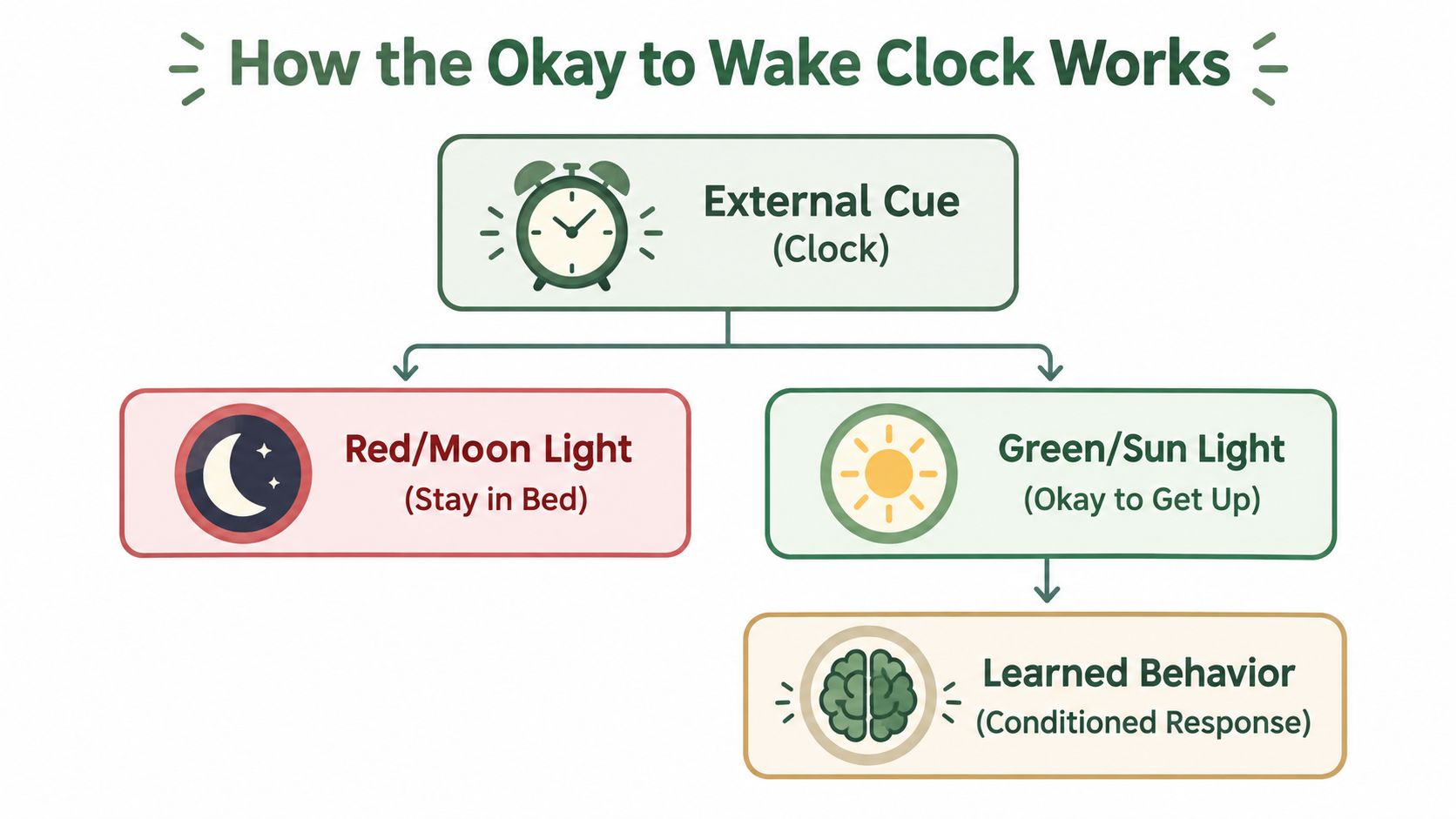
The basic rule is visual:
- Sleep color: Stay in bed or remain in the bedroom.
- Wake color: Morning has started, and it's okay to get up.
- Caregiver response: Adults reinforce the same meaning each time they respond.
A traffic light is a useful analogy. Red means pause. Green means go. The clock doesn't explain the rule with a long conversation at 5:30 a.m. It presents a signal your child can see immediately.
A rule children can practice
During the day, you might say, “When the clock is red, we stay in bed. When it turns green, we get up.” Then show the color change and act out both responses. Keep the language consistent, especially if your household uses more than one language. A Spanish-speaking family might choose a phrase such as, “Rojo, nos quedamos en la cama. Verde, nos levantamos,” as long as every caregiver uses the same meaning.
The clock is more than a night-light or toy because it creates a boundary between two parts of the routine. It can support a child who wakes early, resists bedtime, or calls out during the night, but it works best alongside predictable sleep cues and a calm response from adults.
For a child in a crib, the rule may mean waiting until an adult comes in. For a child in a toddler bed, it may mean staying in the room until the wake color appears. The exact boundary depends on safety, developmental ability, and the family's routine.
For ideas about how wake timing fits into the broader daily rhythm, see this explanation of what a wake window means. The clock marks a boundary. It doesn't decide whether your child is ready for sleep or whether a nap is appropriate.
How the Light Cue Works and Why Consistency Matters
An okay to wake clock works primarily as a conditioned external cue. Your child learns that one color means “stay in bed” and another means “wake up.” That association comes from repetition and caregiver responses, not from the light directly changing the child's biology.
This is why a clock shouldn't be described as a circadian reset button. The practical guidance on using an okay to wake clock emphasizes that the child needs to understand the rule and that the wake signal should be set to a realistic time. If the signal is far beyond the child's current pattern, the expectation may feel impossible rather than teachable.
Learned cue and biological light are different
Light still matters, but in a separate way. The body's circadian system responds strongly to the timing and intensity of light. CDC guidance on light and circadian rhythms explains that morning light after the core body temperature minimum tends to move the body clock earlier, while evening or nighttime light tends to move it later. The same guidance notes that sensitivity is especially important around the pre-bedtime period, overnight, and after the usual wake time.
For the bedroom, that supports a practical design choice: use a low-brightness, stable sleep color at night. A bright light in the evening can work against sleep onset, while a steady, gentle cue is less likely to turn the clock into a stimulating object.
Practical rule: The light should be clear enough to recognize, but night should still look and feel like night.
Consistency is the stronger behavioral lever. If the clock means “stay in bed” on weekdays but “come out whenever you wake” on weekends, the child receives two different rules. The same problem can arise when one caregiver responds to the color and another responds only to the child's calling.
Readiness is more important than extra features
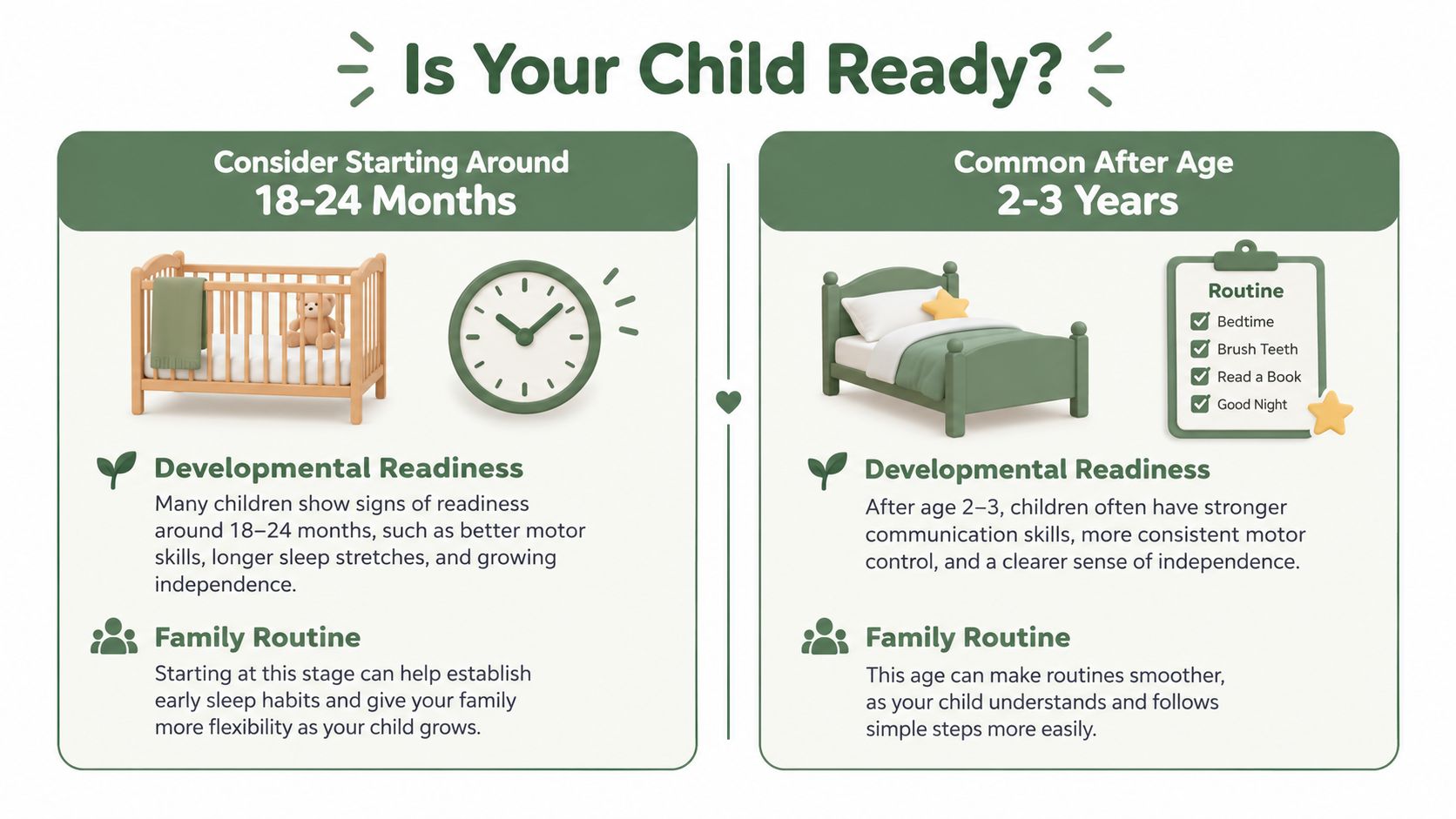
Guidance on starting ages varies. Some sources discuss introduction around 18-24 months, while others place reliable use around age 2, age 2-3 years, or later. This variation is summarized in guidance about when to start an okay to wake clock, and it reflects a developmental question rather than a single universal cutoff.
A child may be ready when they can follow a simple rule during the day, recognize a visual difference, and participate in a short practice without becoming distressed. A younger toddler may notice the colors before consistently following the rule. A preschooler may understand the signal but still need help managing the impulse to leave the room.
For a broader reminder that daily rhythm involves more than one device, read about rhythm rather than the clock. The cue supports the routine. It doesn't replace sleep needs, connection, or an age-appropriate schedule.
When to Start and Whether It Is Right for Your Family
There isn't one correct birthday for introducing the clock. A child who understands colors and follows simple directions may enjoy practicing the rule earlier, while another child may need more time, especially during a crib-to-bed transition or a period of frequent night waking.
The useful question is not only “How old is my child?” Ask instead, “Can my child connect a visible signal with a simple action?” The answer may change over time. Toddlers and preschoolers often benefit most when the rule is concrete, repeated during the day, and supported by adults who respond calmly.
A readiness check without pressure
| Factor | What to Look For | What It Means |
|---|---|---|
| Simple directions | Your child can follow a short instruction during the day. | They may be able to connect the color with an action. |
| Visual understanding | Your child notices and names, matches, or responds to different colors or symbols. | A visual rule may be easier than a spoken time rule. |
| Bedroom boundary | Your child can remain in a crib or understands basic expectations in a bed. | The clock can support an existing boundary, but it can't create safety or impulse control by itself. |
| Routine participation | Your child takes part in bedtime steps with some predictability. | The signal can become another familiar part of the routine. |
| Caregiver agreement | Adults can use the same words and response. | Consistency is in place for learning to occur. |
| Current sleep concerns | Early waking or bedtime resistance is affecting the household. | The clock may be worth trying as one behavioral support, not as a promise of later sleep. |
The potential benefit is clarity. A child who can't read a clock may still understand that the moon-colored light means quiet time and the sun-colored light means morning. This can reduce repeated explanations, especially when parents and caregivers use the same language.
The limit is equally important. The clock won't address every reason a child wakes, and it won't force a child to remain asleep. If the light is ignored, the child may need more practice, a simpler rule, or a different routine. If sleep is disrupted by pain, breathing concerns, illness, or another health issue, speak with your pediatrician rather than relying on a device.
Choose a realistic starting point
Set the signal close to your child's current waking pattern rather than choosing an ideal time that feels unreachable. Once the child understands the cue, the family can consider gradual adjustments, but the first lesson should be easy enough to understand.
A child who wakes at 5:30 a.m. may not be ready to wait for a much later morning signal immediately. You can begin with a time that asks for a manageable change, then reassess the pattern with the other caregivers. The clock teaches a boundary best when the adults can follow through without repeatedly changing the agreement.
How to Introduce the Clock Step by Step Across Caregivers
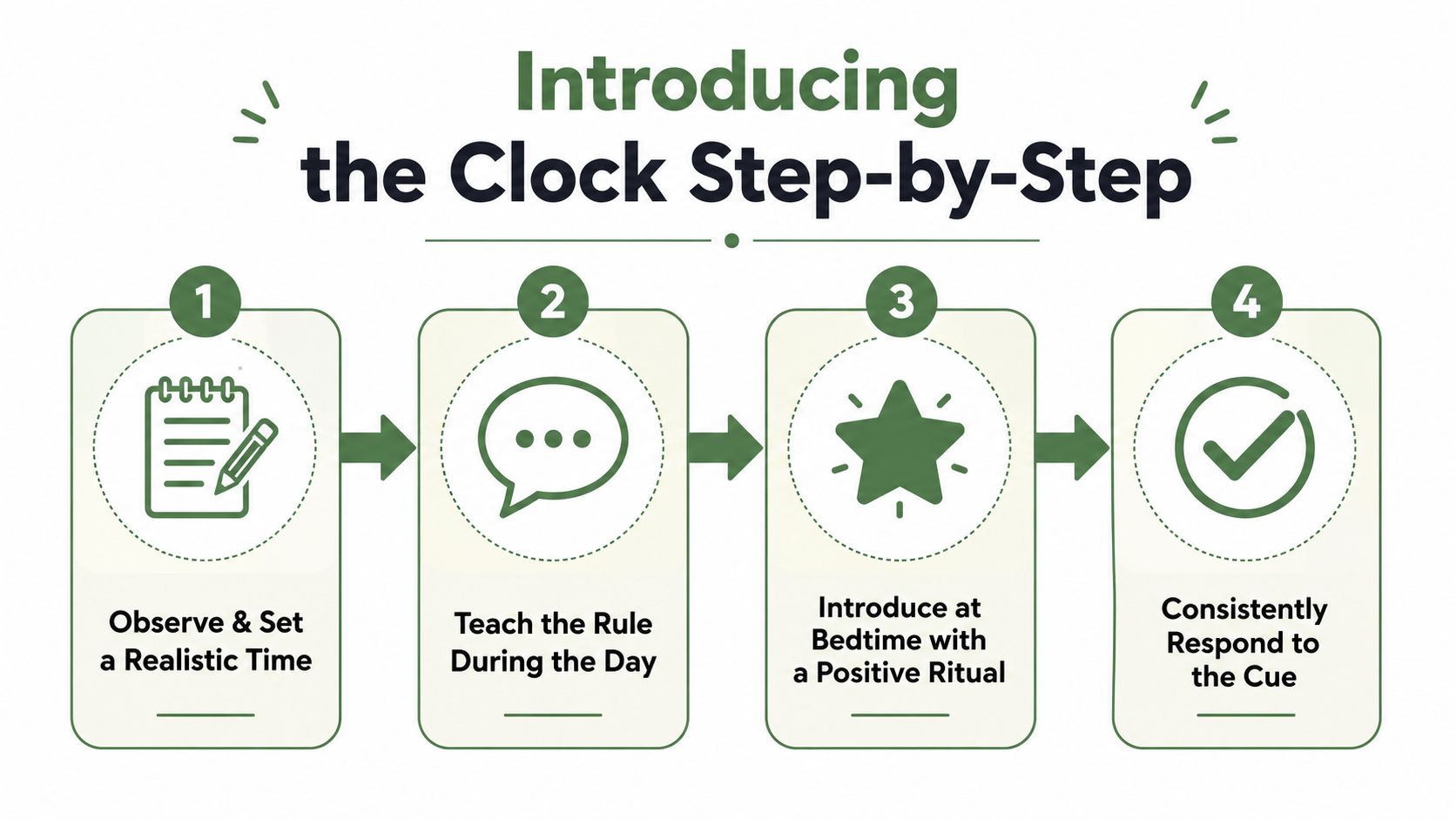
Start with observation, not correction. For several mornings, note when your child wakes, when an adult responds, and whether the child returns to sleep. You're looking for a realistic starting signal, not judging anyone's choices.
1. Set one clear rule
Choose one sleep color and one wake color. Keep the words short:
- “Red means stay in bed.”
- “Green means it's okay to get up.”
- “If you need help, call us. The color still tells us whether it's sleep time.”
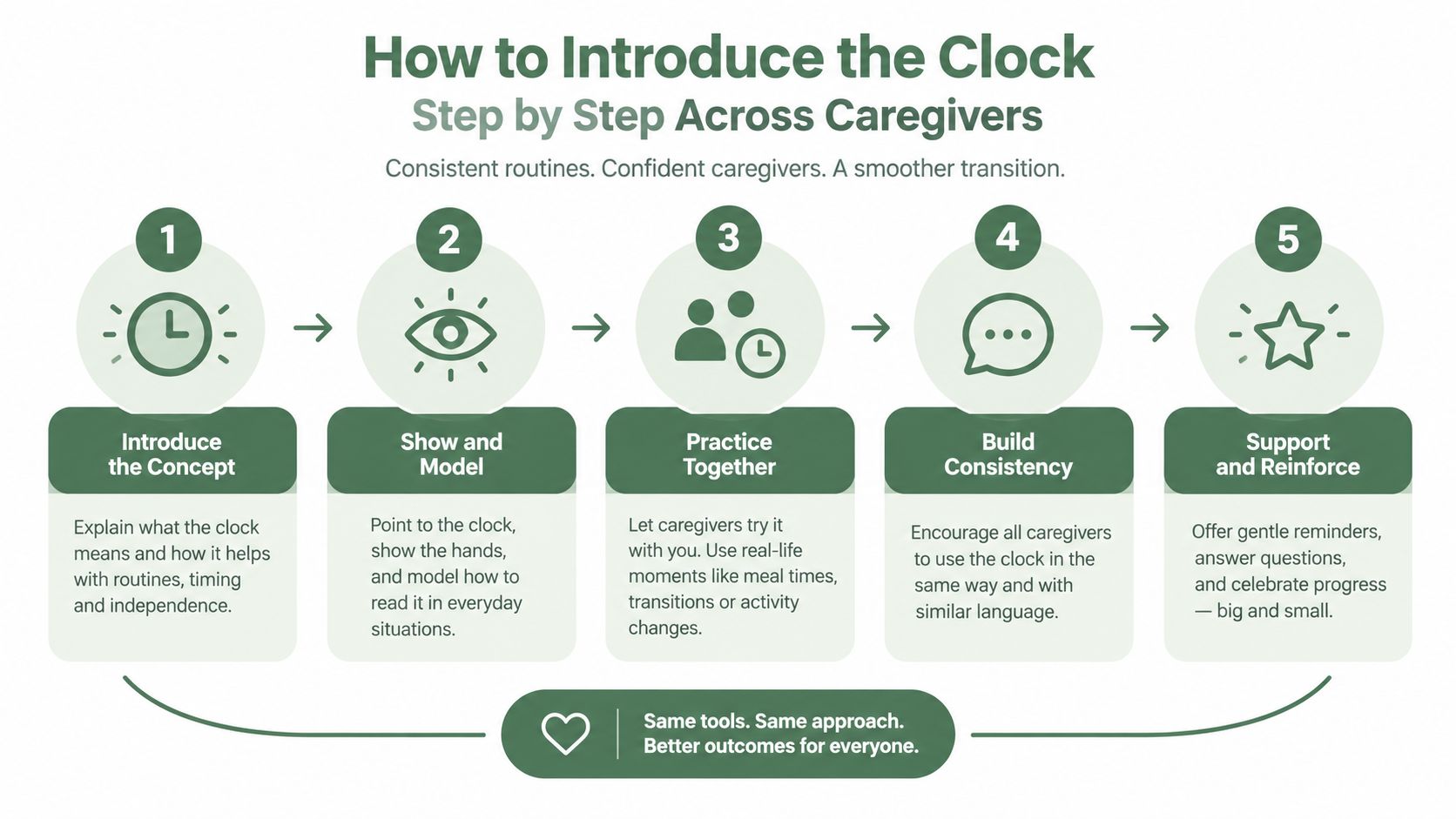
Practice during the day when nobody is exhausted. Let your child watch the color change, then act out staying in bed and getting up. A partner can play the child while your toddler plays the caregiver, or a grandparent can practice the rule during a relaxed visit.
2. Make bedtime part of the lesson
At bedtime, point to the clock and repeat the same phrase. Keep the ritual warm and ordinary, with books, cuddles, or a song. The goal is to make the signal predictable, not to make your child anxious about failing to obey it.
For night calls, caregivers can use a neutral response such as, “It's still sleep time. The wake color hasn't appeared.” If the child needs comfort or practical help, provide it according to your family's needs. The visual cue is a boundary, not a reason to ignore a child.
3. Agree on the morning response
Every adult should know what happens when the wake color appears. Does the parent enter the room? Does the child come to the kitchen? Does the nanny begin breakfast? Write the agreement somewhere visible so a tired caregiver doesn't have to improvise.
Daycare may not use the same clock or schedule, and that's okay. Ask caregivers to describe the child's sleep and wake times in the same terms, especially around naps and unusual mornings. The point is shared information, not forcing every setting to look identical.
4. Keep one timeline
A shared tracker can help parents, partners, nannies, grandparents, and daycare record sleep and wake times in one place. Cradlo gives each caregiver an identity through a QR invite, while daycare can use a bookmarked browser page without installing an app. It supports shared logging across iPhone, Android, and the web, and includes a 7-day free trial on the monthly plan. There's no free plan.
Use the record to compare what the clock showed with what happened. If a child woke early but settled after a brief response, that detail matters. So does a night when the caregiver changed the signal early because the child needed help.
For smoother handoffs, onboarding a caregiver works best when the adult receives the rule, the exact phrases, and the logging expectations together.
Troubleshooting Common Problems Without Starting Over
A clock may be in place and still seem ineffective. That doesn't mean you've failed or that your child is being difficult. Look at the mismatch between the cue and the situation, then change one part at a time.
The early waking hasn't shifted
First check whether the signal is realistic. If the child is being asked to wait much longer than they can manage, move the target closer to the established pattern and rebuild success. Also consider whether a bright bedroom, an inconsistent bedtime, or evening light is making sleep harder, since light timing can affect the body's sleep and wake signals.
Avoid turning the morning into a negotiation. Use one brief phrase, offer necessary help, and keep the response boring until the agreed wake cue appears.
Your child ignores the color
The rule may still be too abstract. Return to daytime practice and connect the color with an action your child can perform, such as sitting with a book or waiting for a caregiver. Preschoolers may benefit from choosing between two acceptable colors, while younger toddlers may need an adult to demonstrate the response repeatedly.
If your child sees the light but leaves the room, calmly guide them back when it's safe to do so. Don't add a long lecture in the middle of the night.
Night calls continue
The clock doesn't remove genuine needs. A child may need the bathroom, water, comfort, or reassurance. Keep the response aligned with the family rule, but respond to the need itself.
A useful script: “You're safe. It's still sleep time. I'll help you, and then we'll rest until the morning light.”
Home and daycare feel out of sync
Ask daycare to record naps and wake times, even if they don't use the same device. A late nap or an unusual day may help explain a different night, but it doesn't require blame. Share the simplest version of the rule and agree on what information should travel home.
If your child has persistent sleep disruption, loud snoring, breathing changes, pain, or another health concern, contact your pediatrician. A clock can support a routine, but it isn't a medical assessment or treatment.
Alternatives Next Steps and Frequently Asked Questions
What if the clock isn't a good fit?
Some children respond better to a simple visual card, a curtain cue, or a picture schedule. Others do better with a spoken routine or a quiet activity basket for the time before morning begins. The best alternative is the one every caregiver can explain the same way and use the same way.
Does the clock replace a bedtime routine?
No. A steady bedtime sequence and support for falling asleep independently still matter, as noted earlier in behavioral sleep guidance. The clock adds one clear signal to that routine, like a shared house rule posted on the fridge.
Should we pause if our child becomes upset?
Yes. Lower the pressure, return to daytime practice, or pause the tool for now. If sleep concerns seem tied to health, development, feeding, or emotional distress, talk with a pediatrician or another qualified professional. Breastfeeding questions belong with a lactation professional.
What should we do next?
Keep logging the actual sleep and wake pattern. Review it with the adults involved, then make one small adjustment at a time. A shared rule works best when it stays kind, realistic, and consistent across parents, nannies, grandparents, and daycare.