Wake Windows 6 Weeks How to Read Cues and Build Naps
You've fed your 6-week-old, changed the diaper, burped them, and tried a little face-to-face time. Then, almost before you've settled into the moment, they're yawning, fussing, or crying as though they've been awake all day. You check a wake-window chart and find several different answers. That confusion is normal.
For wake windows at 6 weeks, think in terms of a flexible range, not a countdown that you can fail. Feeding, burping, diaper changes, alert play, temperament, and the quality of the last nap all affect how long your baby can comfortably stay awake. The most useful plan combines a rough timing guide with close attention to your baby's signals.
Table of Contents
- What to Expect From Sleep at 6 Weeks
- How Wake Windows Work at 6 Weeks
- Reading Sleepy Cues Before Overtiredness Hits
- Sample Nap Schedules You Can Actually Use
- Why There Is No Single Perfect Number
- Troubleshooting Short Naps and Keeping Every Caregiver in Sync
What to Expect From Sleep at 6 Weeks
A 6-week-old's day can feel like a loop with no clear beginning or end. Your baby wakes to eat, dozes during or after the feed, wakes for a diaper change, looks around for a few minutes, and then becomes fussy before the next nap. Another day, the same baby may stay alert longer in the afternoon and need extra comfort in the evening.
That uneven rhythm doesn't mean you've created a bad habit. At this age, sleep is still fragmented rather than organized into a stable schedule. A newborn sleep patterns guide places typical sleep for babies from birth through 8 weeks at 14 to 17 hours in 24 hours, with no fixed nap or bedtime schedule.
Why the clock feels unreliable
Sleep happens across both day and night, and waking to eat remains part of ordinary newborn life. Some pediatric guidance notes that babies around 4 to 6 weeks may wake every 2 to 4 hours to eat and may begin to distinguish day from night while still needing frequent feeds, as described in this overview of sleep for a 6-week-old.
That means a “schedule” may be little more than a repeating pattern:
- Baby wakes and feeds.
- You handle burping and a diaper change.
- There's a short period of quiet alertness.
- You notice sleepy cues and offer another nap.
- The next feeding may happen before or after the nap, depending on your baby.
A rigid routine can make a normal day feel like a problem. One baby may nap soon after feeding, while another needs a little calm interaction first. Both can be within the broad range of newborn behavior.
The practical goal: Notice what tends to happen before your baby sleeps, then make the next nap opportunity easier. You're collecting clues, not grading your caregiving.
A gentle log can help you see those clues over several days. Record when your baby woke, fed, became sleepy, and fell asleep. A newborn wake-window guide can give you background, but your baby's repeated pattern matters more than any chart.
Success at 6 weeks isn't a perfectly repeating day. It's recognizing that awake time is short, offering rest before your baby becomes overwhelmed, and sharing useful observations with the people who care for them.
How Wake Windows Work at 6 Weeks
A wake window is the time your baby is awake between sleep periods. Most guides count it from the moment your baby wakes until they're placed down for sleep again, as explained in this 6-week baby sleep schedule guide.
For practical tracking, start when your baby's eyes open and end when you begin the next sleep attempt. Don't count only active play. At 6 weeks, the window usually includes feeding, burping, a diaper change, carrying, and a small amount of alert interaction.
A simple way to measure it
- Mark the wake time. Use the time your baby is clearly awake, not a brief stir followed by more sleep.
- Log the feed. Feeding may take up much of the available awake period.
- Notice the transition. Quiet staring, reduced movement, or mild fussing can signal that sleep is approaching.
- Begin settling early. Allow time for a diaper change, swaddle if you use one, feeding needs, and calming.
- Record the sleep attempt. Note when you place your baby down, then add a short note if they fell asleep quickly or struggled.
At 6 weeks, many references place wake windows in a newborn range of roughly 30 to 90 minutes, with guidance often clustering around 45 to 60 minutes or 60 to 75 minutes for weeks 5 to 6, according to this 6-week-old sleep and development resource. Your baby may use different parts of that range at different times.
Why the range changes
A newborn who has just taken a full feed may become sleepy quickly. Later in the day, the same baby might tolerate a slightly longer period of calm alertness. That doesn't mean you should stretch every window. It means timing is influenced by the last nap, feeding, stimulation, and individual maturity.
Try to use the range as an early planning tool:
- Start watching closely before the shorter end.
- Offer sleep when cues appear, even if the clock says it's early.
- Treat the longer end as a possible upper boundary, not a target.
- Keep your notes consistent so different caregivers measure the same thing.
If you prefer a starting point for organizing observations, the wake-window calculator can provide age-based guidance. It shouldn't replace watching your baby.
Reading Sleepy Cues Before Overtiredness Hits
At 6 weeks, the difference between an easy nap and a difficult one may be a small change in your baby's behavior. Early sleepy cues can be quiet and easy to miss, especially if you're focused on finishing a feed or getting one more household task done.
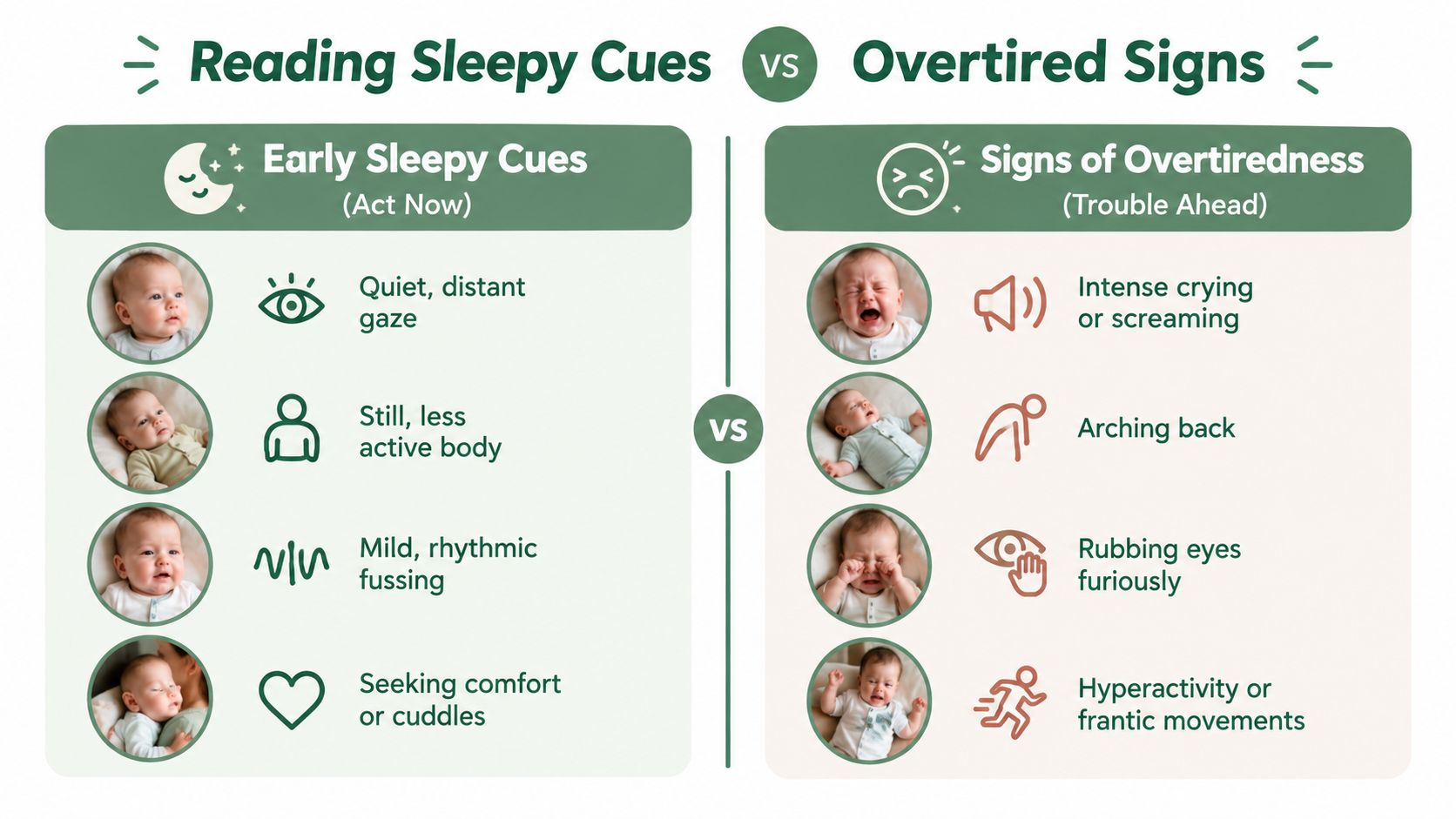
Watch your baby's overall energy rather than waiting for obvious yawning. A baby who becomes still, gazes into the distance, looks away, or seeks extra cuddling may already be ready for less stimulation.
Early cues compared with late signs
| Early sleepy cues | Signs your baby may be overtired |
|---|---|
| Quieter, distant gaze | Intense crying or screaming |
| Less active body | Arching the back |
| Mild, rhythmic fussing | Furiously rubbing the eyes |
| Seeking comfort or cuddles | Hyperactivity or frantic movements |
The difference matters because late signs can look like a baby who needs more activity, not less. A frantic baby may kick, wave their arms, or cry harder when you try to settle them. Adding another toy, conversation, or room change can push them further from sleep.
Watch the baby, not just the timer. The clock can tell you when to start looking. Your baby's behavior tells you when to act.
A week-specific chart places the 5 to 6 week wake window at 40 to 60 minutes and pairs it with 4 to 6 naps per day, while broader newborn guidance uses roughly 45 to 60 minutes for 0 to 8 weeks, according to this newborn wake-window chart. Those figures are useful context, but they aren't a reason to keep a tired baby awake.
Make cues easier to share
Use simple, repeatable words in your family's log. “Quiet gaze,” “less movement,” and “fussy after feed” are more useful than writing “bad nap.” Partners, grandparents, nannies, and daycare caregivers can then respond to the same observations.
If your family speaks Spanish as well as English, agree on equivalent cue descriptions so a handoff doesn't lose meaning. The aim is consistent recognition, not identical soothing methods.
Sample Nap Schedules You Can Actually Use
A sample day can make the range easier to picture, as long as you treat it as a loose rhythm. At 6 weeks, naps may not begin at the same clock time each day, and there may not be a reliable bedtime.
Newborn guidance places this age within the broader 0 to 8 week period, when total sleep commonly falls around 14 to 17 hours in 24 hours. Daytime sleep may total 6 to 10 hours, with naps varying widely, and a baby may manage 4 to 6 naps per day, according to this wake-window guide by age.
Pattern one with shorter morning windows
Your baby wakes, feeds, and becomes sleepy soon after the diaper change. You offer a nap around the shorter end of the range. After the next feed, your baby has a little more alert time, perhaps looking at your face or resting on your lap, before another nap opportunity.
A day might look like this:
- Morning wake and feed.
- Nap after a short period of feeding and care.
- Midmorning feed, diaper change, and brief alert time.
- Another nap when quiet cues appear.
- Afternoon feeds followed by several short rest opportunities.
- A flexible evening with feeding and soothing rather than a fixed bedtime.
This pattern can suit a baby who becomes tired quickly after waking. It may also fit a family that responds to hunger cues rather than trying to align feeds with predetermined nap times.
Pattern two with slightly longer later windows
Another baby may take a little longer to settle after the first afternoon feed. The caregiver still begins watching early, but allows calm alert time if the baby remains comfortable. The final part of the day may include a short nap, a feed, more fussiness, and another sleep attempt.
| Pattern | Wake Window Used | Naps and Feeds |
|---|---|---|
| Shorter and cue-led | Begin near the shorter end, then adjust when cues appear | Frequent nap opportunities, with feeds woven around waking and sleeping |
| Gradually longer later | Shorter after morning sleep, somewhat longer later if baby remains settled | 4 to 6 naps, with feeds commonly recurring every 2 to 4 hours |
The feed interval in that table is a broad reference for this age, not a rule for every baby. Feeding patterns can change, and health or feeding questions belong with your pediatrician or a lactation professional.
Use the schedule as a map, not a destination. If a nap ends early, offer the next rest opportunity sooner. If your baby falls asleep during a feed, count that as sleep rather than trying to create extra awake time.
Caregiver coverage can shape which pattern works best. A parent at home may log cues in real time, while a nanny or daycare caregiver may need a concise handoff describing the last feed, the last sleep, and the first signs of tiredness.
Why There Is No Single Perfect Number
Search results often make wake windows look more exact than they are. One chart says a particular number, another gives a different range, and parents are left wondering which answer is correct. The honest answer is that a wake window is a practical scheduling concept, not a fixed rule that defines what every 6-week-old should do.
Independent coverage notes that no studies specifically test wake windows as a sleep strategy, and that many online schedules aren't grounded in scientific evidence, as discussed in this review of the evidence behind infant wake windows. That doesn't make observation useless. It means you should avoid treating an age chart like a prescription.
What can change the window
Two babies the same age may have different tolerance for light, noise, handling, and interaction. Feeding cadence, temperament, neurological maturity, and the length of the preceding nap can all affect what happens next.
Fussiness at 6 weeks can also overlap with changing feeding patterns and development. If naps worsen even when you're using a reasonable timing range, overtiredness may be part of the picture, but it isn't the only possible explanation.

A helpful mindset is probabilistic:
- Choose a broad starting range.
- Watch for early cues before the window closes.
- Adjust based on what happens repeatedly, not one difficult nap.
- Compare sleep timing with feeds, stimulation, and caregiver changes.
- Ask for professional help when you have health or feeding concerns.
You're not trying to discover your baby's one perfect number. You're learning when this particular baby tends to move from comfortable alertness toward sleep.
Troubleshooting Short Naps and Keeping Every Caregiver in Sync
Short naps and difficult evenings can happen even when you've timed the wake period thoughtfully. Neutral newborn coverage describes 6 weeks as a common point for fussiness and cluster feeding, while guides place wake windows anywhere from roughly 30 to 90 minutes or 45 to 75 minutes at this age, as noted in this newborn wake-window resource.
When a nap ends quickly, avoid trying to “make up” the missed sleep by keeping your baby awake longer. Keep the next period calm, reduce stimulation, and offer another rest opportunity when cues return. In the evening, feeding changes and cluster feeding may overlap with tiredness, so don't assume every unsettled period proves the previous window was wrong.
A calm response to a difficult day
- Short nap: Record when sleep ended, then watch for earlier cues during the next wake period.
- Fussy evening: Keep the environment simple and offer feeding and comfort according to your established care plan.
- Missed nap: Let go of the failed attempt and make the next opportunity low-pressure.
- Caregiver disagreement: Compare the actual timeline, including feeds and handoffs, instead of debating whose memory is right.
A shared log helps because newborn care changes hands often. With Cradlo, families, nannies, and daycare caregivers can record sleep and feeds in one timeline, invite caregivers through a QR code, and use a bookmarked browser page for daycare without requiring an app installation. The app supports offline logging, real-time syncing across iPhone, Android, and the web, plus a daily brief that can summarize patterns for the next handoff. Families can also use consistent naps across caregivers as a practical reference for coordinating responses.
A useful handoff sounds like this: “Fed after waking, became quiet and still during the diaper change, settled after a short cuddle, and slept briefly.” That gives the next caregiver information they can act on.
Contact your pediatrician or a lactation professional for questions about feeding, growth, illness, persistent difficulty waking, or anything that concerns you. Wake windows can help organize observations, but they can't answer health questions.
Cradlo gives families and care teams one shared place to log feeds, sleep, diapers, and handoffs, with gentle daily summaries and offline support. Start the monthly plan's 7-day free trial and use the shared timeline to learn your baby's patterns without chasing a perfect timer.