3 Month Old Sleep: What Is Normal and What to Do
It's 2:17 a.m. and you're standing by the crib, doing quiet math in your head. Your baby slept after the evening feed, woke once, settled, then woke again, and now you're wondering whether this is normal or whether you missed something during the day. Your partner handled the first waking, a grandparent handled the afternoon nap, and nobody's quite sure how long that nap lasted.
That uncertainty is common with 3 month old sleep, because there's no single number that describes every healthy baby. At this age, sleep is still spread across the day and night, night waking is still expected for many babies, and new skills can change a nap from one day to the next. A range is more honest than a rigid schedule.
What helps is a shared picture. When parents, partners, grandparents, nannies, and daycare staff record sleep in the same place, you can see your baby's usual pattern across several days. Then a short nap becomes information, not a verdict, and a pattern that keeps worrying you becomes easier to describe to your pediatrician.
Table of Contents
- How Much Sleep a 3-Month-Old Needs
- Why Night Stretches Still Break Up
- A Sample Nap and Nighttime Schedule
- Fixing Short Naps and Frequent Waking
- Safe Sleep Setup for Every Nap
- When to Call the Pediatrician and What to Bring
How Much Sleep a 3-Month-Old Needs
A three-month-old's sleep makes more sense as a 24-hour total than as one long nighttime stretch. The Centers for Disease Control and Prevention sleep guidance places a three-month-old in the 0–3 months newborn category and recommends 14–17 hours in a 24-hour period, counting naps and night sleep together.
Here's the confusion that clears up. Families often grade the night and ignore the day. A baby who sleeps less overnight but naps well can land in the same daily range as a baby who sleeps long at night and naps briefly. The range describes the whole day, so a long night and a nap-heavy day can arrive at the same place.
Typical Sleep Measures at Three Months
| Measure | What is typical at three months | What it tells you |
|---|---|---|
| Recommended 24-hour total, 0–3 months | 14–17 hours | Daily total, not one overnight stretch |
| Daytime share | Spread across several naps | A short nap does not sink the day |
| Nighttime share | One long overnight period that includes waking | Waking is part of the night, not a failure of it |
| How the split varies | Widely, from baby to baby | Two babies can match on total and look nothing alike |
Read the table as a way to sort your notes, not as a scorecard. The recommended range is wide on purpose: two healthy three-month-olds can divide the same fifteen hours very differently, one sleeping longer at night and napping less, the other waking more often and catching up during the day. A single night tells you little. A week of entries tells you a lot. For a broader view across ages, see this overview of how many hours babies sleep.
How to Work Out Your Baby's Total
Pick one consistent 24-hour window, such as 7:00 a.m. to 7:00 a.m. Add the minutes from every nap and every nighttime sleep period in that window. Don't count quiet feeding or soothing as sleep unless your baby is asleep. Then look at several days side by side.
- Use start and end times: A nap logged as "afternoon" can't be added to a daily total.
- Compare your baby with your baby: A stable pattern slightly outside a population range tells a different story from a sudden change.
- Note who recorded each sleep: When a partner, nanny, grandparent and daycare all log in the same place, afternoons don't vanish and a missed entry doesn't distort the total.
One low day after travel, visitors, or a busy afternoon doesn't rewrite the pattern. A week of totals gives you something steadier to discuss, and it keeps the daily number from becoming a pass-or-fail test. If sleep comes with feeding, breathing, or behavior concerns, that log belongs in a conversation with your pediatrician rather than in a decision you make from the total alone.
Why Night Stretches Still Break Up
Night waking at three months doesn't, by itself, mean something's wrong. A longitudinal study of normal infants found that approximately 50% of babies had an average of 1–2 awakenings per night at 3 months, while more than 2 awakenings occurred in 9% of infants at that age. In other words, waking once or twice was the pattern for about half the babies, not an exception.
The same source describes a video-based assessment of 90 African American 3-month-old infants with an average overnight sleep period of 563.20 minutes, or about 9.39 hours, with average sleep onset near 9:59 p.m. and average rise time near 7:13 a.m. Those times describe the overnight period. They don't mean every baby slept without waking from start to finish.
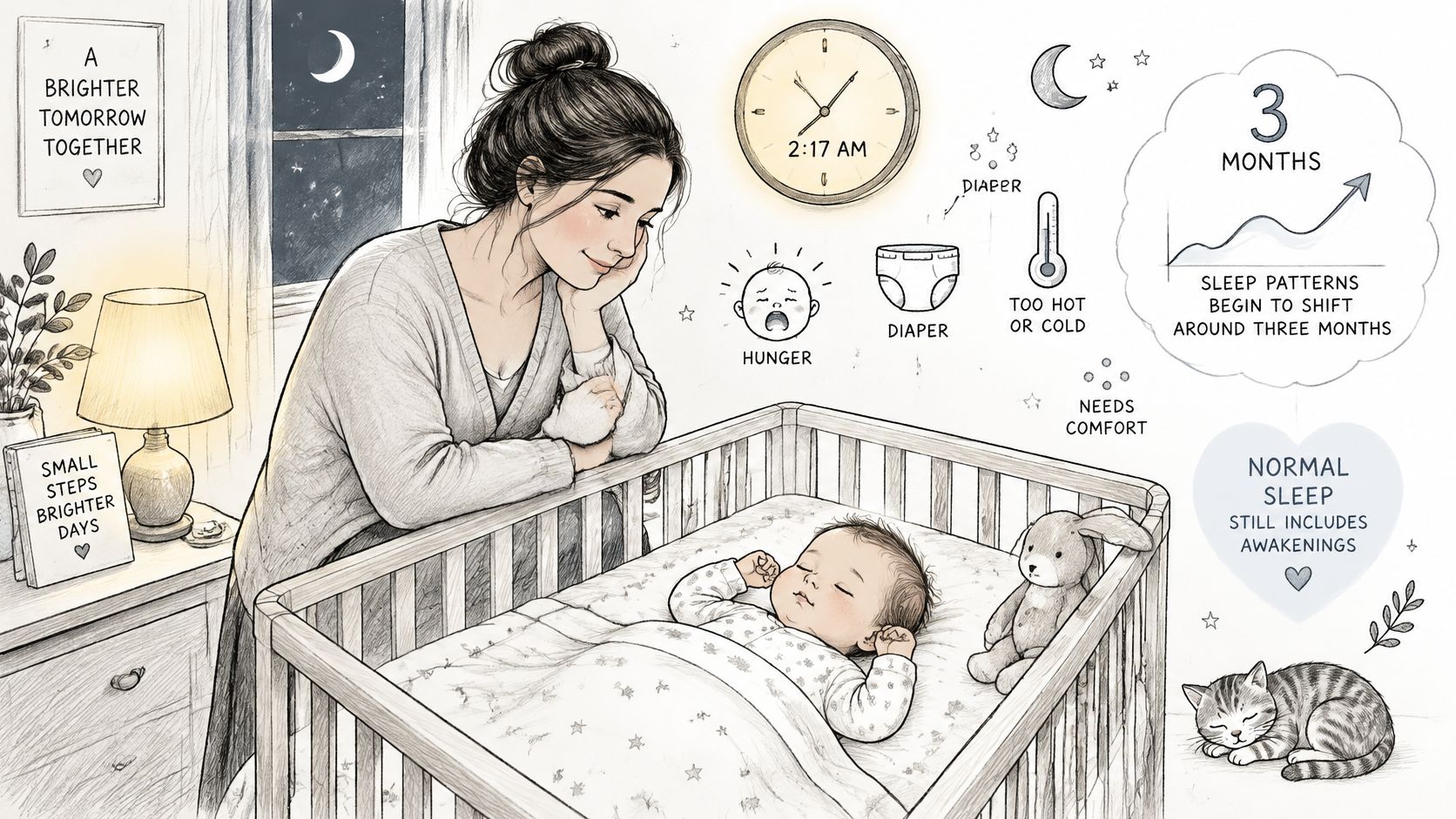
Say your baby settles at 9:30 p.m., wakes at 2:00 a.m. for a feed, wakes again at 5:00 a.m., and starts the day at 7:00 a.m. That's still a long overnight period, even though you were up twice. Calling it "broken sleep" can make a fairly typical night sound like a failure, when the more useful questions are how often your baby woke, what they needed, and how that compares with their own previous nights.
A helpful reframe: Judge the night by the total pattern across a week, not by whether one stretch matched another baby's best night.
New Skills Can Change Sleep From Day to Day
Around three months, babies often become more alert and social, and that can spill into sleep. None of these shifts affects every baby the same way, but each one can change how easily a baby settles.
- More visual engagement: A baby who's busy tracking faces, light, or a mobile may take longer to settle in a bright room.
- First social smiles: A baby who lights up when you lean over the crib may turn a quick check into a full interaction.
- Hand-to-mouth play: Newly discovered hands can soothe one baby and distract another who keeps batting and fussing instead of drifting off.
- Stronger reactions to sound: A sibling's voice or a door closing may end a light nap that would have continued a few weeks earlier.
- Early head lifts: A stronger, more active baby may need a calmer wind-down after active floor time before sleep comes easily.
Many families call a rough patch around this age the three-month sleep regression. That label can be misleading if it sounds like a fixed event with a fixed length. Some babies barely seem to notice a change, while others wake more often for a few weeks as sleep and development shift together. Your baby's log, with a note when a new skill appears, tells you more than the label does.
What to Record Overnight
Log each waking with the time, what seemed to prompt it, what you did, and which caregiver responded. That shared record helps partners avoid the 3:00 a.m. guessing game, and it lets a nanny or grandparent see how the night went before judging the morning nap.
Keep day and night cues steady while you watch the pattern. Bright, active days and dim, quiet nights give your baby a clearer contrast than a strict clock does. Across several nights, you'll start to see whether waking clusters around feeds, follows shorter naps, or shows up alongside a new skill.
A Sample Nap and Nighttime Schedule
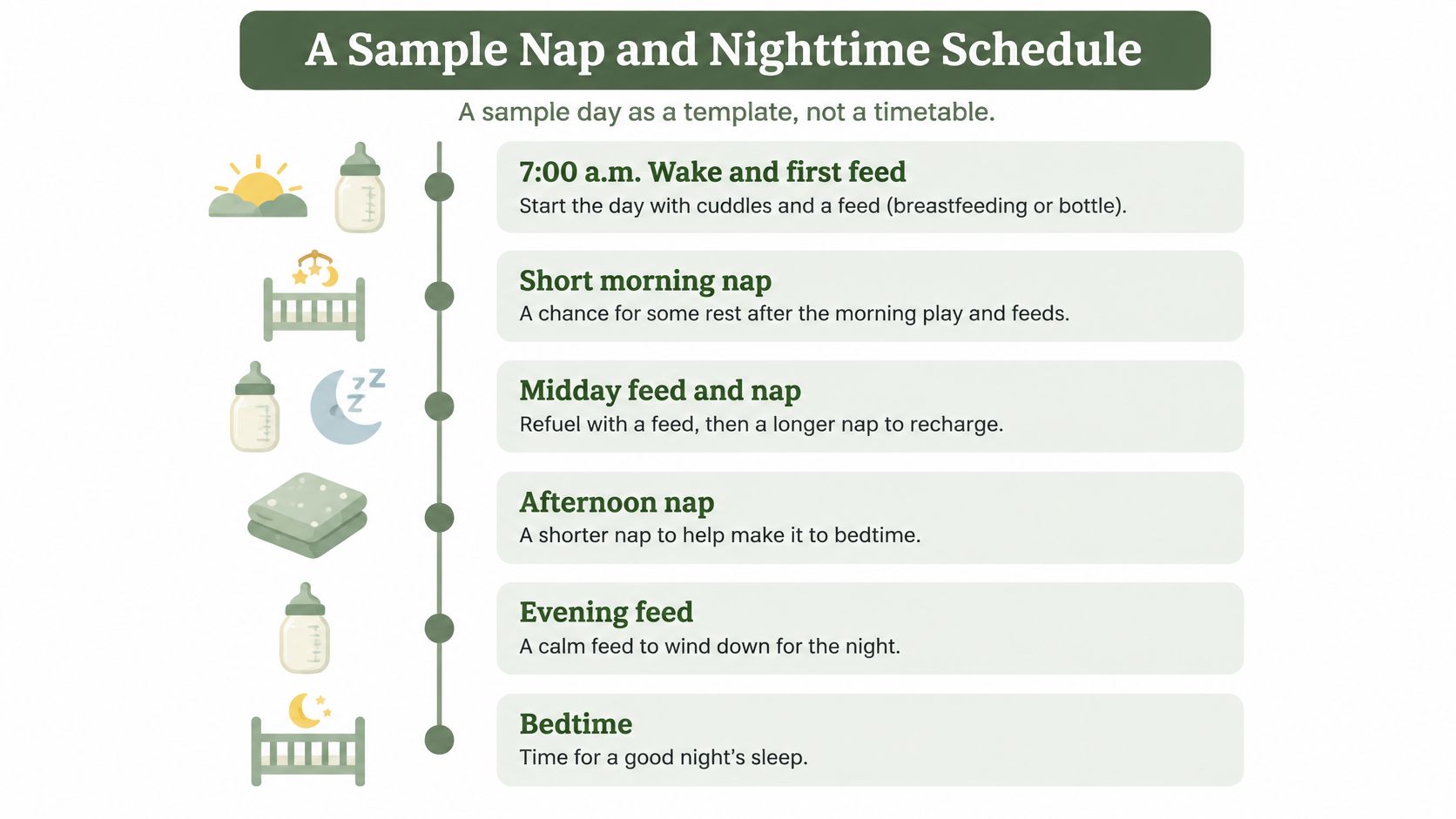
Use a sample day as a template, not a timetable. The clock times below show a shape that works for many families, starting with a morning anchor and ending with the same bedtime steps each evening. Your baby's version may run earlier, later, or with naps in a different order of length.
Sample Day at Three Months Illustrative
| Time | Activity | What to Watch For |
|---|---|---|
| 7:00 a.m. | Wake and first feed | Use the first wake time as the day's anchor |
| Mid-morning | Short morning nap | Start it at the first tired cue, not the clock |
| 11:30 a.m. | Feed, then midday nap | Keep the room dim and quiet for the nap |
| 2:00 p.m. | Afternoon nap | Often the longest daytime sleep; protect it |
| 4:30 p.m. | Brief late-afternoon catnap or cuddle | Keep it short so bedtime stays on track |
| 6:30 p.m. | Bath, feed and bedtime routine | Same steps in the same order each evening |
| 7:00 p.m. | Down for the night | Lay baby down drowsy but awake when possible |
| Overnight | Night feeds as needed | Log each waking with the time and who responded |
The 7:00 a.m. wake and first feed is the anchor because it gives the rest of the day a starting point, even after a rough night. The short morning nap is often the first to show you how your baby signals tiredness. If your baby yawns, stares off, rubs their eyes, or starts fussing well before you expected, believe the cue rather than the planned time.
The midday and afternoon naps carry much of the daytime sleep in this example, so a dim, quiet room helps protect them. The late-afternoon catnap is deliberately brief, because a long sleep late in the day can push bedtime later for some babies. If your baby only wants a quiet cuddle at that point, that still serves as a pause before the evening routine.
Why the Clock Should Stay Flexible
Research on circadian rhythm maturation in infancy identified an approximately 60-minute ultradian activity cycle in 3-month-old infants, and sleep-bout duration averaged about 4.8 hours at that age compared with roughly 9.9-hour bouts at 12 months. That shorter cycle helps explain why a baby may stir near hourly boundaries even when their total sleep looks fine.
It also explains why forcing exact nap times can backfire. A nap started a little too late often leads to an overtired baby and a shorter sleep, while a nap started at the first tired cues has a better chance of settling smoothly. Awake time between naps is best read from your baby's behavior rather than from a fixed number someone else's baby followed.
Adjust one anchor at a time. If your baby shows tired cues earlier than the planned first nap for several days in a row, move that nap earlier by a few minutes and leave everything else alone. If bedtime keeps sliding because the last catnap runs long, shorten that catnap before you change the whole evening.
After a week, ask a simple question. Does the day keep a similar shape, with a morning anchor, several naps, and a predictable bedtime routine, even when the exact times shift? If the answer's yes, the schedule is doing its job.
Fixing Short Naps and Frequent Waking
Start with the most common worry. A nap that ends within minutes feels frustrating, especially if you just sat down, but one short nap isn't a schedule problem. Sleep at this age is spread across multiple bouts, and nap lengths vary a lot from day to day.
A large-scale analysis of infant sleep found an average of 3.9 naps per day and roughly 226 minutes of daytime sleep at 3 months. With sleep divided that way, some naps will be solid and others will be brief. What matters more is whether the overall pattern holds and whether your baby seems rested across the day.
Common Sleep Problems Causes and What to Try
| Symptom | Likely Cause | What to Try |
|---|---|---|
| Naps that end within minutes | Nap started too late, or a bright or noisy room | Start the nap at the first tired cue; dim the room; add white noise |
| Waking near the same point each night | Light sleep transitions tied to the hourly cycle | Pause a few minutes before responding, then use the same calm cue |
| Night waking beyond the usual pattern | Hunger, discomfort or a feeding question | Check the feed log and discuss feeding with the pediatrician |
| Short naps with long daytime gaps | Too much stimulation or too long awake between naps | Keep awake time short and quiet; move the next nap earlier |
| Fighting sleep at bedtime | Overtiredness | Start the bedtime routine earlier, in the same order each night |
Naps that end within minutes often trace back to timing or the room. If your baby was already fussy and rubbing their eyes before you started the nap, the nap probably started late. Try beginning at the first tired cue for several days, with the room dimmed and white noise on, before you conclude the nap itself is the problem. This kind of change can show a difference within a day or two.
Waking near the same point each night calls for a slower response, not a new routine. If your baby stirs, fusses briefly, and isn't fully awake, pause a few minutes before you go in. Some babies resettle on their own, and if yours doesn't, use the same calm cue each time so the response stays predictable. Judge this one over a week rather than one night.
Change one thing, give it several days, and log the result. Changing the room, the timing, and the routine on the same day leaves you unable to tell what helped.
Night waking beyond your baby's usual pattern deserves a look at the feed log before you change the sleep plan. Check when the last feeds happened and who gave them, since a partner, grandparent, or daycare entry may hold the missing piece. If feeding questions keep coming up, bring that log to your pediatrician or a lactation professional instead of trying to solve feeding through the sleep schedule.
Short naps with long gaps between them point to awake time that's stretching too far, which is where understanding what a wake window is helps you read the gap between sleeps more clearly. Keep the period before the next nap quieter and bring that nap earlier. A baby who has had a lively play session with visitors may need a longer calm wind-down, not a later nap.
Fighting sleep at bedtime usually means the routine started after your baby was already overtired. Move the whole routine earlier, keep the steps in the same order, and hold that change steady for several nights. If a pattern persists after consistent changes, or it moves far from your baby's usual pattern, take the log to your pediatrician and work from actual entries rather than memory.
Safe Sleep Setup for Every Nap
One set of rules covers every sleep at three months, whether it's the long afternoon nap at home, a short sleep at daycare, or a doze that starts in the stroller. The setup doesn't change because the sleep is short.
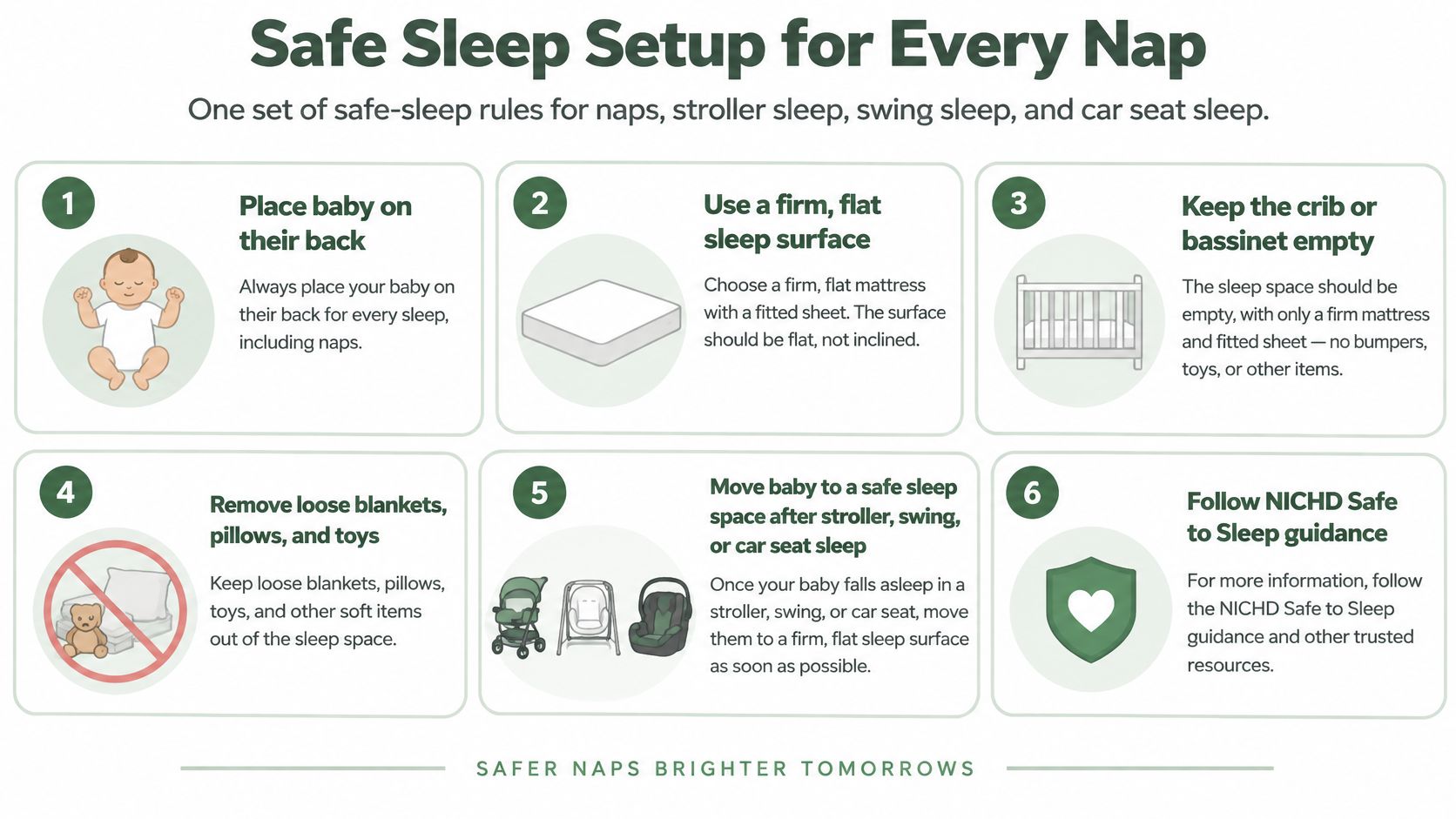
The National Institute of Child Health and Human Development Safe to Sleep guidance says to place babies on their backs for naps and at night and to continue until age 1. It specifies a sleep surface that is firm, flat, and level, with only a fitted sheet, and it recommends room-sharing for at least the first 6 months with a separate sleep space such as a crib, bassinet, or portable play yard.
The Checklist for Every Caregiver
- Back to sleep: Place your baby on their back for every nap and every night.
- Firm, flat, level surface: Use a crib, bassinet, or portable play yard with a fitted sheet, not an inclined or hammock-like surface.
- Empty sleep space: Keep out loose blankets, pillows, stuffed toys, and bumpers. If swaddling has become a struggle in your house, this guide on what to do when a baby hates the swaddle covers calmer options to discuss.
- Separate space, same room: Room-share without bed-sharing, so your baby sleeps close by in their own space.
- Move after device sleep: Don't use a couch or armchair for sleep, and don't use a swing or car seat for routine sleep outside of riding in the car. Move your baby to a safe sleep space when you can.
Write these rules down for everyone who settles your baby, including grandparents who babysit, a nanny running the morning nap, and daycare staff. Spanish-speaking families can ask their pediatrician or lactation professional for safe-sleep guidance in Spanish, and caregivers who speak Spanish at home should receive the same rules in Spanish so nothing gets lost in a handoff.
A log can show when a nap happened and who recorded it. It can't tell you whether a particular setup or product is safe for your baby, so questions about a specific situation belong with your pediatrician.
When to Call the Pediatrician and What to Bring
Most variation at three months is variation. Some patterns, though, are worth raising rather than watching indefinitely, and you don't need certainty before you call. Asking is a reasonable step on its own.
Signs That Warrant a Call
- Feeding has become poor: Your baby is taking much less than usual or feeds have become a consistent struggle.
- Weight gain has been flagged: Your pediatrician has already raised growth as something to watch.
- Breathing concerns: Anything about your baby's breathing during sleep or waking worries you.
- Unusual lethargy: Your baby seems hard to wake or far less alert than usual.
- Illness: Fever or other symptoms alongside a sleep change.
- A lasting shift: Sleep stays far from your baby's usual pattern for several weeks and your family remains concerned.
These are reasons to ask, not a diagnosis, and they aren't a reason to blame a schedule. If something seems like an emergency, seek emergency care rather than waiting for office hours.
What to Bring to the Appointment
Bring a week of records rather than a summary from memory. Include 24-hour totals, nap count and lengths, each night waking with its time and what your baby needed, and feeding times and amounts. Note which caregiver recorded each entry, since that shows the pattern was observed across settings and not reconstructed afterward.
A shared record makes this easier, because every feed, nap and diaper logged by any caregiver shows up instantly for everyone. Your daycare can add entries to that same picture too, since daycare does not need to install an app or create a login to use Cradlo.
For tonight, keep it small. Pick one change from the earlier ideas, such as starting the first nap at the first tired cue or moving bedtime earlier, try it for several days, and log what happens. One steady change with a clear record teaches you more than a full reset.
If you're piecing together naps, feeds, and night wakings from texts and memory, Cradlo gives parents, partners, grandparents, nannies, and daycare one shared log where every entry appears for everyone in real time. That single timeline makes it easier to see your baby's actual sleep pattern across a week and to bring clear notes to your pediatrician. Start the 7-day free trial on the monthly plan and record tonight's first waking together.