Does My Newborn Sleep Too Much? What to Watch For
A lot of sleep alone is usually normal for a newborn in the commonly cited 14-17 hour reference range for babies 0-3 months, and what matters most is whether your baby can be woken to feed, feeds effectively, has wet diapers and is alert when awake. If those pieces are steady, a sleepy day doesn't automatically mean something's wrong.
It's late afternoon, your baby has barely opened her eyes between feeds, and you're doing quiet math in your head. Did she miss a feed? Was that last awake stretch too short? You're not looking for a diagnosis from an article. You're looking for a calmer way to decide what to watch, what to write down, and when to call your pediatrician.
Table of Contents
- Does Your Newborn Sleep Too Much? The Short Answer
- Why Feeding and Waking Matter More Than Hours
- How to Check Sleep Against Feeds and Diapers
- Red Flags That Need a Clinician Right Away
- Keeping Sleep Observations Consistent Across Caregivers
- Safe Sleep Still Applies When Your Baby Sleeps a Lot
- Confirm the Next Step With Your Pediatrician
Does Your Newborn Sleep Too Much? The Short Answer
Start with the whole day. A newborn can sleep for long stretches and still be well. The more useful question is whether that sleep leaves room for waking, effective feeds, wet diapers and moments of normal alertness.
Typical newborn sleep totals by source and age
| Source | Age group | Reported total sleep |
|---|---|---|
| National Institutes of Health | 0-3 months | 14-17 hours per 24-hour day |
| American Heart Association | 0-3 months | 14-17 hours per day |
| Royal Australian College of General Practitioners | 0-2 months | 16-18 hours per 24-hour period |
| American Academy of Pediatrics | Newborn | about 16-17 hours per day |
| Hong Kong Family Health Service | Birth to 3 months | 14-17 hours per 24-hour day |
Read the table as typical reference points. Each total covers a full day and combines daytime and nighttime sleep. The endpoints differ because the sources use slightly different newborn age bands, and an individual baby can sit above or below a range while still feeding and waking normally.
One long stretch is only one piece of the picture. Waking, feeding, diaper output and alertness show whether that piece fits the rest of the day.
A typical sleepy day
A two-week-old may sleep, wake fussy, feed with energy, look around briefly, then settle again. That cycle can repeat all day, and none of the awake periods may feel long. The pattern is reassuring when she keeps rousing, taking feeds, wetting diapers and acting like herself when awake.
The hour count works like a weather report: useful background, with feeding and responsiveness showing the actual conditions. Many short sleep stretches can also add up to a large daily total without looking dramatic at any one time.
When the day feels unusually sleepy, check the pieces that give the total context:
- Feeding: Is she completing feeds at her usual pace?
- Waking: Does she rouse when you gently offer a feed?
- Diapers: Are wet diapers continuing across the day?
- Alertness: Is she focused and responsive when awake?
- Weight trend: Is growth moving as your clinician expects?
If another caregiver takes over, write the same answers in one shared place so you are comparing the same day rather than separate memories. A single long nap with everything else steady calls for observation. Clear changes across feeds, waking or alertness are worth discussing with her clinician.
Why Feeding and Waking Matter More Than Hours
Sleep is easier to judge by what it does to feeding and responsiveness than by the hour count. A baby can rack up a lot of sleep and still feed well. A baby with a lower total can still need attention if she's too sleepy to finish feeds.
The feeding rhythm in the early weeks
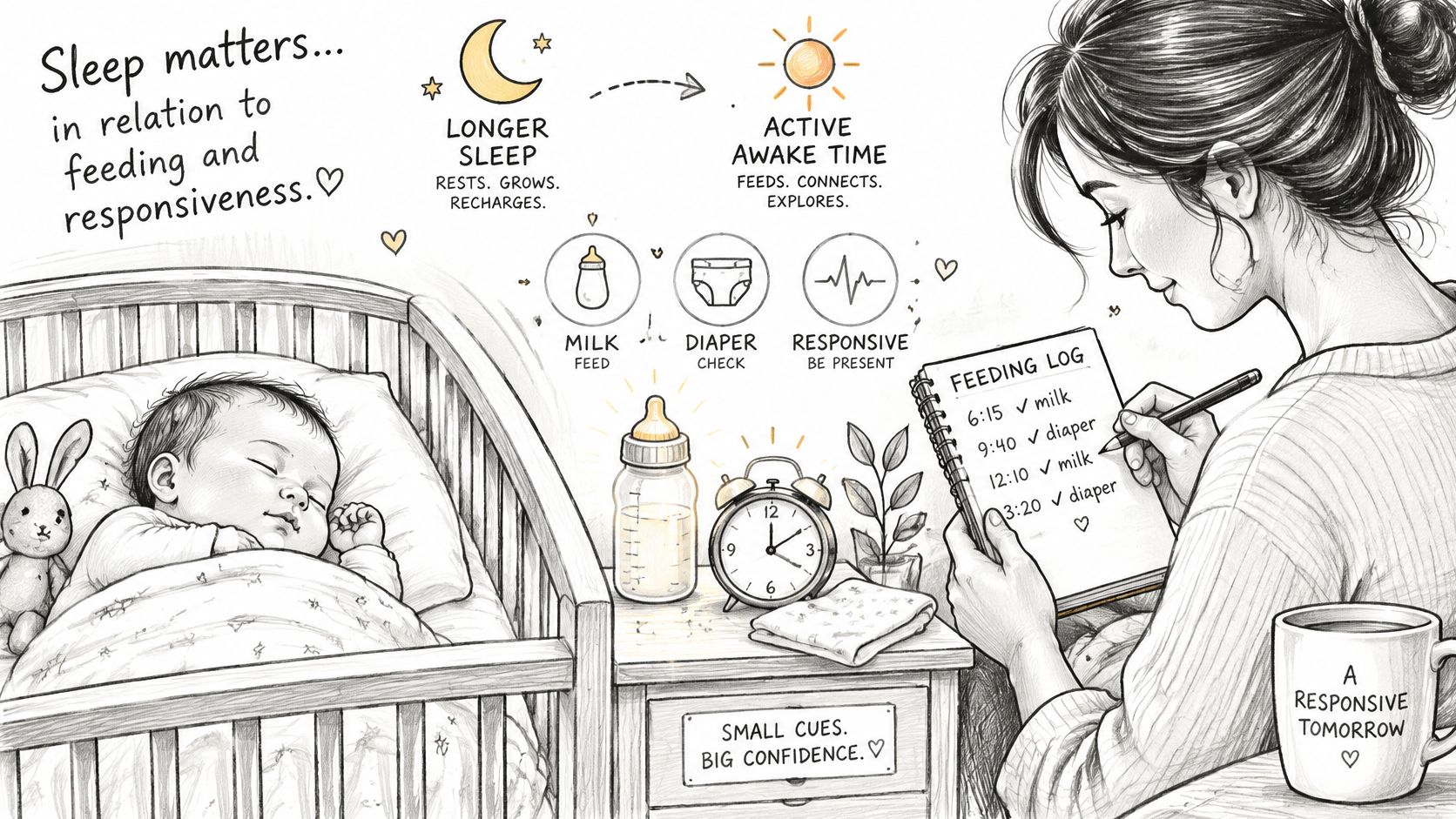
Mayo Clinic guidance on waking a newborn to feed states that most newborns need 8-12 feedings per day, approximately once every 2-3 hours. That rhythm is why a long sleep in the first weeks deserves a quick feeding check, even if the daily total looks ordinary.
Until a baby regains birth weight, usually within 1-2 weeks, feeding may need encouraging, including waking the baby if more than 4 hours have passed since the last feeding. After birth weight is regained and a pattern of weight gain is clear, Mayo Clinic says it's generally acceptable to wait for the baby to wake, subject to guidance from the baby's clinician. Your own clinician confirms which approach fits your baby, especially after premature birth, jaundice or slow weight gain.
You can learn more about the shape of early intake from this overview of infant feeding patterns across the first weeks. Use it to understand the rhythm, not to override instructions you've been given for your baby.
Three babies with the same long nap
The baby who wakes on her own. She stirs, roots or cries, feeds vigorously and produces wet diapers. Her sleep looks long, but it isn't interrupting intake. A useful question for the pediatrician is whether her weight trend lets you keep letting her set the pace at night.
The baby who sleeps through a feed time. He doesn't stir at the usual interval, but when you undress him, change his diaper and offer a feed, he wakes enough to complete it. Note how long waking took and whether the feed was full. Ask your clinician how long he should go between completed feeds at his current weight.
The baby who rouses briefly, then drifts off. She opens her eyes, takes a few sucks and falls back asleep before finishing. That's not the same as a completed feed, even if you started one on schedule. Diapers and alertness over the next hours matter here, and repeated unfinished feeds are worth raising promptly.
Practical rule: Count completed feeds, not feed attempts. A sleepy start that fades after two sucks doesn't give you the same information as a full feed.
The hour count can't separate those three babies. Waking, feeding quality and diapers can, and they give your pediatrician or lactation professional something concrete to assess.
How to Check Sleep Against Feeds and Diapers
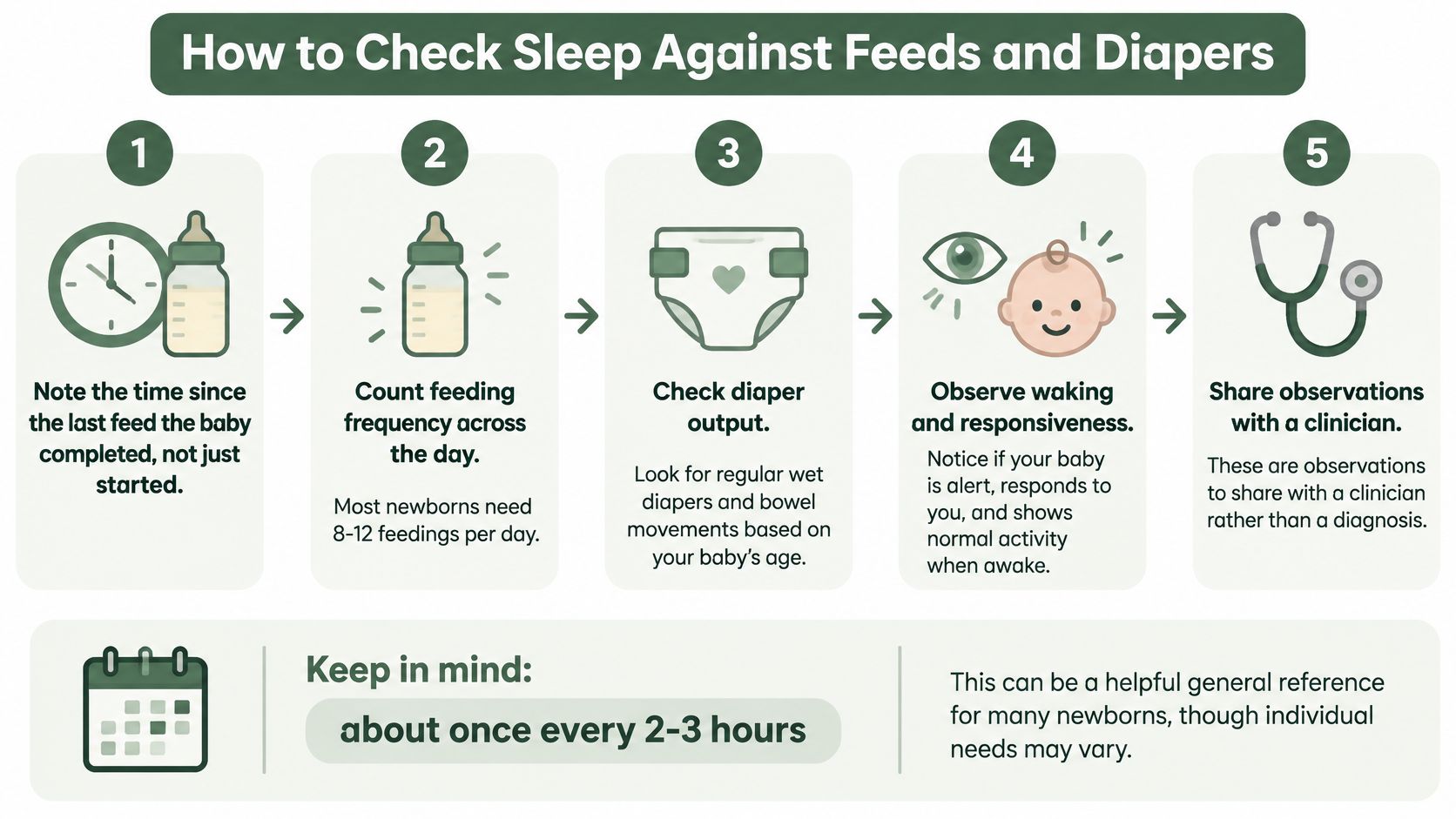
Run this check whenever sleep feels longer than usual. Treat the results as observations to share with a clinician, not as a diagnosis you make at home.
Five observations that work together
-
Note the time since the last completed feed. Write down when your baby last took a full feed, not just when one started. A brief, sleepy attempt can make the gap look shorter than it really is.
-
Offer a feed gently and watch the response. Change the diaper, undress her to the diaper, hold her skin to skin or rub her feet while you talk to her. Note whether she stirs, how long waking takes and whether she can stay awake long enough to feed. A baby who stays hard to rouse needs to be reported to a clinician.
-
Count wet diapers across the day. A steady run is reassuring context. A long dry stretch alongside sleepiness changes the picture. If you're unsure what's expected by age, this guide to how many wet diapers a newborn should have can help you record counts in a consistent way.
-
Watch alertness during awake periods. Does she look around, focus briefly on a face and feed with energy? Or does she seem unusually limp, quiet or hard to engage compared with yesterday? Alertness between sleeps is part of the assessment, not a side detail.
-
Compare today with her usual pattern and weight trend. One long nap is less informative than a change across several feeds. Put today's notes beside the pattern from earlier this week and the weight trend your clinician last shared.
What the two outcomes look like
A reassuring result is a baby who rouses, completes feeds, keeps making wet diapers and looks like herself when awake, even if she sleeps again quickly. You can keep recording and raise the pattern at the next visit if you're still wondering.
A result that calls for a clinician is a baby who's hard to wake, can't sustain feeding, has a marked drop in wet diapers or seems less responsive than usual. Don't keep repeating the check for hours to gather more proof. A clinician makes the actual assessment, using your notes plus an examination and your baby's history.
Judge the change from your baby's usual pattern, not one nap against another baby's day.
That distinction keeps you from overreacting to a quiet afternoon and from waiting too long when several signs move together.
Red Flags That Need a Clinician Right Away
A long nap by itself is rarely an emergency. Newborn sleep totals vary widely, and a quiet afternoon often means nothing at all. What turns sleepiness into a reason to act is the company it keeps. One warning light on a dashboard can be a sensor glitch. Three at once means pull over, and the same logic applies here: sleepiness paired with a baby who will not feed, will not wake or looks different from yesterday is what matters.
The guiding principle is change. A sudden deviation from your baby's own pattern carries more information than any single long stretch, and sleepiness that is new, progressive or paired with other symptoms deserves prompt attention.
Newborn signs that need a clinician and the next step
| Sign | Why it matters | Next step |
|---|---|---|
| Difficult or impossible to wake | Sleepiness that stops feeds is the key concern | Call a clinician now, seek emergency care if the baby is unresponsive |
| Will not feed or cannot sustain feeding | Feeding is the main indicator of intake | Call a clinician now |
| Fever or an unusually low temperature | Can signal illness in a newborn | Seek urgent medical advice |
| No wet diapers | Can suggest inadequate intake | Call a clinician now |
| Breathing difficulty | Needs immediate assessment | Seek emergency care |
| Jaundice in the first 24 hours | Needs same-day evaluation | Contact a clinician the same day |
| Jaundice with poor feeding, lethargy or weight loss above 10% | Can reflect significant illness | Immediate neonatal referral under NHS guidance |
NHS neonatal jaundice guidance treats jaundice during the first 24 hours as needing urgent same-day evaluation, and identifies jaundice combined with poor feeding, lethargy or weight loss exceeding 10% as requiring immediate neonatal referral.
Emergency evaluation is warranted if a jaundiced newborn is difficult or impossible to wake, will not feed, is floppy or stiff, has abnormal movements, has no wet diapers or has breathing difficulty.
How many waking attempts are reasonable
There's no fixed number that works as a safe threshold. Try a few gentle steps in sequence: a diaper change, undressing down to the vest, skin to skin contact, then offering a feed. Make those attempts while you contact a clinician.
If your baby stays hard to rouse, won't feed or seems less responsive than usual, stop the home attempts and seek care. Waiting to see whether she wakes on her own costs time you may need, and finishing a sleep log can wait. Note feeding success and diaper output on the way if you can, because those details help the clinician. The call comes first.
A tracker threshold can't diagnose excessive sleep. Clinicians distinguish normal newborn sleep from lethargy using the full picture.
When you call, a calm and specific description helps. Say when the last completed feed was, what you tried, how she responded, and what her diapers and temperature have been. You hand over observations. The clinician decides what they mean.
Keeping Sleep Observations Consistent Across Caregivers
It's 2 a.m. and two tired parents are whispering over the bassinet. One thinks the baby fed an hour ago. The other thinks that was the feed before. Neither is careless, they're just exhausted, and memory is a weak tool at that hour.
A shared timeline removes that guesswork. That's the situation that shows why it matters who records what, and this look at choosing a newborn log app for shared care walks through what to look for. The tool matters less than the agreement behind it.
What every caregiver should record the same way
- Sleep start and end time: So the next person can see the last stretch without asking.
- Whether a feed was completed: Not just offered, and not just started.
- How the baby woke: On her own, with a diaper change, or only after stronger encouragement.
- Wet and dirty diapers: Logged when changed, not reconstructed later.
- Alertness after waking: A few plain words, such as bright, sleepy but fed well, or hard to rouse.
Consistency is what turns scattered notes into a pattern. A grandparent who thinks long sleep is always a blessing, a nanny who worries sooner and daycare staff following their own routine can all read the same entries and see the same gaps. Nobody has to interpret from memory during a handoff.
For Spanish-speaking families, write notes in the language each caregiver reads most comfortably. If a grandparent logs in Spanish, that observation still reaches everyone, and it will usually be more precise than a hesitant note in a second language. Agree on a few shared terms for completed feed and hard to wake so translations stay clear.
The log serves two purposes. It helps your family coordinate tonight, and it gives your clinician a clean pattern to review. It isn't a substitute for clinical advice, and it shouldn't slow down a call when something in the red-flag list appears.
Safe Sleep Still Applies When Your Baby Sleeps a Lot
A sleepy newborn isn't safer if you keep her awake, and an overtired baby can't just be left to sleep anywhere she drops off. Those two ideas sound protective. Neither replaces safe sleep conditions.
When a baby sleeps through feeds, the right response is a responsiveness and feeding check, followed by a return to a safe sleep space. Keeping her up longer doesn't tell you whether she's feeding well, and it can leave everyone more tired without making sleep safer.
Conditions you can check at a glance
- On the back: For every sleep, day and night.
- Alone in the sleep space: No adult, sibling or pet sharing that surface.
- Firm and flat: A crib, bassinet or play yard surface made for infant sleep.
- Nothing soft added: Keep soft bedding out of the sleep space.
- No routine sleep in inclined products: Move a sleeping baby from a seat or inclined product to a flat sleep surface.
Write those conditions into the shared plan rather than assuming everyone follows them the same way. A parent rooming near the baby at night, a grandparent helping during the day and daycare staff settling a room of infants may each have different habits. The sleepy baby needs the same setup in every setting.
This is general guidance, not a plan specific to your baby. Your pediatrician can adapt it to her health, birth history and any equipment or monitoring she uses, so ask if your situation doesn't fit the standard picture.
Confirm the Next Step With Your Pediatrician
Use the same test you have been using all along: waking, feeding, diapers and alertness. If any red-flag sign is present, contact a clinician now. If your newborn is very sleepy yet wakes for feeds, takes full feeds, makes wet diapers and has bright periods, write down what you see and bring it to the next visit. Call sooner if the pattern changes, if feeds are being missed, or if the question will not wait comfortably.
A single long stretch means little on its own. The useful record shows what happened around it: whether your baby woke or needed waking, whether the feed was completed, what the diapers looked like afterward, and how alert she seemed once awake.
What to bring to that conversation
- Sleep beside feeds: Each stretch paired with the feed before or after it, not sleep alone.
- Feed quality: Completed feeds, struggles to stay awake, and any feed that was skipped.
- Diaper counts: Wet and dirty diapers, with any long dry stretch marked.
- Temperature readings: If you have taken them, include the time.
- Notes from every caregiver: Parents, partners, grandparents, nannies and daycare, so the record reflects the whole day.
Your clinician can set that record beside your baby's weight trend, age and history. That context is what turns “she sleeps a lot” into a clearer question: is she waking to eat, eating well and acting like herself between sleeps?
Cradlo is a shared baby and child care tracker where parents and invited caregivers log sleep, feeds, diapers, growth and health events for their children. Every feed, nap and diaper logged by any caregiver shows up instantly for everyone, so the record you bring reflects the whole team rather than one person's memory. It offers a 7-day free trial on its monthly plan.
Before the appointment, write down one question you want answered. It might be how long your baby may go between completed feeds now, or which change should prompt a same-day call. One clear question, backed by a few days of shared notes, makes the visit far more useful.
If you are asking “does my newborn sleep too much” at 2 a.m., a shared record of sleeps, completed feeds, diapers and alertness can turn worry into observations your whole caregiving team can read together. Cradlo gives parents, partners, grandparents, nannies and daycare one timeline for those entries, so nobody has to guess who did the last feed. Visit Cradlo to start your 7-day free trial on the monthly plan and see whether shared logging makes those sleepy first weeks easier to follow.