When Does Stranger Anxiety Start and What to Do
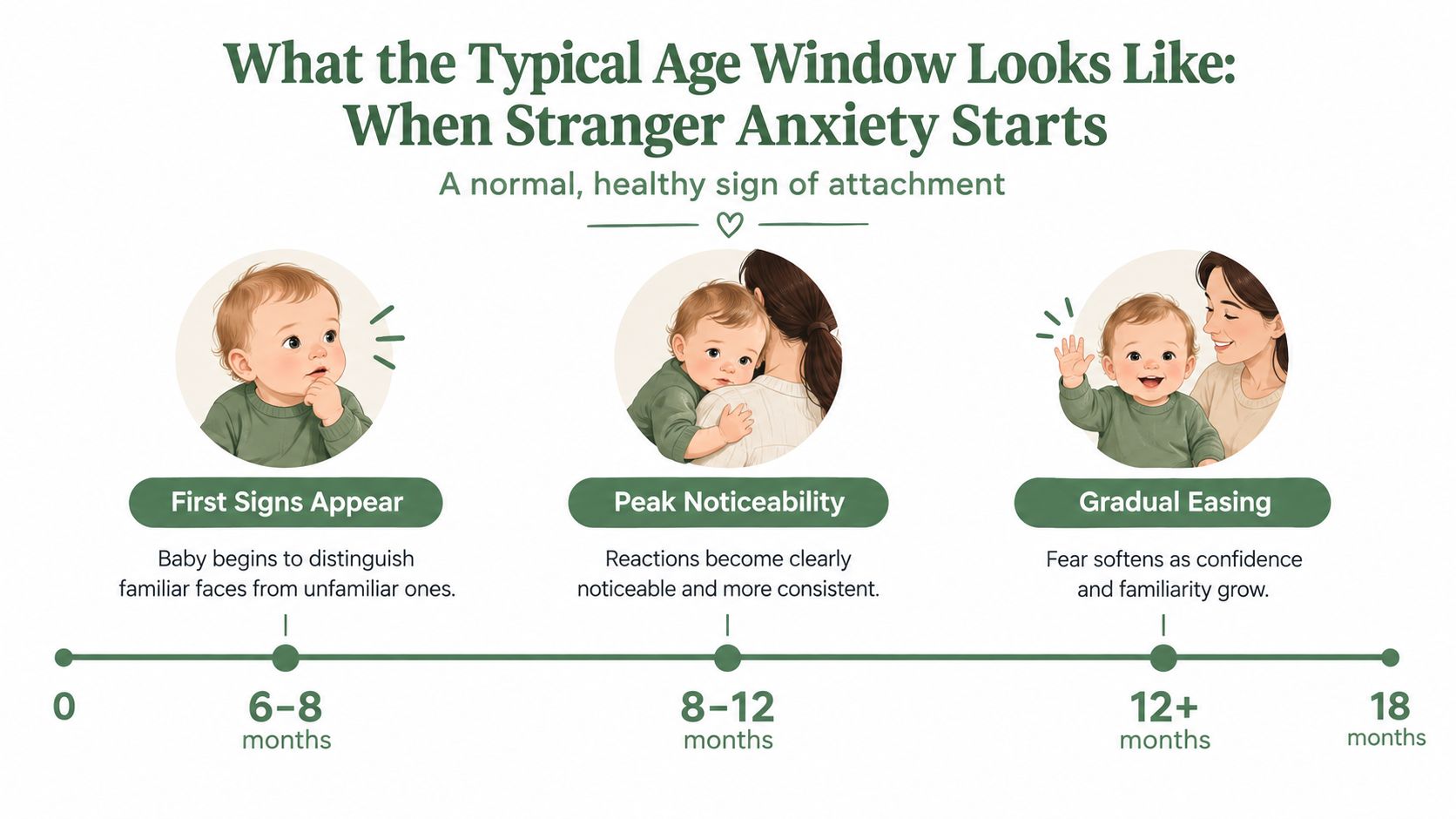
Stranger anxiety typically first appears in a window of about 6 to 8 months and becomes much more noticeable by 8 to 12 months. This is a normal developmental milestone, not a problem with your baby or your parenting.
You may notice it during an ordinary visit. A grandparent reaches out, a new nanny says hello, or a daycare teacher approaches, and your previously social baby suddenly turns away, clings to you, or cries. It can feel surprising, especially when the person is loving and familiar to the adults around your child.
The reaction usually reflects a new ability, not a loss of confidence. Your baby is learning to recognize familiar people, remember caregivers when they aren't right in front of them, and compare known faces with unfamiliar ones. That new awareness can make a visitor feel worth watching carefully.
Table of Contents
- What the Typical Age Window Looks Like
- Why This Phase Happens in the First Year
- How Stranger Anxiety Shows Up by Age
- Soothing Strategies That Actually Help
- Keeping Nannies, Grandparents, and Daycare on the Same Page
- Variations in Temperament and When to Check In
- A Calm Wrap-Up for the Hardest Moments
What the Typical Age Window Looks Like
The clearest answer to when stranger anxiety starts is usually between 6 and 8 months, with reactions becoming more noticeable from 8 to 12 months. Many babies show some form of wariness before their first birthday, although the timing can vary with temperament, experience, and how often they encounter unfamiliar people. Developmental summaries describe early wary reactions around 4 to 6 months, while other pediatric references place the usual beginning around 8 to 9 months (developmental summary, Merck Manual guidance).
Some babies show signs around 5 months, while others remain cautious into the 8 to 18 month period described by pediatric guidance (Merck Manual overview). A baby may fuss briefly when someone new approaches, while another may cry hard, bury their face in a parent's shoulder, or refuse to be held. Both reactions can fit within normal development.
A milestone, not a setback
It helps to think of this phase as evidence that your baby is noticing relationships more clearly. They aren't becoming “difficult,” and you haven't caused the fear by being too protective or by introducing people incorrectly. The brain is sorting familiar comfort from unfamiliar presence.
The intensity often grows through the first year and may be especially noticeable around 9 to 15 months, then gradually softens as a toddler gains experience, communication skills, and confidence. Consumer health guidance also describes a peak between 12 and 15 months, followed by a gradual decrease (Healthline's overview of stranger anxiety).
If you'd like to place this phase alongside other changes, the infant development milestones guide can help you view social wariness as one part of a larger developmental picture. The timing makes more sense once you see what your baby is learning cognitively.
Why This Phase Happens in the First Year
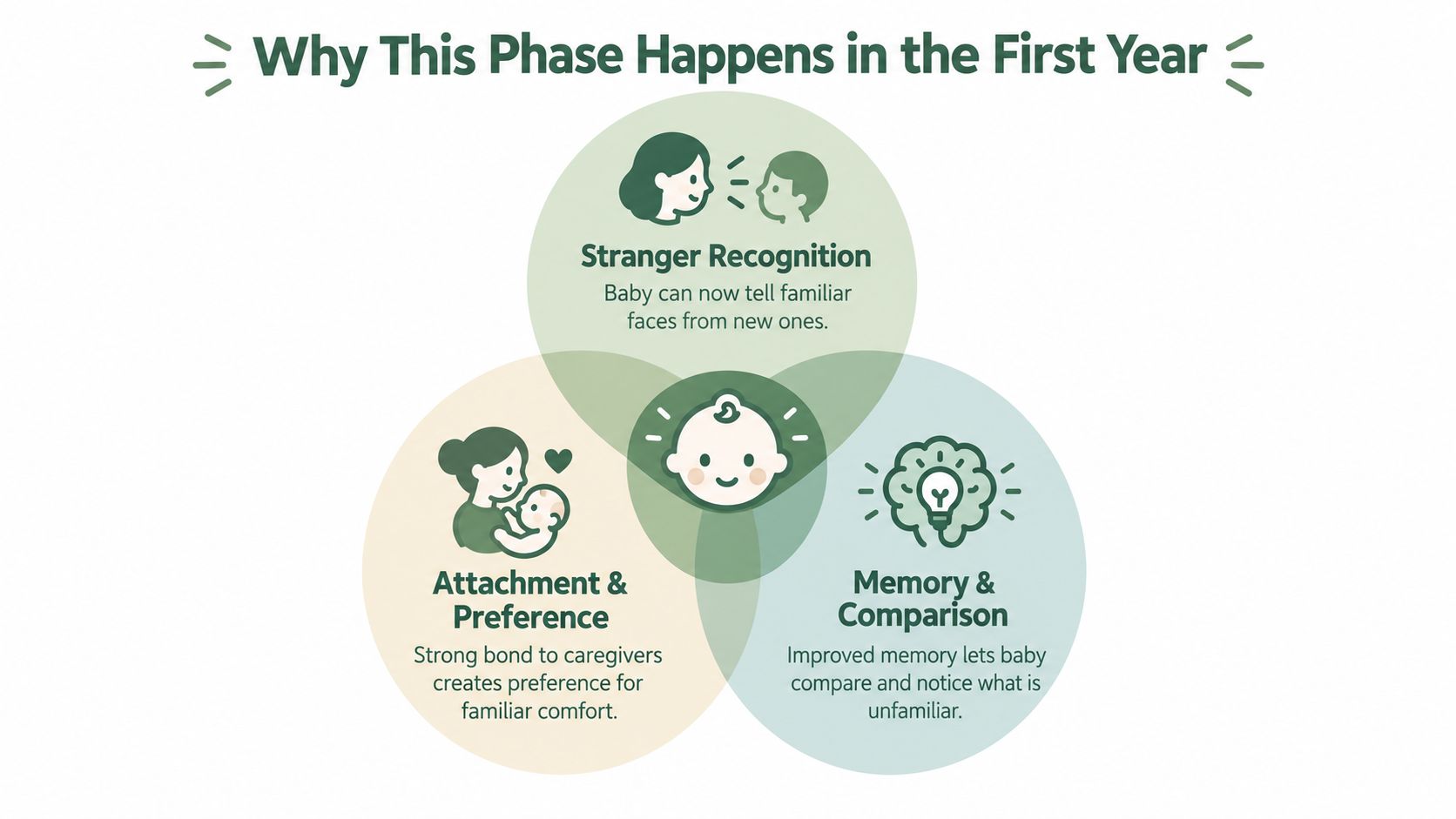
Stranger anxiety appears when several new abilities begin working together. Your baby isn't using adult reasoning to decide that a person is unsafe. Instead, their developing brain is becoming better at recognizing patterns, remembering caregivers, and noticing differences.
Familiar faces become meaningful
Earlier in infancy, many babies respond warmly to a wide range of people. As face recognition strengthens, your baby can more reliably tell a familiar caregiver from someone they don't know well. A new face may now stand out instead of blending into the general category of “person.”
That distinction explains why a baby might smile at a parent, study a grandparent after a long absence, and then turn away when the grandparent reaches for them. The child isn't rejecting the relationship. They need time to connect the present face with stored memories of comfort.
People can exist even when they're gone
Object permanence is another piece of the puzzle. Your baby gradually learns that a person or object continues to exist even when it disappears from view. That sounds reassuring to an adult, but it also means your baby can miss a caregiver who has left the room.
A sitter approaching may feel unfamiliar, while the parent holding the baby represents the known source of comfort. The baby can now compare those experiences. Clinging, crying, or reaching back toward the parent reflects that comparison in action.
Attachment creates a preferred source of comfort
By this stage, many babies have developed a strong preference for particular caregivers. Attachment doesn't mean a baby can only be comforted by one person forever. It means the baby has identified people who reliably help with hunger, tiredness, discomfort, and emotional regulation.
A helpful way to read the behavior: your baby isn't saying that every unfamiliar person is dangerous. They're saying, “I know who helps me feel settled, and I need that person nearby while I figure this out.”
This is a normal milestone rather than anxiety in the adult clinical sense. Your baby's brain is learning who feels familiar, who can provide comfort, and how quickly a new person can become safe through repeated, gentle experiences.
How Stranger Anxiety Shows Up by Age
A baby who once went happily to every relative may react differently from one visit to the next. The change often follows the child's developing ability to recognize people and express discomfort through both sound and body language.
At 4 to 5 months, many babies remain broadly social. You might see them smile at visitors, watch faces closely, and enjoy being talked to. Even then, they may begin showing a preference for primary caregivers by settling more quickly in a parent's arms.
Around 6 to 8 months, early wariness can look subtle. Your baby might stare at a new person, pause before smiling, frown briefly, turn their head, or press into your chest when someone unfamiliar holds them. A quiet baby who watches without crying may still be communicating, “I need more time.”
From 8 to 12 months, reactions often become easier to recognize. Your baby may cry when a sitter approaches, reach back for a parent, hide their face, or refuse to be held by a relative they don't see often. A grandparent might be well-loved by the family and still need to sit nearby while the baby observes.
Between 12 and 18 months, stranger wariness can overlap with protest around separation. A child may cling at a daycare transition, resist being picked up by a new caregiver, or become more upset when tired. New places can intensify the response because both the person and the setting feel unfamiliar.
By 18 to 24 months, many toddlers are more willing to explore after a warm-up period, though caution can flare in a crowded room, during travel, or around unfamiliar adults. Language and mobility give the child more ways to understand and control the interaction, but new situations can still bring hesitation.
| Age Range | Common Signs | Typical Intensity |
|---|---|---|
| 4 to 5 months | Smiles broadly but settles fastest with primary caregivers | Mild preference |
| 6 to 8 months | Staring, frowning, turning away, pressing into a caregiver | Brief wariness |
| 8 to 12 months | Crying, clinging, reaching back, hiding the face | Clearly noticeable |
| 12 to 18 months | Strong caution with new people and protest during transitions | Often intense |
| 18 to 24 months | More willingness to explore, with caution in new settings | Gradually softening |
Crying is only one signal. Stiffening, looking away, gripping clothing, becoming very still, or refusing eye contact can also show discomfort. Reading these quieter cues gives caregivers a chance to slow down before distress becomes louder.
Soothing Strategies That Actually Help
The most useful response usually respects the baby's caution instead of trying to erase it quickly. A child who can observe a new person from a familiar caregiver's arms gets information without losing access to comfort.
Begin with connection, not a handoff
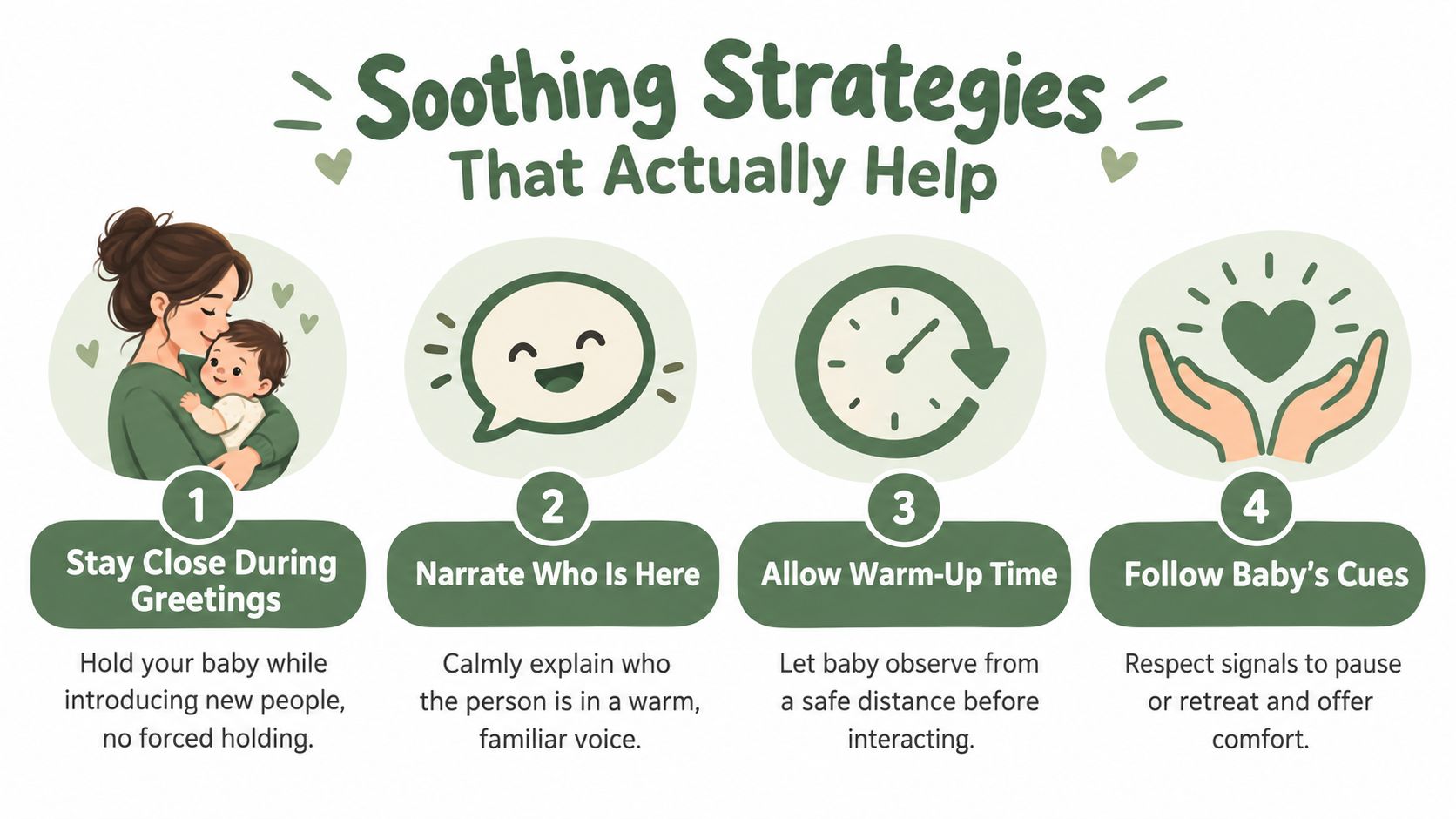
Stay close during the greeting. Hold your baby while the visitor speaks softly, and let the child look at the person's face without being passed over immediately. This gives the baby's internal map of familiar people time to update.
Narrate the moment in a warm, ordinary voice. “Grandpa is here. You're watching him. I'm holding you.” For a Spanish-speaking family, the same idea might sound like, “Abuelo está aquí. Te estoy sosteniendo.” The exact language matters less than the familiar voice and calm rhythm.
Let the baby control the pace
A new caregiver can sit nearby, smile without leaning in, and talk while the parent continues holding the baby. After a little observation, the baby may reach, vocalize, or shift toward the person. Those are useful invitations, but they don't need to happen on an adult schedule.
A familiar phrase, song, or comfort item can make the setting feel more predictable. For babies younger than 12 months, loose comfort objects shouldn't be placed in the sleep space, so ask a pediatrician about safe use and keep sleep-safety guidance separate from awake-time comfort.
Practical rule: a crying baby doesn't need repeated exposure in the form of repeated handoffs. Pause, return to the familiar caregiver, and try a slower interaction later.
Some babies warm up through floor play, while others prefer watching from a lap. One child may accept a new person after a short visit, and another may need several calm encounters. Neither response tells you that you handled the introduction incorrectly.
Keeping Nannies, Grandparents, and Daycare on the Same Page
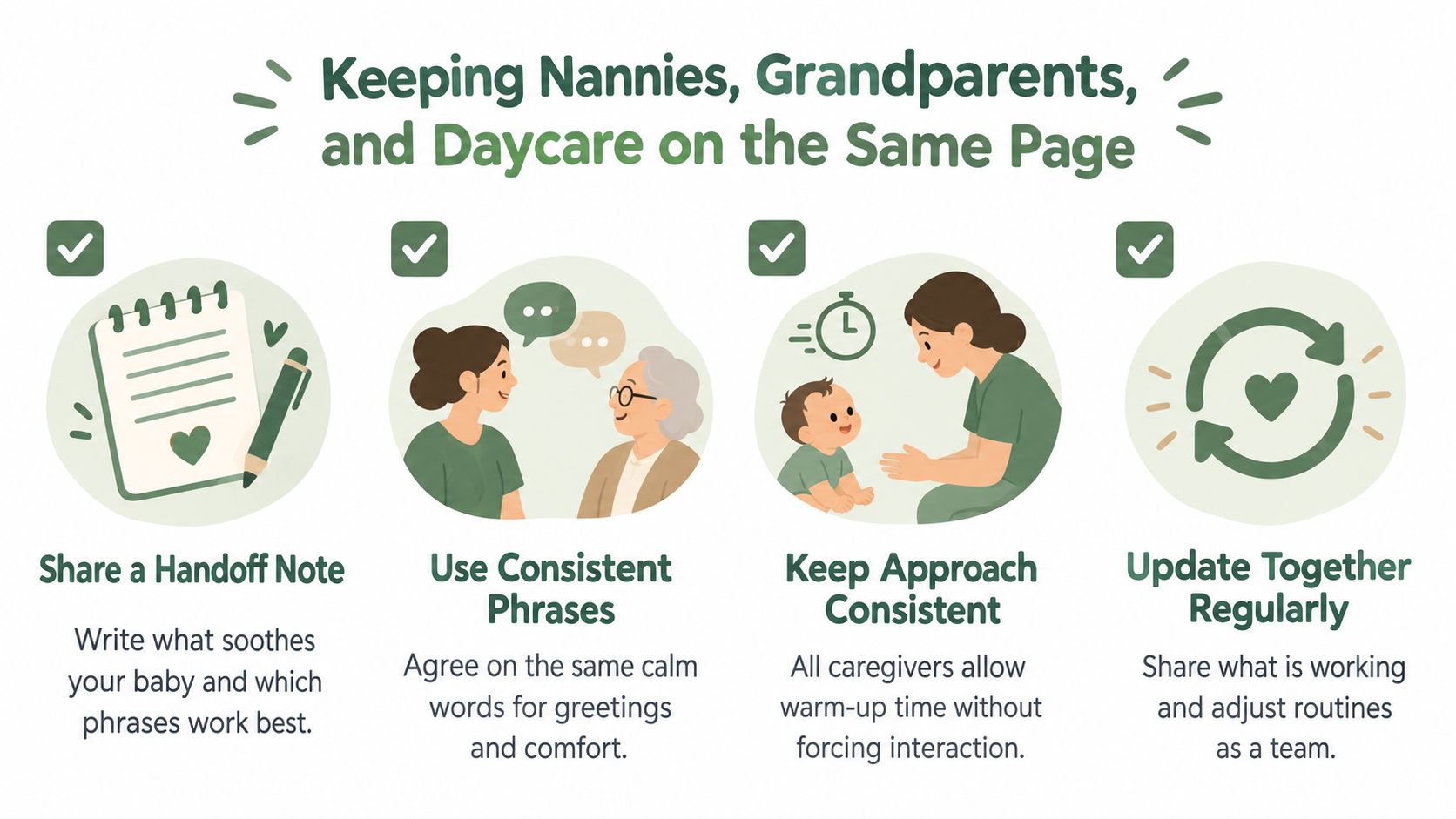
A baby doesn't need every caregiver to use identical personalities or wording. They benefit when the central message stays consistent: unfamiliar people approach slowly, the caregiver remains available, and signals to pause are respected.
A short handoff note can prevent guesswork. Include the phrase that usually settles the baby, the comfort item used during awake time, how greetings tend to go, and what the baby's early signs of discomfort look like. Parents and partners can share the same note with grandparents, nannies, and daycare staff.
Use a simple arrival routine
For a grandparent visiting after a long gap, the routine might be:
- Arrive without a rush: Let the grandparent enter without immediately reaching for the baby.
- Stay nearby: Keep the baby with a parent while the grandparent talks and plays at a comfortable distance.
- Offer a familiar cue: Use the same greeting phrase, song, or game the family uses regularly.
- Follow the response: Move closer only when the baby shows interest, and return to the parent if distress rises.
A new nanny can spend a warm-up period in the home while the parent remains present. A daycare team can use the same low-pressure greeting at drop-off, with the same comfort phrase and predictable sequence. The goal isn't to guarantee a tear-free transition. It's to give the baby a repeated pattern that becomes easier to recognize.
For shared care: write down what happened, not just whether the baby cried. “Watched from my lap, reached after play began, settled with the blue cloth” gives the next caregiver more useful information than “bad drop-off.”
A tracker designed for shared care can help families keep these observations with the rest of the daily record. A nanny log app is useful when parents, partners, and childcare providers need one place to communicate about routines and transitions.
Daycare staff may have a different style from grandparents, and that's fine. Consistency means sharing the same basic response, not making every adult behave identically. When caregivers exchange updates, they can adjust the routine together instead of asking the baby to start over with each person.
Variations in Temperament and When to Check In
A common assumption is that a baby who cries intensely around unfamiliar people is more anxious than a baby who barely reacts. That conclusion is too simple. Babies differ in sensitivity, sociability, past experiences, energy level, and speed of warming up.
One baby may fuss briefly and then return to play. Another may cry hard and need a long period in a parent's arms. A quieter baby may watch carefully, turn away, or become still without making a sound. Limited visible stranger fear doesn't automatically mean a child has weak attachment, just as strong protest doesn't automatically mean something is wrong.
What deserves a closer conversation
The useful question isn't whether the reaction looks dramatic. It's whether the pattern is persistent, unusually disruptive, or connected with other concerns. A pediatrician can consider the whole child rather than one greeting.
| What You're Seeing | Likely Within Normal Range | Worth Mentioning to Pediatrician |
|---|---|---|
| Response to unfamiliar adults | Wariness that eases with time and support | Distress remains severe and doesn't gradually improve |
| Daily routines | Some disruption during transitions | Feeding, sleep, childcare, or medical care is repeatedly blocked |
| Familiar caregivers | Clear preference for familiar people | No noticeable preference for any caregiver at all |
| Developmental pattern | Caution varies by setting and temperament | Regression follows a period of comfort |
| Social communication | Baby watches, responds, or reconnects in familiar settings | Poor eye contact or not responding to name by the end of month nine |
These signs don't diagnose a condition. They indicate that a professional conversation may be helpful, especially if the response persists well into toddlerhood without improvement or makes basic care difficult. Clinical and educational guidance also highlights severe, prolonged distress and co-occurring developmental concerns as reasons to seek follow-up (guidance on when stranger anxiety may merit discussion).
Asking a pediatrician isn't an accusation that anything is wrong. Reassurance and developmental review are normal parts of well-child care.
Keep a brief record of the setting, who approached, what the baby did, how long settling took, and what helped. A behavioral tracking guide can help you organize observations for a conversation without trying to interpret them as a diagnosis. Health questions should go to your pediatrician, and feeding or lactation concerns should go to a pediatrician or lactation professional.
A Calm Wrap-Up for the Hardest Moments
The practical anchor is simple. Stranger anxiety usually begins in the 6 to 8 month window, becomes much more noticeable from 8 to 12 months, and gradually softens across toddlerhood. The exact path differs, so a baby who starts earlier, reacts strongly, or needs repeated introductions may still be developing typically.
The behavior connects to healthy cognitive and attachment changes. Your baby recognizes familiar people more clearly, remembers caregivers when they leave, and understands that some people provide comfort more reliably than others. A new adult is not automatically dangerous, but the baby now has enough awareness to approach unfamiliar people carefully.
During a difficult greeting, keep the response small and repeatable:
- Stay close: Let the baby watch from a parent's or familiar caregiver's arms.
- Keep hellos low pressure: Speak warmly, but don't force eye contact, holding, or interaction.
- Use familiar cues: Offer a known phrase, song, or appropriate comfort item.
- Align caregivers: Share the same greeting and soothing approach with partners, grandparents, nannies, and daycare.
- Notice the pattern: Bring persistent or disruptive concerns to a pediatrician rather than judging the baby or yourself.
A tearful daycare drop-off, a baby clinging to a grandparent, or a face buried in a parent's shoulder doesn't mean you have a problem child or that you're a problem parent. It means your baby has learned who their people are. With steady, gentle support, they can learn to widen that circle again.
Cradlo gives parents, partners, grandparents, nannies, and daycare providers one shared place to record routines, comfort cues, and daily updates, with support for English and Spanish. Visit Cradlo to start the 7-day free trial on the monthly plan and make shared care easier to coordinate.