How to Record Baby Weight Without the Guesswork
The nurse places your newborn on the clinic scale. The number settles at 7 pounds 4 ounces. You feel relief, then a small wave of doubt: Is that the right number? Should it be higher? What will it mean at the next appointment?
That first reading isn't a verdict. It's a starting line. Whether you're researching record baby weight, checking a change after a feeding adjustment, or trying to keep both parents, partners, grandparents, nannies, and daycare aligned, the useful information comes from a consistent record rather than one isolated number.
Table of Contents
- The First Weigh-In and Why It Sets the Tone
- How to Weigh a Baby So the Number Is Trustworthy
- How Often to Weigh and Record Baby Weight
- Logging the Weight in a Shared Tracker
- Reading Growth Percentiles Without Panic
- When a Weight Reading Warrants a Call to the Pediatrician
- A Calm Weekly Habit That Sticks
The First Weigh-In and Why It Sets the Tone
Birth weight gives everyone a shared reference point. Clinicians compare later measurements with it, while caregivers use it to understand the direction of growth after the normal early changes that follow delivery. A newborn may lose weight in the first days and then begin recovering, so a single follow-up reading rarely tells the complete story.
Most babies fall within a broad ordinary range. Nemours KidsHealth describes babies born between 37 and 40 weeks as typically weighing from 5 pounds 8 ounces, or 2,500 grams, to 8 pounds 13 ounces, or 4,000 grams. A baby outside that range isn't automatically unhealthy, just as a baby within it isn't automatically thriving. The number needs context, including age, length, head circumference, feeding, and the pattern across time.
What the record actually means
Public discussions often use “record baby weight” as if there were one simple title. The historical record is more specific. Guinness World Records identifies Anna Bates, née Swan, as delivering the heaviest documented birth in Seville, Ohio, on 19 January 1879. The baby weighed 9.98 kilograms, or 22 pounds, measured 71.12 centimeters, or 28 inches, and died after 11 hours. Guinness identifies the birth as both the heaviest birth and the longest baby documented in history, as described in its record of the heaviest birth.
A separate benchmark concerns survival. Guinness reports that a baby boy born to Carmelina Fedele in Aversa, Italy, in September 1955 weighed 10.2 kilograms, or 22 pounds 8 ounces, and survived infancy. This distinction matters because raw weight and outcome aren't interchangeable. The coverage of the surviving Italian record shows why careful wording matters when a headline says “heaviest baby.”
A useful starting point: Record weight is a historical category. Your baby's own baseline is a clinical reference, not a competition.
Write down the measurement, date, time, unit, and conditions. If the reading came from a clinic scale, keep that detail too. A clear baseline lets you and your pediatrician discuss a trend instead of trying to reconstruct scattered memories.
How to Weigh a Baby So the Number Is Trustworthy
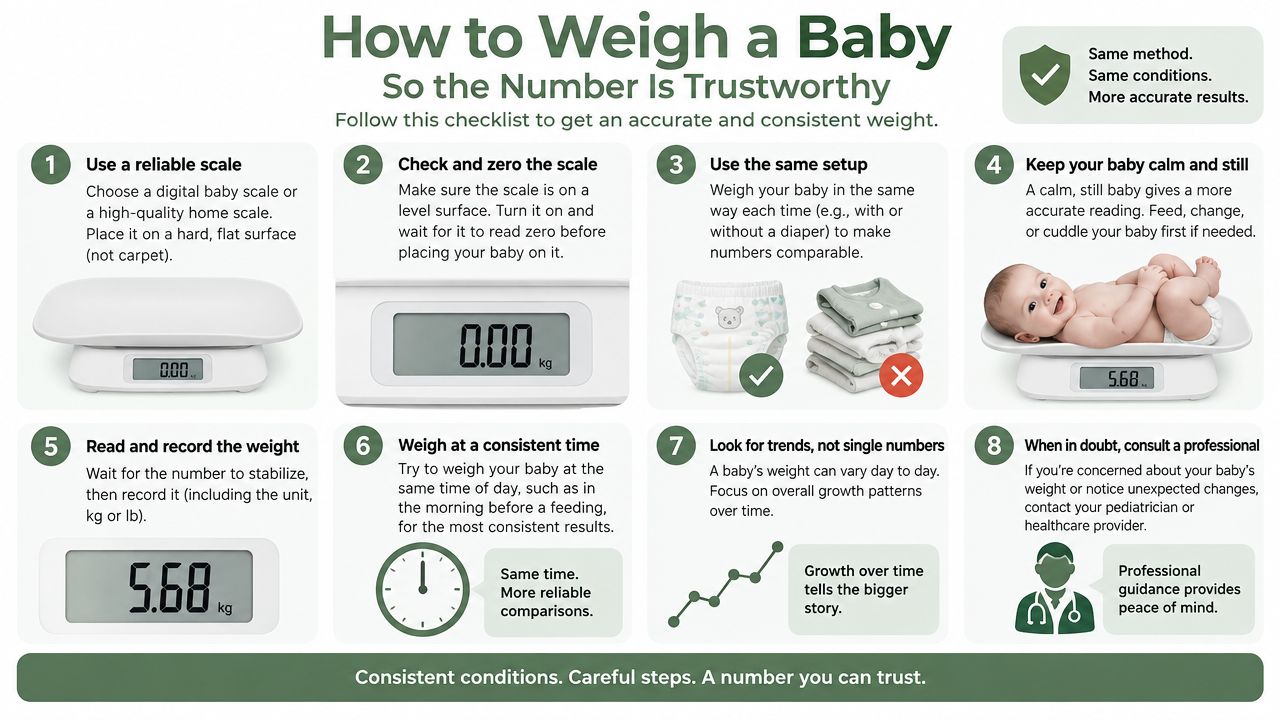
A trustworthy reading depends less on weighing often and more on repeating the same conditions. Home measurements can be useful for a running record, but they shouldn't replace a pediatric clinic's assessment when a health question comes up.
Set up the same way each time
Use a flat, hard surface for a home scale. A baby-specific digital scale is designed to hold an infant securely and display small changes more precisely than a household bathroom scale. A kitchen scale is only appropriate when it can safely support a properly contained baby setup and the manufacturer allows that use. Never place a baby directly on an unstable surface or in a makeshift container.
For infants under four months, choose a consistent time, ideally before a feeding. Weigh the baby completely undressed or in a clean, dry diaper, and use the same choice at every check. Clothing, a wet diaper, a blanket, or a recent feed can change the reading enough to make two otherwise similar measurements look different.
You can also use a tare method if you don't have an infant scale:
- Weigh yourself while holding the baby.
- Weigh yourself alone.
- Subtract your weight from the combined weight.
- Record the result with the date and conditions.
This method is less precise than a clinical infant scale, but repeating it consistently may be more useful than switching between different devices.
Keep the record precise
Write the number exactly as the scale shows it. Don't round one visit to the nearest pound and another to the nearest ounce. Hospital and public-health documentation treats birth weight as a defined measurement captured at delivery, in grams, rather than a later or casual estimate. The Texas birthweight documentation guidance also emphasizes entering birth weight in grams and avoiding premature rounding when converting pounds and ounces.
If the scale seems inconsistent, check its placement, battery, and zero setting. Then compare the reading with a pediatric clinic scale rather than trying to interpret a surprising result alone.
Consistency rule: Same scale, similar time, same clothing or diaper conditions, and one agreed recorder.
A clinic scale is worth using when the baby is unwell, a clinician has asked for a check, feeding has become difficult, or home readings don't make sense. If you're unsure whether a kitchen or sling scale is safe, ask the pediatrician or a qualified healthcare professional before using it.
How Often to Weigh and Record Baby Weight
Frequent weighing can feel reassuring at first, but it can also make normal day-to-day variation seem more important than it is. A practical schedule changes as babies grow and becomes more flexible when feeding or health circumstances change.
| Age Range | Suggested Frequency | Reason |
|---|---|---|
| First two weeks | Every two to three days | Helps identify early feeding or hydration concerns for discussion with a clinician |
| Two weeks to three months | Weekly | Provides a steady pattern without turning every day into a measurement |
| Three to twelve months | Every two to four weeks | Gives enough space to see a meaningful direction in a healthy infant |
| Beyond the first year | Monthly or quarterly | Routine checks are usually more useful than frequent home readings |
These intervals are a tracking framework, not medical instructions. Your pediatrician may recommend a different schedule based on birth history, feeding, illness, or a previous growth concern. Follow that individualized plan over a general routine.
Adjust after a change
Add a check when a healthcare professional asks for one, after an illness, following a clear drop in appetite, or during a significant transition from breast milk or formula to solids. The purpose isn't to create a perfect stream of data. It's to give the clinician comparable information during a period when something has changed.
The exact weekday matters less than the interval. Weighing every third day for a while and then waiting several weeks creates a confusing record. A regular weekly check, even if it occasionally shifts by a day, is easier for a household to maintain and easier to interpret.
If a week is missed, don't try to “catch up” with several readings in a row. Resume under the usual conditions and note the gap. A tracker should reduce mental load, not turn baby care into a test that can be failed.
Logging the Weight in a Shared Tracker
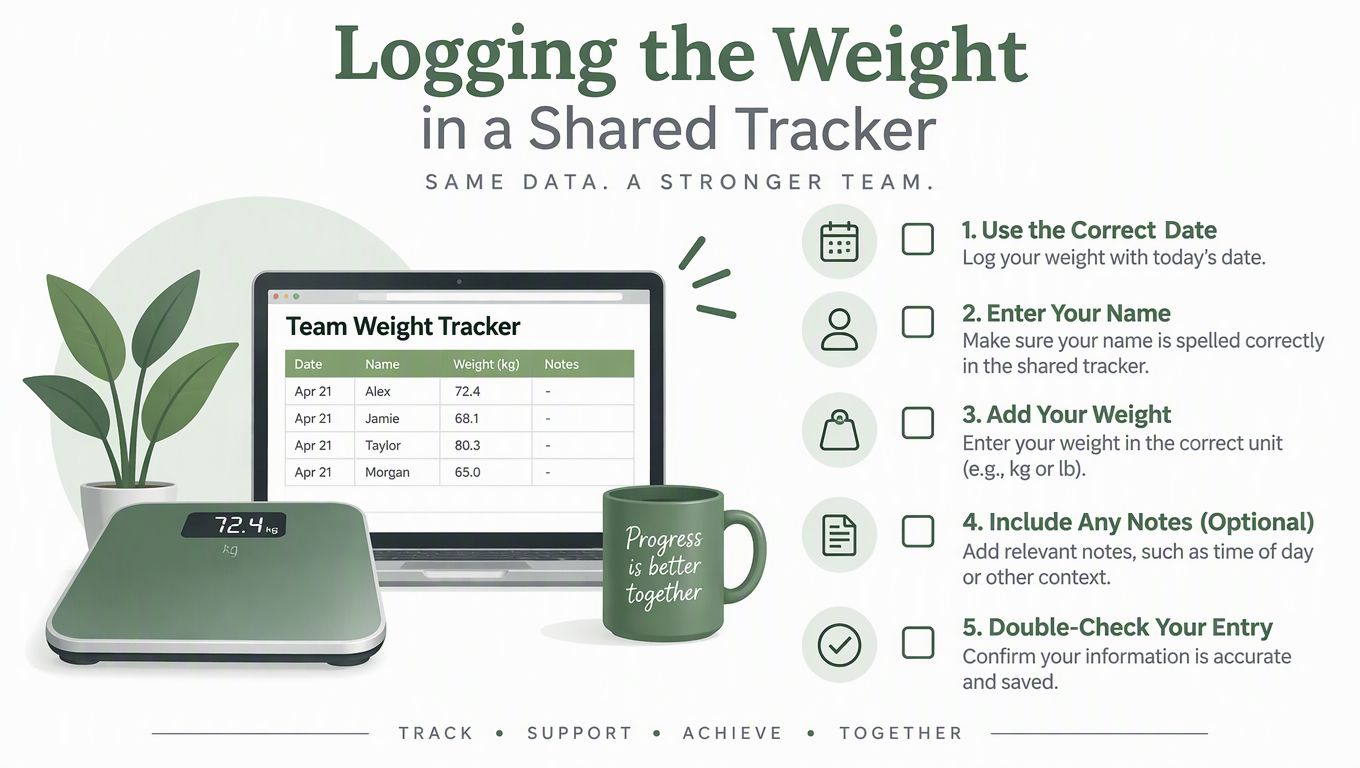
Every entry needs two decisions before you save it. First, choose a unit, either kilograms or pounds and ounces, and keep using it. Second, decide what belongs beside the number, such as a brief note about the diaper, feeding, time, or scale.
Make each entry understandable
Inside a shared baby tracker, open the growth or weight field and enter the digits exactly as displayed. Confirm that the date is correct, especially if you're recording a measurement taken the previous evening. Add one short sentence when conditions were unusual, for example, “wet diaper,” “weighed after feeding,” or “home scale drifted.”
A useful entry might look like this:
- Weight: 7 pounds 4 ounces
- Date and time: Recorded immediately after the morning weigh-in
- Conditions: Clean, dry diaper, same infant scale
- Note: Baby was weighed before feeding
Don't add explanations that you can't verify. A simple, accurate entry is more valuable than a detailed guess.
Let every caregiver see the same record
A shared log prevents one caregiver from recording pounds while another assumes kilograms. It also avoids duplicate entries when a partner, grandparent, nanny, or daycare worker records the same event from a different phone. Families who want a broader record of daily care can use a shared baby diary app alongside their growth notes.
Cradlo is one option for this kind of record. Its growth log can sit alongside feeding, sleep, diaper, pumping, solids, and milestone entries, with access for different caregivers. After three or more readings are in the log, the trend line can make the direction easier to see than a list of disconnected numbers.
Optional fields such as length and head circumference are worth recording when your clinician provides them. Weight alone can't describe every aspect of growth, and a fuller record gives the pediatrician more context for a percentile discussion.
Reading Growth Percentiles Without Panic
A percentile isn't a grade. It describes how a baby's measurement compares with measurements from other babies of the same age and, depending on the chart, sex. If a baby is at the 60th percentile for weight, that means the baby weighs more than the share of same-age babies represented below that point, not that the baby has scored 60 out of 100.
A healthy baby may track along many different parts of the chart. What usually matters most is whether the curve follows a reasonably consistent path over time, alongside length, head circumference, feeding, and the baby's overall condition.
Look for patterns, not isolated points
Suppose a baby moves slightly down over several readings while remaining active and feeding normally. That may call for a conversation, but it isn't the same as a sharp change between two measurements taken on different scales. A jump upward can also reflect a wet diaper, clothing, a recent feed, or a data-entry mistake rather than a biological change.
| Pattern on the chart | Likely cause | Action |
|---|---|---|
| Roughly parallel movement along the curve | Ongoing growth pattern | Continue the agreed record and discuss it at routine visits |
| Small shift across a reading or two | Normal variation or different conditions | Check scale, unit, diaper, timing, and entry details |
| Sharp drop across bands | Measurement difference or possible feeding or health concern | Repeat under consistent conditions and contact the pediatrician if it persists or the baby seems unwell |
| Sharp rise after changing scales | Device or recording difference | Compare devices and bring both readings to the clinician |
A percentile line becomes more useful when it draws from consistent readings. Cradlo's growth notes can help caregivers keep those entries together, but any app's trend line is only as reliable as the measurements entered.
For families tracking an older baby or toddler, the same principle applies. A reference such as average weight for a 16-month-old can provide context, but it shouldn't be used as a target that every child needs to reach.
Add the measurements that complete the picture
Length, head circumference, and weight-for-length can reveal relationships that a weight-only number misses. A baby who is naturally long may look different on a weight chart from a baby with a shorter frame, even when both are growing well.
Ask your pediatrician how to interpret the chart used at your appointment. Spanish-speaking families can also request explanations in Spanish or bring a bilingual caregiver so everyone understands what the plotted points mean.
When a Weight Reading Warrants a Call to the Pediatrician
A weight log can't diagnose a problem, and a home scale can't replace an examination. It can, however, give you specific information to share when something doesn't look right.
Call the pediatrician about sudden changes, including losing more than 7% of birth weight after two weeks, no gain across two consecutive weekly weighings, or a drop across two percentile bands. These thresholds are prompts for professional evaluation, not conclusions about what is happening.
Other observations deserve a call as well:
- Intake signals: Fewer than six wet diapers a day past day five, refusing multiple feeds in a row, or vomiting large amounts after most feeds.
- Appearance cues: A sunken soft spot, dry lips, unusual lethargy, or skin that stays pinched.
- Measurement concerns: A result that conflicts sharply with the previous record, especially when the baby also seems less alert or is feeding poorly.
The clinical overview of fetal macrosomia and newborn risk shows why size is interpreted with context, including diabetes status and gestational age. A large baby and a smaller baby can each need individualized follow-up, so don't use a record-size headline or a fixed number to judge your own child's health.
Use a short phone script
You can make the call easier by reading from the log:
“I'm the parent of a baby who is [age]. The last weight was [exact measurement] on [date], and today's weight is [exact measurement]. We're feeding by [breast, pumping, formula, or combination], and I'm concerned about [specific change or observation].”
Mention the scale, diaper or clothing conditions, wet diaper count, and any feeding change. If your office accepts portal messages, attach a screenshot or export of the record. A resource such as exporting a baby care record for a pediatrician can help you present the timeline clearly.
Calling early gives the care team more context and more options. If the baby appears seriously unwell or you believe there is an emergency, seek urgent medical help rather than relying on a tracker or waiting for a routine response.
A Calm Weekly Habit That Sticks
A useful routine can fit into a tired household:
- Choose one consistent day. Put the weigh-in beside an existing habit, such as a weekly laundry reset or a quiet morning.
- Use the same conditions. Repeat the scale, timing, diaper or clothing choice, and setup described earlier.
- Log the result immediately. Enter the number before another caregiver has to remember it later.
- Glance at the trend once. Look across the record, then close the app. Don't turn a single point into a daily judgment.
The goal is the same trustworthy number under similar conditions, not a perfectly clean data set. A skipped week doesn't erase the pattern, and a slightly imperfect entry can still be useful when its conditions are noted.
Home tracking and clinical weighing have different roles. Bring your log to well-child appointments so the pediatrician can compare your ongoing record with measurements taken in the office. If feeding, hydration, or growth concerns arise, ask the pediatrician or a lactation professional how often to check rather than increasing the schedule on your own.
When several caregivers can see the same entry, nobody has to guess which number is current. That small shared ritual can replace scattered notes with steady information, leaving more attention for feeding, rest, connection, and the baby in front of you.
Cradlo gives families, nannies, grandparents, and daycare a shared place to record growth alongside feeds, diapers, sleep, pumping, solids, and milestones. Start the 7-day free trial on the monthly plan by visiting Cradlo, then use the shared growth log to keep every caregiver working from the same trustworthy record.