10 Month Sleep Regression: What Is It and How to Cope
At 10 months, a sudden run of night waking is usually a temporary blend of developmental change and maturing sleep regulation, not a permanent setback. A clinical sleep table lists about 14 total hours of sleep at 9 months, including around 11 hours at night and 3 hours during the day, so a difficult stretch doesn't automatically mean your baby's overall sleep path has reversed.
You may be reading this beside a crib after the third wake-up of the night. Yesterday, your baby settled with familiar help. Today, they're crying at bedtime, resisting a nap, standing in the crib, or waking and calling for a parent. A nanny reports a short car nap, daycare mentions a late afternoon sleep, and nobody is quite sure what happened before bedtime.
That confusion can make the disruption feel larger and longer than it is. The phrase 10 month sleep regression describes a commonly reported pattern, but it isn't a formal medical diagnosis or a guaranteed event for every baby. The most useful response is calm observation, safe sleep practices, and a consistent plan that every caregiver can understand.
Table of Contents
- What Is the 10 Month Sleep Regression
- Why Sleep Disrupts at 10 Months
- Soothing and Sleep Training Approaches
- Sample Routines and Daily Schedules
- Coordinating Care Across Multiple Adults
- When to Seek Pediatric Guidance
What Is the 10 Month Sleep Regression
A baby who once slept through a predictable first stretch may suddenly wake hourly. Another may sleep reasonably at night but fight both naps. Some babies cry when a parent leaves the room, while others pull up in the crib and can't work out how to settle back down. These experiences are exhausting, but they don't mean you've caused a problem.
The label sleep regression is descriptive. It groups together changes such as more night waking, shorter naps, bedtime resistance, and increased need for reassurance. It isn't an independent medical diagnosis, and research doesn't establish a universal 10-month mechanism or duration. In a longitudinal study of 142 infants, sleep behavior was assessed at approximately 4–6 months and again at 10–12 months. Among infants with no developmental risk or lower risk, sleep generally became less fragmented and better regulated over time rather than worsening universally at 10 months. The study also found no association between neuromotor achievements and caregiver-reported sleep fragmentation or settling difficulty. The findings are summarized in this American Academy of Pediatrics safe-sleep resource.
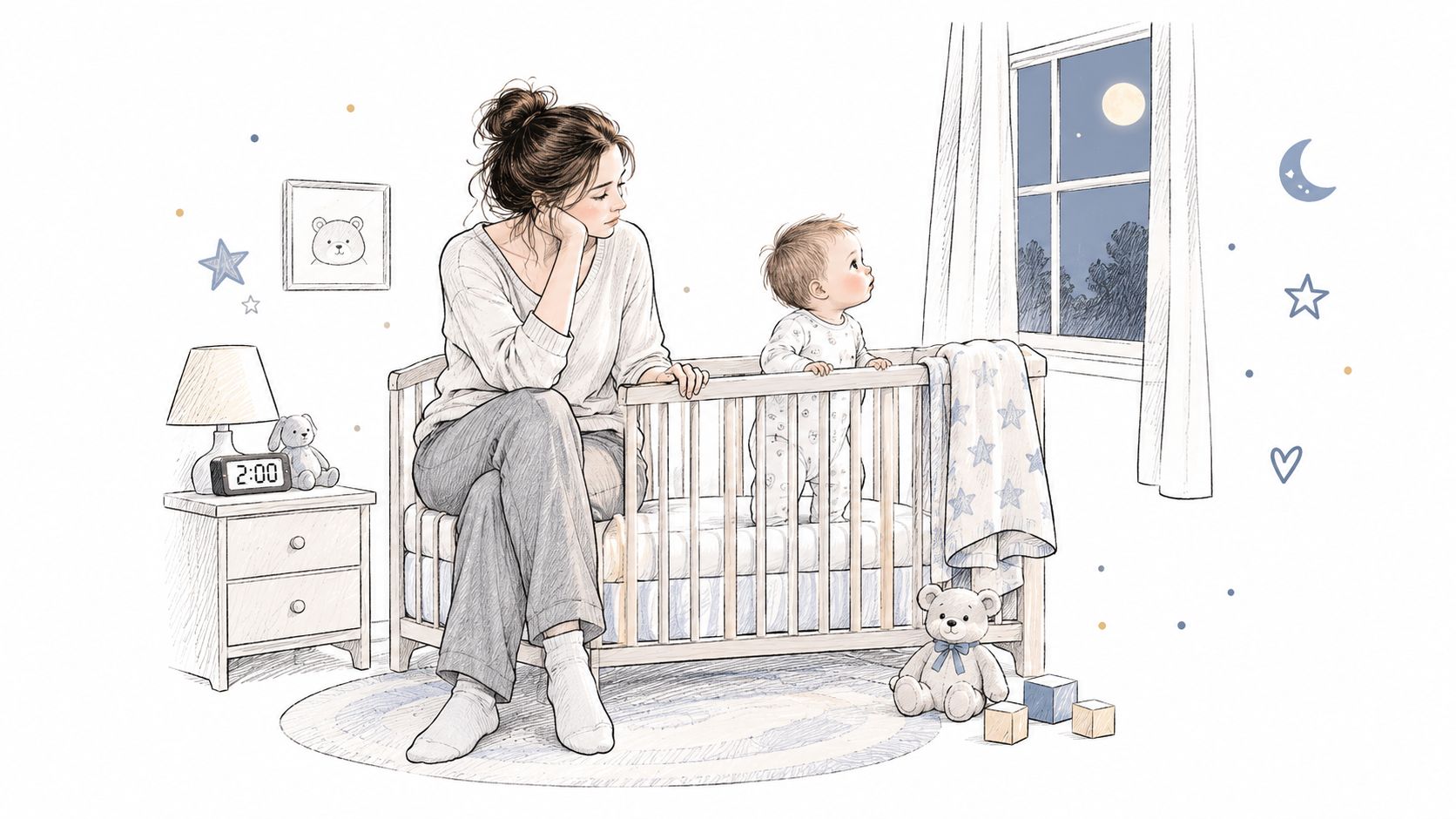
A helpful reframe: “Regression” is a parenting label for a pattern, not proof that your baby's development has gone backward.
What to observe instead of assuming
Write down when the change began and what changed. Note nap start and end times, bedtime routine, time placed down, sleep onset, each waking, feeding, soothing, illness, travel, and changes in caregiving. A sleep regression chart can help you look at the pattern across days rather than judging the night that felt worst.
A temporary increase in waking may reflect a late nap, separation distress, a new motor skill, or an ordinary variation in sleep cycles. It may also reflect hunger, pain, or illness, which deserves a different response. Monitoring trends for several weeks gives you better information than treating every difficult night as a predictable regression.
Why Sleep Disrupts at 10 Months
At this age, several forms of development can overlap. A baby may be crawling, pulling to stand, practicing new sounds, recognizing that a parent still exists after leaving the room, and reacting more strongly to separation. Each change can increase alertness during bedtime or during the brief arousals that occur as sleep cycles end.
The issue isn't that milestones automatically cause poor sleep. In fact, the longitudinal evidence described above challenges the idea that every new motor achievement directly creates sleep fragmentation. A better explanation is that development changes what your baby notices and practices, while sleep regulation continues to mature.
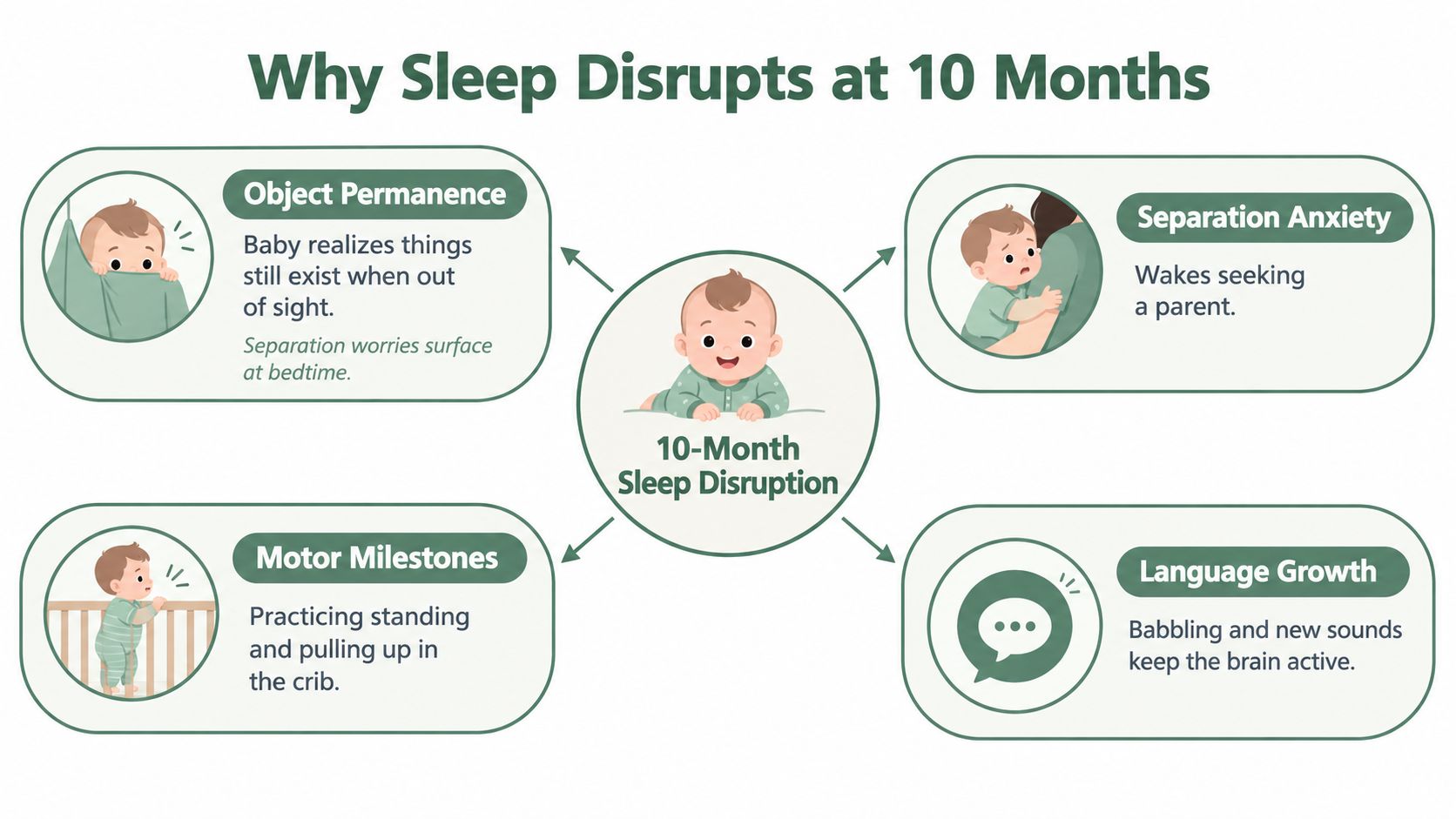
Four sources of extra arousal
- Object permanence: Your baby understands more clearly that you still exist when you leave. That awareness can make bedtime separation harder.
- Separation anxiety: A baby may wake, call for a parent, and settle more easily with familiar reassurance.
- Motor practice: Crawling, standing, and pulling up can become so compelling that the crib becomes a practice space.
- Language growth: Babbling and new sounds can keep the brain active when the room is quiet.
Normal biology adds another layer. Infants have short sleep cycles, and waking can occur naturally when a cycle ends. In a 2024 article in Pediatrics, the infants discussed averaged 2.3 wakings per night, with a mean total waking time of 50 minutes and a standard deviation of 44.5 minutes. Those figures describe a study population, not a target for every 10-month-old. The article's discussion of natural variation appears in the published Pediatrics research.
A clinical baseline can prevent overreaction. Children's Hospital of Philadelphia's infant sleep guidance lists approximately 14 total hours at 9 months, with about 11 hours at night and 3 hours during the day. A separate family-sleep study followed infants at 4, 8, and 12 months and found increases in the longest sleep period and percentage of time asleep, alongside fewer actigraphically measured night wakings. A hard week can coexist with a healthy longer-term trajectory.
Soothing and Sleep Training Approaches
There isn't one morally correct way to respond to a waking. Some families want to offer immediate physical comfort. Others prefer a structured plan that gradually changes how the baby receives help. The important trade-off is between the level of parental involvement, the pace of change, and whether every caregiver can follow the response consistently.
Compare the approaches honestly
| Approach | What it can offer | Trade-off to consider |
|---|---|---|
| Gentle soothing | Rocking, patting, feeding, or staying nearby can provide immediate reassurance and may fit a responsive family preference. | The baby may continue to need the same support at later wakings, and progress can be slower if responses vary. |
| Graduated check-ins | Brief, predictable visits can give the baby reassurance while reducing constant hands-on settling. | Caregivers need to agree on timing and what each visit includes. |
| Independent settling | A structured response plan gives the baby regular opportunities to settle with less direct intervention. | It may feel emotionally difficult, and it won't suit every family or every night. |
Start with the parts that support nearly any approach: a predictable bedtime routine, low stimulation before bed, and a consistent response to wakings. Put your baby down awake but drowsy if that fits your family and your baby's temperament. Keep lights and voices quiet overnight, and avoid changing several variables at once.
A systematic review and meta-analysis of randomized trials involving children from birth to 36 months found that behavioral sleep interventions reduced child sleep problems, with an odds ratio of 0.51, with a 95% confidence interval of 0.37–0.69, and improved maternal sleep quality by a mean difference of −1.30 points, with a 95% confidence interval of −1.82 to −0.77. The findings are reported in this systematic review in Scientific Reports. These results support structured options, but they don't promise that a baby will stop waking.
A randomized trial involving infants aged 6–8 months found improvements in parent-reported sleep problems, longest sleep period, fatigue, mood, and sleep quality, while actigraphy didn't show a significant reduction in nightly awakenings. That distinction matters. Track both the logged number of wakes and how manageable the night feels. A practical guide to sleep regression tips can help you choose a response without treating one method as universally right.
Sample Routines and Daily Schedules
A schedule should give your baby regular opportunities to sleep without turning the day into a test you can fail. At 9 months, CHOP's clinical table lists approximately 14 total hours, including around 11 nighttime hours and 3 daytime hours. The broader question is whether your baby is getting enough restorative sleep and whether the pattern is becoming more or less settled.
Use a two-nap framework as a starting point, then adjust based on what your baby does. For example, the day might include a morning nap, an afternoon nap, and a bedtime that follows enough awake time for sleep pressure to build without pushing your baby into an overtired state. The exact clock times will depend on morning wake-up, nap length, feeding, childcare, and your baby's temperament.
A practical way to adjust
- Record the current pattern first. Include nap start and end times, bedtime routine start, time placed down, sleep onset, night wakings, feeds, soothing, and morning wake time.
- Look for schedule drift. A late car nap, an unusually short daycare nap, or a morning that starts much earlier can change bedtime without anyone intending it.
- Change one variable. Move bedtime, adjust a nap opportunity, or modify the response to waking. Avoid changing all three simultaneously.
- Review the trend. Look across several days rather than reacting to one poor night.
A late nap isn't automatically wrong, and a longer nap isn't automatically the cause of a bad night. The useful question is whether a repeated pattern appears. A 10-month-old sleep schedule guide can provide a framework, but your baby's behavior and the realities of childcare still matter more than a rigid timetable.
Keep the bedtime sequence familiar. Dim lights, use the same short set of activities, and make the final response predictable. If the day was unusually stimulating, don't assume the baby needs a major reset. A quiet evening and an earlier opportunity for sleep may be enough.
Coordinating Care Across Multiple Adults
The most overlooked part of this phase is often the handoff. A baby may nap one way with a nanny, another way at daycare, and settle differently with a grandparent. Parents then see the night result without seeing the daytime context, so each difficult wake feels like a new mystery.
The operational problem is incomplete information. One caregiver knows the nap ended late. Another knows the baby cried before sleeping. A third remembers a feed but not whether the baby fell asleep during it. None of this means anyone has done something wrong. It means the family needs a shared record and a small number of agreed responses.

Build a simple handoff protocol
Agree on what every caregiver records:
- Sleep timing: Nap start, nap end, bedtime routine start, and morning wake time.
- Settling details: Whether the baby was held, patted, fed, or placed down awake.
- Context: Illness, travel, unusual stimulation, separation at drop-off, or a missed feed.
- Mood: Whether the baby woke content, upset, unusually tired, or difficult to console.
- Night plan: Which adult responds first and what support is offered before changing course.
At 8–10 months, separation-related behavior can include crying when a parent leaves, waking to call for that parent, or resisting sleep without them. Broad guidance often describes two naps and roughly 9–12 hours of night sleep, with total daily sleep commonly around 12–16 hours, but those ranges don't tell a daycare team whether to cap a nap or how to handle a late car sleep. The practical answer comes from observing the individual pattern, not enforcing a universal timetable.
A shared baby tracker such as Cradlo can keep sleep, feeds, soothing, and caregiver identity in one record across parents, partners, grandparents, nannies, and daycare. Daycare can use a browser bookmark on an iPad, while families review the same entries and adjust one variable at a time. For Spanish-speaking families, shared English and Spanish access can also reduce misunderstandings during handoffs.
Practical rule: Standardize the information first, then standardize the response. Consistency doesn't require every caregiver to perform bedtime identically.
Safe sleep needs the same consistency across settings. The American Academy of Pediatrics recommends placing babies on their backs for every sleep until age 1 year, using a firm, flat, noninclined sleep surface, and avoiding soft objects and loose bedding. If a baby independently rolls from back to side or stomach and can roll both from tummy to back and back to tummy, the AAP says the baby can be left in the position they reach. The AAP safe-sleep document explains those mechanics.
When to Seek Pediatric Guidance
A disrupted pattern can be developmental, but sleep isn't a diagnosis. Contact your pediatrician if you suspect illness, pain, breathing difficulty, persistent feeding problems, unusual lethargy, or a change that concerns you. A pediatrician can help distinguish ordinary sleep variation from a health issue, and a lactation professional can address questions about breastfeeding, pumping, or feeding comfort.
Also seek guidance when waking and settling problems are severely affecting your baby's daytime function or your family's ability to care safely. Keep your notes available, including sleep timing, feeds, symptoms, and what responses help. The AAP explains that babies naturally wake during the night and may wake to feed every 2–3 hours, describing this as normal and healthy in its safe-sleep guidance.
You don't need to prove that this is a regression before asking for help. A clear record gives your pediatrician useful context, while a calm, consistent approach protects your baby and reduces pressure on you.
Cradlo gives families, nannies, grandparents, and daycare one shared place to record naps, bedtime, feeds, wakings, and settling details, with real-time syncing across caregivers and a 7-day free trial on the monthly plan. Visit Cradlo to make the handoff clearer and see whether a shared record helps you spot the pattern behind your baby's disrupted sleep.