Toddler Separation Anxiety at Bedtime
You've finally reached 7 p.m. The pajamas are on, the book is finished, and you're ready to leave the room. Then your toddler grabs your leg, cries when you stand up, and calls for you again as soon as you reach the door. One caregiver offers another cuddle, another tries to hold the boundary, and bedtime becomes a long negotiation that leaves everyone exhausted.
Toddler separation anxiety at bedtime is usually a developmental challenge, not evidence that you've created a bad habit or done something wrong. A calm plan can protect your child's sense of safety while also making it possible for them to fall asleep with less prolonged help.
Table of Contents
- Why Bedtime Triggers Separation Distress
- Typical Protest Versus Concerning Anxiety
- Building a Predictable Wind-Down Routine
- Gradual Separation and Caregiver Scripts
- How Daycare and Naps Affect Evening Behavior
- Coordinating Multiple Caregivers for Consistency
Why Bedtime Triggers Separation Distress
At bedtime, a toddler moves from a day filled with voices, movement, food, play, and familiar adults into a quiet room where the main attachment figure is expected to leave. That change can feel much bigger to a young child than it looks to an adult. Clinging, crying, repeated calling, and resistance often reflect the difficulty of the transition rather than a deliberate attempt to control the evening.
The American Academy of Pediatrics describes separation anxiety as a normal part of emotional development. It can begin during the second half of a child's first year, disrupt sleep for many nights, and often fades around the child's second birthday, although children develop at different rates. The AAP's guidance on separation anxiety and sleep also emphasizes that this phase isn't a sign that a caregiver has caused harm.
What your toddler may be communicating
A toddler who cries when you leave may be saying, in the only way available to them, “I'm not ready for this change.” They may understand that you still exist elsewhere in the home, but that knowledge doesn't automatically make separation feel comfortable at night.
The behavior can look especially intense after a busy day, a change in childcare, or a period when your child has needed extra reassurance. That doesn't mean the attachment is unhealthy. It means the end-of-day handoff is asking your toddler to shift from connection to rest before they feel ready.
A useful reframe: Your child's tears are information about a difficult transition, not a verdict on your parenting.
You can acknowledge the feeling without making bedtime longer indefinitely. “You want me to stay. It's hard to say goodnight. I'm nearby, and it's sleep time” offers emotional recognition while keeping the routine predictable. The aim isn't to eliminate every protest before sleep. It's to make the separation familiar, brief, and reliably followed by reunion in the morning.
Typical Protest Versus Concerning Anxiety
A toddler can protest bedtime loudly and still be experiencing ordinary development. The important questions are how long the pattern lasts, how intense it is, and whether it affects life beyond the bedroom.
Clinical guidance distinguishes common separation fears from separation anxiety disorder. A disorder involves developmentally inappropriate or excessive fear, clinically significant distress or impairment, and symptoms lasting at least four weeks. Possible features include persistent refusal to sleep away from an attachment figure, repeated nightmares about separation, and physical complaints when separation is anticipated. Clinical diagnostic guidance from the National Center for Biotechnology Information explains why a bedtime protest alone doesn't establish a psychiatric disorder.
A practical comparison
| More consistent with typical protest | Worth discussing with a pediatrician |
|---|---|
| Your toddler cries or calls after you leave but eventually settles with a consistent response | Distress remains intense and persistent across settings |
| Resistance is strongest during transitions, illness, fatigue, or schedule changes | Fear substantially disrupts sleep, childcare, family functioning, or daytime participation |
| Your child can separate from familiar caregivers at other times | Your child persistently refuses to sleep away from an attachment figure |
| The pattern improves when the routine and caregiver response become predictable | The pattern continues for at least four weeks with meaningful impairment |
Population-based estimates for separation anxiety disorder are approximately 4%, while pediatric clinical samples show about 7.6%, according to the clinical reference above. The average onset of diagnosed separation anxiety disorder is approximately 6 years, so ordinary toddler bedtime resistance shouldn't automatically be interpreted as a disorder.
For families comparing bedtime with daytime behavior, this guide to when stranger anxiety starts may provide useful developmental context. Still, health questions belong with your child's pediatrician. If your toddler has pain, breathing concerns, repeated vomiting, unusual daytime behavior, developmental concerns, or distress that feels beyond what your family can safely manage, pause any sleep plan and seek professional guidance. A lactation professional can help with feeding-related questions, while a pediatrician can assess medical, developmental, or emotional concerns.
Building a Predictable Wind-Down Routine
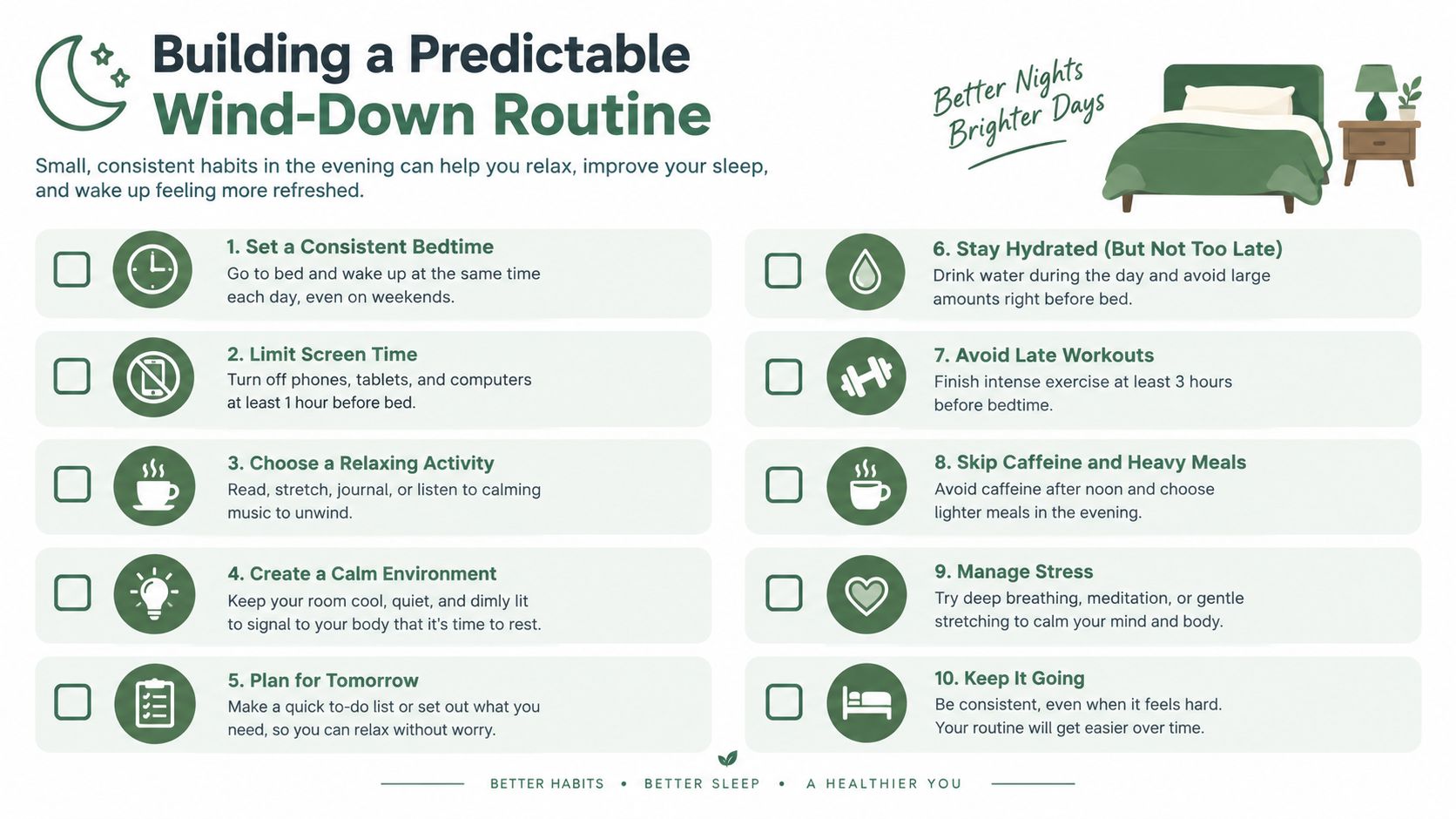
A routine reduces the surprise of separation by giving your toddler the same sequence of cues each night. The activities don't need to be elaborate. What matters most is that the order stays recognizable, the ending is brief, and every caregiver knows what happens next.
Sleep Foundation describes a bedtime routine as a consistent, repetitive set of activities before sleep. A typical routine includes three or four activities, such as a snack, brushing teeth, pajamas, and a book, performed in the same order. Sleep Foundation's bedtime routine guidance also supports offering limited choices while keeping the bedtime boundary steady.
A sequence caregivers can repeat
-
Close the day gently. Lower the stimulation before the routine begins. Put away active toys, dim the lights, and use the same short phrase to signal that bedtime is approaching.
-
Keep the order stable. For example, offer a small snack, brush teeth, put on pajamas, read one book, then turn out the light. If a nanny handles bedtime one night and a parent handles it the next, the people can change while the sequence stays the same.
-
Offer bounded choices. Ask, “Blue pajamas or green pajamas?” or “Which of these two books?” Don't offer a choice about whether bedtime happens. Choice gives your toddler participation without moving the final boundary.
-
End with one clear goodbye. Use the same words each night, such as, “I love you. You're safe. It's time to sleep. I'll see you in the morning.” Avoid adding new promises that you can't keep.
-
Use a familiar comfort item when appropriate. A blanket, stuffed animal, or favorite toy can provide a reassuring bridge after the caregiver leaves. Families should follow age-appropriate safe-sleep guidance and discuss questions about a comfort item with a pediatrician.
The routine should feel reassuring, not like a performance that has to be perfect. If one caregiver reads slowly and another sings softly, that's fine as long as the order, boundaries, and closing words remain familiar.
Gradual Separation and Caregiver Scripts
Once the routine is stable, change the physical distance gradually rather than disappearing suddenly or staying beside the bed indefinitely. UC Davis Health recommends consistent bedtime rules, familiar routines, and a comfort item, while Pediatric Associates describes moving from touch at the bedside to a position across the room and later toward the doorway. Pediatric Associates' bedtime routine guidance offers a flexible example that families can adapt to the child's tolerance.
You might begin seated beside the bed for a short period, then move your chair farther away on later evenings. The pace doesn't need to be identical for every child. If your toddler is sick or unsafe, respond to that need first. If the protest is frustration about the separation, keep your response calm and short.
Use one script across adults
A graduated approach can include fixed check-ins, such as every 5 minutes, or progressively longer check-ins such as 5, 10, then 15 minutes. Evidence summarized by the American Academy of Sleep Medicine supports graduated extinction for bedtime problems and night wakings. A systematic review identified 7 randomized controlled trials involving 230 children, with improvements in sleep duration, sleep-onset latency, bedtime resistance, and night waking outcomes. The systematic review and evidence summary also reports that benefits can persist at 1-year follow-up, while not supporting a guaranteed result for every toddler.
Try a brief script such as:
“You want me close. I'm going to check on you, and it's time to sleep.”
If your child calls again, repeat the same words rather than explaining more. Avoid restarting play, offering another book, adding a snack, or beginning a long conversation unless there's a genuine need. Extended interaction can teach a calling toddler that crying reliably brings a new round of attention, even when the caregiver is responding with love.
The goal is independent sleep initiation, not emotional suppression. Your child can be upset and still receive a predictable, respectful boundary. Every adult should know where to sit, what phrase to use, how long to stay, and what counts as a reason to change course.
How Daycare and Naps Affect Evening Behavior
A toddler may leave daycare cheerful, then cry when the evening caregiver arrives. Another may cling to a grandparent who is leaving just before bedtime. These reactions can reflect the whole day, including fatigue, stimulation, missed connection, and a change in who handles the transition. The same child may cry, bargain, cling, or leave the bed repeatedly on different evenings.
A 2025 exploratory study found bedtime resistance in 61.3% of toddlers. Younger toddlers were more likely to cry or tantrum, while older toddlers showed a wider range of resistance behaviors. Children with bedtime resistance took twice as long to fall asleep, had less consolidated sleep, shorter nighttime and 24-hour sleep, and were less likely to fall asleep independently. The study indexed by PubMed supports examining the day's events rather than treating every protest as separation anxiety.
Read the pattern instead of guessing
Several patterns deserve attention:
- Busy daycare days can leave a toddler overstimulated or seeking focused one-on-one time.
- A late or extended nap can reduce sleep pressure, making bedtime resistance partly a scheduling issue.
- A short or missed nap can produce frantic, tearful behavior that resembles stronger separation distress.
- A caregiver handoff can create another separation shortly before bedtime, particularly when a nanny or grandparent leaves before the routine starts.
Childcare arrangement, attendance, and hours can also affect sleep outcomes. More outside-home childcare was commonly associated with less nighttime sleep for infants and toddlers, while mandatory naps could increase sleep among preschoolers, according to a separate 2025 systematic review. Keep that finding in context: it describes broad patterns, not the schedule your child must follow.
Record what changes after daycare, nanny care, grandparent care, or a parent-led day. Note the nap timing, the handoff, who starts bedtime, and how long the child takes to settle. A shared record helps every adult respond to the same pattern instead of forming separate explanations.
A practical guide to toddler naps can help you assess nap timing without treating every difficult evening as a reason for stricter sleep training. Adjust the pace and connection time to match the day, while keeping the final bedtime boundary familiar.
Coordinating Multiple Caregivers for Consistency
A plan can work for one caregiver and fail across a household if each adult responds differently. If a parent sits beside the bed until sleep, a grandparent returns after every call, and a nanny uses brief check-ins, your toddler receives three different answers to the same question: what happens when I protest?
| Approach | Immediate effect | Longer-term trade-off |
|---|---|---|
| Long reassurance and repeated returns | May calm the child briefly | Can extend the routine and make calling more rewarding |
| Sudden withdrawal | May shorten adult involvement | Can feel abrupt and increase distress for some children |
| Brief, repeated reassurance | Validates feelings while preserving the boundary | Requires adults to coordinate and follow the same response |
| Shared notes about naps and bedtime | Reveals patterns across households | Takes a little time and works only when entries are specific |
Write the plan where every caregiver can see it. Include the routine order, the goodbye phrase, the check-in timing, the comfort item, and the exceptions for illness or safety. A shared daily record should also note the nap's timing, who handled bedtime, when the routine started, and what happened after the caregiver left.
A tool such as Cradlo can give parents, partners, nannies, grandparents, and daycare caregivers a shared timeline for sleep, naps, routines, and notes. It supports separate caregiver identities, real-time syncing across iPhone, Android, and the web, a browser-based daycare log, and English and Spanish use, so a Spanish-speaking caregiver can record the same information without relying on a verbal handoff. A daycare daily report template can also help families decide which details are useful to pass between care settings.

The point isn't to monitor your toddler perfectly. It's to replace “What happened tonight?” with a shared record that helps adults adjust thoughtfully. When the adults use the same words and boundaries, bedtime becomes more predictable, even when the child still has feelings about the separation.
Cradlo gives families, nannies, grandparents, and daycare caregivers one shared place to record naps, bedtime routines, caregiver responses, and daily notes, helping you spot patterns without blaming anyone for a difficult night. Visit Cradlo to start the 7-day free trial on the monthly plan and coordinate your toddler's bedtime with the whole caregiving team.