15 Week Old Baby Milestones: What to Notice
By 15 weeks, many babies are nearing the 4-month stage, when you may notice smiling to get attention, chuckling, cooing like “oooo” and “aahh,” turning toward a caregiver's voice, steadier head control, hands coming to the mouth, and pushing up on elbows or forearms during tummy time. Many also sleep about 14 to 16 hours in a day, although how that sleep is spread out can vary.
One caregiver hears a new coo during a diaper change. Another says the baby nearly rolled during tummy time. A daycare teacher logs a big smile right after pickup. That's often what 15 week old baby milestones look like in real life. Not a neat sequence, but little flashes that show up in different places with different people.
At this age, development often comes in uneven bursts. A baby may seem very social one day and mostly sleepy the next. They may hold their head more steadily at home but fuss through tummy time at daycare. None of that automatically means something is wrong. This list is for observation, not a pass-or-fail test.
You may notice changes across four core areas. Motor skills, social connection, early language, and sensory curiosity. Sleep and feeding patterns also start to feel more recognizable, even if they're still far from predictable. For families juggling home, nanny care, daycare, or grandparent help, shared notes can make these changes easier to see.
If you have questions about health, feeding adequacy, hydration, or development, bring them to your baby's pediatrician. If breastfeeding or pumping is part of the picture, a lactation professional can also help with feeding questions. Spanish-speaking families can make this easier by sharing labels and observations in English, Spanish, or both, as long as everyone understands what was noticed.
Table of Contents
- 1. Social Smiling and Eye Contact
- 2. Hand Awareness and Batting
- 3. Increased Vocalization and Cooing
- 4. Improved Head Control and Neck Strength
- 5. Rolling Attempts and Body Awareness
- 6. Increased Alertness and Awake Window Extension
- 7. Preference Recognition and Caregiver Distinction
- 8. Sleep Consolidation and Nap Patterns
- 9. Feeding Cues and Appetite Variation
- 10. Diaper Output Patterns and Hydration
- 11. Growth Progression and Clothing Sizes
- 12. Temperature Regulation and Seasonal Clothing Needs
- 13. Sensory Exploration and Texture Interest
- 14. Preparation for Independent Sitting
- 15. Documentation and Communication Across Caregivers
- 15-Point Comparison: 15-Week Baby Milestones
- Notice the Pattern, Not the Stopwatch
1. Social Smiling and Eye Contact
You may notice this first in an ordinary moment. Your baby hears your voice during a diaper change, pauses, looks at your face, and then gives a wide, unmistakable grin. A daycare teacher might see the same thing at pickup. A grandparent may get a smile by repeating the same hello in the same sing-song voice.

At 15 weeks, smiles often start to feel more social and less accidental. The key idea is response. A social smile usually shows up after something your baby notices, like a familiar face coming close, a voice they know, or a little pause-and-wait game during feeding or burping.
Eye contact often grows alongside that smile. It works like the first version of conversation. Your baby looks, you respond, they brighten or calm, and the exchange repeats for a few seconds. Those brief back-and-forth moments can tell caregivers more than one big smile caught on camera.
What caregivers may notice
A baby does not need to smile on cue to show connection. Look for patterns across settings and over several days.
- Response to people: Smiles or brightening after a parent, nanny, daycare teacher, or grandparent speaks or comes into view
- Face watching: A few seconds of studying your face during a bottle, song, or diaper change
- Back-and-forth moments: Looking at you, pausing, then reacting again when you talk or smile
- Different reactions for different people: Relaxing faster with familiar caregivers, or showing extra excitement at reunion times
One missed moment usually means very little. Babies get tired, hungry, overstimulated, or interested in something else.
If you are unsure what you are seeing, make it easier to spot. Try face-to-face time in a quiet room after your baby has eaten and rested. Hold your face about a forearm's length away, speak gently, then pause. That pause gives your baby time to look, process, and answer in their own way.
Shared notes help here. If home says, "She smiled after her uncle sang," and daycare says, "He locks eyes during bottle feeds," you start to see a pattern across people and routines. That is more useful than treating one moment like a test.
If your baby rarely seems to notice faces, rarely makes eye contact, or you have concerns about vision, hearing, or overall development, bring those questions to your pediatrician. If feeding interactions feel difficult or stressful, a lactation professional may also help you sort out what is feeding-related and what is normal variation in social engagement.
2. Hand Awareness and Batting
You set your baby on a play mat, look away for a second, and hear the toy arch jingle. It was not a big reach. More like an accidental tap that happened again, then again. At this age, those little repeats are often what hand discovery looks like.
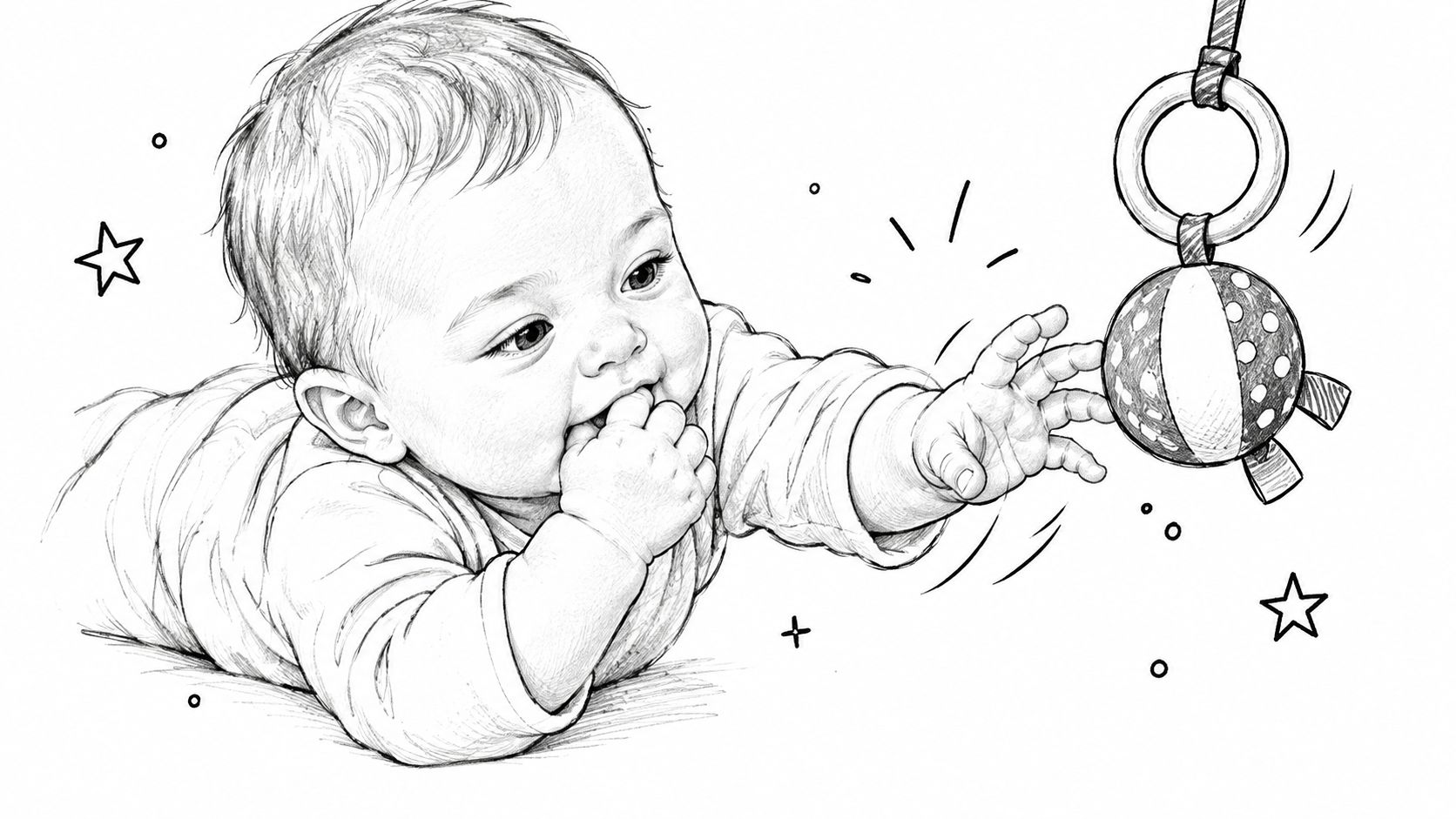
Around 15 weeks, many babies are starting to notice that their hands belong to them and can affect the world around them. A hand drifting into view can be as interesting as a new toy. Then comes mouthing, waving, opening and closing the fists, or swiping at something nearby. The movement is often part discovery, part practice.
You may notice different versions of this in different places. At home, a baby on the floor may stare at one hand before batting a dangling ring. With a grandparent, they may keep bringing fingers to the mouth during cuddle time. A nanny might notice that tummy time brings out more reaching than time in a swing. At daycare, a caregiver may see the baby briefly hold a soft toy that was placed in the hand.
A helpful way to read this stage is to watch for patterns, not polished skill. One baby smacks toys with both arms. Another studies their fingers for long stretches. Another mostly grabs clothing, burp cloths, or your shirt during feeds. Those all fit the same bigger picture of growing body awareness and early hand use.
You can support this without turning play into practice drills. Place one easy-to-hit toy near chest or shoulder level. Offer floor time when your baby is calm and alert. Soft rings, fabric toys, and crinkly cloth books are often easier to connect with than heavier objects.
A few practical notes help, too. Short nails can prevent face scratches while hand control is still developing. Position matters. Babies often move their arms more freely on a blanket at home than when tucked into a seat at grandma's house or strapped into daycare gear between activities.
If you are comparing notes across caregivers, share what you saw. "Batted the green ring twice after nap" is more useful than "good at reaching." That kind of detail helps everyone notice the pattern across settings.
If your baby keeps one hand tightly fisted most of the time, rarely brings hands toward the middle of the body, or seems uncomfortable during movement, bring those questions to your pediatrician. If hand-to-mouth movements are making feeding feel confusing or frustrating, a lactation professional can help you sort out normal exploration from latch or hunger concerns.
3. Increased Vocalization and Cooing
At 15 weeks, crying usually isn't the only sound in the room anymore. Many babies start making soft vowel sounds and responding to voices with little bursts of cooing. The Ohio early milestone checklists describe cooing, making sounds back when spoken to, watching faces intently, and swiping at dangling objects as common behaviors in this age range.
A nanny may hear a long “aaah” during a diaper change and answer back. A parent may sing the same lullaby every evening and notice more sound-making during the quiet middle of the song. A daycare provider might be the first to notice that the baby pauses as if waiting for someone to respond.

Back-and-forth matters more than fancy sounds
You don't need to judge whether a sound is advanced. What helps most is replying. Pause after your baby coos. Copy the sound. Add a new one. That tiny conversation is practice for later communication.
Some babies are chatty in the bath, others after a feed, others only when the room gets quiet. The pattern matters more than the exact sound.
If your family speaks more than one language, this is still a great age to talk naturally in both. English and Spanish labels, songs, and everyday phrases all count as rich language exposure.
4. Improved Head Control and Neck Strength
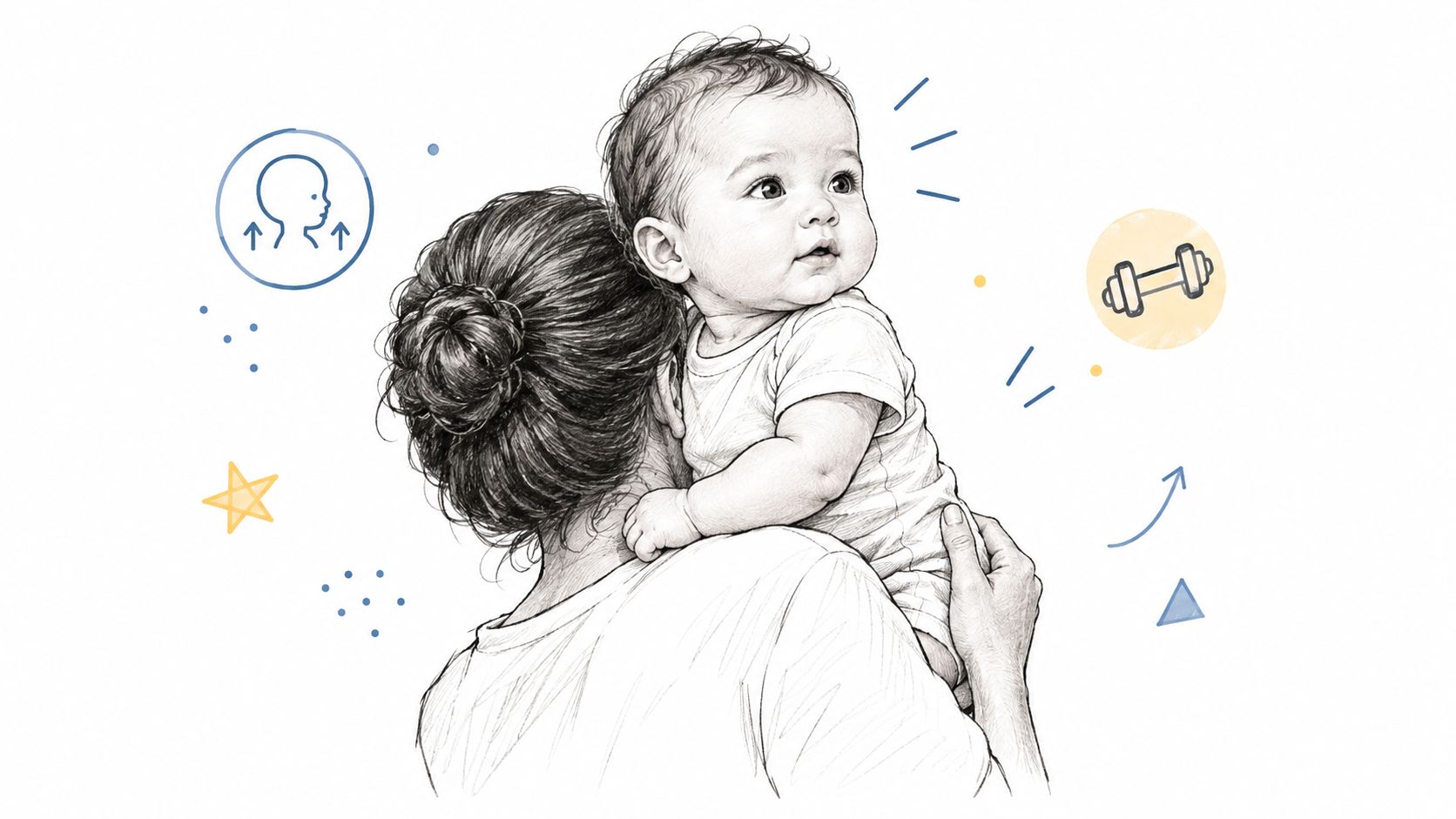
One of the clearest 15 week old baby milestones is stronger head control. By around this stage, many infants can hold their head steady without support, push up onto elbows or forearms during tummy time, and bring hands to the mouth, according to the CDC-linked milestone summary discussed by The Bump's 15-week page.
A parent may notice they aren't doing quite as much under-the-head support when lifting the baby from the crib. A grandparent holding the baby upright on their shoulder may feel less wobble and more active looking around. During floor play, the baby may lift the head, turn toward a sibling's voice, and stay there for a few extra seconds.
Support without rushing
Short tummy time sessions still do a lot of work here. So does being carried upright against an adult's chest while fully supported.
- Keep transitions slow: Head control is better, not perfect.
- Use the floor often: Babies usually practice best on a flat, safe surface.
- Share observations clearly: “Held head steady during tummy time for part of the song” tells another caregiver more than “did great today.”
If head control seems not to be improving over time, that's worth mentioning to your pediatrician.
5. Rolling Attempts and Body Awareness
You set your baby on the play mat, look down a moment later, and somehow they are no longer lined up the same way. Maybe the hips have scooted sideways. Maybe one shoulder has tipped forward and the whole body looks a little corkscrewed. That kind of shifting is often what caregivers notice first at this age.
Rolling usually starts as a chain of small parts. The head turns, the shoulder follows, the ribs rotate, and the hips try to catch up. A full roll may come later. What you can notice now is body awareness starting to connect from top to bottom, like your baby is learning where each piece is and how to use it together.
That can look different across settings. A parent may see the baby hook a foot against the mat and pivot during floor play. A nanny may notice the baby reaches across the body for a toy and ends up tilted onto one side. A grandparent may say, “She almost rolled when I was singing to her.” Those observations matter because they describe the pattern, not just the finish line.
One practical change belongs here. Treat every flat surface as if a surprise move could happen today.
During diaper changes, keep one hand nearby and supplies within reach. On the floor, give enough open space for wiggling and turning. On a couch or bed, stay close the whole time, because “not rolling yet” does not mean “won't suddenly shift.”
If you want more context for the usual progression, this guide on when babies start rolling can help you compare what different early attempts may mean without turning it into a test.
If movement seems very one-sided, or your baby seems uncomfortable during floor play, bring that up with your pediatrician.
6. Increased Alertness and Awake Window Extension
One day your baby is ready for a nap soon after a feed. A few days later, they stay bright-eyed through diapering, floor play, a song with grandma, and a short stroller walk. That shift can catch caregivers off guard, especially when one person says, “She seemed ready to sleep,” and another says, “He wanted to keep looking around.”
At 15 weeks, many babies have longer stretches of alert time because they can take in more of the world before tiring out. Awake time works a bit like a battery with a small charge. Some days it lasts longer, and some days busy surroundings use it up faster.
What caregivers can notice is the pattern around that alert time. A parent at home may see the easiest play happen after the first morning feed. A daycare teacher may notice the baby stays engaged for books but gets overstimulated in a louder room. A nanny might find that late afternoon brings quick fussing even if the earlier part of the day went smoothly.
Instead of aiming for one exact clock-based window, watch how your baby looks and acts before sleep. Quiet staring, less active kicking, turning away, jerky movements, rubbing eyes, or losing interest in faces can all be early signs that the awake period is ending. If you want a plain-language guide, this explanation of what a wake window is can help connect those cues to daily timing.
This is also a good section to share notes across caregivers.
“Best tummy time happens within about 20 minutes after the first nap” is useful. “Gets fussy faster after errands” is useful too. Those small observations help everyone handle the day with less guesswork.
If your baby suddenly seems much sleepier than usual, is hard to wake for feeds, or seems unwell, check in with your pediatrician. If feeding and sleep timing start to feel tangled together, a pediatrician or lactation professional can help you sort out what is developmental and what may need closer attention.
7. Preference Recognition and Caregiver Distinction
By this age, babies often start showing that familiar people are, in fact, familiar. They may brighten at one voice, settle faster with a known hold, or stare longer at a face they see every day. That doesn't mean they only bond with one person. It means they're learning who belongs in their world.
A baby may stop fussing when a weekly grandparent arrives and starts the usual bounce. Another smiles faster for the daycare teacher who always sings during diaper changes. A parent coming home from work may get a very clear look of recognition, even if the baby was content a minute earlier.
What this means for shared care
Recognition is good news for all kinds of care setups. Babies can build secure relationships with parents, partners, grandparents, nannies, and daycare staff.
A preference in one moment doesn't erase another bond. It often reflects familiarity, timing, or who has the right soothing move that day.
If one caregiver sees more smiles and another sees more fussing, context matters. The baby may be tired, hungry, or transitioning between activities when that person is on duty.
8. Sleep Consolidation and Nap Patterns
At 2 a.m., one parent may be pacing with a baby who woke twice after a decent first stretch of sleep, while the grandparent says, "But she napped so well this afternoon." Both observations can fit the same week.
Around 15 weeks, sleep often starts to show a loose shape without becoming predictable in every setting. You may notice one longer nap at home, several shorter naps at daycare, or an earlier bedtime after a busy morning with the nanny. Babies this age are still adjusting to light, noise, activity, and how much help they need to settle.
Sleep works a bit like traffic flow. You can usually spot patterns, but one loud day, a skipped nap, or a growth spurt can change the route. A rough night does not always mean something is wrong, and one "perfect" day does not mean the pattern has fully changed.
What helps most is comparing notes across caregivers in plain language. "Slept 35 minutes unless held." "Stayed cheerful for about an hour, then got glassy-eyed." "Needed a darker room at daycare." Those details are often more useful than trying to judge whether a baby "should" be on a strict schedule yet.
A few observations are especially useful to share:
- The baby's first sleepy signs, such as zoning out, rubbing eyes, or losing interest in play
- Which naps tend to be easiest or hardest
- Differences between home, daycare, the stroller, and contact naps
- Whether night waking looks like hunger, discomfort, or trouble settling back to sleep
If you want a practical reference point for daytime sleep, this 4-month-old nap schedule guide can help you compare rhythms without treating the clock like a test.
For health questions about snoring, breathing pauses, reflux, very hard-to-settle sleep, or feeding and sleep concerns that seem connected, check in with your pediatrician.
9. Feeding Cues and Appetite Variation
One caregiver says, "She was hungry again already." Another says, "He got distracted after a few minutes and smiled at the bottle." Both can be true at 15 weeks.
Feeding at this age often looks less reflexive and more communicative. A baby may not root the way they did in the early newborn weeks, but you might notice a different pattern: hands moving to the mouth, a tense body, quick head turns, or fussing that settles as soon as feeding starts. Fullness can look just as clear. Slower sucking, relaxed hands, turning the head, or drifting off are all common signals.
Appetite also shifts with the day. After a long nap, a baby may feed with real focus. In a bright daycare room, the same baby may keep stopping to watch voices, lights, or other children. That does not automatically mean something is wrong. It often means their growing brain is paying attention to more than one thing at once, like an older sibling trying to eat dinner while watching everything happening at the table.
What helps most is sharing what the feed looked like, not only when it happened. A nanny might report, "Took the bottle better after we moved to a quieter room." A grandparent may notice, "Started calm, then pulled off to look around every minute." A breastfeeding parent may find one side goes smoothly in the early morning, while late afternoon takes more patience.
Those details travel well across caregivers:
- Early hunger cues you saw
- Whether the baby fed calmly, eagerly, or in short distracted bursts
- Signs that seemed to mean "all done"
- Settings that made feeding easier, such as dim light, fewer voices, or a sleepier time of day
Patterns matter more than performance on any single feed. If you have questions about intake, weight gain, latch, milk transfer, pumping output, reflux, or pain with feeding, check in with your pediatrician or a lactation professional.
10. Diaper Output Patterns and Hydration
By 15 weeks, a diaper log often becomes one of the easiest ways adults compare notes. A parent may ask at pickup, "How many wets today?" A nanny may text, "One poop after the late bottle." A grandparent may say, "He soaked that last diaper."
Those small reports are useful because they describe what caregivers can see across settings. They also work best as pattern notes, not scorecards. One quieter day does not usually mean much by itself. A few days that look different from your baby's usual rhythm are more worth noticing.
Stooling can be especially confusing at this age. Some babies go more than once in a day. Others space stools out longer and still seem comfortable. That is why shared records help so much. Daycare may have seen the diaper that explains what looked like an "off" afternoon at home.
A simple handoff note is often enough:
"Two good wet diapers before lunch, one stool after nap, fussier than usual during the last wake window."
That gives the next caregiver something concrete to work with. It connects diapers with the rest of the day, instead of treating them as an isolated milestone.
If you want to keep track, keep it basic. Wet, stool, both, and anything that seems clearly unusual for your baby. If something concerns you, a photo can help you describe what you saw when you call the pediatrician.
Hydration questions belong in the health category, not the milestone category. Diaper output can support the conversation, but it does not diagnose the reason for a change. If wet diapers drop off, stools change sharply, or your baby seems unusually sleepy, hard to wake, or not feeding well, check in with your pediatrician. If feeding and milk transfer are part of the question, a lactation professional may also help.
11. Growth Progression and Clothing Sizes
One week the cuffs fold over your baby's hands. A short time later, the same sleeper pulls at the toes and will not snap easily after a feed. That is often how growth shows up in daily life at 15 weeks. Caregivers usually notice it in fabric, fit, and routine before they see a number at a checkup.
Clothing size is a practical clue, not a milestone to pass. A baby may still wear the same labeled size in one brand and need the next size up in another. Daycare backup clothes, a grandparent's spare outfit, or a nanny's carrier check can all reveal the same pattern. Your baby is filling out, stretching longer, or both.
What helps most is sharing what people see.
A note like "the 3-month onesie was hard to snap after the afternoon bottle" gives other caregivers something useful to watch for. It separates a normal growth observation from a health concern. The first needs a closet update. The second belongs with your pediatrician.
You can also treat clothing fit like a quick home signal:
- Sleeves and pant legs seem suddenly short
- Snaps strain even in the right diaper size
- Socks leave deeper marks than usual because the pair is too small
- The spare outfit at daycare no longer fits comfortably
Those clues work like pencil marks on a doorway. They show change over time, even if the change is easy to miss day by day.
If growth, feeding, or weight gain feels unclear, bring those questions to your pediatrician. If milk intake or transfer is part of the picture, a lactation professional can help sort out feeding questions.
12. Temperature Regulation and Seasonal Clothing Needs
Temperature comfort is less about a developmental milestone and more about responsive care. At 15 weeks, babies still rely on adults to dress them for the room, the stroller, the car seat, and the weather outside.
One baby may be sweaty in a heavily heated daycare room while wearing layers packed for a cold morning commute. Another may seem comfortable at home in a light sleeper but need a different setup at a grandparent's cooler house. This is one reason handoff notes matter.
Keep the message consistent across caregivers
Simple instructions often work better than long explanations. “One cotton layer indoors.” “Add hat only for outside walk.” “Spare outfit in daycare bag.”
Comfort can look different across homes and care settings. Shared notes help adults adjust the environment, not blame each other.
For health questions about fever, unusual lethargy, or illness, check with your pediatrician rather than relying on clothing tweaks alone.
13. Sensory Exploration and Texture Interest
You may notice this during an ordinary part of the day. Your baby pauses during a diaper change to rub the changing pad cover, stares at the tag on a blanket, or keeps bringing the same soft bib toward the mouth. That kind of repeat attention is often what sensory exploration looks like at 15 weeks.
Babies this age learn by running little "tests" with their bodies. They touch, look, listen, and mouth an object to gather information. A crinkly book gives one kind of feedback. A silicone teether gives another. The point is not whether they choose the fanciest toy. The useful observation is what holds their attention, what seems calming, and what feels like too much.
Different caregivers may spot different patterns. A daycare provider may notice that a baby watches light moving across the floor during tummy time. A nanny may find that a muslin cloth helps during a fussy transition. A grandparent may see that the baby turns toward a gentle rattle but startles at louder household sounds.
At home, keep the setup simple. Offer one or two safe objects with different textures, such as a soft cloth and a firm ring, then watch how your baby responds over a few days. Fewer choices make it easier to notice a pattern and easier to share that pattern with other caregivers.
Useful notes sound like this: "Likes crinkle sounds." "Chews the corner of the burp cloth." "Looks away when the toy is bright and noisy." Those details help adults match the environment to the baby instead of treating every reaction like a milestone test.
Choose items made for babies, large enough to avoid choking risks, and in good condition. For questions about gagging, persistent feeding discomfort, or whether mouthing behavior seems unusual, check with your pediatrician or a lactation professional.
14. Preparation for Independent Sitting
You may notice this during an ordinary part of the day. Your baby is on your lap after a feed, looks around for a moment, and holds their head a little steadier before folding back into your chest. That small stretch of control is often the part to watch at 15 weeks.
At this age, sitting is still a foundation skill, not a performance skill. The body is practicing the pieces that sitting will later require: head control, upper-back strength, balance with support, and learning where the body is in space. It works a bit like stacking blocks. The bottom blocks need to feel steady before the top ones can stay in place.
What caregivers can share here is simple and useful. A parent may notice better upright posture during lap time. A nanny may see that tummy time starts rough but improves after the first minute. A daycare provider may report that the baby can stay engaged longer when supported against an adult's chest. A grandparent may notice the baby turns the head more evenly from side to side while being held.
A few everyday setups help without turning this into practice drills:
- Hold your baby upright against your chest and let them work on brief head control while you support the trunk fully.
- Use lap sitting with your hands around the ribcage or torso, especially during songs, reading, or quiet face-to-face time.
- Offer short tummy time chances across the day instead of expecting one long session.
- Skip propping a baby into a seated position they cannot maintain on their own.
The question is less "Can my baby sit?" and more "What support helps my baby use their body well right now?" That shift keeps the focus on patterns you can notice and share, not on rushing the next milestone.
If your baby seems very uncomfortable in supported positions, has a strong preference for looking only one way, or you have questions about muscle tone, reflux, or feeding-related discomfort during upright time, check with your pediatrician. If positioning is affecting feeding, a lactation professional may also help.
15. Documentation and Communication Across Caregivers
A baby can have three different days in one day. Home may bring long cuddly feeds, daycare may bring short naps and busy watching, and a grandparent may catch the biggest smiles during an afternoon visit. At 15 weeks, that split view is normal. Development often shows up in small moments scattered across places and people.
Good notes help everyone compare patterns instead of relying on memory. They also keep developmental observations separate from health questions. "Turned toward my voice during diaper change" tells the next caregiver something different from "spit up more after bottles" or "fewer wet diapers today." Both matter. They just belong in slightly different buckets.
A simple handoff can work like passing a relay baton. Each adult adds one clear piece, and the full story gets easier to follow.
Try sharing updates in three lanes:
What baby noticed or did Short observations work best. "Looked at faces during pickup." "Batted the hanging toy twice." "Cooed after bottle." These are everyday snapshots, not scores.
What was happening around it Context keeps a note useful. Was the baby just waking up, in a noisy daycare room, on a play mat at home, or being held by grandma after a nap? The same baby may act very differently in each setting.
What may need follow-up Save this lane for care questions. Examples include ongoing feeding discomfort, much shorter feeds than usual, fewer diapers, unusual sleepiness, or a sudden change from the baby's usual pattern. Those are good items to mention to parents promptly and to bring to a pediatrician or lactation professional if needed.
The goal is not a perfect record. The goal is a shared picture that helps the next adult respond well.
Some families use a notebook by the diaper station. Others use a group text, a daycare app, or a quick voice memo after pickup. A nanny might send one sentence about naps and one about play. A grandparent might mention, "He stayed calm longer when I sang before the bottle." A parent coming home late from work may only need the headline version: how feeding, sleep, mood, and play looked across the day.
If notes start feeling like homework, shrink the system. One or two useful observations per shift is often enough to spot patterns over time.
15-Point Comparison: 15-Week Baby Milestones
| Milestone | 🔄 Implementation complexity | ⚡ Resource requirements | 📊 Expected outcomes | 💡 Ideal use cases | ⭐ Key advantages |
|---|---|---|---|---|---|
| Social Smiling and Eye Contact | Low, natural, responsive behavior | Minimal, caregiver attention, face-to-face time | Increased social engagement and bonding | Feeds, diaper changes, short interactions | Strong caregiver–baby bond; easy to observe |
| Hand Awareness and Batting | Low–Moderate, guided tummy/play needed | Simple toys, supervised tummy time | Improved fine motor control and coordination | Tummy time, play mats, hanging toys | Foundation for reaching and exploration |
| Increased Vocalization and Cooing | Low, responsive interaction encourages growth | Caregiver talk/singing, quiet environment | Early speech building blocks; back‑and‑forth exchange | Singing, talking, peek‑a‑boo sessions | Encourages language development; easy to reinforce |
| Improved Head Control and Neck Strength | Moderate, regular short practice required | Tummy time surface, caregiver support | Better head stability and visual exploration | Supported sitting, shoulder carrying, tummy time | Enables safer handling and new play positions |
| Rolling Attempts and Body Awareness | Moderate, supervised practice and safe space | Soft floor space, toys slightly out of reach | Emerging body coordination and weight‑shifting | Tummy time, prompted reach for toys | Signals readiness for next motor milestones |
| Increased Alertness and Awake Window Extension | Low, observing and adjusting routines | Tracking tool, consistent caregiver timing | Longer, predictable awake periods for interaction | Scheduling activities between naps | Improves planning and responsive care |
| Preference Recognition and Caregiver Distinction | Low, arises naturally with exposure | Consistent caregiver presence and routines | Differential calming and social responses | Transitions between caregivers, visits | Validates multiple secure attachments |
| Sleep Consolidation and Nap Patterns | Moderate, observation and gentle routines | Tracking, consistent sleep environment | More predictable naps and slightly longer sleep stretches | Nap scheduling at home and daycare | Easier daily planning; better caregiver coordination |
| Feeding Cues and Appetite Variation | Moderate, attentive responsive feeding | Tracking logs, caregiver education | Clearer hunger/satiety signals; feeding confidence | Bottle/breastfeeding sessions, growth tracking | Supports responsive feeding and trust |
| Diaper Output Patterns and Hydration | Low, routine tracking | Diaper logs, shared tracker | Objective hydration and digestion markers | Daycare shifts, pediatric checkups | Reduces feeding anxiety; early problem detection |
| Growth Progression and Clothing Sizes | Low, routine measurement and notes | Scale/height check, clothing inventory | Steady growth monitoring and gear planning | Pre-checkup prep and caregiver wardrobe sync | Practical planning for clothing and gear |
| Temperature Regulation and Seasonal Clothing Needs | Moderate, education and communication | Layers, thermometer, clear guidelines | Better thermal comfort and safety | Outings, daycare, seasonal transitions | Prevents overheating/overcooling across settings |
| Sensory Exploration and Texture Interest | Low–Moderate, supervised offering of textures | Safe, varied textured toys | Enhanced sensory learning and preferences | Tummy time, supervised play sessions | Builds tactile learning; informs toy choice |
| Preparation for Independent Sitting | Moderate, structured tummy/support practice | Supportive seats, regular tummy time | Core strength leading toward sitting readiness | Supported sitting, short daily tummy sessions | Lays groundwork for major gross motor milestone |
| Documentation and Communication Across Caregivers | Moderate, consistent system setup | Shared tracker/app, photos, brief notes | Unified developmental record and coordinated care | Work shifts, nanny/daycare handoffs | Ensures continuity; supports pediatric visits |
Notice the Pattern, Not the Stopwatch
The simplest way to use 15 week old baby milestones is this. Notice one thing. Write down what happened and where it happened. Share it with the people who also care for your baby. Then watch for change over time.
That approach works better than testing your baby on command. It also fits real life. A baby may coo most with a nanny, smile biggest for a parent at pickup, nap longest at daycare, and show their strongest tummy time push with a grandparent on the floor nearby. None of those moments cancel out the others. Together, they show a fuller picture of development.
The biggest takeaway is that milestones at this age are often emerging patterns, not one-time events. A steadier head today and a slightly longer push-up next week can matter more than whether the baby performed a skill once while everyone was watching. The same is true for social and language growth. Repeated smiles, more back-and-forth sounds, and growing alertness tell you more than a single standout moment.
The practical side matters too. Sleep, feeding, diapers, clothing fit, and sensory preferences all shape what caregivers notice. MedlinePlus describes typical sleep at this stage as 9 to 10 hours at night plus 2 daytime naps, for a total of 14 to 16 hours in 24 hours, in this cited summary. In real homes, that may still look messy. Some babies nap briefly at daycare and catch up later. Some wake more at night just as they become more social by day. Tracking helps you see whether you're looking at a short phase or a true shift.
There's also room for uncertainty. Many families want a list that says exactly what counts and what doesn't. Real development isn't that tidy. Evidence-based guidance for the 4-month stage says babies may hold their head steady, push up on elbows, reach for objects, bring hands to mouth, and coo or babble, while also noting that lack of improvement in head control, not reaching, or not babbling are reasons to seek advice, as outlined in the Mayo Clinic infant development overview. The important idea is that these skills can emerge unevenly.
When to call the pediatrician
A checklist can't diagnose anything, and it shouldn't be used to scare you. Still, some concerns deserve a direct conversation with your pediatrician.
Talk with your baby's doctor if you notice a loss of previously acquired skills, an ongoing concern about hearing, vision, movement, feeding, or responsiveness, or anything that worries you and doesn't seem to be settling. Caregiver intuition counts. If breastfeeding, pumping, latch, transfer, or milk supply questions are part of the picture, a lactation professional can help alongside your pediatrician.
For families managing handoffs across parents, partners, grandparents, nannies, and daycare, a shared tracker can make this whole stage easier to see. Cradlo is one option built for that kind of coordination. It keeps one timeline for milestones, sleep, feeds, diapers, and pumping, with separate caregiver identities, real-time syncing across iPhone, Android, and web, a browser-based daycare entry point, English and Spanish support, offline logging, and gentle summaries without streaks or guilt.
If that sounds useful, it's worth knowing the pricing clearly. Cradlo offers a 7-day free trial on the monthly plan, followed by a paid plan. It doesn't have a free plan.
The goal isn't to log every adorable second. It's to make daily care easier, help caregivers stay connected, and give you a calmer way to notice who your baby is becoming.
If you're trying to make sense of new smiles, shifting naps, feeding changes, and those first stronger tummy time pushes, Cradlo gives families, nannies, grandparents, and daycare one shared place to log it all. You can track milestones alongside sleep, feeds, diapers, and pumping, then see the pattern across caregivers instead of relying on scattered handoff notes.