2 Month Old Milestones: What Most Babies Do by 8 Weeks
By around 2 months, most babies, at least 75 out of every 100, can calm when someone speaks to them or picks them up, smile back at a face, coo, startle or turn toward a loud sound, follow a person moving across the room, and lift their head briefly during tummy time. That's the short answer, and the rest is about what it looks like in your living room.
It's a Tuesday afternoon. The baby has been fed, burped, changed and is finally awake and quiet on the play mat. You're crouched beside her with your phone, halfway through a search for 2 month old milestones, and somewhere in a group chat a baby the same age is reportedly rolling over. Your neighbor's granddaughter smiled "on day one." You're trying to work out whether the fact that your daughter stared at the ceiling fan instead of your face means anything at all.
It doesn't, at least not from one afternoon. What follows is the plain version of what pediatric clinicians look for at this age, why the timing spreads so widely, and how four or five caregivers can keep one calm record instead of trading anxious texts.
Table of Contents
- 2-Month-Old Milestones at a Glance
- Why Milestones Are Ranges and Common Worries Fade
- How Two-Month Skills Build on Each Other
- How to Watch for Milestones Without Turning It Into a Test
- What Milestone Moments Look Like in Real Life
- When to Check In With Your Pediatrician
- Start One Shared Record Before the Next Visit
2-Month-Old Milestones at a Glance
Something shifts around eight weeks. The baby who mostly ate, slept and cried starts to answer you. She holds your gaze a beat longer, her cry softens when you scoop her up, and one afternoon she looks straight at your face and grins.
Here's the checklist organized the way clinicians think about it, by area rather than by skill.
| Area | What you may notice by 2 months | What it can look like |
|---|---|---|
| Social and emotional | Calms when spoken to or picked up | Crying eases when you lift her and talk softly |
| Social and emotional | Looks at your face and smiles in response to interaction | A real grin appears during a diaper change, not just from gas |
| Social and emotional | Seems happy when a familiar person approaches | Legs kick when grandma, the nanny or a daycare teacher leans in |
| Communication | Makes sounds other than crying, like cooing | Little ooh and aah sounds during a calm, alert stretch |
| Communication | Reacts to loud sounds | Startles, blinks or turns toward a dropped pan or the doorbell |
| Cognitive | Watches a person move across the room | Eyes follow you as you walk to the kitchen and back |
| Cognitive | Looks at a toy for several seconds | Stares at the mobile, then looks away when done |
| Movement | Holds the head up briefly during tummy time | Chin and chest lift for a few seconds, head at about 45 degrees |
| Movement | Moves both arms and legs | Symmetrical kicks and swings on the play mat |
| Movement | Briefly opens the hands and loosens tight fists | Fingers unfurl around your finger during a feed |
The CDC milestone page for 2 months organizes these abilities across social-emotional, communication, cognitive and physical domains, and every item on it is something a caregiver can see and write down: head lifting on the mat, a coo, eyes tracking a face, a blink at a loud noise. The American Academy of Pediatrics describes the same stage in similar language, with more alertness, more active responses to caregivers, smiling and babbling.
Every row is an observation, not a score
Development at this age doesn't arrive as one skill. It arrives as small, repeatable moments spread across a day and, in many families, across several caregivers. That's why the useful thing to record is the date, the setting and who was holding the baby, not just a checkmark.
A habit that pays off: write down what you saw, not what you concluded. "Turned her head toward the door at 4:10" gives a pediatrician more to work with than "seemed distracted all day."
Scan the rows and mentally tick off what you've already seen. Then keep the unticked ones in mind, with a date next to any you're still waiting on.
Why Milestones Are Ranges and Common Worries Fade
Two months is a checkpoint, not a finish line. An older CDC developmental reference put it plainly: among term-born infants, approximately 90%, or 9 out of 10, should be able to demonstrate a defined group of abilities at 2 months. That list included lifting the head about 45 degrees from the surface during tummy time, no longer keeping the fists tightly clenched all the time, following an object moved in an arc past the body's midline, recognizing parents, smiling spontaneously before being talked to or touched, and making vowel-like cooing sounds such as "ooh" and "aah."
Read that 90% as a description of a population, not a deadline for your baby on a particular Tuesday. Nine in ten also means one in ten isn't doing all of it yet, and that tenth baby is not automatically a concern. A single missed behavior is one data point. The pattern across a week or two, seen by more than one person, is what tells you something.
Babies who arrived early get measured from their due date rather than their birthday, and clinicians adjust expectations the same way. A baby with six fewer weeks of practice should be compared to the timeline she has lived.
The worries that show up most often
- "She doesn't smile on demand." Responsive smiling depends on state, timing and who is leaning in. One quiet smile during a feed counts for more than a dozen attempts at a face that's already tired.
- "Her fists are always clenched." Loosely curled hands are still typical at this age, and they open and close more as control grows. You'll feel the fingers unfurl around yours.
- "Daycare says she does more there than at home." The setting changes what gets observed, not what your baby can do. A busy room offers different chances to watch than a quiet one.
- "The tracker is grading my baby." A record documents what someone saw. It doesn't rank her against the baby two doors down.
Then there's the group-chat baby who rolled over at six weeks. Wide variation is the norm at this age, and early comparisons predict very little about the child who eventually walks into kindergarten. Knowing the timelines isn't universal either. A 2025 study published in the Journal of Family Medicine and Primary Care reported that 73% of 100 mothers knew the expected age range for an infant's head-holding milestone, which leaves a sizable share of experienced parents unsure about one well-known skill. Not knowing is common. Asking is a strength.
How Two-Month Skills Build on Each Other
Sit with a two-month-old on the play mat for ten minutes and you can watch the newborn reflexes loosen their grip. The stepping and grasp reflexes that dominated the first weeks start to fade, head lag lessens when you pull her gently to sitting, and she can hold her head upright for a moment against your shoulder.
None of that happens in isolation. Each skill is the practice ground for the next one.
One skill is the practice ground for the next
Tummy time is the gym for head control. Short, frequent sessions on a firm surface, always awake and supervised, build the neck and upper-back strength that later supports rolling and sitting. Face-to-face talk is the gym for communication. Your voice, your pause, her sound, your answer: that loop is the earliest form of conversation, long before words.
Visual attention has its own practice. Move your face slowly from side to side while she's alert and you'll see her eyes catch up in small jumps, then settle.
Ordinary care carries most of the load. Narrate the diaper change out loud. Hold her close enough that your face fills her view. Get down to her eye level during alert stretches rather than talking from standing height.
Try this at the changing table: say "here comes the cold wipe," then stop and wait. Those two or three seconds of quiet are where her reply lives.
Head lifting has a progression worth knowing, from a few wobbly seconds on your chest to longer stretches on the floor, and tummy time milestones walks through it week by week. A few seconds of a lifted chin is the whole accomplishment at this age. Nobody is measuring for duration.
How to Watch for Milestones Without Turning It Into a Test
Watching for skills and testing for them feel similar from the outside and are completely different in practice. The CDC 2-month checklist is built from skills that three in four children can do by a given age, which makes it a description of what's common rather than a score to beat.
Six steps keep the week calm and still give you real information.
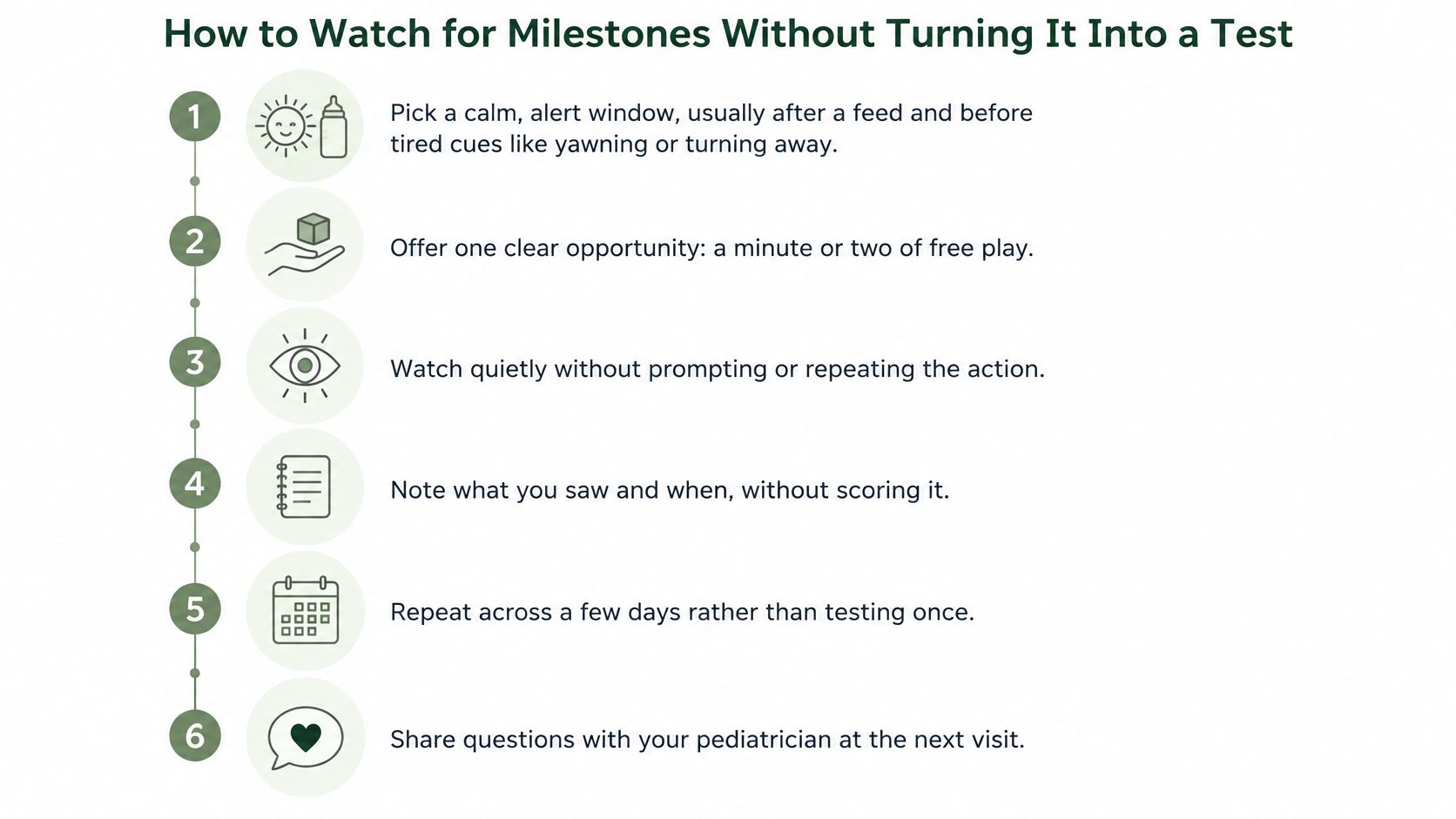
- Pick a calm, alert window. Usually after a feed and a burp, before the tired cues start: yawning, turning away, a glazed stare. A baby in that state can show you what she's working on.
- Offer one clear opportunity. A minute or two of supervised tummy time on a firm surface, your face close and talking, or a toy moved slowly from side to side. One invitation, not five.
- Watch a few separate times across the day. Babies are not on demand. A skill seen once at 9 a.m. and again at 6 p.m. tells you more than a single attempt before a nap.
- If you're unsure, look again over the next week or two. The CDC advises exactly that rather than repeating a prompt until somebody gets upset.
- Write down the date, the setting and who saw it. Keep the observation separate from the interpretation: "turned toward my voice" is what happened, "ignored me" is a story you told about it.
- Stop while it's still play. A hungry, fussy or overstimulated baby won't show anything fairly, and neither will a stressed adult.
What not yet actually means
"Not yet" is a scheduling note, not a diagnosis. Infants born more than three weeks prematurely should be assessed using corrected age, a detail that's easy to miss and changes how a whole checklist reads.
Choosing that calm window gets easier when you read cues early. The AAP's Bright Futures guidance for the 2-month visit lists early hunger signs as bringing a hand to the mouth, sucking, rooting and fussing, with fullness signs such as turning away, closing the mouth and relaxing the arms and hands. Catching the first cue beats waiting for the cry.
What Milestone Moments Look Like in Real Life
Milestones arrive in the middle of ordinary life, usually when nobody is looking for them. Two scenes that happen in almost every household with a two-month-old:

- 5:40 a.m., the second night feed. A mother gets the first clear social smile, aimed at her face rather than at the ceiling, and it lasts about a second and a half. Nobody else is awake to see it.
- Saturday afternoon at grandma's. Grandma moves from the couch to the kitchen and back, and the baby's eyes follow the whole trip. Grandma calls it "watching me," which is exactly right.
- Tuesday at daycare. The teacher notes a brief head lift during tummy time in the mid-morning. That evening, dad hears a coo during a diaper change and has no idea it's the same developmental push.
- Handoff at 6 p.m. The nanny's voice calms the baby instantly. Grandpa has to sing the same three songs. Same skill, different triggers.
Relational skills rarely perform on request. They surface across many small moments, and different caregivers use different words for identical behavior. Cooing, talking, gorjeos in a Spanish-speaking household: three descriptions of one sound.
The CDC milestone checklists group calming when spoken to or picked up, looking at a caregiver's face, seeming happy when a familiar person approaches, and smiling in response to interaction right alongside the motor and language items. Those are relational milestones, and they never show up in a single daily snapshot.
The rule that keeps it calm: one snapshot is weather. A week of observations is climate.
The fix isn't more vigilance. It's a shared note of who saw what, when, during which routine, and whether the baby was calm or tired. Tracking how she moves across a room also sets up the next question, and when do babies start rolling picks up where the head-lifting phase leaves off.
When to Check In With Your Pediatrician
A check-in with the pediatrician isn't a verdict. It's the next ordinary step in a relationship you already have, and the 2-month well visit is the natural place for it.
Bring the questions that have been building. A skill that appeared and then disappeared deserves a call rather than a wait. So do arms or legs that move in a clearly lopsided way, a head that always turns to the same side, head control that seems stuck week after week, or any concern about feeding and growth. Your own gut counts as a reason on its own.
Growth is read as a curve
Clinical guidance on the 2-month visit describes the shift from reflex-driven newborn movement toward more purposeful control: less head lag, brief upright head control when held, head lifting during tummy time, and the stepping and grasp reflexes beginning to fade. The same guidance on the 2-month visit emphasizes plotting weight, length and head circumference along the baby's own predicted curve, because one measurement says far less than the trajectory across visits. A baby tracking steadily on a low percentile is growing exactly as she should.
| What you are seeing | A reasonable next step | Why it makes sense |
|---|---|---|
| One skill hasn't shown up yet, but baby was tired, hungry or fussy | Try again over the next week or two in a calm, alert window | State and opportunity change what you will see |
| Baby was born early | Compare progress to corrected age and mention it at the well visit | Clinicians adjust expectations for prematurity |
| A skill appeared and then faded away | Contact the pediatrician rather than waiting for the next visit | Losing a skill is always worth a prompt conversation |
| Arms or legs move very differently, or the head always turns one way | Point it out at the visit or call the office | Persistent asymmetry is a pattern worth clinical eyes |
| Head control seems stuck, with full head lag in supported positions week after week | Raise it with the pediatrician | Ongoing head-control concerns warrant evaluation |
| Something simply feels off to you | Call and describe what you have noticed, and ask about developmental screening | Caregiver concern alone is a valid reason to check in |
A short written summary does more than a long explanation in the exam room: which skill, seen when, in which setting, by whom. Asking for a formal developmental screening when a concern persists is a reasonable, calm request, and clinicians can arrange one.
Start One Shared Record Before the Next Visit
Two months is a wide-open range. Daily responsive care does most of the work, and patterns across days and caregivers carry more weight than any one afternoon. Before the next appointment, spend a week noting three things.
- The observation itself. Which skill, on what date, in what setting, and who was holding her.
- What changed. A skill that got stronger, one that stalled, or one you saw once and never again.
- The questions. Write them as they come up rather than trying to reconstruct them in the waiting room.
That's the whole system: noticing, written down, shared. If a notes app starts to feel like the wrong container, this guide to a baby milestone tracker app explains what to look for, and Cradlo is a shared baby and child care tracker built for exactly this, where parents, partners, grandparents, nannies and daycare each log in their own way and every feed, nap and diaper shows up instantly for everyone else. Families who want to try it can use the 7-day free trial on the monthly plan before deciding.
Noticing is the milestone. No caregiver is doing it wrong by asking.
Cradlo gives your whole care team one shared record for sleep, feeds, diapers, growth and milestones, so a week of small observations becomes a calm summary instead of a group-chat interrogation. Every entry logs in real time for parents and invited caregivers, which means the smile your partner saw at 5 a.m. and the head lift your daycare teacher noted at mid-morning land in the same place. Visit Cradlo to start the 7-day free trial on the monthly plan and walk into the next well visit with a pattern rather than a vague memory.