Wondering About Your Toddler? 13 Month Old Milestones
It's 6:40 on a Tuesday. Your mom texts a photo of your 13-month-old letting go of the couch with one hand. At lunch, the nanny swears she heard "ba" for ball. Your partner thinks the pointing started last week. You're sitting on the kitchen floor with a cold cup of tea, wondering whether any of that counts, and whether the fact that she isn't walking across the room yet means something.
Those three reports have something in common. Each one is a real observation, made by someone who was paying attention. None of them is a score.
The reason 13 months feels confusing is structural. The CDC's public milestone checklist moves from 12 months straight to 15 months, so families land in the gap with no dedicated page to read (CDC developmental milestones). Add a first birthday party where three relatives asked whether she's walking yet, and it gets easy to grade a child against a calendar.
A range is the better frame. The CDC defines a milestone as a skill most children, at least 75%, can do by a given age, which means roughly one child in four isn't doing it yet on that date and is still developing typically. Development also moves unevenly. A toddler in the middle of a walking burst may go quiet on words for a few weeks, then surprise everyone with three new ones.
Read the 13 month old milestones below as things to watch for and notice, not boxes to tick. Each one comes with a shared-log habit, because the person who sees the first step is rarely the person who hears the first word, and no single adult has the whole picture.
Table of Contents
- 1. Wondering if your 13-month-old should be walking yet? Here is what many toddlers are doing around this age
- 2. Is your toddler pointing at things but not saying much yet? Pointing is one of the key communication milestones
- 3. Hearing a few first words and wondering what counts? Early words are a gradual process
- 4. Does your 13-month-old understand what you say but not yet respond? Following simple directions is a common milestone
- 5. Wondering how much your toddler can feed themselves? Cup and spoon skills are building
- 6. Is your toddler stacking blocks or dropping things over and over? Playful exploration is a sign of learning
- 7. Watching your toddler copy you with a phone or a broom? Imitation is a growing social skill
- 8. Does your toddler look for toys that disappear under a blanket? Object permanence is developing
- 9. Is your toddler clingy with one caregiver but happy with others? Attachment and separation feelings are normal
- 10. Wondering how to play peekaboo or wave bye-bye? Social games build turn-taking and connection
- 11. Is your toddler sitting down from standing without help? Balance and body control keep developing
- 12. Are your toddler's naps shifting and leaving you unsure what to expect? Sleep patterns change around this age
- 13. Feeling unsure whether your toddler is on track? Keeping a simple milestone record helps you notice progress
- Milestone Areas at a Glance
- Milestones Are a Shared Story, Not a Scorecard
1. Wondering if your 13-month-old should be walking yet? Here is what many toddlers are doing around this age
A toddler letting go of the couch and wobbling two steps before sitting down hard is one of the most photographed moments of the second year. It's also one of the most uneven.
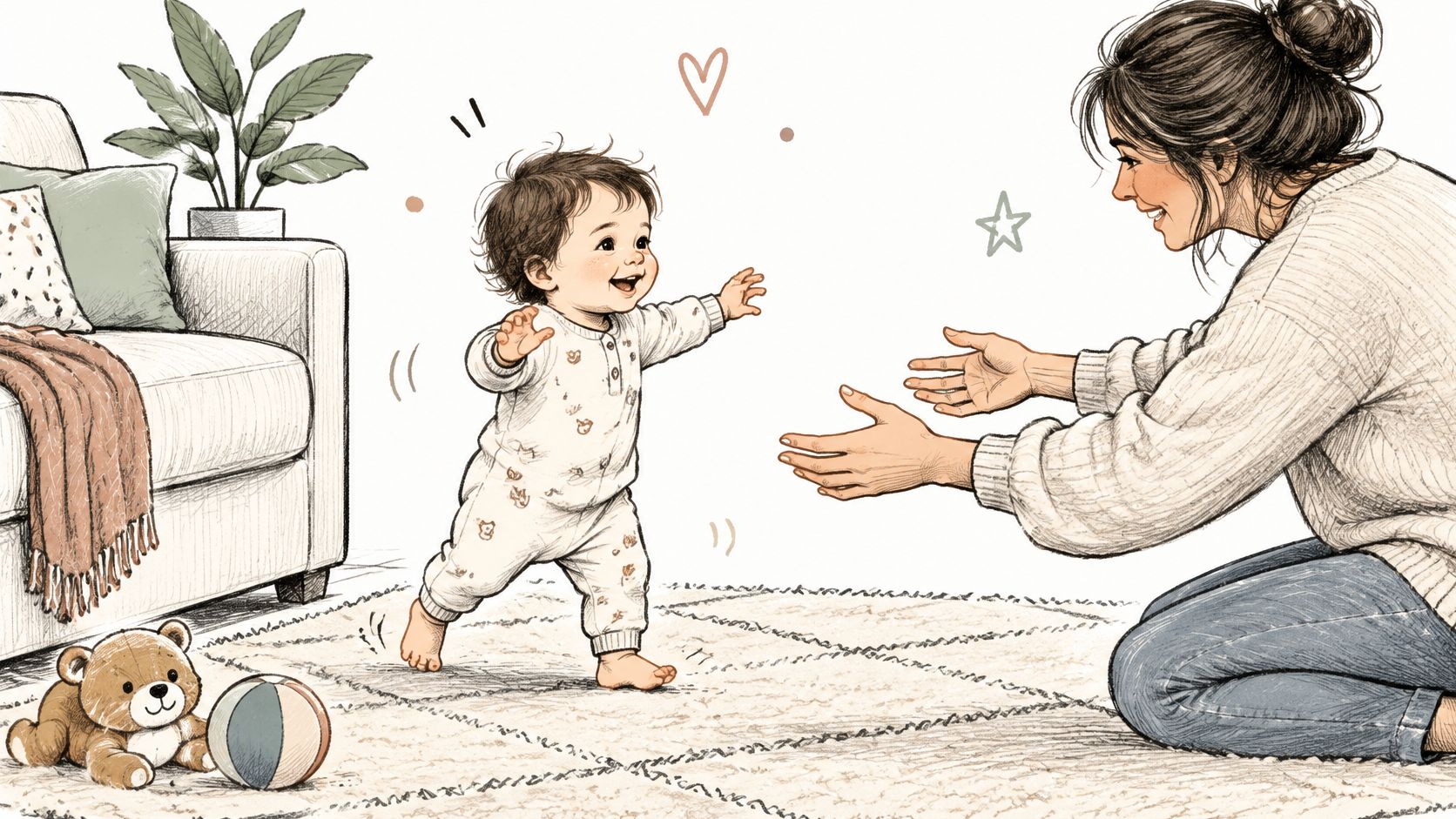
The range is wider than most families expect. A longitudinal study of 25 infants, followed across the months around the onset of walking, reported a mean walking-onset age of 11.76 months with a standard deviation of 1.56 months, and cited a typical range of about 8.2 to 17.6 months (the published study). Read that as a parent: a 13-month-old taking four wobbly steps and a 13-month-old cruising the sofa at speed are both inside the normal band.
What the walking range actually looks like
New walkers fall. They climb things they couldn't reach last month. They carry a toy in one hand and hold the wall with the other.
The same study found infants added "moving communications" at about 4.54 behaviors per month while walking developed. Movement and communication grow together, even in the weeks when spoken words are sparse. A grandparent who sees a new gesture at home and a nanny who sees four steps at daycare are watching the same story from two angles, which is exactly why one shared note beats two separate memories.
- Log the moment, not the verdict. "Four steps, sofa to coffee table, 6:40 p.m." tells the nanny and the pediatrician more than a yes/no box.
- Clear the path, not the child. Anchor heavy furniture, cover the sharp corner, and let her practice barefoot on a firm floor.
- Skip the hand-pulling. Furniture and a low stool are enough support. Dragging a toddler forward by the hands teaches her to lean on you rather than balance herself.
Frequent falls are expected. If movement looks painful or uneven, or bearing weight seems hard, that's a pediatrician question.
2. Is your toddler pointing at things but not saying much yet? Pointing is one of the key communication milestones
A finger out at a passing dog. Then a look back at you. Then the finger again.
That second look is the milestone. Pointing to request something or to get help appears on the CDC's list of skills most children have by 15 months (CDC 15-month milestones), and plenty of toddlers get there well before.
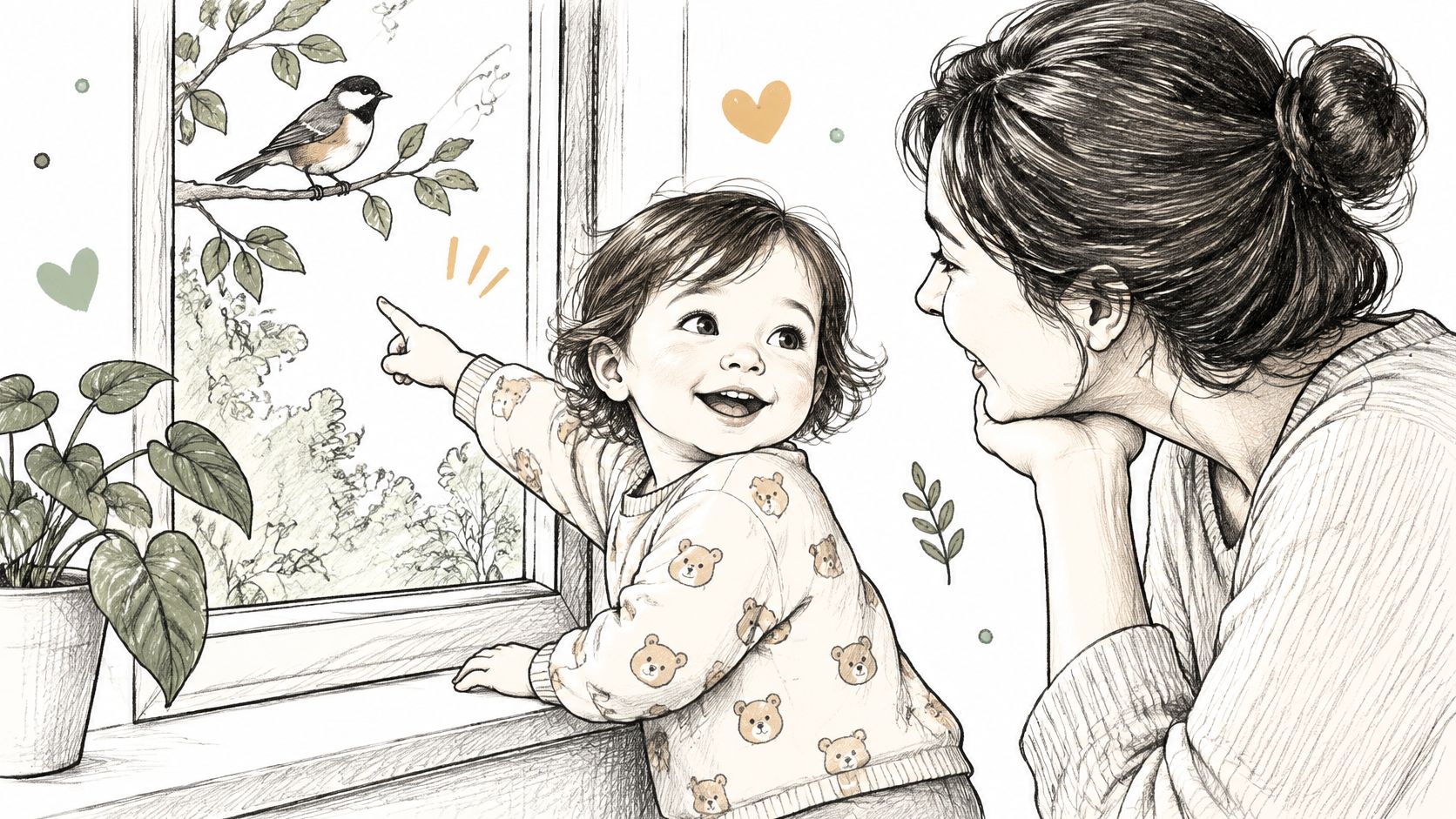
Gestures usually arrive before words. A child who points, waves, reaches up to be lifted, and shakes her head is running a full conversation without a vocabulary.
- Name what she points at. One word, twice, in the language your home uses. "Perro." "Dog." Don't turn it into a quiz.
- Deliver the goods. If pointing works, she keeps pointing. If it gets ignored, she finds another way or stops trying.
- Keep responses consistent across caregivers. A nanny who says "agua" and a grandmother who says "water" are both right, as long as each adult stays consistent.
Say the nanny writes a note that the toddler pointed at the board-book shelf and grunted until the puppy book came down. The parents read it that evening and know what to hand over at bedtime, instead of guessing why she's fussy at 7 p.m.
3. Hearing a few first words and wondering what counts? Early words are a gradual process
Mamá. Papá. Agua. Ball. "Ba" for every bottle, cup, and dog in the neighborhood.
A word counts when your child uses it the same way more than once. It doesn't need to be pronounced correctly, and it doesn't need to be English. If your family speaks Spanish at home and English at daycare, both sets count toward the same total.
Many toddlers at this age have a small handful of consistent words plus a lot of babbling with sentence-like intonation. Both patterns are normal. Some children go heavy on movement first and light on words, then flip the balance a month later.
- Narrate the boring parts. "Sock on. Other sock on." Routine language sticks because it repeats every single day.
- Pause longer than feels natural. Count to five after you ask something. Toddlers need processing time, and most adults fill the silence too fast.
- Write the word down with the date and the situation. "Agua, pointing at cup, grandma's kitchen" is a data point. "Says a few words" isn't.
A shared record also settles the friendly argument about who heard it first. For a closer look at how early words build over weeks rather than days, this piece on first words and the shared log walks through the pattern.
4. Does your 13-month-old understand what you say but not yet respond? Following simple directions is a common milestone
"Bring me the diaper." She walks over, picks it up, and hands it to you. She hasn't said a word.
Receptive language runs ahead of speech at this age, often by several months. A toddler who follows a one-step direction, especially when you pair it with a gesture or a familiar routine, is showing that she takes in far more than she can produce.
Watch for the routine version first. "Time for bath" sends her toward the bathroom because the words sit inside a predictable sequence. That's the same skill in an easier form, and it's the version to celebrate first.
- Keep it to one step. "Shoes" plus a point works better than "Go get your shoes and bring them to the door."
- Pair words with a gesture. Tap the cup, point at the ball, hold out the diaper. The gesture carries the meaning while the words catch up.
- Use the same phrases across caregivers. Daycare saying "time to tidy" and home saying "clean up" is fine, but the first weeks go faster when the words match.
If directions never land, even with a gesture and a quiet room, that's worth raising with a pediatrician. One missed cue in a noisy kitchen is not.
5. Wondering how much your toddler can feed themselves? Cup and spoon skills are building
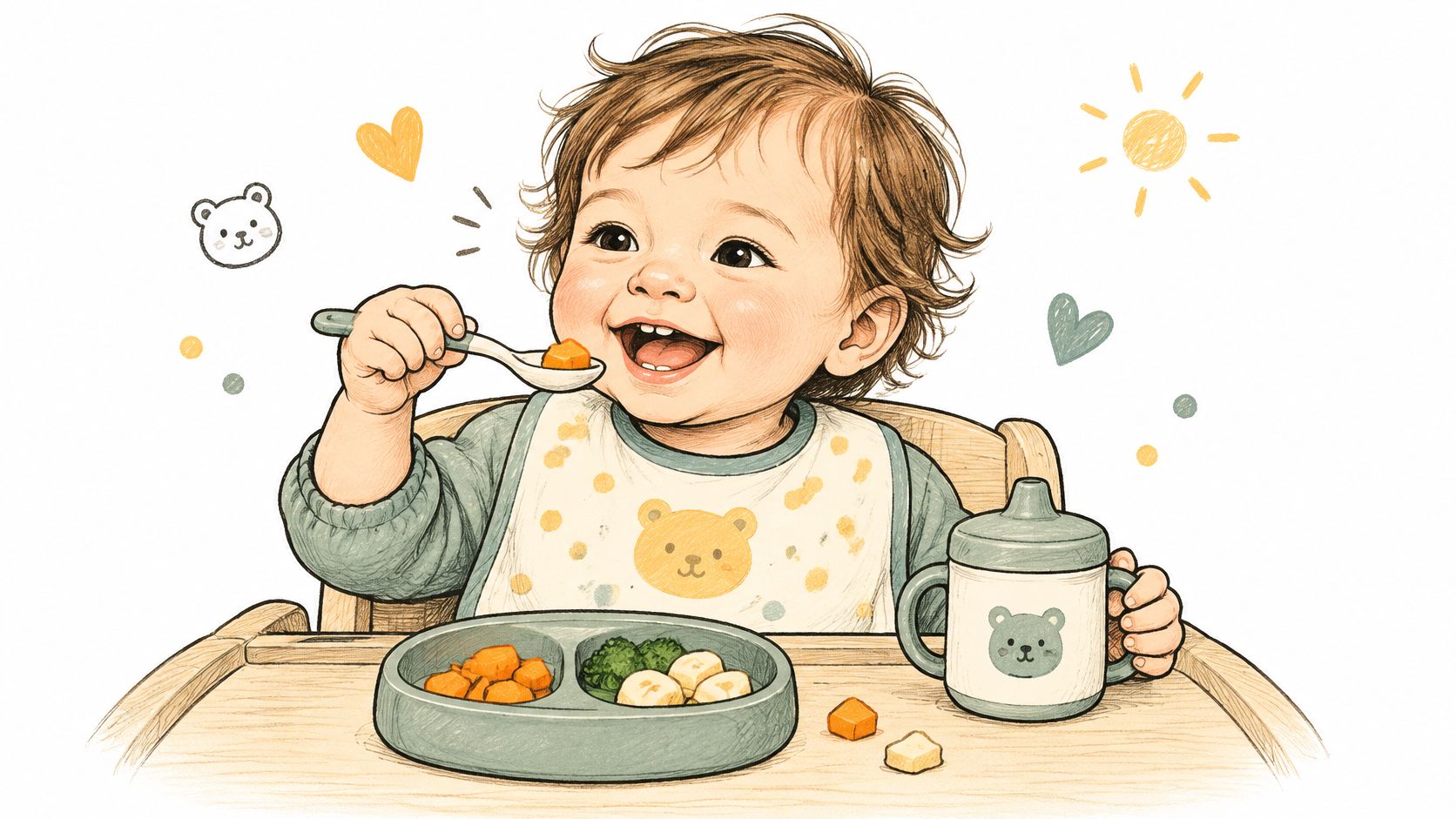
A 13-month-old with a spoon and a bowl of yogurt is a mess with a purpose. The spoon goes in, the yogurt goes sideways, most of it reaches her cheek, and she wants to try again.
Independence at the table comes in bursts. One meal she insists on doing it alone. The next she wants you to load the spoon and hand it over. Both are fine, and both count as progress.
What a feeding routine looks like at 13 months
The general pattern shifts around this age. The WHO recommends offering complementary foods 3 to 4 times a day from 12 to 24 months, with 1 to 2 nutritious snacks as desired, and notes that by 12 months most children can eat the same types of foods as the rest of the family (WHO complementary feeding guidance). Breastfeeding can continue to 2 years or beyond.
- Offer a second spoon. One for her, one for you. It keeps the meal moving without a power struggle.
- Start with a small amount. A tablespoon of yogurt is easier to manage than a full bowl, and less dramatic when it lands on the floor.
- Log what was eaten, not just when. Solids and fluids in a shared log tell the daycare what lunch looked like, and tell you why she's ravenous at 4 p.m.
Choking, allergies, and growth questions belong with a pediatrician, and breastfeeding or formula questions with a lactation professional.
6. Is your toddler stacking blocks or dropping things over and over? Playful exploration is a sign of learning
Block in the bucket. Bucket tipped over. Blocks out. Repeat nine times.
That loop is the work. Two or three blocks stacked, an object posted into a container, a toy dropped from the high chair to see where it lands. Each repetition tests a small rule about how the world fits together.
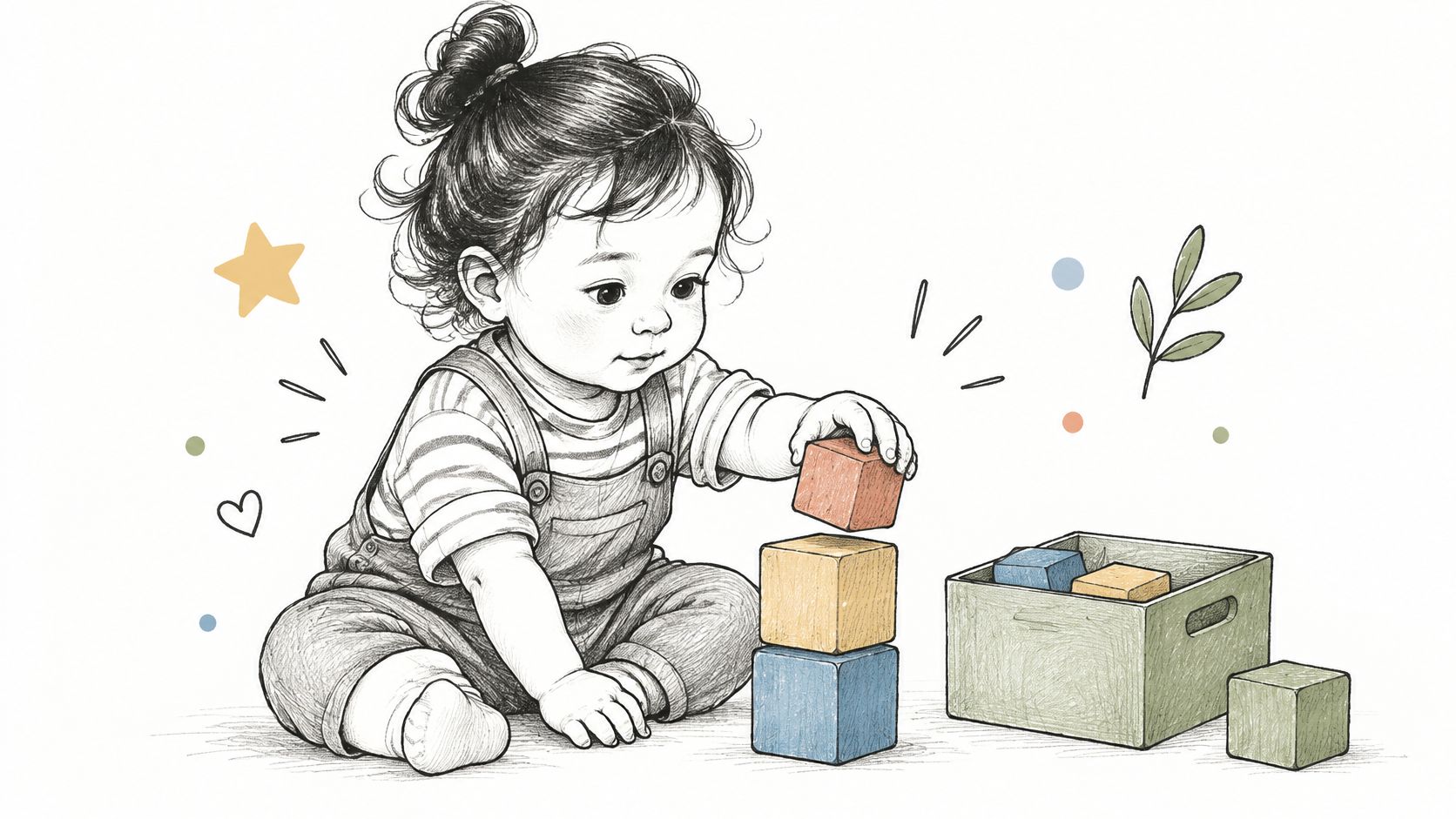
The dropping stage tests something else too. It tests you. A toddler learning cause and effect is also learning what happens to the adult across the room, and the reaction is half the fun.
- Give containers, not just toys. A clean plastic tub and four blocks outperform most battery-powered objects in the house.
- Let repetition stand. The tenth dump isn't a failure to learn. It is the learning.
- Write down the current favorite. "Stacked three blocks, knocked them down, laughed" tells the grandparent exactly what to try on Saturday afternoon.
If a toddler never reaches for, holds, or brings objects together, mention it at the next well-child visit rather than waiting.
7. Watching your toddler copy you with a phone or a broom? Imitation is a growing social skill
Phone to ear. "Hello?" A cloth wiped across the table. A wooden spoon stirring an empty pot on the floor.
Copying familiar actions is one of the quiet milestones, and families often miss it because it looks like ordinary life. It's also doing real work, linking memory, language, and social understanding. A toddler who copies your routine is storing a sequence and rehearsing it later.
Toddlers copy people they trust. That's why she imitates the nanny's sweeping and the grandparent's phone voice, and rarely performs on demand for a stranger in the grocery line.
What works better than a lesson: doing the real thing slowly, once, while your child watches, then leaving the tool within reach and walking away.
- Slow the model down. Wipe the table in three clear strokes, then hand over the cloth.
- Keep it real and safe. A wooden spoon, a dry cloth, an old remote with the batteries out. Purpose-built toy versions rarely get the same attention.
- Log the new imitation. "Brushed the doll's hair this morning" lets the nanny build the same game at nap time, with the same words.
8. Does your toddler look for toys that disappear under a blanket? Object permanence is developing
You hide a block under a towel while she watches. She pulls the towel off. Do it again and she's faster.
Object permanence, the understanding that something still exists when it's out of sight, is why the game becomes fun rather than confusing. Some toddlers dig for the toy immediately. Others give up after one attempt and wander off. Both responses sit inside the range at this age.
This skill feeds memory and early problem-solving, and it's the reason peekaboo stops being startling and starts being funny.
- Start with a partial hide. A block half under the towel is easier than one dropped into a closed box with a lid.
- Keep rounds short. Three or four searches, then move on before a game turns into a drill.
- Note the games that land. A game a toddler loves on Monday is worth repeating on Wednesday with whichever adult is on duty.
If your toddler never searches for a hidden object, or seems to lose all interest in things the moment they're out of sight, raise it with your pediatrician.
9. Is your toddler clingy with one caregiver but happy with others? Attachment and separation feelings are normal
The morning handoff is the hardest five minutes of the day. She clings to your leg, cries when you reach the door, then settles within minutes and has a perfectly good morning.
That pattern points to secure attachment, not to something going wrong. A strong preference for one or two trusted adults is typical at this age, and so is a meltdown when a familiar person leaves the room. The understanding that people come back is still under construction.
Goodbyes go better when they're short, warm, and predictable. A hug, a wave through the window, and the same words every time.
- Say when you'll be back in toddler terms. "After snack" lands better than "at 5:30."
- Share the comfort routine. The song, the blanket, the specific book. When every caregiver uses the same one, every transition gets shorter.
- Write two lines about how the handoff went. The caregiver who follows you gets the context, and you get the afternoon update instead of a mystery.
For more on how separation feelings show up at bedtime, this piece on toddler separation anxiety at bedtime is worth reading.
10. Wondering how to play peekaboo or wave bye-bye? Social games build turn-taking and connection
A blanket over your face, then down. Laugh. Again. Then she pulls the blanket over her own face and waits for you.
Peekaboo, pat-a-cake, waving bye-bye, rolling a ball back and forth. These games look like filler between meals and naps. They're early conversation: my turn, your turn, anticipation, payoff.
They also give a tired adult a way to connect in ninety seconds at the end of a long day, which counts for something on its own.
The game isn't the point. The pause is. Waiting for her to reach, laugh, or lift the blanket is what teaches the back-and-forth.
- Repeat the favorites. Novelty isn't the goal here. Mastery is, and mastery comes from the tenth round.
- Run the same game in every household. If grandma plays peekaboo on video calls, the nanny can play it at drop-off and the toddler recognizes the rhythm.
- Write the favorite down. "Cracks up at peekaboo with the blue towel" is the kind of note that makes a Saturday shift easier for everyone.
11. Is your toddler sitting down from standing without help? Balance and body control keep developing
You hear a thump from the play mat, then a laugh. She stood up, let go, and landed on her bottom.
Getting down from standing is a skill, and it's harder than getting up. Most toddlers drop rather than lower themselves at first. Over a few weeks you'll see her bend her knees, crouch to pick up a block, and stand back up without holding anything.
Changing direction, carrying a toy while walking, and stepping over a threshold all draw on the same control. These skills are refined through practice, not instruction, so a demonstration does more than a lecture.
- Give her a soft landing zone. A rug, a low mat, and clear floor space matter more than any piece of equipment you can buy.
- Stay close, not holding. A hand hovering near her back works better than a hand gripping her arm.
- Note the new move. "Crouched to pick up a block and stood back up, twice" is exactly the detail worth keeping, because it shows a direction of travel.
Frequent falls are expected at this stage. If movement looks painful, strongly uneven, or she struggles to bear weight, talk with your pediatrician.
12. Are your toddler's naps shifting and leaving you unsure what to expect? Sleep patterns change around this age
Some weeks the first nap is long and the second is a twenty-minute car nap. Then it flips. Then both shorten and bedtime moves earlier.
Nap timing and length often shift in the months after the first birthday. Some toddlers start consolidating toward one nap. Others still need two for a while longer. Dropping a nap because of a birthday rather than because of a pattern usually backfires, and the result is a toddler who's overtired at dinner and awake at 4 a.m.
A short record is the strongest tool here. Wake time, nap start and end, bedtime, and how the evening went. Four or five days of that shows a pattern no single adult can see alone.
- Keep the wind-down sequence identical. Bath, teeth, book, song. Same order, wherever she sleeps.
- Log naps in one place. When parents and daycare keep separate notes, the pattern disappears into two half-pictures.
- Ask about persistent changes. Ongoing night waking, a sudden refusal to settle, or loud snoring deserve a conversation with your pediatrician.
If bedtime has become a battle, this look at the 12 month sleep regression explains why the routine matters more than the clock.
13. Feeling unsure whether your toddler is on track? Keeping a simple milestone record helps you notice progress
Most of the anxiety around 13 month old milestones comes from the word itself, which sounds like a gate. The WHO's Multicentre Growth Reference Study describes population-based windows for six gross-motor skills, including standing alone and walking alone, rather than a single expected month for each one (WHO growth standards). Windows, not deadlines.
That's why a record of what you saw beats a yes/no column. "Stands independently for three seconds" and "takes four unaided steps" are the observations a clinician can use. A checkbox that says "walking: no" tells nobody anything.
When a concern is worth acting on sooner
There's a middle path between waiting until 18 months and worrying in silence. The AAP recommends general developmental screening at 9, 18, and 30 months, with autism screening at 18 and 24 months, and also recommends screening whenever a caregiver raises a concern (CDC guidance on developmental monitoring and screening). Thirteen months isn't a formal checkpoint. It also isn't a do-nothing stretch.
Escalation triggers worth acting on: losing a skill she already had, no communication gestures at all, several weeks with no progress in any area, or the same concern raised by both home and daycare.
- Write the behavior, the context, and the help given. Detail is what makes a note useful in a fifteen-minute appointment.
- Bring the record to the well-child visit. A short dated list is easier to discuss than a general worry.
- Keep one shared place. Grandparents, nannies, and daycare staff should all add to the same timeline, so nobody reconciles three versions of the same week.
Milestone Areas at a Glance
| Item | Developmental Area | Who Often Notices It | Easy Way to Support It |
|---|---|---|---|
| Walking and early movement | Gross motor | Parents, grandparents, and daycare staff | Make the space safe and note new movements |
| Pointing and gestures | Social communication | Parents, nannies, and other caregivers | Name what your child points to and respond warmly |
| First words | Language | Family members and daycare providers | Talk during routines and record new words |
| Following simple directions | Receptive language | Parents and nannies | Use short directions with gestures |
| Cup and spoon skills | Self-feeding and fine motor | Parents and daycare staff | Offer a spoon and small portions for practice |
| Stacking and exploring objects | Fine motor and problem-solving | Grandparents and daycare staff | Provide blocks and simple containers |
| Copying familiar actions | Social learning and imitation | Parents, partners, and nannies | Model simple actions and offer safe props |
| Looking for hidden toys | Memory and cognition | Parents and daycare providers | Play short, simple hiding games |
| Attachment and separation | Social-emotional development | Parents, nannies, and daycare staff | Use warm goodbyes and familiar comfort routines |
| Peekaboo and turn-taking | Social interaction | Family members and daycare staff | Repeat favorite games and take turns |
| Balance and body control | Gross motor | Parents and daycare teachers | Offer a safe space to practice moving |
| Changing naps and sleep routines | Sleep and daily rhythms | Parents, partners, and childcare providers | Keep a steady routine and track sleep patterns |
| Recording milestone progress | Developmental monitoring | Family and childcare caregivers | Keep brief, dated notes in one shared place |
Milestones Are a Shared Story, Not a Scorecard
Every toddler reaches these 13 month old milestones in their own order. One walks at 11 months and says three words at 20. Another talks early and cruises until 15 months. A few weeks of difference rarely tells you anything on its own, and a single missed skill is not a diagnosis. What does tell you something is the direction of travel across a month or two, and whether the same concern keeps resurfacing from different adults.
The habit that helps most is smaller than it sounds. Pick one thing this week. A new word, a new movement, a new game. Write it down with a date and one sentence of context. Then invite every adult who spends time with your child to add to the same place.
No single caregiver sees the whole picture. The grandparent sees the couch pull-up. The nanny hears the word at lunch. Daycare sees the block tower and the goodbye ritual at drop-off. When those observations live in three separate heads and one text thread, they turn into a debate about who's right. When they live in one timeline, they become a pattern you can read.
A few things make a record more useful and less stressful.
- Two or three entries a week is plenty. Milestone tracking isn't a daily performance review, and a sparse log with real detail beats a full one with "fine" in every field.
- Context beats counts. "Said agua, pointed at the cup, 7:15 a.m." is worth more than a tally of words.
- Date everything. A note without a date is a memory, and memories drift.
- Keep health questions separate from milestone notes. Weight, feeding, sleep, and growth belong in a conversation with your pediatrician, not in a comparison chart.
Bring the record to the next well-child visit. Ask what your pediatrician wants to see, and follow their guidance rather than anything you read online, including this.
If you want one shared place for that record, Cradlo is a shared baby and toddler tracker where each caregiver gets their own identity, so a nanny, a grandparent, and a daycare teacher can all add to the same log without sharing a password. Milestone notes sit alongside naps, feeds, and growth entries, which means the note about first steps lands next to the note about a short morning nap and the two finally explain each other. There's a 7-day free trial on the monthly plan, and no free plan.
For questions about development, your pediatrician is the right person to ask. Not an app, not a forum, and not the toddler at the next table.
Cradlo gives your whole care team one shared log, so the first steps your mother saw and the new word your nanny heard end up in the same timeline instead of three separate text threads. Milestones, naps, feeds, and growth entries sync as they happen, in English or Spanish, and daycare can join from a bookmarked browser link without installing anything. Start the 7-day free trial on the monthly plan at Cradlo and give every caregiver the same view of the same week.