A 4 Week Old Sleep Schedule That Actually Works
At 3:14 a.m., you're swaying in the hallway with your baby asleep on your shoulder. The fridge is covered in feeding notes, nap guesses, and half-finished reminders, yet none of it resembles the neat timetable in the baby book. You're tired, your partner is asking whether the baby already ate, and the phrase 4 week old sleep schedule is starting to feel like a test you're failing.
You're not failing. A four-week-old baby usually doesn't have a dependable clock-based routine yet. Sleep comes in frequent, irregular episodes, and feeding, settling, and waking can change from one stretch to the next. The useful plan is a responsive feed, awake, sleep rhythm that every caregiver can understand, not a promise that bedtime will happen at the same hour each night.
Table of Contents
- Why a 4 Week Old Sleep Schedule Is Not a Clock Schedule
- How Newborn Sleep Actually Works at 4 Weeks
- A Sample 24 Hour Feed Awake Sleep Day
- Safe Sleep Rules That Shape Every Nap and Night
- Sharing the Schedule Across Every Caregiver
- Troubleshooting Cluster Feeds Short Naps and Overtiredness
- Your First Week With the New Rhythm
Why a 4 Week Old Sleep Schedule Is Not a Clock Schedule
A fixed bedtime sounds reassuring. In practice, a four-week-old may be hungry, unsettled, sleepy, or wide awake at an entirely different time from yesterday. The American Academy of Pediatrics describes newborn sleep as a pattern that develops over time, not a routine that should be forced into place at a particular age. Its safe-sleep guidance is the firm foundation, while the timing remains flexible. Read the AAP's updated safe-sleep recommendations.
A better rhythm is simple:
- Feed responsively. Offer feeding according to your baby's cues and the guidance you've received from your pediatrician or lactation professional.
- Keep awake time gentle. A feed, diaper change, cuddling, brief conversation, or supervised floor time may be enough.
- Watch for settling cues. When your baby becomes drowsy or fussy, move toward sleep instead of extending awake time to reach a target hour.
- Record what happened. Note when sleep began, when it ended, when feeding occurred, and where the baby slept.
A wake period of roughly 45 to 60 minutes can be a useful starting point for many families, but it isn't a rule that overrides hunger, illness, prematurity, or your baby's cues. Some days the rhythm will hold together. Other days, a short nap will move the next feed earlier and the whole pattern will shift.
Practical rule: Use the clock to notice patterns, not to overrule the baby in front of you.
A shared notebook can do this job. So can a shared tracker, provided every caregiver records the start and end of sleep rather than entering an idealized timetable. This responsive newborn rhythm gives tired adults something practical to follow without turning an unpredictable day into a source of guilt.
How Newborn Sleep Actually Works at 4 Weeks
At four weeks, sleep is still organized into short, irregular episodes. Your baby may fall asleep after feeding, wake during a diaper change, settle in someone's arms, and then wake again soon after being placed down. That pattern doesn't mean you've created a bad habit. It reflects a newborn rhythm that is still maturing.
Research tracking infants from 4 to 18 weeks found substantial individual variation in sleep. Studies of babies aged 0 to 2 months reported mean total sleep values ranging from 12 to 16 hours in 24 hours, with wide variation around those averages. The same research found that parents could estimate sleep differently from actigraphy, which is another reason to treat a log as a record of patterns rather than a scorecard. Review the infant actigraphy research.
What day and night may look like
Nighttime may contain a longer stretch followed by several wake-ups for care. Daytime sleep may appear scattered across brief naps, contact naps, and repeated attempts to settle. A baby can seem to sleep constantly while still waking often enough to feed and need help returning to sleep.
Day-night confusion is also common at this stage. A newborn's internal timing is not yet reliably organized, so bright daytime activity and quiet nighttime care may support the gradual pattern without producing an immediate change.
Track the details that help another caregiver understand the day:
- Sleep: Start time, end time, location, and whether the baby was transferred to an approved sleep surface.
- Feeding: Time, feeding type, and any relevant note from the parent or lactation professional.
- Care: Diaper changes, soothing, pumping, and who provided each task.
- Cues: Calm, drowsy, fussy, difficult to settle, or unusually hard to wake.
The aim isn't to make every nap longer. It's to see repeated patterns across several days and respond to the baby you have today. These newborn wake-window notes can help you think in cues and sequences rather than treating a missed nap as a scheduling failure.
A Sample 24 Hour Feed Awake Sleep Day
A sample day can make the rhythm easier to picture, as long as you treat it as guidance rather than a timetable. Start with a morning wake and feed when your baby wakes, then allow a short period for a diaper change and gentle interaction. When drowsiness appears, begin settling.
The same sequence can repeat through the day. A baby may feed, spend a little time awake, and sleep again. Another baby may need a second feed before settling, especially during a fussy period. Neither pattern proves that the day is going wrong.
A flexible rhythm at a glance
| Time Window | Activity | Typical Length | Caregiver Cue |
|---|---|---|---|
| Morning | Wake, feed, diaper, quiet interaction | Brief awake period | Begin settling at early drowsy cues |
| Late morning | Sleep after feeding and care | Variable | Record the actual sleep start and end |
| Midday | Feed, change, cuddle, supervised awake time | Brief awake period | Keep stimulation gentle |
| Afternoon | Repeat feed, awake, sleep sequence | Variable | Let the previous nap shape the next period |
| Late afternoon | More frequent feeding and soothing may occur | Variable | Treat repeated feeding responsively |
| Evening | Dim lights, feed, calm routine, sleep attempt | Flexible | Keep the same safe sleep setup |
| Overnight | Waking for feeds and care | Irregular | Keep care quiet and record who responded |
A late-afternoon cluster-feeding period can make the day feel as if it has stopped following any pattern. Settle somewhere comfortable, keep the environment calm, and respond to feeding cues. Don't use sleep tracking to decide that your baby should wait for a planned feed, and don't assume frequent feeding alone proves that milk supply is inadequate. Questions about intake, weight, breastfeeding, pumping, or formula belong with a pediatrician or lactation professional.
What to write down
Record sleep onset, waking, feeds, diaper changes, and sleep location. Include contact naps and any sleep that begins in a car seat, then note whether the baby was moved to an approved surface. This gives the next caregiver enough context to continue care safely.
A calming evening routine can include a diaper change, feeding, a quiet song, and a transfer to the sleep space. It doesn't need to happen at a fixed hour, and a longer night stretch shouldn't be treated as a goal that replaces feeding guidance from your child's clinician.
Safe Sleep Rules That Shape Every Nap and Night
The rhythm can bend. The sleep environment can't.
The AAP recommends placing infants on their backs for every nap and nighttime sleep, on a firm, flat, noninclined surface with only a fitted sheet. Keep pillows, bumpers, blankets, stuffed toys, positioners, and other soft objects out of the sleep space. The recommendation applies to every caregiver, including parents, partners, grandparents, nannies, and daycare staff. See the AAP's safe-sleep guidance for families.
Room-sharing without bed-sharing is also recommended, ideally for at least the baby's first 6 months. Evidence cited in the AAP's policy states that room-sharing on a separate infant sleep surface can reduce sudden infant death syndrome risk by as much as 50%. That makes the bassinet or crib part of the plan, not an optional detail.
When sleep happens somewhere convenient
Contact naps may happen while an awake adult is actively watching. If the adult feels sleepy, the baby belongs on a separate approved sleep surface. A couch, armchair, or adult bed isn't a substitute for the bassinet or crib.
Car seats, strollers, swings, infant carriers, and slings are for their intended uses, not routine sleep. If your baby falls asleep in one, move the baby to a firm, flat sleep surface as soon as practical. Record the exception so the next caregiver knows what happened, but don't label it a normal nap location.
Swaddling doesn't reduce sudden infant death syndrome risk. If you swaddle, place the baby on the back and stop when there are signs of rolling, commonly around 3 months. Ask your pediatrician about changing the approach as your baby develops, and use the same agreed rules at home and in childcare.
Put these decisions on a one-page rule card. Include back sleeping, the approved sleep surface, the transfer plan, and the swaddling stop rule. The card helps a grandparent or daycare provider act consistently when everyone is tired.
Sharing the Schedule Across Every Caregiver
At 7 a.m., one caregiver opens the log and sees that another adult handled the overnight feed, a brief contact nap, and a diaper change. There's no need to reconstruct the night from whispered fragments or guess whether the baby woke before or after the feed. The record shows what happened, when it happened, and who entered it.
That continuity matters in households where care moves between partners, grandparents, nannies, and daycare. One person may notice that the baby was drowsy but didn't sleep. Another may see that the baby settled only after feeding. Both observations become useful when they're attached to the correct time and caregiver.
Make each handoff readable
Keep the shared language ordinary. A handoff might include:
- Last feed: When it happened and the feeding context.
- Last diaper: When it was changed and anything the caregiver needs to know.
- Awake period: Whether the baby has just woken or has been awake for a while.
- Mood: Calm, hungry, drowsy, fussy, or difficult to settle.
- Sleep safety: Where the baby slept and whether a transfer was completed.
- Question: A note to discuss with the pediatrician or lactation professional.
You don't need rigid jargon. A Spanish-speaking grandparent and an English-speaking nanny should be able to record the same event in clear language, with the family agreeing on a few shared labels. Privacy also deserves a place in the setup. Decide who can view entries, who can edit them, and how you'll mark a question that needs professional follow-up.

A shared baby diary can make fragmented care legible without asking every caregiver to be available at the same time. The important feature is not a perfect prediction. It's a trustworthy timeline that shows the actual sleep, feeds, care, and handoffs. A shared baby diary approach works just as well with a notebook, provided everyone uses it consistently.
Troubleshooting Cluster Feeds Short Naps and Overtiredness
Newborn disruptions are easier to handle when you separate observation from interpretation. A fussy evening doesn't automatically mean the routine is wrong. A short nap doesn't automatically mean your baby needs a stronger settling technique.
| Disruption | What It Looks Like | Adjustment Steps | Call the Pediatrician If |
|---|---|---|---|
| Cluster feeding | Repeated feeding and difficulty settling, often during a fussy part of the day | Respond to cues, keep the setting calm, and record the pattern | You're concerned about intake, weight, feeding difficulty, or unusual sleepiness |
| Short naps | Sleep ends soon after settling, followed by another tired period | Check whether the baby is still drowsy, keep the room calm, and offer another settling attempt | The pattern comes with poor feeding, breathing concerns, or a marked change from usual behavior |
| Overtiredness | Escalating fussiness, frantic movements, or difficulty calming | Start the next nap earlier and reduce stimulation | The baby is difficult to wake, seems unwell, or has concerning symptoms |
Cluster feeding
Repeated feeds can be normal newborn behavior. Don't turn a frequent-feeding evening into a judgment about supply or parenting. Offer responsive care and ask a lactation professional or pediatrician about intake concerns, weight, or feeding technique.
Short naps
A nap that ends quickly may be the end of one sleep episode. Pause long enough to observe whether your baby is awake, then try a calm resettle if the baby remains drowsy. Dim light, quiet voices, and a consistent transfer can help, but no technique works every time at this age.
Overtiredness
When fussiness rises, extending awake time usually makes settling harder. Lower the stimulation, return to the sleep space, and respond earlier at the next cycle rather than trying to force a longer period of alertness.
A difficult day calls for better observation, not a stricter schedule.
Contact the pediatrician promptly for unusual lethargy, breathing changes, fever, persistent vomiting, feeding concerns, or any behavior that seems markedly different from your baby's usual pattern. A tracker can organize observations, but it can't diagnose the cause.
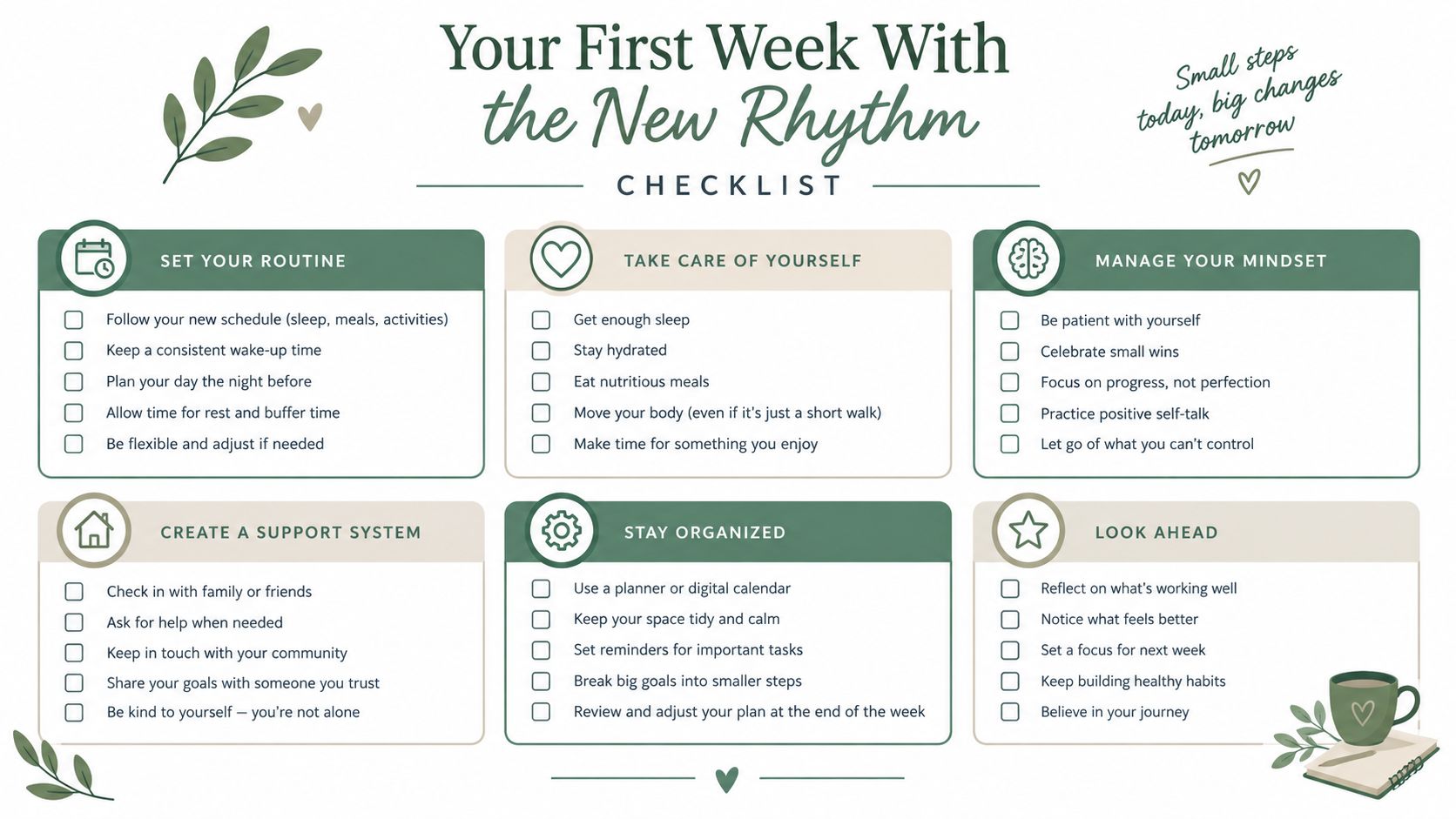
Your First Week With the New Rhythm
Start tonight with a plan that's small enough to use while tired.
- Print a rhythm card: Write feed, change, dim light, and down.
- Choose one log: Record the actual start and end of every sleep and feed.
- Name the caregiver: Add who noticed or completed each entry.
- Share the safe-sleep rules: Keep the card near the changing table and send it with the baby.
- Use cues first: Treat roughly 45 to 60 minutes as a flexible awake-time reference, not a deadline.
- Review patterns: Look across repeated days instead of judging one difficult night.
Ignore the neat clock times, comparisons with older babies, and pressure to produce a long overnight stretch. At four weeks, the useful milestone is continuity. Every caregiver should know what happened, where the baby slept, when the last feed occurred, and what the baby seemed to need next.
Call your pediatrician about fever, refusal to feed, concerning diaper changes, labored breathing, persistent vomiting, unusual lethargy, or an episode that looks like a seizure or apnea. Feeding and intake questions can also belong with a lactation professional. Keep the language flexible across English and Spanish so every caregiver can participate clearly.
Cradlo gives families, nannies, grandparents, and daycare one shared place to log sleep, feeds, diapers, pumping, and caregiver handoffs in real time, with a 7-day free trial on the monthly plan and no free plan. Start a shared care log with Cradlo so tonight's fragmented sleep becomes a clear record the whole team can use.