5 Month Old Daily Schedule: Naps, Feeds and Night Sleep
You're taking over after work, and your baby is rubbing their eyes. Your partner remembers a bottle, the nanny recorded a nap, and nobody's sure whether the afternoon sleep happened. You don't need a stricter timetable. You need a clear picture of the day so far.
A useful 5 month old daily schedule combines sleep ranges, responsive milk feeds, and a shared record. It gives parents, partners, grandparents, nannies, and daycare enough information to make the next decision without expecting every day to look alike.
Table of Contents
- Typical Sleep, Feeds and Awake Time at Five Months
- Reading Hunger Cues and Logging Milk Feeds
- A Flexible Sample 5 Month Old Daily Schedule
- Naps That Drift Off Track and How to Adjust
- When to Start Solids and How to Keep Milk First
- Share the Day Without Guessing
Typical Sleep, Feeds and Awake Time at Five Months
At five months, start with how much sleep the whole day holds, not whether the morning nap began at yesterday's minute. For infants aged 4 to 12 months, guidance endorsed by the American Academy of Pediatrics recommends 12 to 16 hours per 24-hour period, including naps, as summarized in the Thrive sleep guidelines.
That range is a reference, not a daily score. A longer night can balance a shorter nap day and still fit inside it. Some breastfed babies also wake overnight to feed. A shared record should separate time asleep from time spent feeding or settling, so the next caregiver does not treat a feed as a nap.
Typical daily measures at five months
| Daily measure | Typical range | What to log |
|---|---|---|
| Sleep per 24 hours | 12 to 16 hours, including naps | Rolling 24-hour total |
| Daytime sleep | Spread across several naps | Each nap start and end time |
| Milk feeds per day | Repeated through the day, paced by hunger rather than a fixed count | Start time, side or bottle, cues seen |
| Amount per feeding | Bottle or pumped milk by the volume taken; direct nursing by the session itself | Volume when measured, or duration and side |
| Awake time | Short stretches between sleeps, guided by cues | Time from each wake to the next sleep |
| Solid foods | Not a daily slot yet; milk stays first until solids are appropriate | Readiness signs only |
Those milk notes describe what to write down. They are not a cap on nursing sessions or a reason to finish a bottle.
Track awake time without chasing a target
An awake stretch starts when your baby wakes and ends when they fall asleep again. Feeding, diaper changes, play, and settling all sit inside that stretch. Looking away, losing interest in a toy, or growing fussy often means rest is closer than the clock says.
A wake window calculator can sketch a likely next window. Compare that suggestion with this baby's cues before you offer sleep.
Handoff check: Review the sleep total and how regularly milk feeds happened, then notice satisfaction, mood, and this baby's usual pattern. One imperfect day does not rewrite the routine.
Growth and feeding questions belong with your pediatrician or lactation professional, not with a schedule score.
Reading Hunger Cues and Logging Milk Feeds
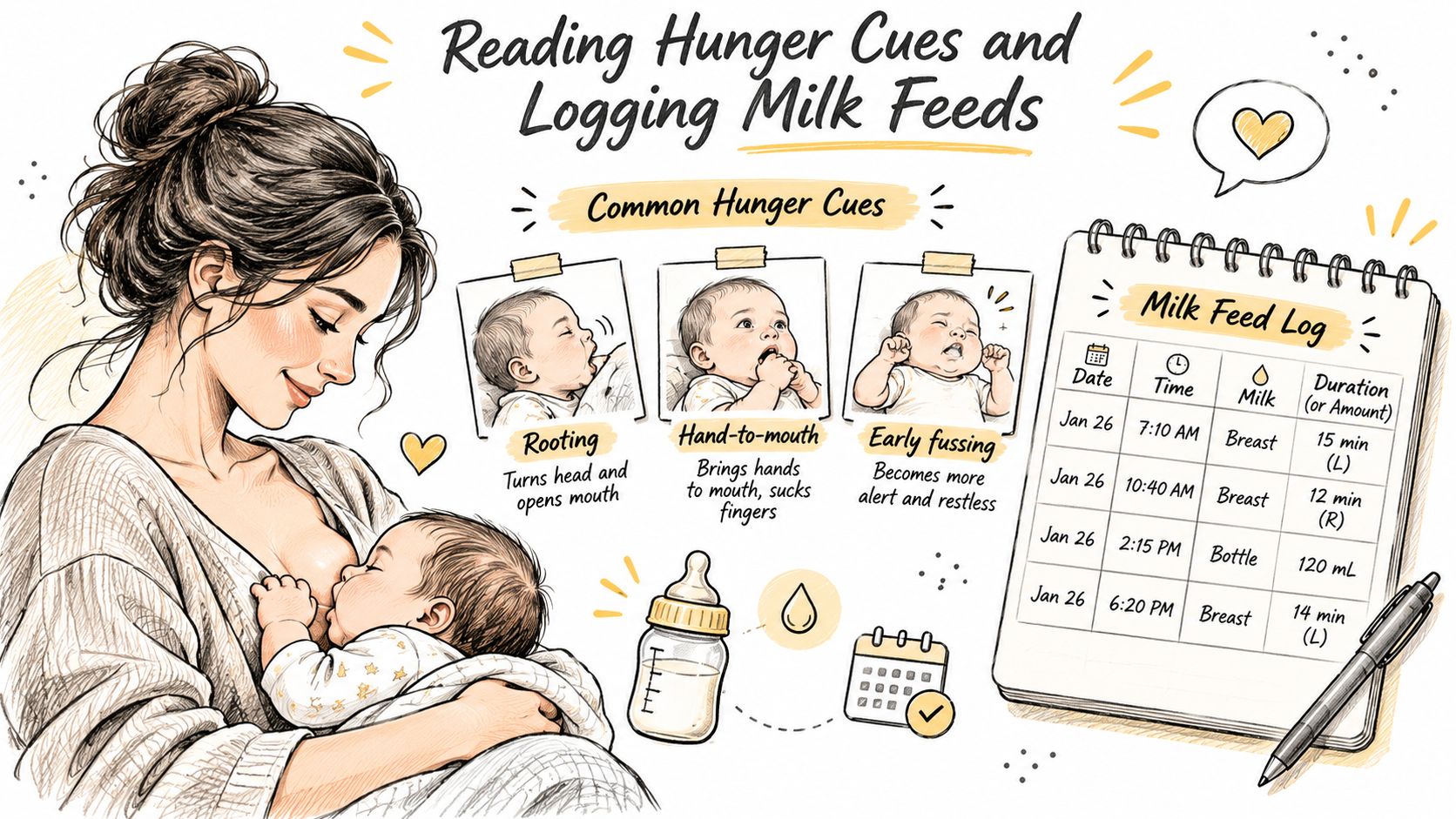
Milk feeds give the day its practical rhythm, but the clock shouldn't decide whether your baby is hungry. For babies around 5 to 6 months, Missouri's early-childhood feeding guidance describes about 4 to 6 milk feedings daily, with approximately 4 to 7 ounces per feeding when measured.
Treat those figures as context, not a prescription. Direct breastfeeding doesn't produce a visible ounce count, and session length alone doesn't establish intake. Responsive cues and growth matter more than making each entry match a bottle range.
Record what the next caregiver needs
Keep entries short enough that everyone can use the same format:
- Start time: Record when feeding began, rather than when someone entered it later.
- Feed type: Note direct breastfeeding, expressed milk, or formula.
- Side or bottle: Include breast side when useful, or bottle volume taken.
- Duration or volume: Record what you know without converting breastfeeding minutes into ounces.
- Before and after: Describe hunger cues, fullness cues, and whether the baby settled.
Rooting and hand-to-mouth movements can signal hunger, though context matters. After feeding, a baby may appear relaxed and calm; turning away can indicate they've had enough. Describe what you observed rather than assigning a judgment such as a good or bad feed.
A nanny's note that the baby turned away with milk remaining tells a grandparent more than an unfinished bottle entry alone. Consistent wording also helps distinguish a change in appetite from a missing record.
A blank feed entry means the record needs checking. It doesn't prove the baby went without milk.
Ask the caregiver who was present before adjusting the plan. If you're concerned about intake, feeding comfort, or growth, contact your pediatrician or lactation professional rather than changing amounts based only on a gap in the log.
A Flexible Sample 5 Month Old Daily Schedule
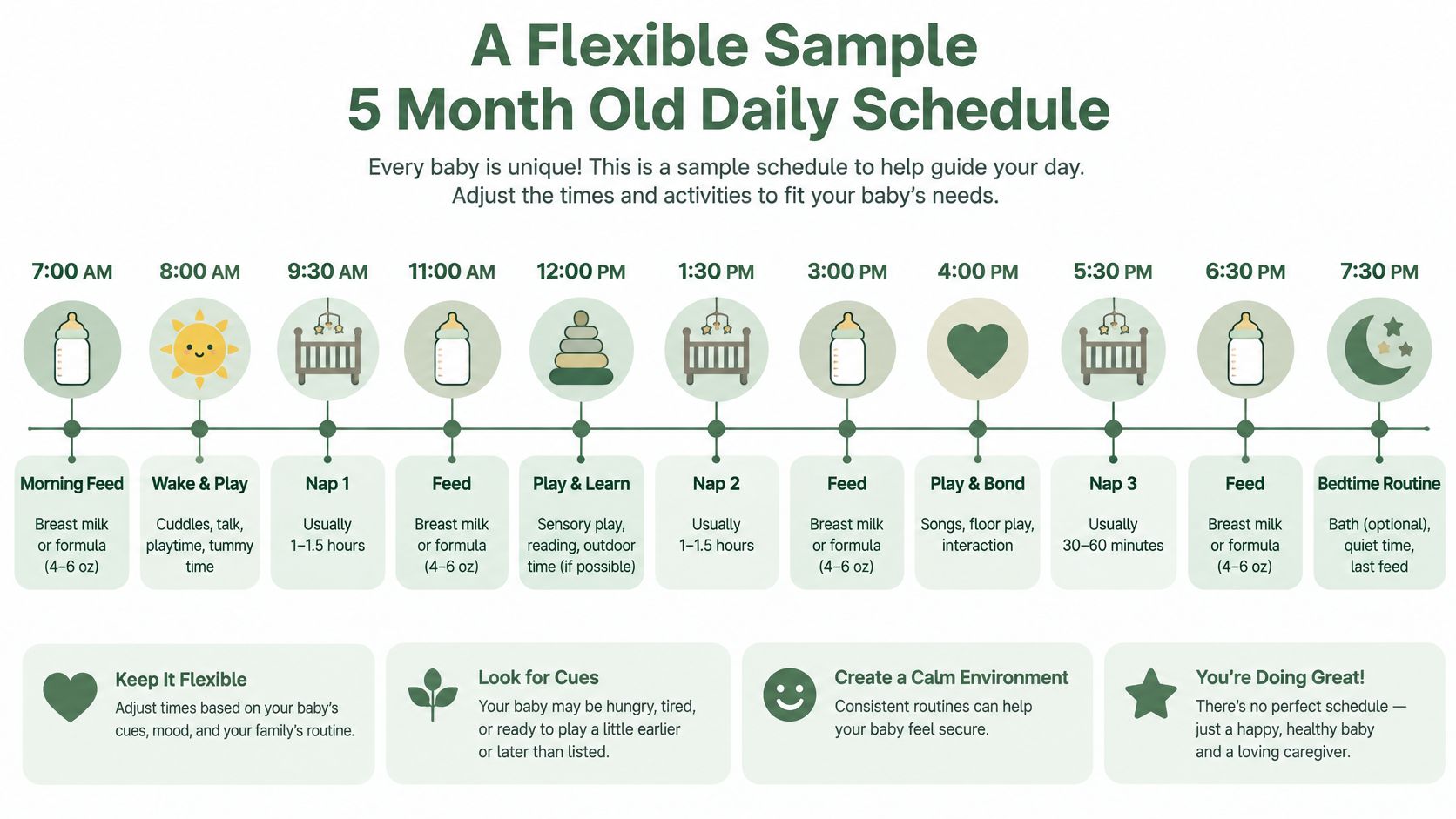
Use this hypothetical sample day as a sequence you can bend, not a set of medically recommended clock times. If your baby wakes earlier, needs milk between listed events, or becomes tired before the suggested nap, respond to that need.
The feed rows are anchors, not a complete feeding prescription. Offer and record additional milk feeds according to your baby's cues and individualized professional guidance.
Sample day timeline for a 5-month-old
| Time | Typical event | Flexible note |
|---|---|---|
| 6:30 to 7:30 a.m. | Wake and first milk feed | Anchor the day to the first wake, not the clock |
| Late morning | Morning nap | Start it when tired signs appear, even if that means earlier |
| 11:30 a.m. to 12:30 p.m. | Midday milk feed and nap | Shift the nap if the morning ran long |
| 3:00 to 4:00 p.m. | Shorter afternoon nap | Keep it short enough to protect bedtime, without automatically cutting needed rest |
| 5:30 to 6:30 p.m. | Milk feed and wind-down | Low light, quiet, same sequence each night |
| About 7:00 p.m. | Bedtime | Set by the log and cues, not the calendar |
| Overnight | Feeds as needed | Log each feed and whether the baby settled |
The illustration offers another way to picture the sequence.
Keep the order familiar, not the minutes
Begin with the actual morning wake. After milk and a diaper change, leave room for comfortable interaction, such as talking, supervised floor play, or looking at a book together. Don't stretch wakefulness just to reach the next table row.
Keep the bedtime sequence recognizable even when its start shifts. A feed, diaper change, quiet song, and familiar settling routine can remain in the same order without happening at an identical time.
For a working parent, the most useful daycare update is often the last nap's actual end time. That lets the evening caregiver judge whether the baby needs a quieter afternoon or an earlier wind-down instead of trying to reproduce the planned schedule.
Look for a workable overall pattern: your baby appears refreshed after some sleep periods, bedtime feels manageable, and the total sleep fits their needs. An occasional short nap or unsettled evening doesn't mean the routine has failed.
Naps That Drift Off Track and How to Adjust
A drifting day often shows up as a timing mismatch: a nap ends earlier than expected, the next sleep opportunity comes too late, or bedtime keeps moving back. Start by checking what happened before deciding why.
The patterns below are possibilities to investigate, not diagnoses. A short nap alone can't tell you whether hunger, tiredness, surroundings, or another factor was responsible.
Nap and night patterns, likely causes and adjustments
| Pattern | Likely cause to check | Adjustment to try |
|---|---|---|
| Short naps | Missed tired cues or awake time that ran long | Offer the next nap earlier and log the tired signs |
| Early-morning waking | Bedtime or last nap ran late | Try a slightly earlier bedtime for a few days |
| Crankiness before bed | Overtiredness around a delayed afternoon nap | Move the afternoon nap earlier; consider its length only in context |
| More night waking than usual | Hunger, a nap shift, or a possible growth-related change | Log feeds and naps, then raise it with the pediatrician if it persists |
| Nap skipped at daycare | Transition or handoff gap | Share the logged wake time with daycare before the next nap |
Change a small part of the routine
Check the last confirmed wake time, then compare the following awake stretch with days that felt easier. If tired signs appeared before the nap attempt, offer the next sleep a few minutes earlier rather than making a large schedule change.
Keep the settling sequence familiar while testing the timing. As a practical observation exercise, note the result for three days before changing again, unless your baby's needs or a health concern call for a different response. This isn't a clinical waiting period.
Say a nanny records a brief morning nap that ends early. The afternoon caregiver offers sleep earlier when tired signs appear, rather than keeping the baby awake until the original slot. Bedtime can stay near its usual place if the baby is comfortable, but it needn't be protected at the expense of obvious fatigue.
A daycare transition creates a different question. First establish whether sleep was skipped or unrecorded, then adapt the evening to the confirmed wake time.
Keep the conclusion modest: A log can reveal that a timing change helped. It can't establish the medical reason for waking.
Persistent night waking, feeding concerns, or unusual sleepiness belong with a pediatrician. A schedule supports rest; it doesn't diagnose a problem.
When to Start Solids and How to Keep Milk First
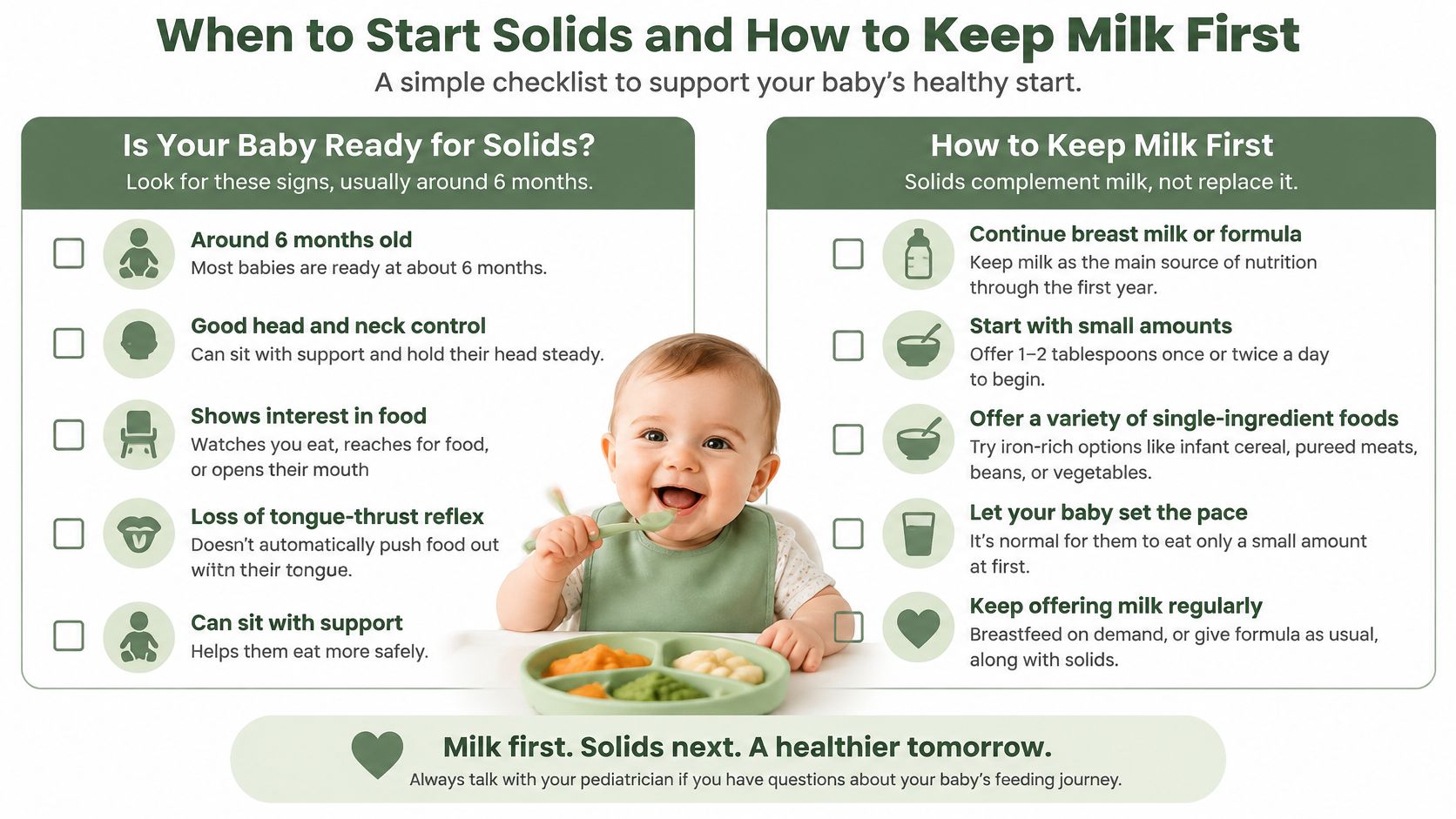
Reaching this age doesn't automatically create a breakfast slot. The World Health Organization's complementary-feeding guidance recommends exclusive breastfeeding for the first six months, with complementary foods generally beginning around six months while milk feeding continues.
For a formula-feeding or combination-feeding household, the practical scheduling principle is still milk first. Don't replace a regular milk feed with cereal or purée because a sample routine includes a meal heading. Ask your pediatrician about your baby's individual transition.
Observe readiness without creating a deadline
Notice supported sitting, interest in family meals, and developing ability to accept food from a spoon when introduction is appropriate. Missouri's guidance also identifies reduced gagging and early chewing movements as developments to discuss. These observations aren't a home test that independently clears a baby for solids.
A baby can join family meals without tasting food as a required daily task. Use an age-appropriate seat according to its instructions, supervise closely, and focus on participation rather than intake.
- Keep milk visible: Continue recording the feeds that form the baby's current routine.
- Note observations: Record interest and developing skills without labeling the baby ready.
- Agree on a boundary: Make sure relatives, the nanny, and daycare know whether any food has been approved.
- Ask before introducing: Discuss timing and suitable first foods with the pediatrician.
If a grandparent wants to offer cereal, a calm response can be specific: you're continuing the current milk routine and will share the agreed food plan after discussing it with the pediatrician. Nobody needs to defend the decision using a timetable.
The baby feeding chart for solids can help organize later planning. Individualized clinician advice takes priority over any general schedule, and a single interested afternoon at the table doesn't settle readiness.
Share the Day Without Guessing
The parent walks in at 5:30 with the baby on one hip and three texts from earlier still unread. A useful handoff is short enough to scan while holding the baby. Start with confirmed events, then leave uncertainty visible instead of smoothing it into a tidy story.
The handoff brief
| Item | What the incoming caregiver needs |
|---|---|
| Last confirmed milk feed | Start time, who fed, breast side or bottle, and relevant cues |
| Last confirmed sleep | Actual start and end, plus whether settling was difficult |
| Diaper status | Last recorded change and anything needing follow-up |
| Still unknown | Missing entries, unconfirmed details, and who can clarify them |
A precise but false timestamp can lead someone to delay a feed or shift a nap for no reason. Unknown is useful information when the alternative is a guess. At five months, milk still sets the day, so the brief names the last real milk feed before anyone discusses other food.
Reconcile the gap before rewriting the evening
Say a parent comes home and sees a recorded nap but no afternoon feed. The first step is to read the timeline and ask the nanny who was present, rather than treating a blank row as a missed bottle.
If the nanny confirms that a bottle happened but cannot remember the exact time, keep that distinction: feeding confirmed, timing approximate. If nobody can confirm it, leave the event unresolved and respond to the baby's current cues instead of calculating from an invented timestamp.
Each handoff should answer these questions:
- Who last fed the baby? Identify the caregiver, not just the event.
- When did the baby last sleep? Use actual sleep, not the planned nap.
- What needs watching tonight? Name the specific issue, such as an unsettled feed or an unusually fragmented nap day.
For sleep records, agree whether everyone logs attempts separately from actual sleep. A note about nap hours is more useful when caregivers use the same meaning for start and end.
Set up the shared record together
Choose one caregiver to start the log, then invite the partner, grandparent, nanny, or daycare individually so each person has a separate identity. Enter one sleep and one milk feed that same day while the details are still fresh. Agree on a short note format instead of expecting each person to write a diary.
Families who prefer Spanish can share a few terms, such as dormir for sleep and comer for feeding. At this age, the feeding entry means milk. Keep those labels clear for everyone who will open the timeline.
Cradlo is a shared baby and child care tracker for families with children from newborn through age 5. Parents and invited caregivers log sleep, feeds, diapers, growth, and health events. Every feed, nap, and diaper logged by any caregiver shows up instantly for everyone. Daycare bookmarks one browser link on an iPad, with no app install and no login, and those logs reach the parent's phone in real time. The AI coach drafts daycare summaries, predicts nap windows, and fills gaps when a caregiver forgets to log. We offer a 7-day free trial, then Plus at $4.99/month or $49.99/year, or Lifetime at $99.99 one time.
Treat filled gaps and predicted windows as suggestions to check, not proof that care happened. The person who was there remains the best source, and uncertainty stays visible until it is resolved.
Bring the shared record to a pediatrician visit when sleep or feeding raises health questions. A lactation professional can help with breastfeeding concerns. For today, the concrete step is smaller: start the log together and record the next actual feed and sleep.
Cradlo helps parents and caregivers keep feeds, naps, and diapers in the same shared timeline, so the next person does not have to reconstruct the day. Visit Cradlo, invite your baby's caregivers, and begin with the next confirmed milk feed or nap.