Average Weight for 16 Month Old: What to Know
At 16 months, the median weight is about 10.5 kg (23.2 lb) for boys and 9.8 kg (21.6 lb) for girls. A child can also be perfectly healthy at a weight well above or below those midpoints, with a broad normal range that can run from roughly 7.8 kg to 12.9 kg depending on sex and where that child has been tracking on their own curve.
That's the part many worried caregivers need to hear first. You go to a well visit, your toddler steps on the scale for half a second, and suddenly one number seems to carry a lot of emotional weight. Parents compare to cousins. Grandparents remember what older siblings weighed. A nanny or daycare provider may mention appetite changes. In Spanish-speaking families, you may even hear loving comments like “come bien” or “está flaquito,” which can add another layer of concern even when everyone means well.
The reassuring truth is that growth charts were never meant to give your child one number to “hit.” They work better as maps. They help your pediatrician see whether your child is growing along a pattern that fits their own body, timing, and development.
Table of Contents
- The Checkup Moment That Makes Parents Pause
- Typical Weight Ranges at 16 Months
- How Growth Charts Actually Work
- What Dropping or Rising Percentiles Really Mean
- Factors That Influence Weight at This Age
- When to Talk to the Pediatrician
- Practical Next Steps for Tracking Growth
The Checkup Moment That Makes Parents Pause
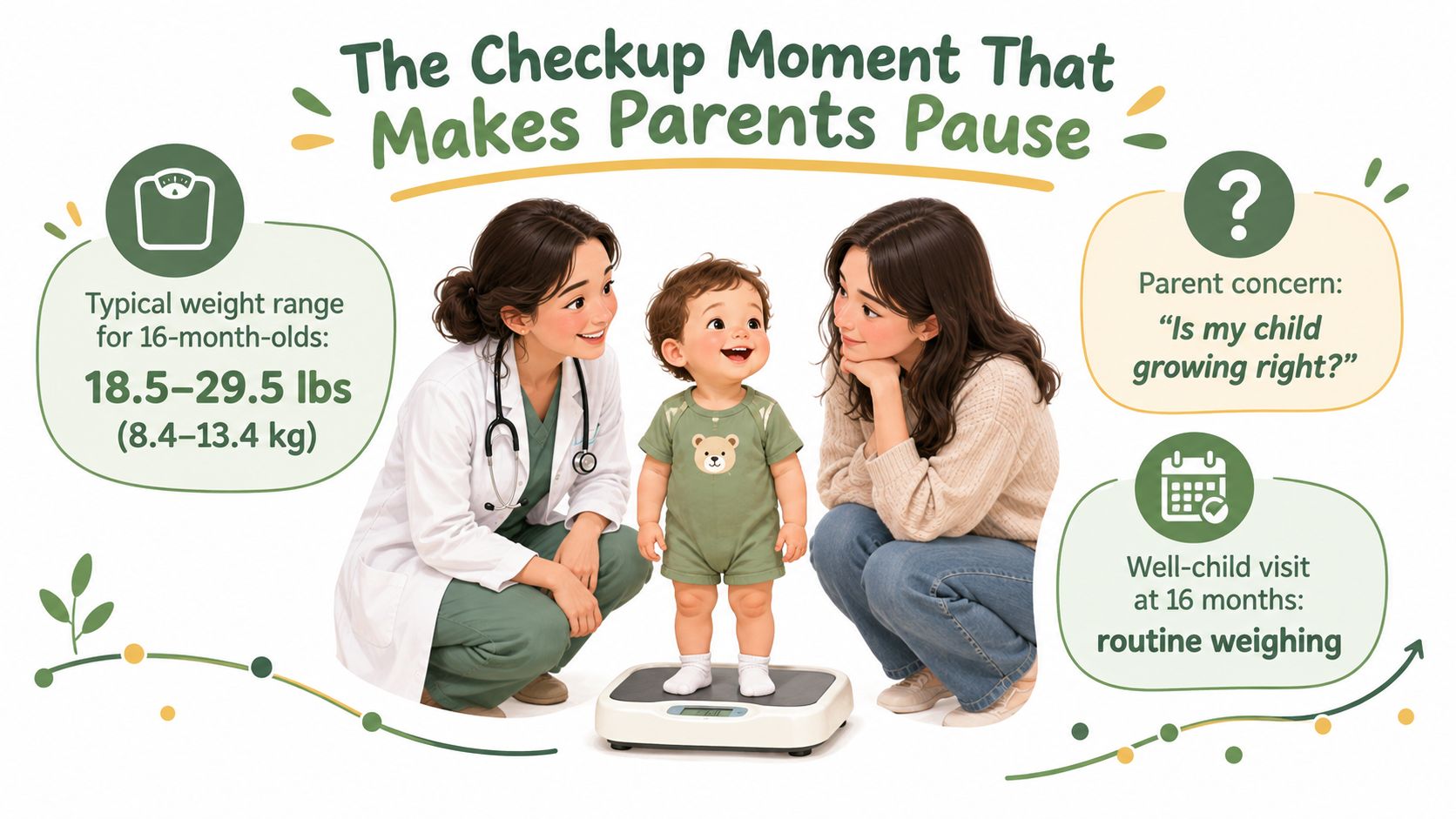
The room is quiet for a minute. Your 16-month-old is wiggling, maybe trying to grab the paper on the exam table, and the nurse writes down the weight. Then comes the pause. You look at the number. Maybe you try to remember the last one. Maybe you wonder if your child should weigh more by now.
That reaction is common, and it doesn't mean you're overthinking. It means you care.
What's typical at this age
If you're searching for the average weight for 16 month old children, the clearest starting point is the midpoint on WHO-based charts. Widely used references place the median at about 10.5 kg for boys and 9.8 kg for girls, with common ranges around 8.5 to 12.9 kg for boys and 7.8 to 12.5 kg for girls depending on percentile cutoffs, as summarized in this 16-month growth reference overview.
That spread can feel surprisingly wide. It's supposed to be.
Children don't all grow with the same body build, appetite, or pace. One toddler may be solid and stocky. Another may be long, active, and lighter. Both can be doing well. The scale gives one piece of the picture, not the whole story.
Growth is easier to understand when you ask, “Has my child been following their usual path?” instead of “Does this number match someone else's child?”
Why the number can stir up so much worry
At 16 months, many toddlers are walking, climbing, refusing food one day, eating very well the next, and changing fast in ways that don't feel predictable. That makes a weight check feel bigger than it is.
A single appointment can also be a noisy moment. Shoes may or may not be off. A child may have just eaten, just had a diaper change, or be squirming all over the scale. That's one reason clinicians look for patterns across visits.
If your child's number didn't land where you expected, take a breath before you assign meaning to it. The chart works best over time. That's where it becomes useful instead of stressful.
Typical Weight Ranges at 16 Months
Most families feel calmer once they can see the range, not just the midpoint. The phrase “average” often makes it sound like there's one right answer. There isn't.
Median weights for boys and girls
WHO-based references list the 50th-percentile weight at 16 months as 10.5228 kg for boys and 9.8124 kg for girls in this percentile table. Another WHO-based calculator shows the same medians in rounded form as about 10.5 kg for boys and 9.8 kg for girls, or roughly 23.2 lb and 21.6 lb in this medical reference.
That difference between boys and girls matters because growth references are sex-specific. So if you're comparing your daughter's weight to a chart for boys, or your son's to a sibling of a different sex, the comparison may not be useful.
A wider normal range than many parents expect
Here's a simple way to look at it:
| Child | Midpoint at 16 months | Typical broader range |
|---|---|---|
| Boys | 10.5 kg | About 8.5 to 12.9 kg |
| Girls | 9.8 kg | About 7.8 to 12.5 kg |
Those broader ranges come from WHO-based references summarized in the earlier source and reflect why one toddler can look much smaller or larger than another and still fall within a normal growth pattern.
For boys specifically, WHO-based chart materials place the median near 10 kg, with about 11.8 kg around the 85th percentile and about 12.9 kg around the 97th percentile at 16 months, as described on the World Health Organization child growth standards page.
Practical rule: A weight that's different from the median isn't automatically a problem. The median is only the middle of the map, not the goal line.
Why the spread is built in
Growth charts include many healthy body types. A child with shorter parents may naturally sit lower on the chart. A child from a family with larger builds may sit higher. Some toddlers also gain in little bursts rather than in a smooth, steady pattern that parents can easily spot week to week.
That's why “typical” should never feel like “identical.” A broad range at this age is normal by design.
How Growth Charts Actually Work
Growth charts get treated like report cards, but they work more like road maps. They don't tell you whether your child is “good” at growing. They show where one measurement falls compared with children of the same age and sex, and then they let clinicians watch the path over time.
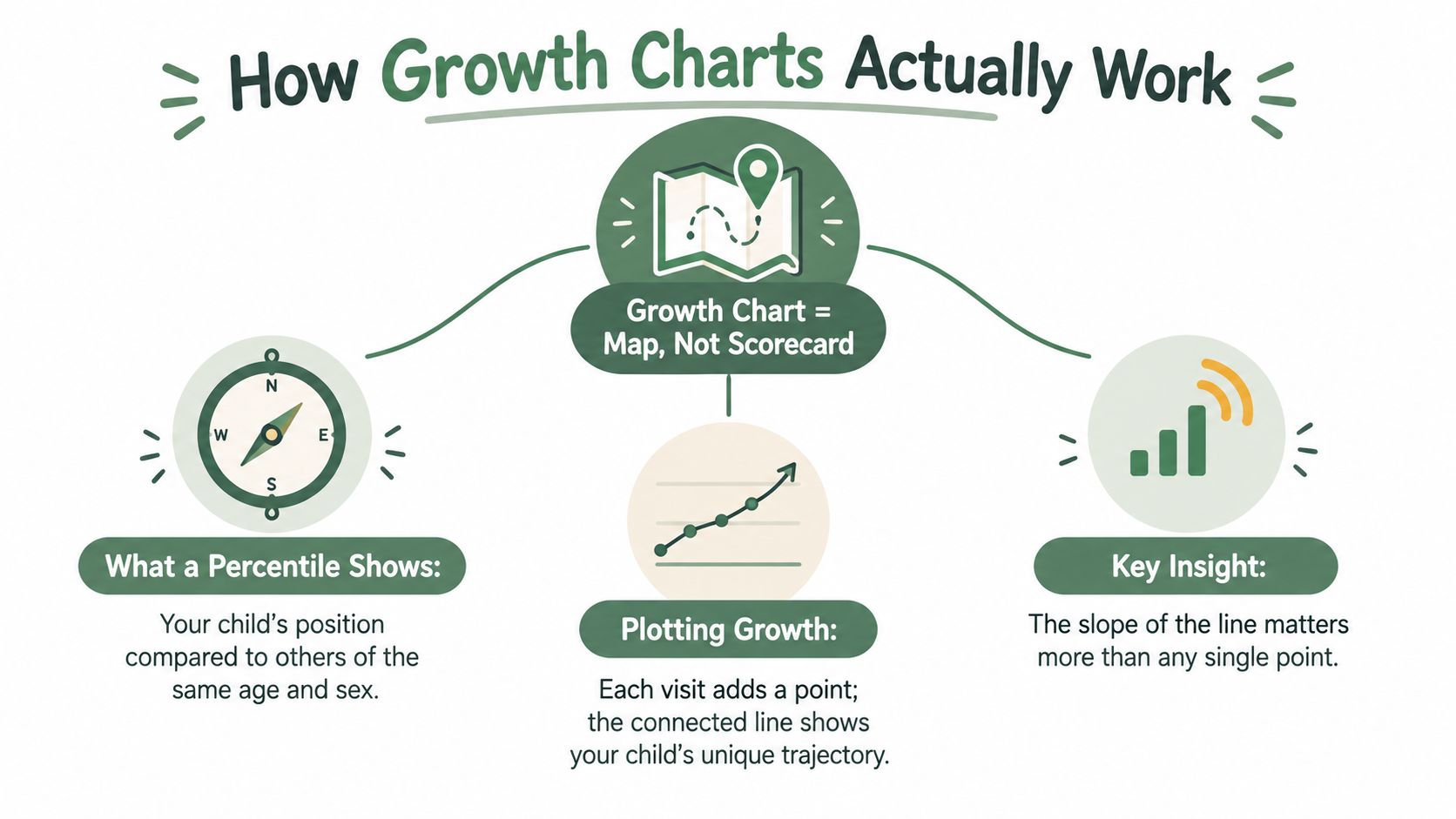
What a percentile really means
The CDC describes growth charts as percentile curves that show the distribution of body measurements in children, and its WHO-based resources include weight-for-age charts covering birth to 24 months, which is the exact age range for a 16-month-old, on the CDC growth charts overview.
So when a pediatrician says your child is at a certain percentile, that percentile is describing position on a reference chart. It is not grading your parenting. It is not predicting your child's future. It is not telling you your toddler should move toward the middle.
Why these charts exist
The current global standard changed in 2006, when the World Health Organization published its Child Growth Standards based on healthy children raised in favorable conditions across multiple countries. That history matters because it shifted growth tracking toward a more globally relevant standard rather than one tied to a single country. You can see that framework on the WHO Child Growth Standards page.
The CDC later incorporated WHO-based charts for young children, which is why many pediatric practices use that approach in the first two years.
How to read your child's chart at a visit
If you've ever looked at the printout and felt like it was written in another language, this is the part to focus on:
- Find the right chart. Age and sex matter, so the chart has to match both.
- Locate the measurement. Your child's age goes on one axis and weight on the other.
- See where the point lands. That plotted point lines up with a percentile curve.
- Look backward, not just at today. The old points matter because they show direction.
- Ask about the shape of the line. That tells more than one isolated weight.
The most useful question in the room is often, “Does this point fit my child's pattern so far?”
Why trajectory matters more than a single point
For children under 2, clinicians don't use one fixed “ideal” weight. They look at whether growth is unfolding along a consistent track. The chart is doing its job when it helps your pediatrician notice patterns early, not when it pressures you to chase a single percentile.
That shift in mindset helps many caregivers relax. The chart isn't asking your toddler to become an average child. It's helping you understand the child you have.
What Dropping or Rising Percentiles Really Mean
Few phrases worry parents faster than “dropped on the curve.” It sounds final. It often isn't.
A percentile can move for ordinary reasons. Toddlers become more active. Appetite gets less predictable. Growth after the first year doesn't feel as rapid as it did in infancy. A child who has started walking, climbing, and running may not look the same on the chart as they did when they were a less mobile baby.
A lower percentile isn't automatically bad
Many parents hear “down” and think “danger.” But a lower percentile can mean your child's body is settling into its own pattern. The same is true in the other direction. A rise doesn't always mean overfeeding or a problem.
What matters is context. Was the previous measurement taken during an illness? Was today's weight hard to get because your toddler wouldn't stay still? Has eating changed because teething, travel, or a schedule shift threw everything off for a week or two?
If your child seems to eat less during bursts of development or after a recent appetite change, some families also find it helpful to understand how fast toddler phases can come and go. This short read on growth spurts around 3 weeks and how patterns can shift is about a younger age, but the broader idea still applies. Feeding and growth rarely move in a straight line.
What deserves a calm second look
These situations are worth bringing back to the pediatrician for interpretation:
- A clear pattern change: Several visits in a row suggest your child is no longer following their usual curve.
- More than the number changed: Weight shifts come with fatigue, feeding struggles, or other symptoms.
- The timing seems abrupt: A sudden change feels different from the slow settling that happens as toddlers become more active.
A percentile is a clue, not a conclusion.
Internet searches often turn a normal wobble into a frightening story. Your pediatrician has the full chart, your child's medical history, and the benefit of seeing the whole picture.
Factors That Influence Weight at This Age
At 16 months, weight reflects much more than how much a toddler ate yesterday. Build, movement, sleep, health, and family patterns all play a part. That's why two healthy children the same age can look very different.
Body type and family pattern
Some children are naturally lean. Some are naturally broader. Families usually recognize this once they step back and stop comparing cousins, classmates, or siblings with very different builds.
A toddler with a long, wiry frame may eat well and still stay light. Another child may have a compact body type and sit higher on the chart while being just as healthy.
Feeding rhythm and appetite swings
This age is full of mixed messages at the table. A child may love blueberries for three days and reject them on day four. They may eat a big breakfast and then pick at lunch. That unpredictability is frustrating, but it's also common.
A useful question isn't “Did my child eat enough at this one meal?” It's “How has eating looked across several days?” Families who worry that every extra snack is too much or every skipped lunch is too little may find it helpful to read common concerns about overfeeding a baby, then bring any feeding-specific concerns to a pediatrician or lactation professional.
Movement changes the picture
By 16 months, many toddlers are busy. They walk with purpose. They squat, climb, carry toys, and resist sitting still for long. That increased movement can change how weight gain looks over time.
A child who just discovered speed may not gain in the same way they did during a less active stage. That doesn't mean something has gone wrong. It often means development is doing what development does.
Sleep and general health matter too
Sleep supports growth, appetite regulation, and recovery. Illness can temporarily change eating, drinking, and weight trends. Teething can do the same for a short stretch. So can transitions like daycare, travel, or a new caregiver routine.
- Sleep pattern: Broken sleep can throw off meals and energy.
- Minor illness: Even a brief bug can affect appetite for several days.
- Routine changes: New schedules often lead to short-term feeding shifts.
- Caregiver differences: Parents, grandparents, nannies, and daycare may each notice different pieces of the same pattern.
Looking at weight alongside these factors usually gives a more realistic picture than the scale alone ever could.
When to Talk to the Pediatrician
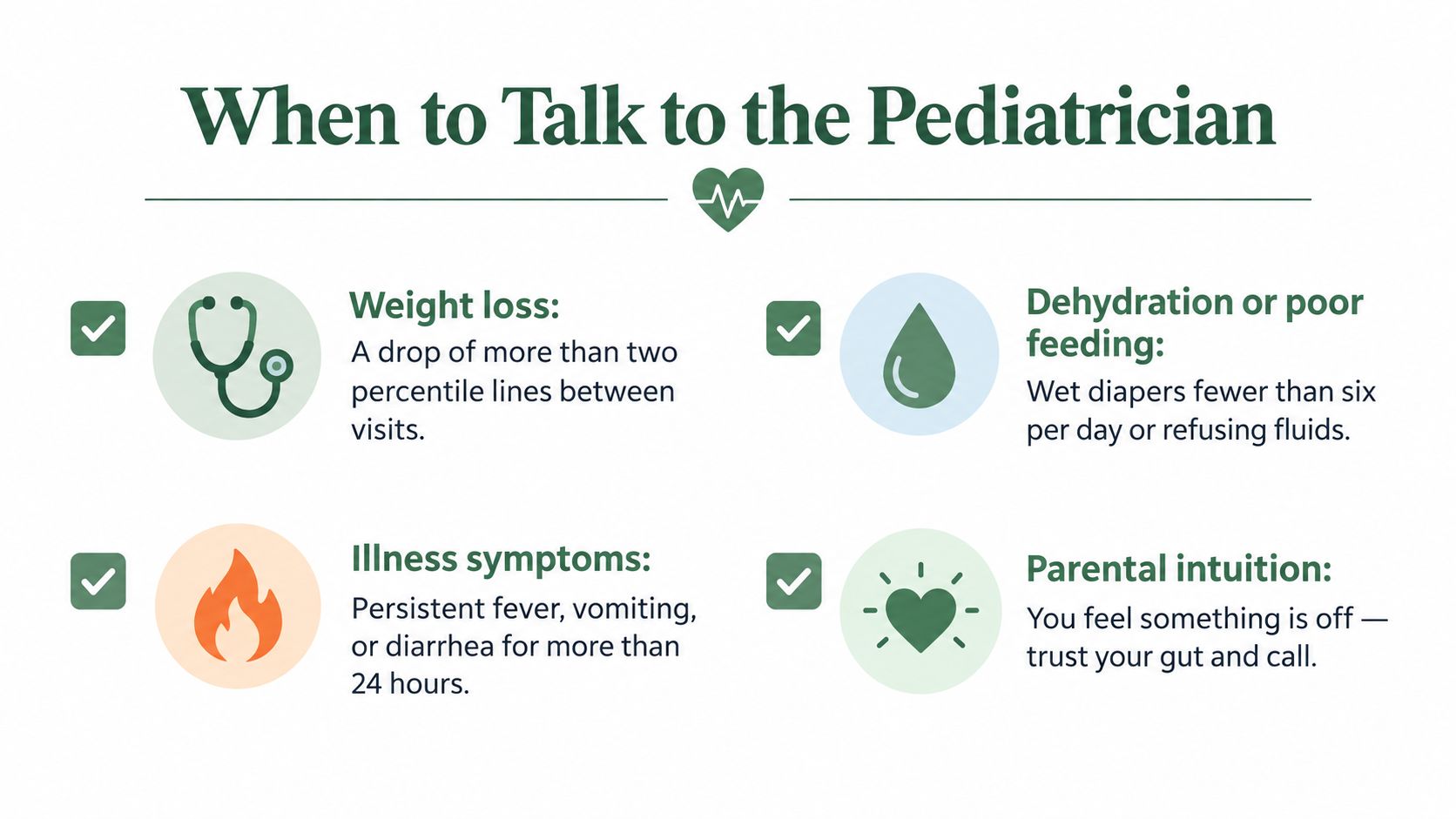
Most weight questions at 16 months don't need urgent action. They do deserve thoughtful attention when the pattern feels off or your child seems unwell. The goal isn't to panic early. It's to know when a calm phone call is the right next step.
Situations worth calling about
Clinical chart guidance emphasizes percentiles and trajectory rather than a single target, and notes that weights between the 3rd and 97th percentiles are typically considered within the normal WHO range for this kind of tracking, with the 50th percentile around 9.8 kg for girls and 10.5 kg for boys at 16 months on the CDC growth chart reference page. Even within that broad range, it's reasonable to contact your pediatrician if something changes sharply.
Consider reaching out if:
- Weight seems to be falling, not just fluctuating: especially after a period of steadier growth.
- Eating is consistently difficult: your child is refusing many foods or struggling to drink.
- You notice low energy or other symptoms: not just picky eating, but a child who seems unlike themselves.
- The chart pattern changes noticeably across visits: your pediatrician can tell you whether it fits your child's history.
What to bring to the conversation
You don't need a perfect spreadsheet. A few basic notes can help a lot.
- Recent weights or visit summaries: if you have them.
- A short feeding snapshot: what meals, snacks, and drinks have looked like lately.
- Sleep and illness notes: even a brief timeline helps.
- Questions from all caregivers: parents, partners, grandparents, nannies, and daycare may each notice different things.
If your instinct says something feels off, it's okay to call. You're not wasting anyone's time by asking a thoughtful question about your child.
A pediatrician or lactation professional is the right person to help interpret concerns. Online charts can inform the conversation, but they can't replace it.
Practical Next Steps for Tracking Growth
Once the initial anxiety settles, most families want a simple plan. Not a perfect plan. Just something that keeps everyone informed without turning growth into a daily stress project.
Keep the record simple
Start with the basics. Save weights from routine visits. Jot down a few notes about appetite, sleep, illness, and new skills. If your toddler suddenly starts walking everywhere, climbs nonstop, or cuts several teeth in a rough stretch, that context matters.
You don't need to weigh your child constantly at home. For many families, frequent home checks increase worry more than clarity. What helps more is having a consistent picture of what was happening around each measurement.
Get every caregiver on the same page
When several adults care for one child, information scatters fast. A parent may know sleep was rough. A grandparent may have noticed poor lunch intake. Daycare may have seen a very active morning and a better snack later.
That's where one shared record can lower stress. If you want something digital, Cradlo lets families, nannies, grandparents, and daycare log growth and daily care in one place, and you can also export records for a pediatrician visit when you want a cleaner conversation in the exam room.
Focus on patterns, not performance
A healthy tracking habit sounds like this:
- Notice trends: appetite, sleep, energy, and growth together.
- Use routine checkups well: bring observations, not just worries.
- Let the chart be a map: helpful for direction, not a score to chase.
The point isn't to produce an ideal number. It's to understand your child a little better, with less guesswork and less guilt.
If keeping growth notes across parents, partners, grandparents, nannies, and daycare feels messy, Cradlo gives everyone one shared tracker for feeds, sleep, growth, and daily care. It's available in English and Spanish, works across phone and web, and offers a 7-day free trial on the monthly plan if you want a calmer way to bring organized notes to your child's next checkup.