Baby Constipated After Starting Solids: What to Do
You've started offering purées, and now you're watching diapers more closely than the high-chair tray. Your baby seems to strain, the usual bowel movement hasn't arrived, and you're wondering whether dinner caused a problem. If you're searching for “baby constipated after starting solids,” the most useful place to begin is stool texture and your baby's comfort, not the calendar alone.
You haven't done something wrong by introducing food. A few clear observations can help you explain what's changed to your pediatrician, especially when parents, partners, grandparents, nannies, and daycare staff each see different parts of the day.
Table of Contents
- Normal Stool Changes Versus Real Constipation
- Foods and Fluids That Help Stools Soften
- How Can I Add New Foods Without Harder Stools
- What Gentle Home Measures Are Reasonable and What to Skip
- How Can Every Caregiver Read the Same Stool Record
- When to Call a Doctor Right Away
Normal Stool Changes Versus Real Constipation
It's the third day of purées. Your baby bears down, goes quiet, and seems to be concentrating. You're waiting to see whether a stool follows and wondering whether that effort means constipation.
A slower bowel schedule alone doesn't establish constipation. A baby passing soft stools comfortably presents a different picture from a baby passing dry pellets with obvious pain. Singapore's HealthHub guidance on infant constipation emphasizes that reduced frequency alone isn't enough to identify the problem.
Read the diaper and the behavior together
Use these descriptions to organize what you observe, rather than to diagnose your baby at home.
Stool and behaviour signs and what they can suggest
| Sign | What it can suggest |
|---|---|
| Fewer bowel movements, stools still soft and passed easily | Often a normal adjustment as solids begin |
| Hard, dry, pellet-like stools | A common sign of constipation after solids |
| Straining, distress or pain while passing stool | Can follow large or hard stools |
| Small streak of blood on the stool | May come from a small fissure caused by hard stool |
| Firm-feeling belly with reduced appetite | Can accompany constipation |
The distinction in the first row matters: less frequent isn't automatically harder to pass. By contrast, hard pellets and painful evacuation describe the stool itself and the difficulty involved. Straining needs context, including what eventually comes out and whether your baby seems distressed.
A small streak of blood can follow a tiny tear, called an anal fissure, after a hard stool. That's a possible explanation, not something caregivers should assume without medical guidance. A firm belly and reduced appetite also belong in the record rather than being dismissed as an ordinary feeding change.
Why the transition can affect stools
The NHS guidance on constipation and bottle-feeding describes hard, dry, lumpy stools and difficulty passing them, and explains how feeding changes and insufficient fluids can contribute.
As solids grow, a baby may take less milk. Early meals may also rely heavily on low-fiber refined cereals or processed foods, while a formula change may occur around the same time. Several changes can overlap, so it's rarely useful to blame the last spoonful.
Observation first: Describe what came out, how it passed, and how your baby behaved. A count alone leaves out the most useful details.
The pattern across days is more informative than an isolated diaper. Your pediatrician decides whether it represents constipation and whether treatment is needed.
Foods and Fluids That Help Stools Soften
Fiber works best alongside adequate fluid. Adding concentrated fiber without enough liquid can make hard stools worse, so food choices and hydration belong in the same conversation with your pediatrician. The National Institute of Diabetes and Digestive and Kidney Diseases nutrition guidance explains the connection between fiber and liquids.
For a baby already developmentally ready for solids, the discussion usually starts with suitable foods, manageable textures, and an age-appropriate fluid plan, not supplements.
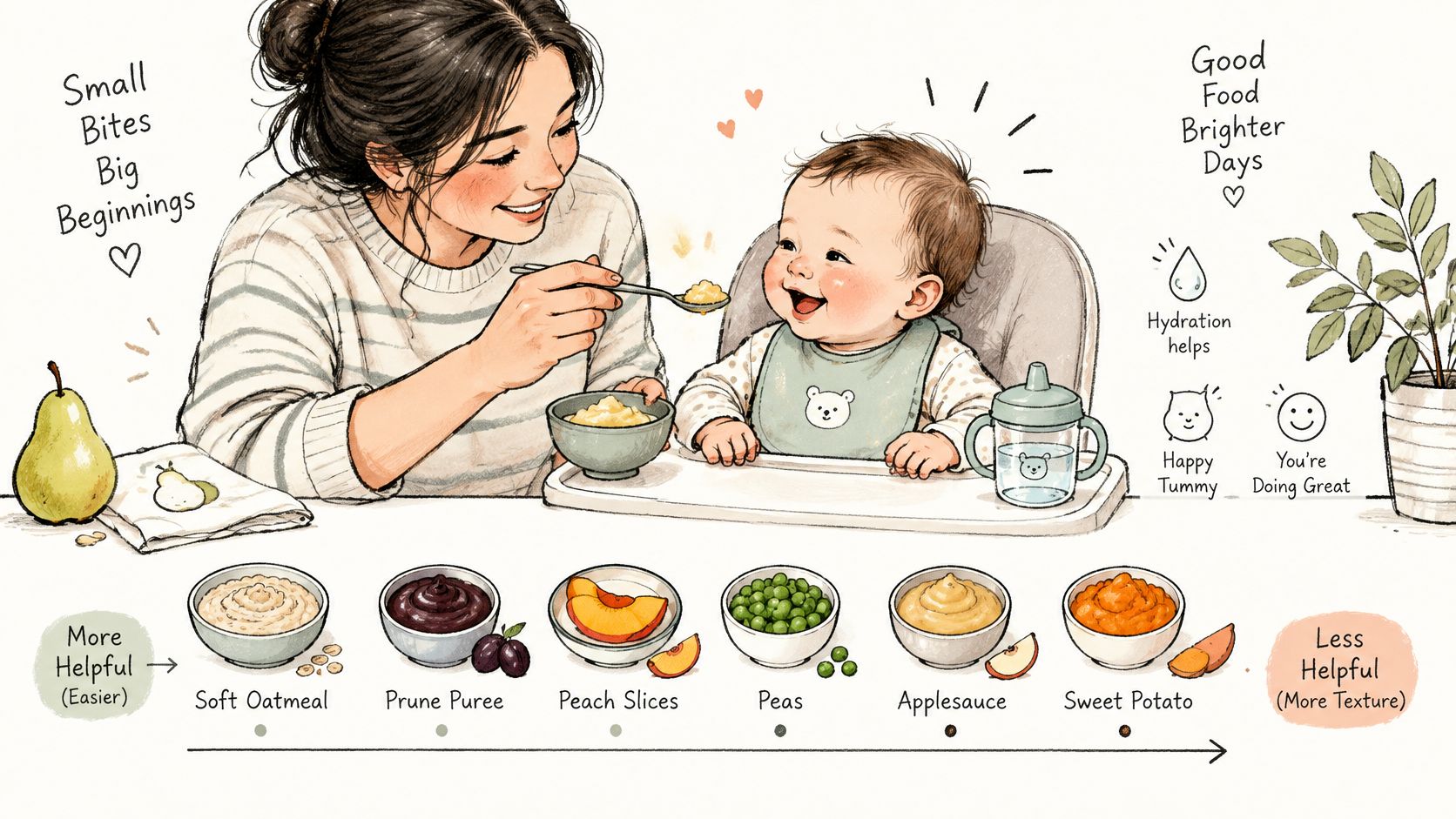
Food choices to discuss with your pediatrician
Pears and prunes contain sorbitol, which helps retain water in the intestine and can soften stools. Vegetables, legumes, and oatmeal offer food-based fiber without making fruit the whole menu.
Foods and drinks after starting solids
| Food or drink | Why it can help or what to watch | How to offer it |
|---|---|---|
| Puréed pear | Contains sorbitol, which holds water in the intestine and can soften stools | Smooth purée, offered with a meal |
| Puréed prune | Sorbitol-containing fruit with a similar softening effect | Smooth purée; ask the pediatrician before any prune juice |
| Soft cooked vegetables | Add fiber alongside fruit | Mash or purée to a texture the baby can manage |
| Well-cooked legumes | Provide food-based fiber | Soft, mashed, and cooked thoroughly |
| Oatmeal | A fiber-containing grain rather than a refined low-fiber cereal | Serve as a spoon food, never added to a bottle |
| Refined low-fiber cereal and processed foods | Heavy reliance on these can leave meals low in fiber | Discuss offering them less often |
| Juice | Not a universal first-line fix, and age-based advice differs | Ask the pediatrician before offering |
| Water | Supports hydration when offered as advised for the baby's age | Follow local pediatric guidance |
These are options for a feeding conversation, not a prescribed constipation menu. For families exploring different serving styles, these baby-led weaning meal ideas can help organize questions about foods and textures.
Keep bottle preparation unchanged
Juice isn't interchangeable with fruit, and advice varies by age and country. Your pediatrician should decide whether it has any place in your baby's care.
Keep these boundaries firm:
- Never dilute formula. Prepare it exactly as directed.
- Never add sugar or cereal to a bottle. Cereal belongs in an appropriate spoon-fed meal.
- Never replace breast milk or formula with juice. These substitutions can create nutritional, choking, or electrolyte risks.
Bring practical questions to the next visit: How much water fits this baby's age? Which fruits and vegetables suit their current texture skills? Should any particular food be paused? If milk feeding has become difficult, ask the pediatrician or a lactation professional for individualized support.
How Can I Add New Foods Without Harder Stools
A steady pace makes changes easier to interpret. If several unfamiliar foods appear together, caregivers may struggle to explain which arrived before a change in stools. A dated introduction record is more useful than trying to reconstruct the menu afterward.
Discuss a new-food-at-a-time routine with your pediatrician. Record when a food first appears, its preparation, and the texture offered. This is an observation method, not a way to prove that a particular ingredient caused constipation.
Make the record specific enough to use
Say your baby tries mashed lentils, then later passes a hard stool. A useful entry describes the lentils, the milk feeds around that meal, and the stool that followed. “Lentils caused constipation” goes beyond what you know.
Keep the feeding plan simple:
- Use a manageable texture. Ask about progressing from smooth purées to thicker or more varied textures according to your baby's readiness.
- Preserve the milk-feeding plan. Discuss changes in breast milk or formula intake rather than letting meals replace feeds unintentionally.
- Choose foods rather than powders. Ask about food-based fiber instead of independently introducing concentrated fiber supplements.
- Follow the approved water plan. Where your pediatrician has approved water, record what was offered with meals.
A baby feeding chart for starting solids can provide a place to organize the feeding routine without turning it into a rigid schedule. The useful comparison is your baby's actual intake and comfort, not whether every meal matched a chart.
Change less, observe more clearly
Families don't need to overhaul the menu after an uncomfortable diaper. Ask the pediatrician whether temporarily pausing a suspected food makes sense and what to offer instead. Avoid removing whole food groups based on timing alone.
A food appearing before a hard stool is a detail worth recording, not proof that the food caused it.
If a new food is followed by hard stools or painful straining, note the sequence and ask the pediatrician before offering it again. You're gathering a clearer history, not conducting a home treatment trial.
What Gentle Home Measures Are Reasonable and What to Skip
Comfort measures aren't a treatment plan. Their role is to help your baby feel settled while you follow the pediatrician's guidance, not to force a bowel movement or postpone an assessment.
During a diaper change, ask whether gentle bicycling movements of your baby's legs are appropriate. If approved, keep the motion easy and stop if your baby resists or seems upset. There's no need to complete a routine when your baby isn't comfortable.
Keep the goal small
A calm changing space, an unhurried caregiver, and familiar handling can make observation easier. Notice whether your baby settles afterward, but don't treat that response as proof that constipation has resolved.
The NIDDK guidance on childhood constipation advises gradual fiber increases and leaves medicines and other constipation treatments to the child's doctor. That distinction matters: something being available without a prescription doesn't make it appropriate for an infant.
Without a doctor's direction, skip:
- Forceful rectal stimulation. Don't try to trigger a stool by inserting objects.
- Laxatives, enemas, or suppositories. Let the pediatrician decide whether a treatment is appropriate.
- Unverified online remedies. A familiar ingredient or reassuring testimonial doesn't establish infant safety.
Don't keep adding measures
It can be tempting to try another remedy when the last one didn't produce a diaper. Instead, keep the record clear and contact the pediatrician when symptoms aren't improving. Several simultaneous interventions make it harder to explain what happened.
Comfort boundary: Stop a supportive movement when your baby seems upset. Producing a stool isn't a task you need to complete.
Keep bottle and juice decisions within the feeding safeguards already described. If constipation continues or home measures aren't helping, call rather than expanding the routine yourself, and bring the dated record.
How Can Every Caregiver Read the Same Stool Record
The morning caregiver notices a soft stool; the person on duty later sees straining. If the only handoff is “no poop today,” those details can be lost. A shared record gives everyone the same pattern to read, where texture and effort matter more than counting days.
For example: Tuesday, 7:40 a.m., oatmeal and pear purée; two milk feeds; one soft stool passed after a short strain; logged by Grandparent. This hypothetical entry shows what a clear record can capture. It is not a feeding target.
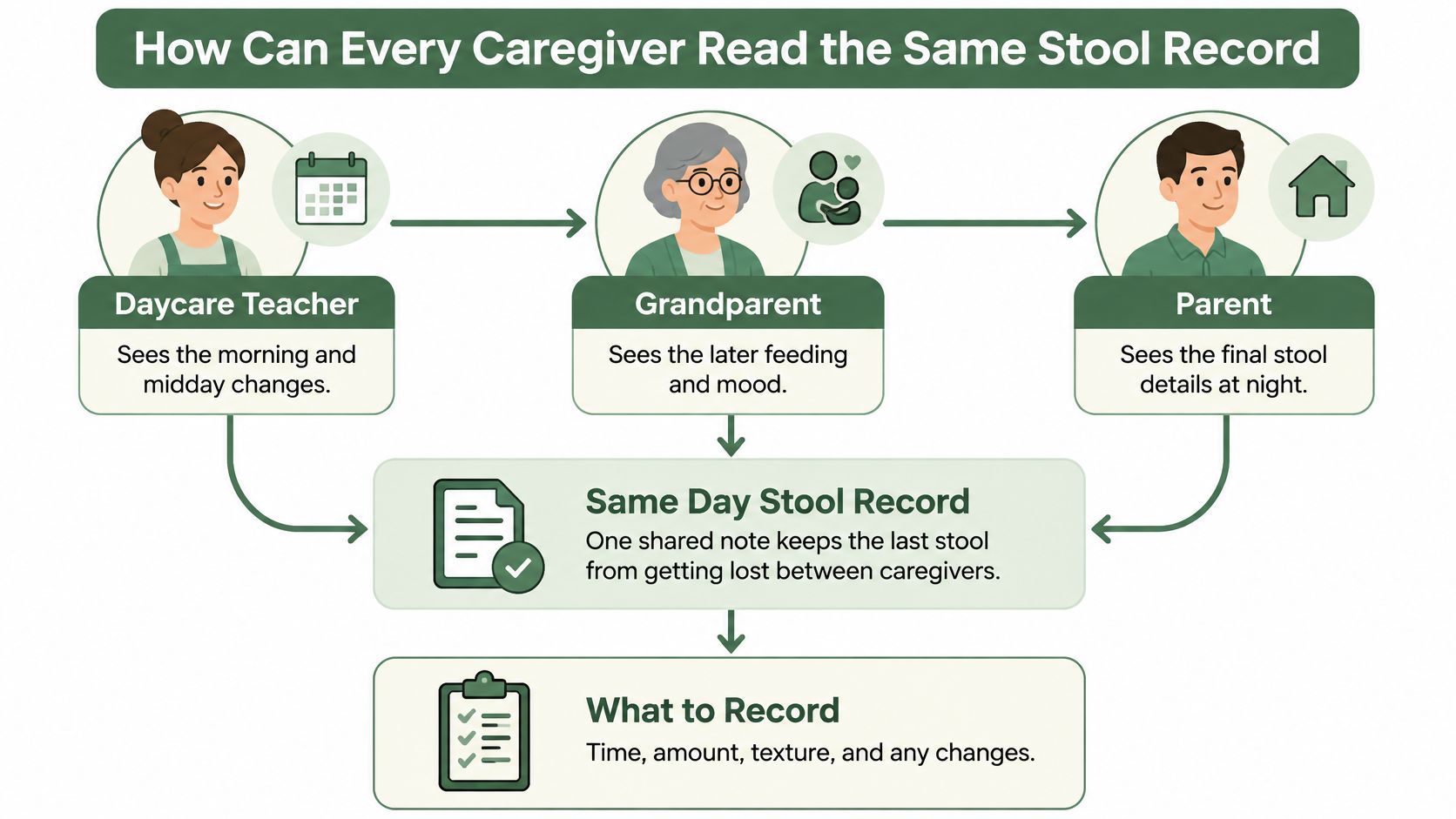
Use words everyone understands
The NHS guidance on constipation in children discusses food variety, fiber, and fluids. Ask the pediatrician how that general guidance applies to your baby's age, feeding pattern, and health.
Use the same plain descriptions in each entry:
- Date and time each stool. This lets caregivers compare observations without relying on memory.
- Describe texture and amount. Choose words such as soft, hard, dry, pellet-like, or runny, and note the approximate amount.
- Record effort and discomfort. Note straining, crying, or apparent pain during passage.
- Include milk feeds and approved water. This gives the pediatrician context about intake.
- Date each new solid. Name the food and how it was prepared.
- Identify the caregiver. A parent, partner, nanny, grandparent, or daycare worker can each add an observation.
Agree on a shared handoff
Choose one place for the record, and have each caregiver check the latest entry before feeding or changing the baby. A shared diaper-tracking routine can keep observations together instead of scattered across messages.
Cradlo began at 2 a.m., with repeated texts between two tired parents asking whether the other had already fed the baby. It is a shared baby and child care tracker for families with children ages 0–5. Parents and invited caregivers log sleep, feeds, diapers, growth, and health events; each caregiver's entries appear instantly for everyone. Before a pediatrician visit, review the dated record and prepare a summary of changes and questions. Agreeing on the same texture words is a useful place to start.
When to Call a Doctor Right Away
A baby's stool pattern can change after starting solids. Stool that is hard or painful to pass, or symptoms that persist, deserve a conversation with the pediatrician. You don't need to diagnose the cause. Describe what you've noticed and let the clinician advise you.
The NIDDK's guidance on constipation symptoms and causes advises contacting a doctor when constipation lasts more than two weeks or doesn't improve with at-home treatment. It also recommends seeking care right away for blood in the stool, abdominal bloating, constant abdominal pain, vomiting, or weight loss.
Contact the pediatrician about persistence
Call if dietary changes or supportive measures approved by your pediatrician aren't helping. You don't have to wait for a particular duration if your baby seems uncomfortable, feeds are changing, or you're unsure whether the stool is normal.
A small streak of blood can have a fissure-related explanation, but you can't confirm the cause from a diaper. Tell the pediatrician about any blood rather than assuming hard stool explains it.
Seek prompt assessment for concerning symptoms
Get medical guidance right away if constipation occurs with:
- Rectal bleeding or blood in the stool, especially more than a small streak.
- A bloated or markedly swollen belly, or constant abdominal pain.
- Vomiting, particularly alongside abdominal swelling.
- Fever, unusual lethargy, or signs of dehydration.
- Poor feeding, weight loss, or concerns about growth.
A very young infant who has gone without a stool for longer than usual should be assessed by a clinician promptly, rather than waiting to see whether the pattern changes. A newborn's situation may need a different assessment from that of a baby established on solids.
These signs call for assessment, not a diagnosis from you. The clinician can decide whether an examination or treatment is needed.
Bring observations, not a conclusion
When you call, describe what changed from your baby's usual pattern, what you've tried under medical guidance, and whether discomfort happens only while passing stool or continues afterward. Dated observations about stool texture and symptoms can help make the conversation clearer.
Don't delay seeking care to finish a record. An incomplete log is still useful, and a clear description is enough to start the conversation. A shared baby and child care tracker like Cradlo lets parents and invited caregivers record diapers and health events in one place, so everyone can refer to the same pattern. Every entry appears for everyone as soon as it's logged.