How to Get Baby Off Pacifier: A Gentle Weaning Timeline
You've put the pacifier away during playtime, but your baby reaches for it before a nap. Your partner finds a spare, a grandparent offers it during a cuddle, and daycare asks whether it's still allowed. You're trying to make a gentle change, yet everyone seems to be following a different rule.
If you're wondering how to get baby off pacifier, start with your child's age and a plan every caregiver can understand. You don't need a perfect week or a child who never protests. You need a manageable next step, familiar comfort, and adults who respond predictably.
Table of Contents
- Pacifier Weaning Timeline by Age
- Choosing Between a Staged Plan and a Planned Stop
- How to Wean in Three Stages
- Keeping Grandparents, Nannies and Daycare on One Plan
- Setbacks, Night Wakings and When to Call a Clinician
- Choose Your First Step This Week
Pacifier Weaning Timeline by Age
Pacifiers serve a real purpose in early infancy. Weaning is a gradual, age-based process, not an emergency.
The American Academy of Family Physicians clinical review describes sleep-onset pacifier recommendations during infancy and reducing use during the second six months to lower middle-ear infection risk. The American Academy of Pediatric Dentistry's pacifier policy identifies increased ear-infection risk after 12 months, concerns about developing oral structures beyond 18 months, and discontinuation of nonnutritive sucking by 36 months.
| Age | What guidance says | Suggested first step |
|---|---|---|
| Birth to 6 months | Offering a pacifier at sleep onset is recommended for its association with lower SIDS risk; timing needs discussion if breastfeeding is still being established | Keep the current routine and ask a pediatrician about timing if feeding is a concern |
| 6 to 12 months | Guidance commonly recommends reducing use during the second six months to lower ear-infection risk | Limit daytime use first |
| 12 to 18 months | Use after 12 months is linked with higher ear-infection risk | Narrow use to naps and bedtime |
| 18 to 36 months | Prolonged use after 18 months raises concern for the developing bite | Finish the sleep-only phase and plan the last step |
| 36 months and older | Dental guidance is to discontinue nonnutritive sucking | Ask a pediatric dentist if use continues |
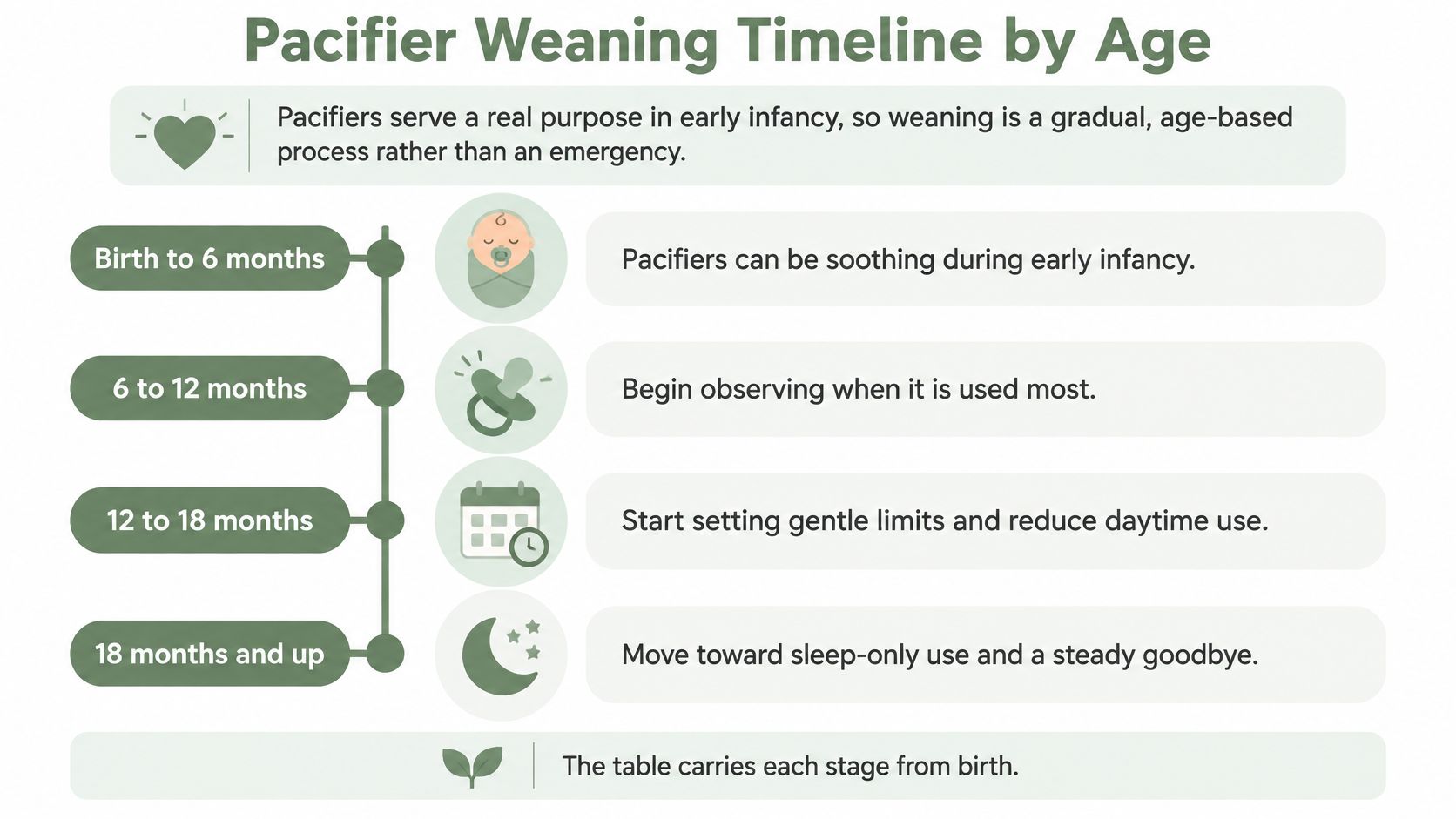
These rows are starting points, not verdicts. A baby who still uses a pacifier for naps hasn't failed a developmental test.
Sleep guidance also needs context. A Cochrane review on pacifiers and SIDS found no randomized controlled trials directly testing prevention, so sleep recommendations draw largely on observational evidence. Before changing an infant's sleep-time use, discuss feeding or sleep concerns with a pediatrician or lactation professional, especially while breastfeeding is becoming established.
Treat the timeline as a range for that conversation, not a deadline your child has to meet alone.
Choosing Between a Staged Plan and a Planned Stop
Before changing the routine, check that your child is well and that any feeding or sleep questions have been addressed with a pediatrician or lactation professional. A week with illness, travel, or a childcare change adds competing demands that can make the transition harder to interpret.
Then consider what your child understands and what your household can maintain. A staged plan changes one setting at a time. A planned stop gives an older toddler a clear ending, with support before and afterward.
| Criterion | Staged plan | Planned abrupt stop |
|---|---|---|
| Best fit | Babies and young toddlers still learning routines | Older toddler who understands simple choices |
| Pace | Gradual, over several weeks | One chosen calm week |
| Main risk | Slow progress when limits are inconsistent | Distress or unsafe self-soothing if rushed |
| Switch if | Progress stalls after several weeks on the same rule | Severe distress, prolonged sleep disruption, or unsafe self-soothing |
A behavioral-economics analysis of pacifier cessation found abrupt cessation superior to approaches such as merely limiting use or altering the nipple, but it didn't establish a universal success percentage. That finding doesn't mean every baby should stop abruptly or that a gradual approach is wrong.
Choose a plan the adults can support
For a younger child, predictable routines are more useful than a long explanation. An older toddler may understand choosing a goodbye day and taking part in a small farewell ritual.
Ask each caregiver what they can realistically follow. If daycare can support sleep-only use but a grandparent expects unrestricted access, resolve that difference before starting rather than asking the child to manage it.
Decision guide: If your child can't yet understand the goodbye, stage the change. If they understand and every caregiver can maintain the same response for several nights, a planned stop is a reasonable option.
Neither choice requires ignoring distress. A plan should remain responsive to your child, with professional help when the response raises concerns.
How to Wean in Three Stages
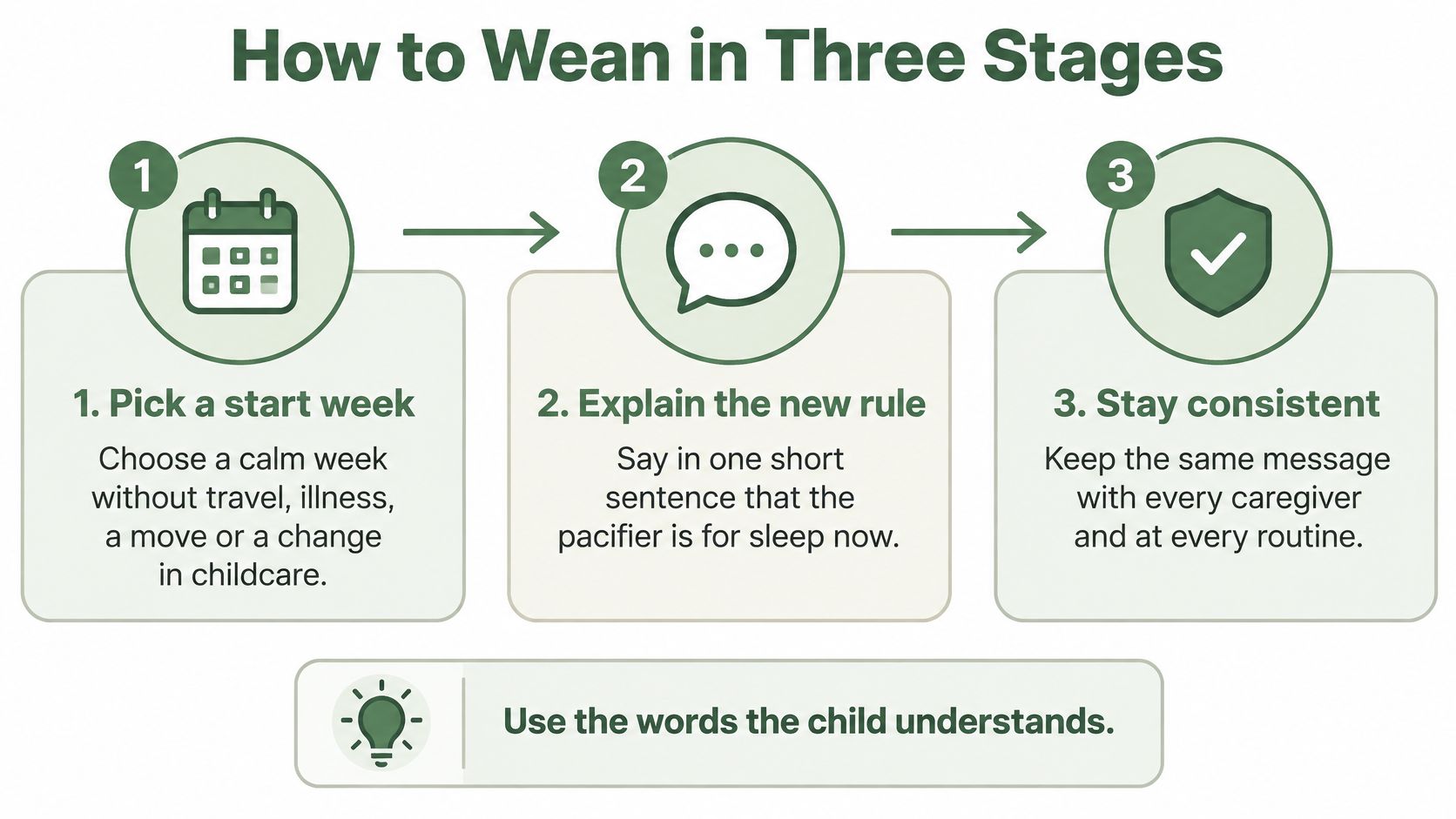
Think of the transition as daytime limits, a settled sleep-only routine, then sleep without the pacifier. The middle stage matters: it gives everyone time to learn the rule before another familiar cue changes.
A multidisciplinary study of pacifier removal supports pairing clear explanations with positive reinforcement. The practical lesson is to teach what your child can do instead, rather than focusing only on what's being taken away.
Prepare before changing access
-
Choose an ordinary start week. Avoid beginning during illness, travel, a move, or a change in childcare. Check that the adults handling naps and bedtime know the plan.
-
Use one short explanation. Tell your child, in familiar words, that the pacifier is for sleep now. Long explanations can become confusing, especially when a tired child is asking for comfort.
-
Choose the replacement cue ahead of time. A cuddle, predictable song, or quiet phrase gives caregivers something concrete to offer. A developmentally appropriate comfort object can be used outside the crib, but don't introduce loose objects into an infant's sleep space.
Move through the stages
-
Stage one is daytime play without the pacifier. Put it out of sight rather than leaving it beside the toys. When your child reaches for it, offer closeness or an activity without turning the request into an argument.
Praise coping as it happens. Notice that your child accepted a cuddle, returned to playing, or settled beside you. Asking for the pacifier isn't misbehavior, so avoid shaming, punishment, or comparisons with other children.
-
Stage two is a dependable sleep-only routine. Once daytime feels settled, keep access limited to naps and bedtime. Don't rush onward just because one afternoon went well; check that the routine works with your partner, grandparents, nanny, and daycare too.
-
Stage three removes it from naps, then bedtime. Keep the rest of the wind-down familiar. Change the pacifier cue without also changing the room, song, caregiver, and entire bedtime sequence.
For families still establishing infant sleep routines, the guide to putting a newborn to sleep provides related routine ideas. It isn't a reason to accelerate infant weaning or replace individualized sleep guidance.
Record the useful details: when your child requested the pacifier, which replacement helped, and whether sleep finished without it. Expect weeks rather than a quick transformation, and advance when the current stage feels settled across caregivers.
Repeatedly reversing a limit can keep the request-and-return pattern going. Stay predictable while offering comfort, but don't interpret consistency as a reason to push through severe distress. Feeding, sleep, or dental concerns belong with the appropriate clinician.
Keeping Grandparents, Nannies and Daycare on One Plan
A grandparent offers the pacifier on the sofa. A nanny uses it to settle a nap. Daycare keeps a spare in the cubby, just in case.
None of these caregivers is trying to undermine you. But mixed responses can keep the habit going because your child doesn't know which request will lead to a pacifier. The household rule needs to travel with the child.
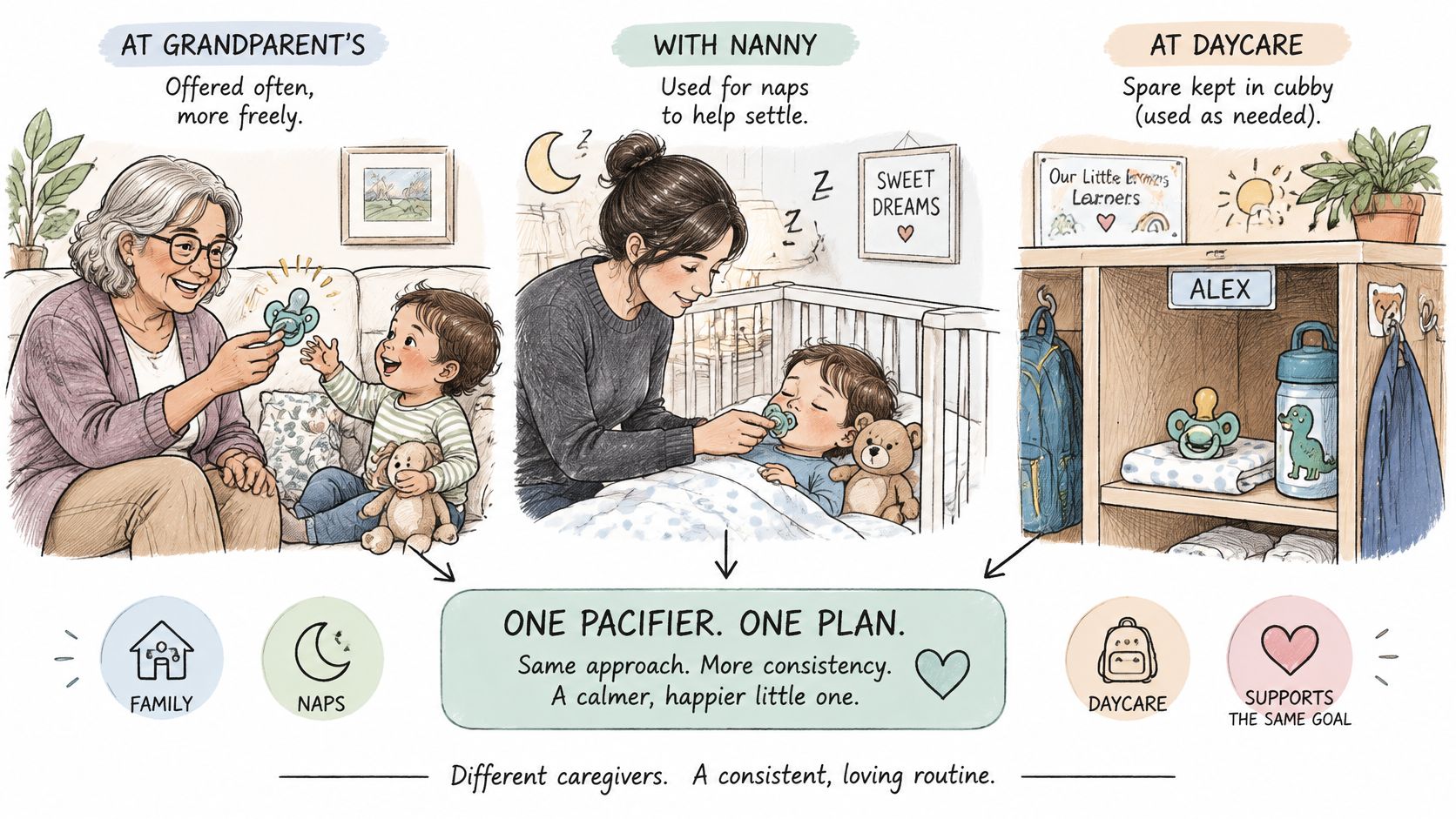
Make each handoff specific
At home, agree on the current permission: sleep-only, bedtime-only, or no pacifier. Tell your partner what happened during the last settling attempt, not whether the day was good or difficult.
With grandparents, explain what they can do when your child asks. A familiar song and cuddle are easier to follow than an instruction to avoid giving in. If a caregiver mainly speaks Spanish, agree on an equivalent short phrase in Spanish so the child hears the same meaning in familiar language.
At childcare, speak directly with the person handling naps. Ask the center to remove every pacifier from the cubby when you reach the no-pacifier stage; during sleep-only weaning, agree on staff-controlled storage instead. Share the replacement routine and ask staff to record nap requests and responses.
A daycare summary can help parents carry that context into bedtime rather than guessing how the afternoon went.
Handle exceptions without blame
If someone makes an exception, discuss it privately. Don't argue in front of your child or describe one caregiver as the person who ruined the plan. Clarify what happened and return to the agreed response at the next opportunity.
A caregiver needs more than a rule. They need a comforting response they can actually use.
Keep the practical setup simple:
- Label one storage bin. During the limited-use stages, give adults a designated place for pacifiers instead of leaving spares around the house.
- Agree on log fields. Record the setting, request, adult response, replacement cue, and outcome.
- Allow an adjustment period. Hold the shared response for several nights before judging ordinary progress, unless distress or health concerns call for earlier help.
The aim isn't to monitor or criticize caregivers. It's to make the next handoff easier for both the adult and the child.
Setbacks, Night Wakings and When to Call a Clinician
Protest at naptime after daytime removal can mean your child is adjusting to a changed cue. It doesn't automatically mean the plan is wrong, and it doesn't tell you that every cry is about the pacifier.
Look at the setting and your child's needs before deciding what to change. Illness, hunger, discomfort, and a difficult transition deserve attention rather than being dismissed as resistance.
| Setback | Likely reason | What tends to help | When to call a clinician |
|---|---|---|---|
| Protest at naptime after daytime removal | The cue changed and the child is adjusting | Keep the same replacement cue and phrase for several days | Distress continues or worries you |
| More night wakings after a bedtime change | The bedtime cue may have been removed too quickly | Return to the last stage that worked, then restart the familiar cue | Prolonged or severe sleep disruption |
| Emergency pacifier kept nearby | A backup makes exceptions easy | At the planned-stop stage, remove every pacifier from home and childcare | Not usually needed for this issue alone |
| Thumb, bottle, or sweet item becomes the new habit | The child still needs a soothing cue | Offer calm, non-food comfort and praise coping | Ask a pediatric dentist about a persistent sucking habit |
| Nipple worn, torn, or sticky | Wear, damage, or residue | Discard it right away; never repair or coat it | Not usually needed for wear alone; discard it |
For a sucking habit continuing past 36 months, the AAPD's policy on pacifiers supports discussing discontinuation with a pediatric dentist. Seek guidance sooner if you notice bite changes, difficulty eating, repeated ear infections, or speech concerns.
Make a planned goodbye safe
For an older toddler using the planned-stop approach, explain the final day in simple language and let them participate in a symbolic goodbye. Put the pacifiers in a goodbye box, for example, then have an adult remove them from every caregiving setting.
Never cut or damage the nipple to make it less appealing. That can create choking and material-safety hazards. Don't apply sweet or unpleasant coatings, and don't replace the pacifier with a bottle or sugary comfort item.
Respond to disrupted sleep
If wakings increase, note whether your child is struggling to fall asleep, waking repeatedly, or showing signs of discomfort. The guide to a baby waking up every hour at night can help you organize observations for a conversation, but it can't identify the cause for your child.
If abrupt removal causes severe distress, prolonged sleep disruption, or unsafe self-soothing, return to a staged sleep-only plan and consult a pediatric clinician or pediatric dentist. Setbacks don't mean your family has failed; sometimes the next useful step is a smaller change or individualized support.
Choose Your First Step This Week
A pacifier rule only holds when every adult holds it the same way. Pick the step you can repeat at home, at grandma's house, and at daycare pickup without renegotiating it each time.
For a toddler ready for gradual weaning, daytime play gives you a low pressure place to practice the new rule this week. For a young infant, the useful step may be keeping sleep and feeding steady and bringing questions about timing to the next checkup. Preparation counts, too.
Bring clear questions to your pediatrician
Use the appointment to discuss your child rather than asking only for a general stopping age:
- Timing: What timing fits our child's development and current pacifier use?
- Feeding and sleep: Do our feeding or sleep concerns change the plan?
- Dental follow-up: When should a pediatric dentist see our child?
A shared log makes that discussion more concrete. Record when requests happen, what was happening just before, and which comfort cue helped. The next caregiver can then see the last response clearly instead of piecing it together from texts.
At Cradlo, we offer a shared baby and child care tracker where parents and invited caregivers log sleep, feeds, diapers, growth, and health events. That shared record helps home, grandparents, nannies, and daycare keep the same rule through each handoff.
A useful first step: Write the current rule and replacement cue together before changing the routine.
You can keep presence, reassurance, and familiar bedtime steps fully available while the pacifier becomes less central. Comfort stays. Only the tool changes.
Slow progress still counts. A difficult nap does not erase an easier afternoon. Aim for steady repetition with your child, not a perfect week.
Visit Cradlo to keep sleep and care records shared with your partner and invited caregivers as you work through the transition. Cradlo starts with a 7-day free trial, then offers Plus at $4.99/month or $49.99/year, or Lifetime at $99.99 one time, so you can try a shared record during everyday handoffs.