How Long Is Formula Good for Once Opened or Mixed
Opened powder is generally used within one month after opening, while a prepared bottle is used within 2 hours at room temperature or 24 hours if refrigerated right away, and discarded 1 hour after feeding starts. That's the short answer, but it's easy to mix up which clock you're looking at when you're holding a half-finished bottle at 2 a.m. or handing care to a partner, nanny, or grandparent.
The confusion usually isn't about effort. It's about three different times living side by side: when you opened the can, when you mixed the bottle, and when your baby started drinking. Once you separate those clocks, how long formula is good for once opened becomes much easier to track, even across shift changes at home and daycare.
Table of Contents
- Storage Times for Opened and Prepared Formula at a Glance
- How Long Opened Powder Keeps Once the Can Is Open
- Ready-to-Feed Liquid Formula and Opened Cans
- How to Time a Prepared Bottle From Mixing to Feeding
- Fridge, Room Temperature, Daycare and Travel Rules
- What to Do When the Clock Is Unclear
Storage Times for Opened and Prepared Formula at a Glance
An opened container of powder is generally used within one month, while a prepared bottle is measured in hours, not weeks. Those two timelines run at the same time, which is why a fresh can doesn't make an old mixed bottle safe, and a freshly mixed bottle doesn't extend the life of an old can.
Think of it as four clocks that different caregivers may be watching. One clock belongs to the dry powder in the cupboard. The other three belong to a bottle after water has been added: time sitting out, time in the fridge, and time since feeding began.
The Four Storage Windows
| Form | Where it is stored | Safe window | At the limit |
|---|---|---|---|
| Opened powder | Cool, dry place, tightly closed, not refrigerated | One month after opening | Discard after one month or after the Use By date |
| Prepared bottle at room temperature | Room temperature, not yet fed | 2 hours from preparation | Discard if not refrigerated within 2 hours |
| Prepared bottle refrigerated before feeding | Refrigerator at no more than 4 to 5°C (39 to 41°F) | 24 hours | Discard after 24 hours |
| Bottle after feeding has started | Baby's feeding bottle, at feeding | 1 hour from start of feeding | Discard after 1 hour, along with any leftovers |
A parent, partner, nanny, or grandparent can scan this in seconds before a feed. Start by asking which form you're holding, powder or mixed liquid, then match it to the right row instead of trying to remember every rule at once.
If a bottle has already been fed from, what's left inside is discarded rather than refrigerated for later. That last row is the one most often missed during a handoff, because the bottle may look fine and still be past its window.
The powder clock and the bottle clocks run separately. Opening a new can never resets the timer on a bottle that's already mixed.
For any specific can, the product label controls, so check it before you rely on a general window. If you have questions about your particular baby, your feeding situation, or a specific product, bring them to a pediatrician or lactation professional rather than guessing.
How Long Opened Powder Keeps Once the Can Is Open
Write the opening date on the lid as soon as you open a new can. That one habit does most of the work for the powder clock, because nobody has to reconstruct the date from a grocery receipt or a memory a few weeks later.
The U.S. Food and Drug Administration guidance on powdered formula identifies one month after opening as the typical limit for opened powdered formula, provided the container remains tightly closed and is stored in a cool, dry place, not in a refrigerator. The FDA also advises following the product label, since manufacturers must provide the storage and disposal instructions for that specific product.
That one-month window applies only to the dry powder in the container. It doesn't apply to formula that's already been mixed with water, which is why the opening date and the preparation time need to be recorded separately.
Keeping Moisture Out of the Can
Keep the lid tightly closed between scoops and store the can in a cool, dry cupboard, away from steam and heat. Don't refrigerate or freeze the container, because moisture can get in and affect the powder when it moves between cold and room air.
Check the "Use By" date printed on the label, too. Formula shouldn't be used after that date even if you opened the can recently, so the earlier of the two dates, one month after opening or the Use By date, is the one that counts.
Say you open a can on the first of the month, write that date on the lid, and add the same date to your shared log. A grandparent or nanny covering a shift later can see at a glance when it's time to start a new can, without calling to ask.
The same routine works if your family reads labels in Spanish. Look for the Use By date under its Spanish label, fecha de caducidad, write the opening date in whatever format your household uses, and make sure everyone reads the date the same way.
- Opening date written: Put it on the lid the moment the seal comes off.
- Can closed after each scoop: Press the lid down fully before it goes back in the cupboard.
- Stored away from heat and moisture: Keep it out of the fridge, freezer, and steamy spots near the stove or sink.
- Replacement planned early: Note the one-month mark so a new can is ready before the old one runs out of time.
This is a routine to build, not a test to pass. Once dating the lid becomes automatic, the powder clock mostly takes care of itself.
Ready-to-Feed Liquid Formula and Opened Cans
Ready-to-feed liquid formula comes in cans or bottles that are ready to pour, so there's no mixing step and no powder clock to track. That convenience changes the question. Instead of asking about dry powder, you're asking what this particular opened can allows.
Once a ready-to-feed can is opened, its storage time is set by the product label, not by the rule you use for dry powder. Don't assume one brand's after-opening instruction matches another's, and don't borrow a number from a different type of formula.
A Label-First Routine
- Find the dates and instructions. Look for the Use By date and any after-opening direction printed on the can.
- Write the opening date. Put it on the can itself or in your shared log, where the next caregiver will see it.
- Refrigerate if the label says to. Follow the can's own storage instruction rather than a general habit.
- Pour only what you need. Measure out the amount for the next feed instead of pouring extra into the bottle.
Once liquid is poured into a bottle, treat that bottle the same way you'd treat any bottle at feeding time, including the feeding-start limit and discarding leftovers. Say a grandparent is covering an afternoon feed with ready-to-feed formula. They'd check the label first, then the opening date on the lid, and only then pour and offer the bottle.
Because there's no single after-opening number that fits every ready-to-feed product, the manufacturer's label is your main reference here. If a label is unclear or you're unsure about a specific product, ask a pediatrician before offering it. It's a quick label check to make before each new can, not a test you can fail.
How to Time a Prepared Bottle From Mixing to Feeding
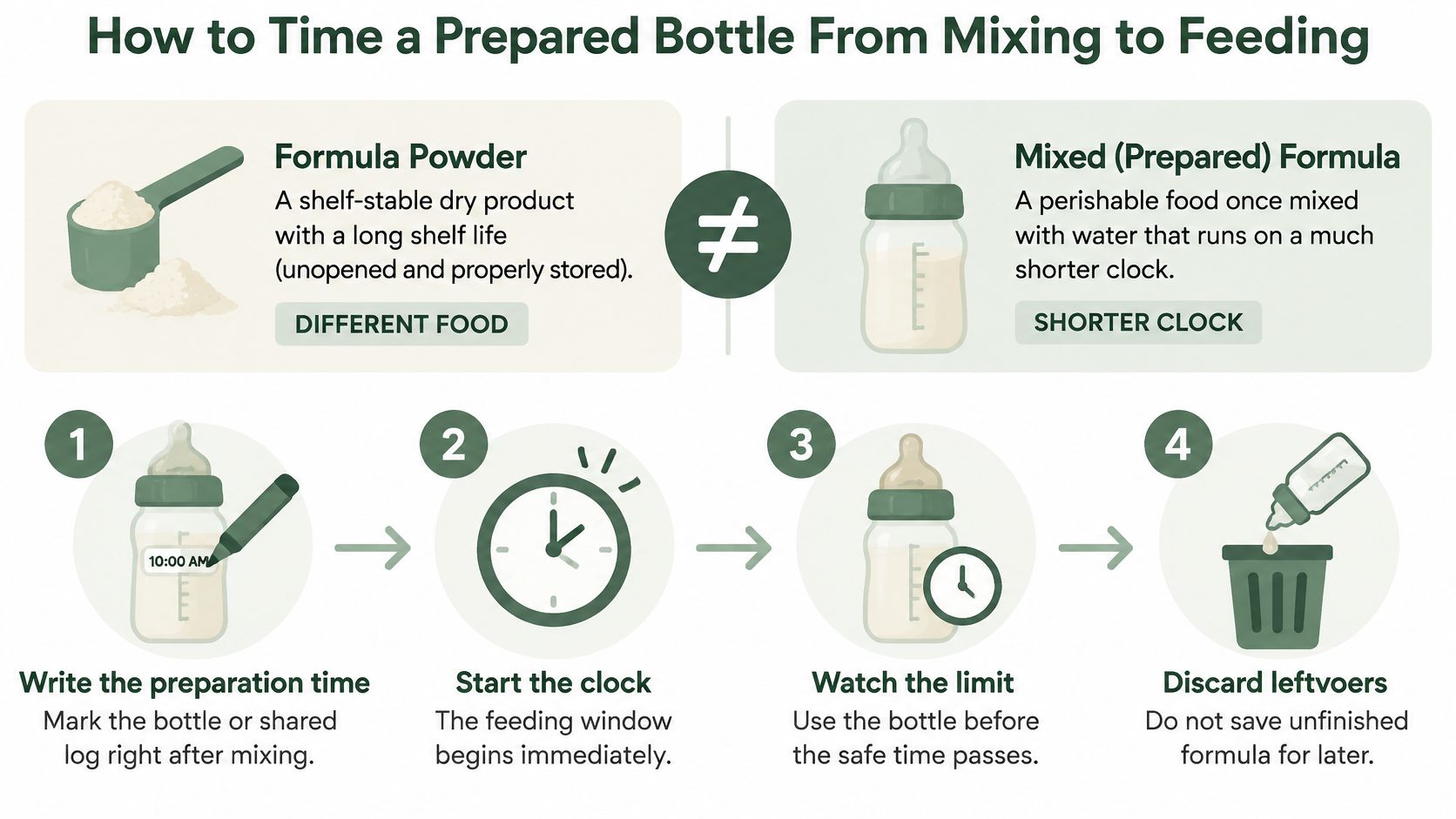
A mixed bottle is a different kind of food from dry powder, and it runs on a much shorter clock. The U.S. Centers for Disease Control and Prevention page on preparation and storage recommends using prepared formula within 2 hours of preparation and within 1 hour from the start of feeding. If feeding won't begin within that first window, the bottle should be refrigerated immediately and used within 24 hours.
The World Health Organization similarly recommends preparing formula fresh for each feed where possible and keeping refrigerated prepared formula at 5°C or below for use within 24 hours. In practice, you're tracking three milestones: the preparation time, the refrigeration deadline, and the feeding-start deadline.
Six Steps From Mixing to Discarding
-
Write the preparation time as soon as the bottle is mixed. Put it on a label on the bottle or in your shared log, along with who prepared it. That single timestamp anchors every deadline that follows.
-
If feeding will begin soon, keep the room-temperature window in view. A bottle sitting out is meant to be used within 2 hours of preparation. If your baby falls asleep and the feed keeps slipping, that original mixing time still counts.
-
If feeding won't begin within 2 hours, refrigerate the bottle immediately. Don't wait until you're sure, because the room-temperature window keeps running while you decide. A refrigerated bottle that hasn't been fed from yet is used within 24 hours.
-
Once feeding starts, note that time and count 1 hour from it. This is a new, shorter clock, and it's the one a second caregiver is most likely to miss. Recording when feeding began, not just when the bottle was made, keeps everyone on the same page.
-
After the feeding, discard any formula left in the bottle. Whatever remains shouldn't be refrigerated and saved for later. Contact with your baby's saliva during feeding is what makes leftovers different from an untouched refrigerated bottle.
-
Where possible, prepare formula fresh for each feed. Fresh preparation sidesteps most of the timing questions entirely. When you do mix ahead, the steps above give you a clear record to work from.
A concrete timeline helps. Say a bottle is mixed at 10:00 and fed at 10:45. If your baby doesn't finish it, that bottle is discarded by 11:45, one hour after feeding started, even though it was mixed less than two hours earlier.
Now change the scenario. A bottle mixed at 10:00 and put straight in the fridge is used or discarded by 10:00 the next day. Warming that bottle before a feed doesn't reset either clock, so plan from the original times, not from when it came out of the fridge.
If you're also working out how feeds fit across the day, our guidance on building a formula feeding schedule can help you pair these safety windows with your baby's usual rhythm.
Fridge, Room Temperature, Daycare and Travel Rules
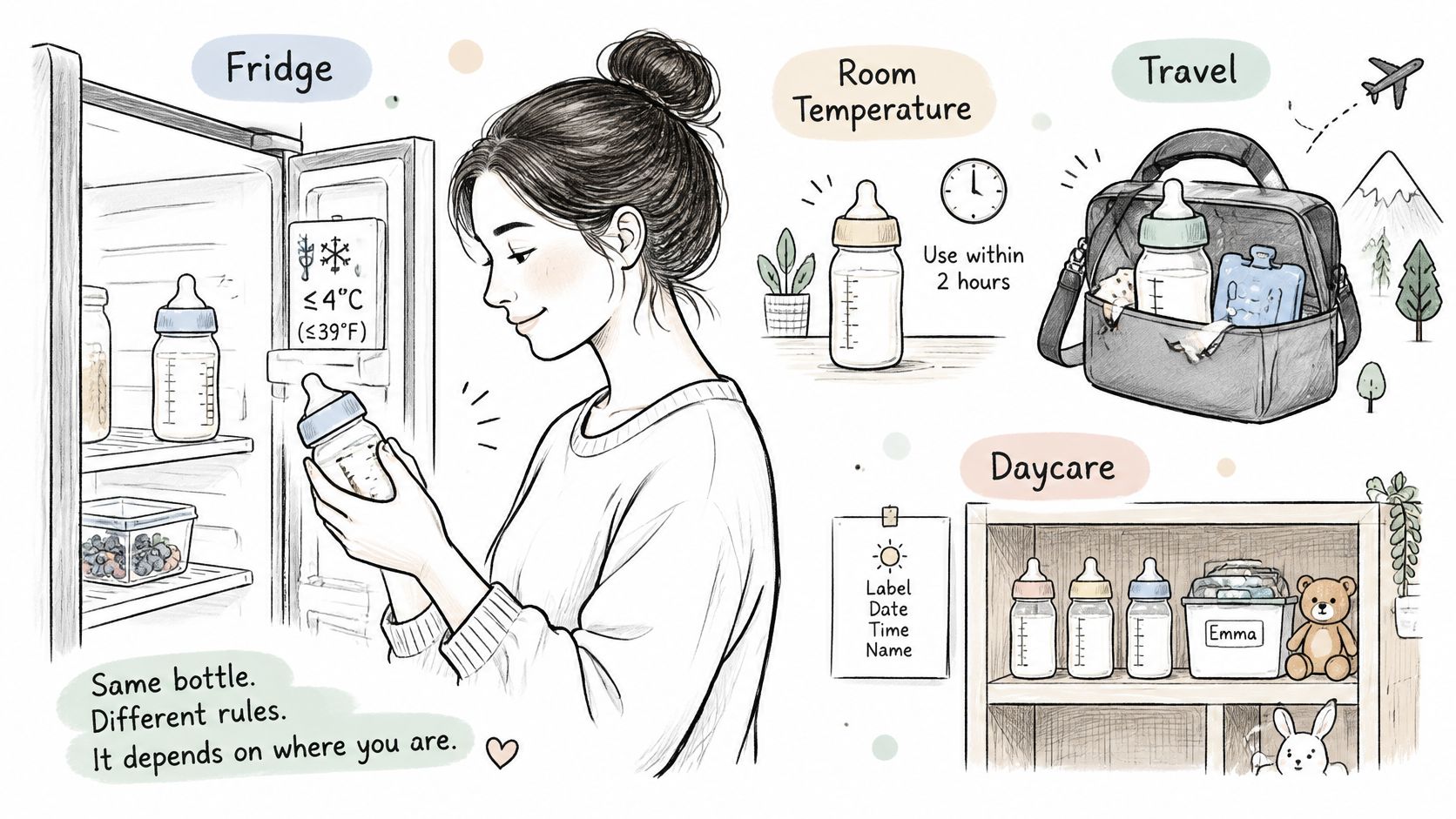
The same bottle faces very different conditions in a kitchen fridge, a daycare cubby, and a warm car. The FDA consumer update on infant formula safety notes that prepared formula should be used within 2 hours of preparation or refrigerated immediately and used within 24 hours, with refrigeration at no more than 4 to 5°C (39 to 41°F). Where the bottle sits, and how long it spends getting there, matters as much as the number itself.
At Home in the Fridge
Put a refrigerated bottle toward the back of the fridge, where the temperature stays steadier. The door shelf swings through warm kitchen air every time someone opens it, so it's the least stable spot you could choose.
Label the bottle with its preparation time before it goes in, not when it comes out. At a late-night feed, a partner on night duty shouldn't have to guess which of two bottles was mixed first.
At Daycare and With a Nanny
Send a clearly labeled bottle, or powder with clear mixing instructions, and write the preparation time where staff can see it. Before your baby's first week, confirm which routine the daycare follows for mixing, refrigerating, and discarding, so home and daycare aren't running two different systems.
A shared daily record helps here, and our overview of what belongs in a daycare summary for parents and providers shows how feed times can travel with your child. Say a nanny starts a feed at the park, for example. Logging the feeding-start time right then means a parent arriving later knows the bottle's window without a string of text messages.
In the Car and On the Go
Carry a prepared bottle in a cooler bag with ice packs so it stays cold until the feed. A diaper bag left on a sunny seat or a bottle sitting in a warm car shortens your margin quickly, even if the trip felt short.
When timing is uncertain, carrying powder and water separately and mixing at feeding time is a calmer option. A grandparent covering a late afternoon bottle, for instance, can mix fresh on arrival instead of wondering how long a premixed bottle sat in transit.
Handoff checklist: Is the bottle refrigerated? What time was it prepared? Will feeding start within the room-temperature window? Who discards the leftovers?
Use extra caution for infants younger than 2 months, premature infants, or infants with weakened immune systems. For those babies, bring any questions about preparation and storage to a pediatrician, who can advise on your child's specific situation.
What to Do When the Clock Is Unclear
Sometimes you find a bottle on the counter and nobody's sure who made it or when. Hours can also be hard to reconstruct after a broken night, and that's true in almost every household. A simple decision path helps more than trying to remember perfectly.
| Sign | What it may mean | What to do |
|---|---|---|
| Clumps, moisture or an unusual odor in the powder | Moisture or contamination may have reached the container | Do not use; discard the powder |
| Past the Use By date or one month after opening | Outside the storage window | Discard, even if it looks normal |
| Prepared bottle held past 2 hours at room temperature or 1 hour after feeding began | Outside the safe window | Discard the bottle |
| Sour smell or change in appearance that was not there before | Possible bacterial growth or spoilage | Do not give; discard and wash the bottle |
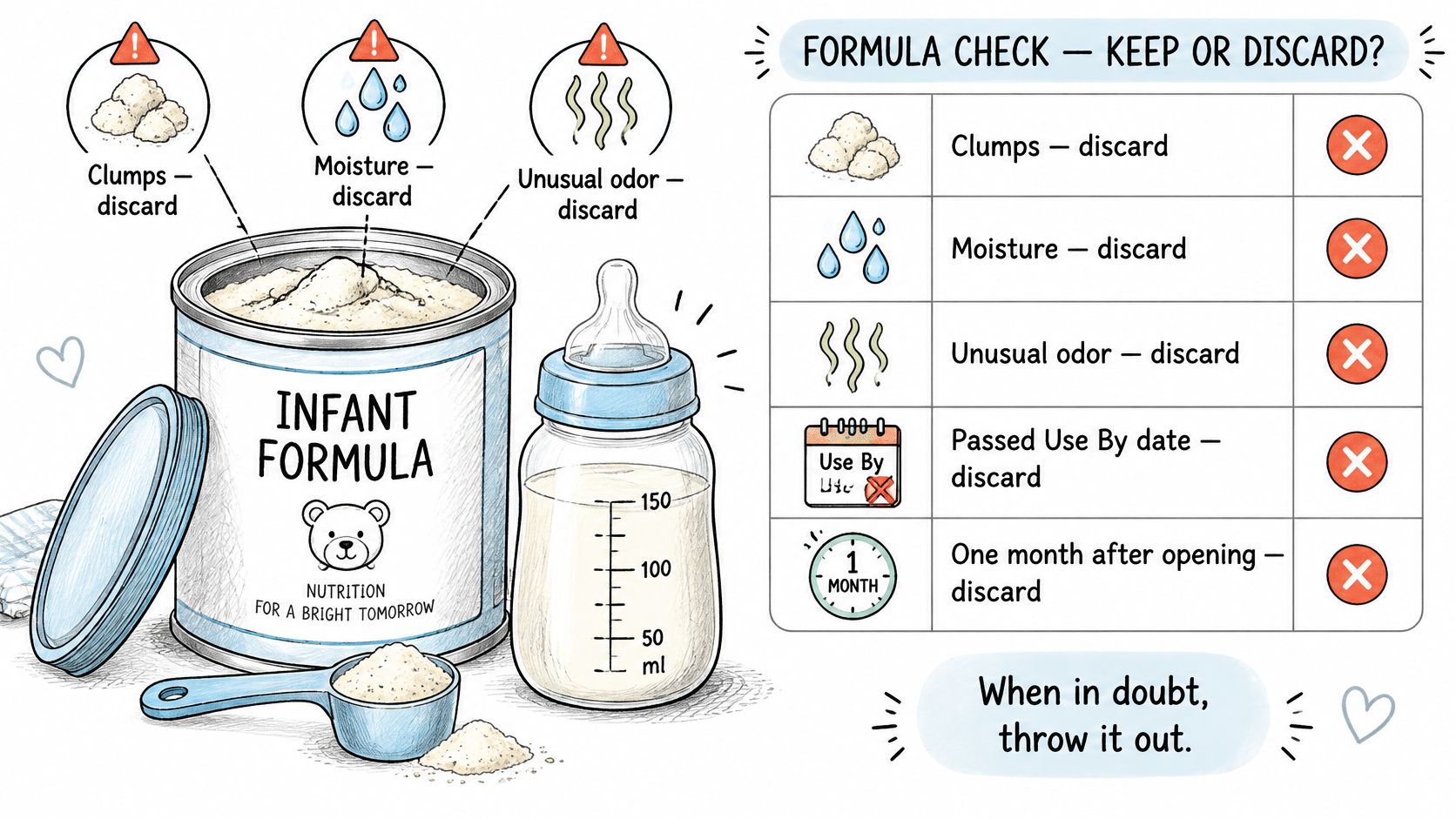
The clock beats appearance, because formula that's past its window often looks and smells completely normal. Use the signs above as an added check, not as a substitute for the time.
A Calm Decision Path
- Stop and don't give the formula yet. Pausing for a minute costs nothing and keeps a guess from becoming a feed.
- Check the clocks you have. Look for the opening date, the preparation time, any refrigeration time, and the feeding-start time, on the lid, the bottle label, or your log.
- If the time is unclear, discard it. The same goes if the powder or liquid looks or smells different than usual. When you can't place a bottle inside its window, treat it as outside it.
- Wash the bottle and nipple before the next preparation. Starting with clean equipment closes the loop on the discarded feed.
- Call the pediatrician if you're worried. If your baby seems unwell, or formula was given past a limit, call promptly and describe the timing as best you can.
A shared log makes step 2 much faster. When the opening date, preparation time, and feeding start are recorded in one place, a partner on night duty or a nanny on a morning shift can read the clocks without waking anyone to ask. A simple baby feeding log template shows the basic fields worth capturing if you're setting one up.
That's also how we built Cradlo, a shared baby tracker for families with kids from newborn through the early years, ages 0 to 5, where parents, partners, nannies, grandparents, and daycare log feeds, preparation times, and diaper changes under their own identity. Daycare can use a bookmarked browser page on an iPad with no app to install, and there's a 7-day free trial on the monthly plan, with no free plan after that.
Before the next feed, do one small thing. Check the lid date, note the preparation time, and decide which clock is nearest its limit. That thirty-second habit is what keeps every caregiver working from the same information.
If tracking three different clocks across several caregivers sounds familiar, Cradlo keeps opening dates, preparation times, and feeding starts in one shared log that parents, partners, grandparents, nannies, and daycare can all read in real time. You can start with the 7-day free trial on the monthly plan and log your next bottle together, so nobody has to guess which clock a bottle is on.