Baby Sleep Schedule 3 Months: A Flexible Daily Plan
At 6:45 p.m., one parent is swaying a fussy baby while the other reheats a bottle. Nobody knows whether the next wake window began at the diaper change, the feed, or the burp. The baby is tired, but not settling, and the evening that looked manageable an hour ago now feels like a group project with no instructions.
That's the problem with a baby sleep schedule at 3 months. A clock can tell you when sleep usually happens, but it can't tell you whether your baby is ready for sleep today. At this age, the useful schedule is a moving rhythm built around wake windows, sleepy cues, naps, feeds, and a consistent morning anchor.
Table of Contents
- The 6 - 45 P.M. Problem Most 3-Month Schedules Miss
- What 3-Month Sleep Actually Looks Like
- Three Sample Days Built Around Wake Windows
- A Bedtime Routine You Can Repeat in the Dark
- Sharing the Schedule Across Every Caregiver
- Common Setbacks and How to Read Them
- When to Trust the Loop and When to Call the Pediatrician
The 6 - 45 P.M. Problem Most 3-Month Schedules Miss
The 6:45 p.m. bedtime usually isn't the core problem. It's the final visible symptom of a day that may have included a short nap, a missed sleep cue, or a last wake window that stretched too long.
At three months, one late nap can change the entire evening. A baby who wakes from a brief afternoon nap may need sleep again sooner than the clock suggests. If caregivers wait for a fixed bedtime, that baby can move from pleasantly tired to overtired before the routine even starts.
Practical rule: Treat the last wake window as the decision-maker. Treat the clock as a helpful reference.
Clock-only schedules fail because they assume every nap will last the same amount of time. Three-month-olds rarely cooperate with that plan. Some days include a longer midday nap and several short naps. Other days are made almost entirely of brief sleep periods and contact naps.
The common advice also misses the handoff problem. One tired parent remembers the last wake time, the last feed, the nap that lasted only half an hour, and the baby's mood at pickup. The other caregiver then starts guessing. By bedtime, both adults may be working from different versions of the day.
What the evening is telling you
If your baby is content during the early evening, the final wake window may be landing well. If your baby becomes frantic, arches away, cries through the feed, or fights every soothing attempt, the last window may have run too long. If your baby is cheerful and wide awake in the crib, the window may have been too short, although persistent fussiness is more often linked to tiredness than to a lack of tiredness.
A practical schedule has three jobs:
- Create a starting point: Use a reasonably consistent morning wake time.
- Protect sleep pressure: Offer the next nap before your baby becomes overtired.
- Make the day visible: Record the last wake, feed, and sleep so every caregiver can respond to the same information.
The rest of the day should flex around those anchors. A 6:45 p.m. bedtime may be right on one evening and far too late on another. The better question is not, “What time should bedtime be?” It's, “How long has my baby been awake since the last sleep?”
What 3-Month Sleep Actually Looks Like
At around three months, major guidance places total sleep needs in the neighborhood of 14 to 17 hours in 24 hours for infants up to three months, although the Canadian child-health range is broader, at 11 to 19 hours for babies from birth to three months. The World Health Organization guidance on infant sleep gives the 14 to 17 hour recommendation, while Children's Hospital of Philadelphia describes many three-month-olds as sleeping about 15 hours total.
That total can feel like a lot until you divide it across an uneven day. A useful working picture is roughly 10 to 11 hours of nighttime sleep and 4 to 6 hours of daytime sleep, often spread across four or five naps. Those figures describe a pattern, not a pass-fail test. A baby may sleep in several night blocks, wake to feed, and take naps that vary substantially in length.
The awake periods are short. Cleveland Clinic places babies from one to three months at 1 to 2 hours awake between sleeps, and CHOP's three-month examples use about 1.5 to 2 hours with four to five naps. See the Cleveland Clinic wake-window guidance for the distinction between a wake window and a fixed daily timetable.
Finding your baby's useful window
Start at the lower end when your baby has slept poorly, is recovering from a busy day, or is showing early sleepy cues. A longer window may work after a restorative nap, particularly in the middle of the morning. Late afternoon often calls for a shorter window because tiredness has accumulated across the day.
An undertired baby may look relaxed but remain alert, smile at the room, or need a long time to settle. An overtired baby may stare, turn away, fuss, jerk their arms, or become difficult to feed. Crying isn't the only sign, and by the time it arrives, the best window may already have passed.
| Metric | Typical Range | Notes |
|---|---|---|
| Total sleep in 24 hours | 14 to 17 hours | Guidance varies widely, and individual sleep can fall outside this range. |
| Wake window | 1 to 2 hours | Use sleepy cues and recent nap quality to choose the timing. |
| Daytime naps | 4 to 5 naps | Some babies begin moving toward three naps, but frequent naps remain normal. |
| Night stretch | 5 to 8 hours for some babies | Longer stretches are emerging, not guaranteed. |
Night feeds still belong in this picture. Some babies begin sleeping 6 to 8 hours at a stretch around this age, while others continue waking more often. Mayo Clinic notes that by three to four months, many babies sleep at least five hours at a time, but “sleeping through the night” can mean only five to six hours for an infant. Your target is a gradually more settled night, not the elimination of every feed.
Three Sample Days Built Around Wake Windows
Use these examples as flexible maps, not appointments. Each one starts with a morning anchor, then lets the next sleep follow the preceding wake window. Nap length will move the later parts of the day, especially bedtime.
Early third-month pattern
This version suits a baby who becomes tired quickly and still needs five daytime sleeps.
- 7:00 a.m.: Wake and feed.
- 8:15 a.m.: Nap, after a 1 hour 15 minute wake window.
- 10:15 a.m.: Wake and feed.
- 11:30 a.m.: Nap, after a 1 hour 15 minute wake window.
- 1:00 p.m.: Wake.
- 2:15 p.m.: Nap, after a 1 hour 15 minute wake window.
- 3:00 p.m.: Wake and feed.
- 4:15 p.m.: Catnap, after a 1 hour 15 minute wake window.
- 5:00 p.m.: Wake.
- 6:15 p.m.: Short evening nap, after a 1 hour 15 minute wake window.
- 7:00 p.m.: Wake, feed, and begin watching for bedtime cues.
- 8:15 p.m.: Bedtime, after a 1 hour 15 minute wake window.
Middle third-month pattern
This is a balanced four-nap day for a baby who usually manages about 1.5 hours in the morning and a little longer later.
- 7:00 a.m.: Wake and feed.
- 8:30 a.m.: Nap, after a 1 hour 30 minute wake window.
- 10:00 a.m.: Wake.
- 11:30 a.m.: Nap, after a 1 hour 30 minute wake window.
- 1:00 p.m.: Wake and feed.
- 2:45 p.m.: Nap, after a 1 hour 45 minute wake window.
- 3:30 p.m.: Wake.
- 5:00 p.m.: Catnap, after a 1 hour 30 minute wake window.
- 5:30 p.m.: Wake and feed.
- 7:00 p.m.: Begin bedtime routine.
- 7:30 p.m.: Bedtime, after a 2 hour wake window.
Later third-month pattern
This pattern fits a baby approaching a more stable four-nap day, with bedtime shifting according to the final nap.
- 6:45 a.m.: Wake and feed.
- 8:15 a.m.: Nap, after a 1 hour 30 minute wake window.
- 9:45 a.m.: Wake.
- 11:30 a.m.: Nap, after a 1 hour 45 minute wake window.
- 1:00 p.m.: Wake and feed.
- 2:45 p.m.: Nap, after a 1 hour 45 minute wake window.
- 3:30 p.m.: Wake.
- 5:00 p.m.: Catnap, after a 1 hour 30 minute wake window.
- 5:30 p.m.: Wake.
- 7:00 p.m.: Begin bedtime routine.
- 7:30 p.m.: Bedtime, after a 2 hour wake window.
If the last catnap ends earlier, move bedtime earlier. If it runs late, shorten the final wake period rather than forcing the usual clock time. Pick the sample closest to your baby's current behavior, then adjust one wake window at a time. A wake-window calculator can help you see the next target without turning the day into a rigid worksheet.
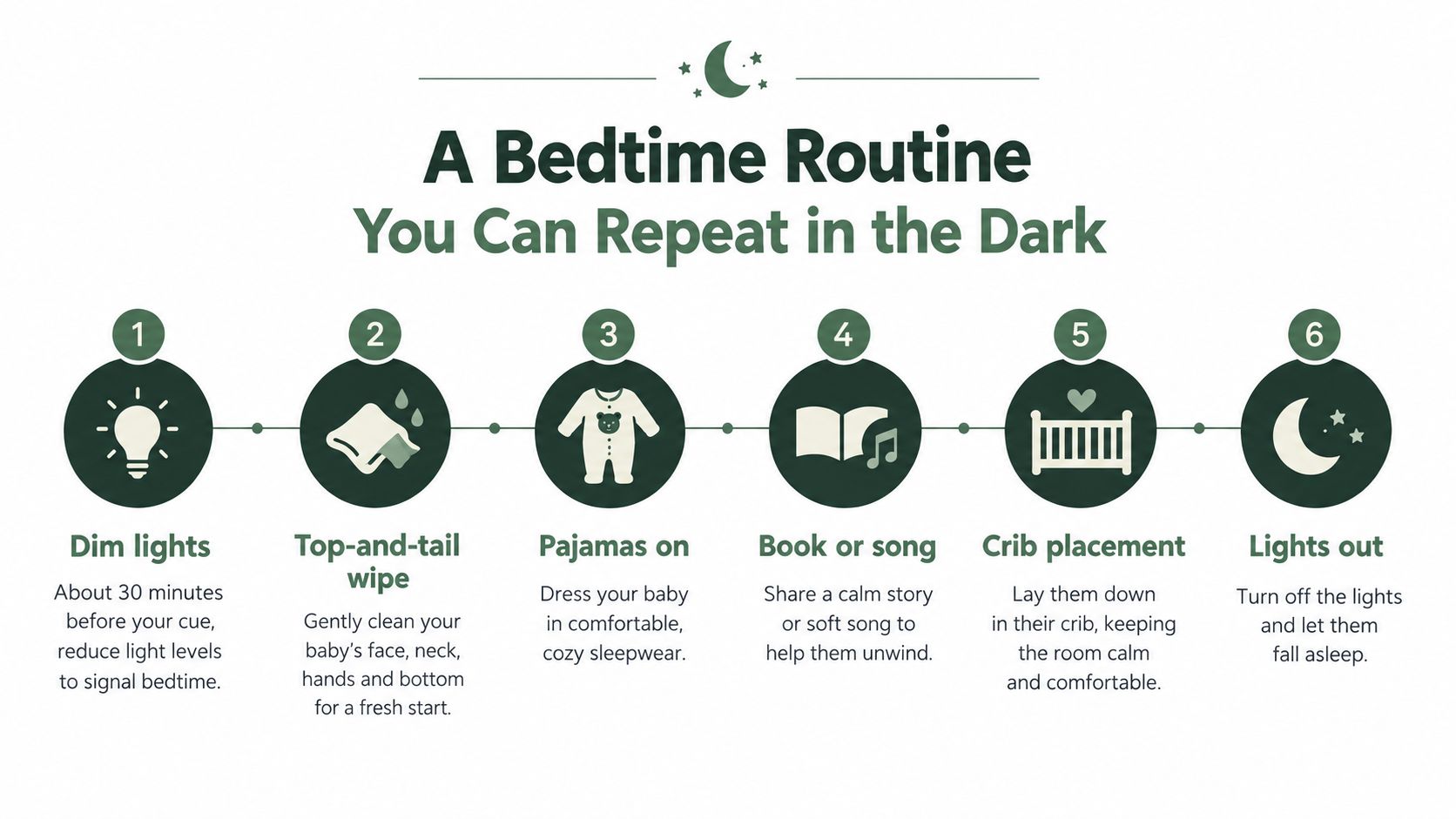
A Bedtime Routine You Can Repeat in the Dark
A bedtime routine should be short enough to repeat when you're exhausted. Aim for 25 to 35 minutes, and keep the order stable even when the bedtime clock changes.
Start with a clear environmental shift
Begin dimming the room about 30 minutes before the sleep cue you're watching for. Lower light helps separate evening from daytime, while the repeated action itself signals that play is ending. This step is less about making a baby instantly sleepy and more about removing stimulation before tiredness becomes frantic.
Use a brief top-and-tail wipe rather than a full bath unless it's bath night. Give the baby a clean diaper, put on pajamas and a safe sleep sack, then move to the feeding space. The wipe and clothing change create a transition. They don't need to become a long production.
Keep feeding calm and boring
Feed with the overhead light off, using a nightlight instead. Hold your baby upright and burp for about two to three minutes, or follow the advice you've received from your pediatrician or lactation professional. Feeding is a care need, not a sleep-training obstacle, and many three-month-olds still need night feeds.
Read a short board book or sing the same quiet song. This lowers the emotional temperature of the room without requiring your baby to understand the words. Keep the final phrase consistent, such as “It's sleep time now,” then place your baby in the crib drowsy but awake when that's realistic for your family.
Drowsy but awake matters because it gives your baby some experience falling asleep in the sleep space. True self-soothing develops later and varies by child, so don't treat this as a test your baby can fail. At three months, the routine is building familiarity, not demanding independent sleep.
Log the sequence, especially on difficult nights. The useful question later is whether the same order helped your baby settle more smoothly, not whether one particular bedtime was perfect.
Sharing the Schedule Across Every Caregiver
At 2 a.m., one parent often becomes the unofficial historian. By 5 p.m., that same person is explaining to a partner, grandparent, nanny, or daycare worker when the baby last woke, whether the feed was complete, and why bedtime may need to happen early.
That bottleneck creates avoidable confusion. The caregiver who was present remembers details that never make it into the handoff, while the next caregiver makes a reasonable decision with incomplete information. Nobody is careless. The system depends entirely on one exhausted person's memory.
A handoff that takes less conversation
A workable shared process can be simple:
- One caregiver creates the day's starting pattern from the morning wake and first nap.
- The second caregiver scans the QR-code invite on the fridge and accepts it in under a minute.
- Every nap, wake window, and feed then appears on the shared timeline.
- The next caregiver checks the last wake, last feed, and target sleep window before taking over.
That removes the 7 a.m. partner debrief, the 5 p.m. daycare text, and the late-night question, “Did the baby already eat?” A partner can see the same timeline from another phone. A grandparent can receive access without sharing a login. A nanny can record the afternoon nap while the parent is still at work.

Share the useful details, not everything
The most valuable handoff fields are practical:
- Last wake: When the previous sleep ended.
- Last feed: When the feed happened and whether anything unusual occurred.
- Next sleep target: The approximate window based on the baby's current rhythm.
- Nap response: Whether the baby settled easily or needed extra support.
Keep private information out of broad caregiver sharing. Medical notes, personal journal entries, and details unrelated to the next care decision don't need to sit on the daycare timeline. Families coordinating several caregivers can use a baby diary app to keep care notes in one place while deciding who can view each type of information.
The point isn't to make every caregiver follow an identical script. It's to make the starting facts identical so each person can respond thoughtfully.
Common Setbacks and How to Read Them
Three problems show up repeatedly in the third month: naps that end after one sleep cycle, evenings that unravel, and nights that become more alert than days. Each one calls for a different adjustment.
| Setback | Likely cause | First fix |
|---|---|---|
| Short naps | The preceding wake window may have been too short | Stretch that prior window by 10 to 15 minutes while keeping bedtime stable |
| Overtired evenings | The final wake window ran closer to 2 hours than 90 minutes | Move bedtime earlier for two nights |
| Day-night flip | Brightness and stimulation are poorly separated between day and night | Use strong daytime light and a dark, boring nursery overnight |
Short naps
A baby who wakes after roughly 30 to 40 minutes may have reached the end of one sleep cycle. At this age, that doesn't automatically mean there's a sleep association problem. The preceding wake window may not have created enough sleep pressure.
Try extending that window by 10 to 15 minutes, then keep the bedtime anchor stable. Don't change the entire day after one short nap. If the next nap improves, you've learned something useful. If the baby becomes more upset, return to the previous timing and look at the full pattern rather than forcing the stretch.
Overtired evenings
Fussiness from 5 to 7 p.m. often follows a long final wake period. A last window closer to two hours may be too much for a baby who already had broken daytime sleep.
Move bedtime earlier for two consecutive nights. That may mean starting the routine while dinner is still being made. An early bedtime is not a failure of the schedule. It's a way to stop asking an exhausted baby to stay awake until an attractive clock time.
If growth, feeding, or a sudden change is also affecting sleep, review common three-month growth spurt symptoms and take feeding questions to your pediatrician or lactation professional.
Day-night confusion
A baby who stays awake longer at night than during the day needs a sharper contrast between the two. Offer bright, engaging daytime light and normal household activity. At night, keep the room dark, your voice quiet, and the interaction strictly focused on feeding, changing, and returning to sleep.
Don't turn a night waking into playtime, even if your baby is smiling at you. Make the same boring response each time and allow the pattern to settle before judging it.
When to Trust the Loop and When to Call the Pediatrician
The most useful rhythm is observe, log, adjust. Note when sleep started, note how your baby responded, give the new timing 3 to 5 days before judging it, and change one variable at a time. A tracker can make the pattern visible, but it can't replace your judgment or a clinician's assessment.
Normal-but-annoying phases include one short nap, a fussy evening, or a brief day-night flip that corrects itself within a week. They deserve support, not panic. If your baby's sleep is persistently unusual alongside feeding or health concerns, contact your pediatrician rather than trying to solve it through scheduling.
Pause the experiment and call the pediatrician for:
- Breathing faster than 60 breaths per minute
- Pauses in breathing
- A fever above 100.4°F
- Refusal of multiple feeds in a row
- Fewer than 6 wet diapers in 24 hours
- A flat or sunken soft spot
- Persistent vomiting
- Any episode that looks like a seizure
A pediatrician or lactation professional can help with health and feeding questions. Keep dated observations in the shared record so you can describe what happened, when it happened, and whether it repeated. That turns vague worry into information a clinician can use.
Cradlo gives families, nannies, grandparents, and daycare one shared place to log sleep and feeds, with wake-window guidance and nap predictions based on your baby's rhythm. Start the 7-day free trial on the monthly plan by visiting Cradlo, then use the shared timeline so the next caregiver knows exactly when the last wake and feed happened.