How Often Do Newborns Cluster Feed? the Real Answer
You feed your newborn, settle back into the chair, and start wondering whether you'll get a break before the baby roots again. Another feed begins. Then another. By evening, it can seem as if your baby has been nursing all day and still isn't satisfied. Partners, grandparents, nannies, and daycare caregivers may each remember a different version of what happened, which makes the pattern even harder to interpret.
So, how often do newborns cluster feed? Usually, cluster feeding happens in a concentrated burst, often over a few hours, rather than continuously across the entire day. The useful question isn't only how close together the feeds are. It's whether your baby is transferring milk effectively, producing reassuring diapers, and following a healthy weight pattern.
Table of Contents
- What Cluster Feeding Actually Looks Like
- Why Newborns Cluster Feed
- Distinguishing Normal Clusters from Concerning Patterns
- Tracking Feeds for Caregiver Coordination
- Managing Cluster Feeding Without Losing Your Mind
- When Cluster Feeding Changes
- Key Takeaways for Navigating Cluster Feeding
What Cluster Feeding Actually Looks Like
At 7 p.m., your newborn feeds. You think the evening might finally settle, but a short time later the baby roots again. You offer the breast, hear some swallowing, and your baby relaxes. After a brief pause, the cycle starts over. One caregiver checks the clock, another asks whether there's enough milk, and everyone wonders whether this can really be normal.
Cluster feeding means several short feeds occurring close together, often within a few hours, instead of feeds spaced evenly throughout the day. It can happen in the evening, although it may also appear during another concentrated period. A baby may feed repeatedly, then have a longer sleep interval afterward.

Think in bursts, not schedules
Cluster feeding is better understood as an intermittent feeding burst, not a fixed daily timetable. A newborn's pattern can change from one day to the next, and one intense evening doesn't automatically mean feeding will remain that frequent overnight or the next morning.
The first days are particularly demanding. Cleveland Clinic describes around-the-clock cluster feeding as normal during the first few days after birth, while noting that by days 4 to 5, many babies generally nurse about every 2 to 3 hours (Cleveland Clinic's guidance on cluster feeding). By the end of the first week, continuous all-day cluster feeding isn't expected for most infants.
Why the clock can mislead you
A feed that begins soon after the previous one may be part of a normal cluster, but frequency alone can't tell you whether your baby is getting enough milk. Notice what happens during the feed, how your baby behaves afterward, and what the full day looks like.
You're not failing because the evening feels chaotic. Once you look at feeding in context, the repeated nursing becomes easier to understand, record, and discuss with a healthcare professional if something doesn't seem right.
Why Newborns Cluster Feed
Newborn feeding is already frequent, so cluster feeding is an intensification of a normal pattern rather than a completely separate behavior. The CDC's guidance on how much and how often newborns feed states that breastfed newborns commonly feed 8 to 12 times in 24 hours. Some want to eat every 1 to 3 hours, including overnight, and some infants feed as often as every hour at times, an interval the CDC identifies with cluster feeding.
In the first days, colostrum is produced in small volumes, but it's rich in nutrients and antibodies. Frequent access to the breast gives a newborn repeated opportunities to transfer colostrum while also signaling the breasts to increase milk production as mature milk arrives.
Several needs can overlap
A cluster isn't always caused by one thing. It may reflect normal appetite variation, an infant's need for comfort and regulation, immature feeding efficiency, or the stimulation of milk production. Feeding also gives a newborn warmth, closeness, and a familiar way to settle after the major transition of birth.
Short growth-spurt periods can bring another burst of frequent feeding. Clinical guidance commonly notes windows around 2 to 3 weeks and 4 to 6 weeks, but timing varies substantially between infants. A baby feeding more often during one of these periods isn't automatically showing that milk supply is inadequate.
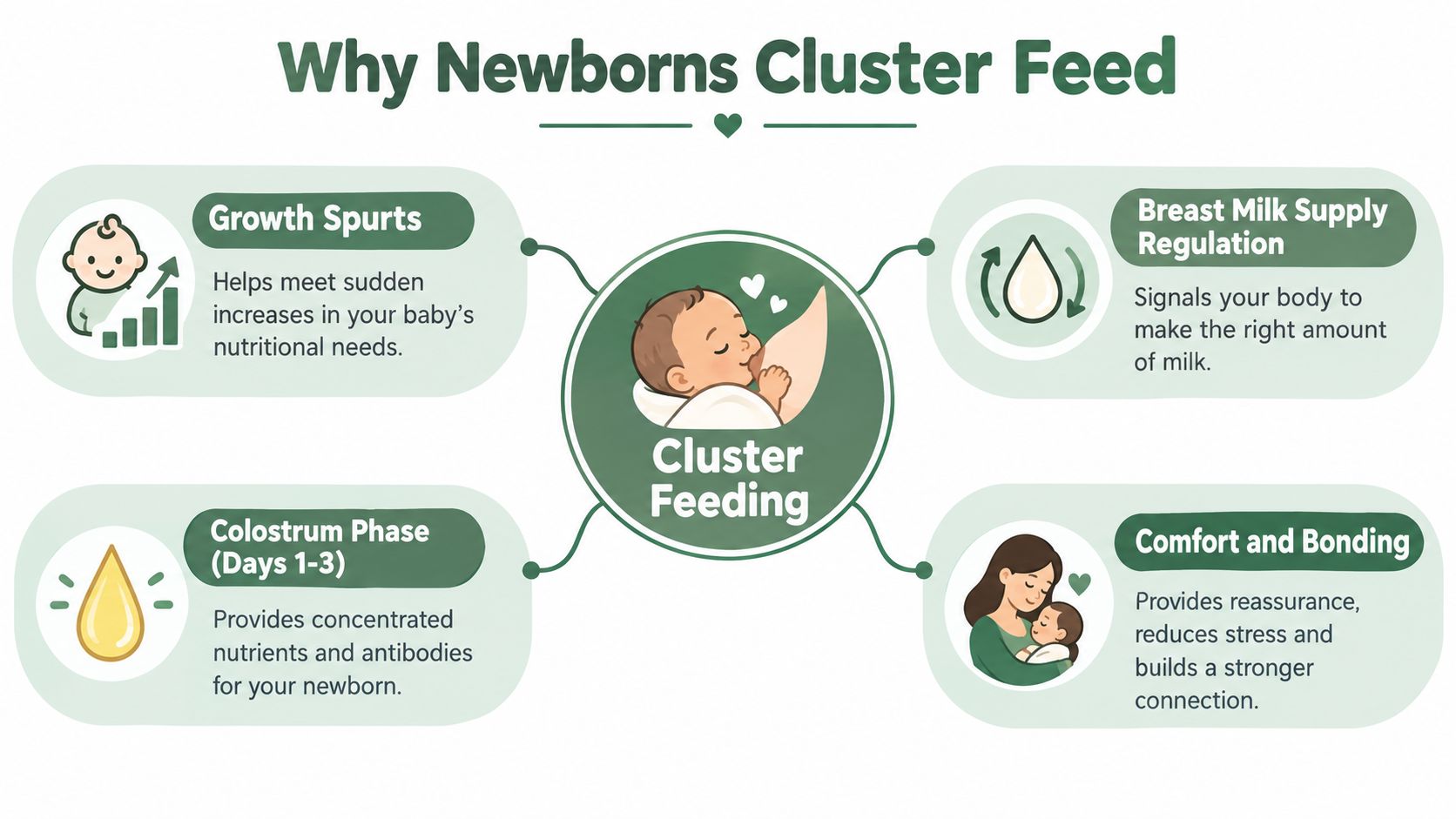
The evening scene that felt senseless has a biological explanation. Your baby may be asking for repeated opportunities to eat, soothe, practice, and help regulate milk production. For a broader look at how newborn patterns vary, see infant feeding patterns.
A helpful reframe: A cluster is a period of intensified feeding, not proof that something has gone wrong.
Distinguishing Normal Clusters from Concerning Patterns
The number of feeds matters, but it doesn't answer the whole question. A newborn can feed several times close together and still transfer milk well. Another baby can feed frequently yet need help with latch, milk transfer, or supply.
Use the feeding episode as one observation within a full-day pattern. During nursing, listen and look for swallowing rather than assuming that every sucking movement transfers milk. Consider whether the latch feels effective, whether your baby seems more settled after feeding, and whether weight and diaper trends are reassuring.
A practical review
At the end of a 24-hour period, ask:
- Is your baby feeding regularly across the day and night?
- Do you see or hear swallowing during feeds?
- Does the latch appear secure and feel manageable?
- Does your baby show periods of contentment or alertness?
- Are wet diapers and stools changing as expected?
- Are clinical weight checks showing an appropriate trajectory?
The CDC flags fewer than eight feeds per day, continued weight loss after day five, fewer than six urinations or three bowel movements per day by day five, poor latch, or no visible or audible swallowing as reasons to contact a healthcare professional (CDC newborn breastfeeding basics). These are screening indicators, not a diagnosis.
Consistently very short feeds, under roughly 10 minutes, or very long feeds, over roughly 50 minutes, may also suggest ineffective suckling or insufficient milk production. Bring that pattern to a pediatrician or lactation professional rather than trying to interpret it alone.
| Normal Cluster Feeding | Indicators for Evaluation |
|---|---|
| Several feeds close together during a concentrated period | Frequent feeding that continues throughout the entire day |
| Sustained swallowing during at least part of the feed | No visible or audible swallowing |
| A latch that appears effective and is not persistently painful | Poor latch or ongoing feeding pain |
| Periods of calm, alertness, or satisfaction after feeds | Persistent lethargy or a baby who never seems to settle |
| Reassuring diaper output and clinical weight checks | Fewer than six urinations or three bowel movements per day by day five |
| A temporary burst followed by a longer interval | Continued weight loss after day five |
Families may describe the same observations in English or Spanish. A bilingual caregiver can record “swallowing,” “wet diaper,” “toma,” or “pañal mojado” in the language that feels clearest, then share those notes with the pediatrician or lactation professional.
Tracking Feeds for Caregiver Coordination
A timestamped record can answer a question that memory can't: was the baby feeding in one concentrated burst, or unusually often all day? Record the start time, duration, and caregiver identity for each feed. If breastfeeding, note the side when useful. Also record wet diapers, stools, and any relevant weight checks.
This matters when care changes hands. A partner may see the evening cluster, a grandparent may take over overnight, and a nanny or daycare provider may need to understand what happened before the baby arrived. Without a shared record, every handoff depends on tired recollection, and small but important details disappear.

Record patterns, not just episodes
A useful log includes more than “fed”:
- Timing: When did the feed start, and how close was it to the previous feed?
- Effectiveness: Was swallowing sustained, occasional, or absent?
- Duration: Was it a brief session or an unusually long one?
- Context: Was the baby calm, sleepy, unsettled, or difficult to wake?
- Whole-day picture: How many feeds, wet diapers, stools, and clinical observations appeared across 24 hours?
For example, a record might show several feeds concentrated in the evening, sustained swallowing, and reassuring diaper output, followed by a longer sleep interval. That pattern looks different from repeated brief attempts scattered across the entire day with little swallowing and concerning diaper trends.
A shared digital log can make this coordination easier for parents, partners, grandparents, nannies, and daycare caregivers. Cradlo is one option that lets caregivers record feed timing, duration, breastfeeding side, and bottle amounts in a shared timeline. You can also use a paper notebook or the baby feeding log template, as long as every caregiver understands what to record and where to find it.
Managing Cluster Feeding Without Losing Your Mind
Cluster feeding asks a lot of the nursing parent, especially when the same evening also includes dinner, older children, household tasks, or a return to work. The goal isn't to perform each feed perfectly. It's to make the repeated sessions physically and emotionally more manageable while keeping an eye on the baby's overall pattern.
Set up a comfortable place before the usual unsettled period begins. Support your back and arms, keep water and food within reach, and use positions that let your shoulders relax. A partner can refill your drink, prepare a meal, change the baby, manage burping, or handle messages while you focus on feeding.
Match the response to the pattern
If your baby is feeding in a short, effective burst and the broader intake picture looks reassuring, practical support may be all you need. You don't have to stop every cluster or treat it as a supply emergency. Pumping changes should be discussed with a lactation professional, particularly if you're considering extra pumping because you're worried about milk supply.
If the pattern includes little or no swallowing, a poor latch, persistent pain, concerning diapers, or a baby who is unusually sleepy, contact a pediatrician or lactation professional. The difference isn't “many feeds versus few feeds.” It's frequent and effective compared with frequent and potentially ineffective.
HealthyChildren.org notes that by 5 to 7 days old, babies should have 6 or more wet diapers per day with nearly colorless or pale-yellow urine (HealthyChildren.org's guidance on recognizing adequate milk intake). Use this kind of observation alongside weight and feeding behavior, not as a substitute for professional assessment.
Let care become a team activity
Partners, grandparents, nannies, and paid caregivers can protect the nursing parent's rest without replacing the feeding relationship. They can bring food, manage the environment, track diapers, and write down what happened. In multilingual households, agree on simple English or Spanish terms for feeds, diapers, pumping, and concerns so information remains clear during tired handoffs.
Some nights will feel harder than others. Cluster feeding is temporary, and getting through it imperfectly still counts as getting through it.
When Cluster Feeding Changes
The pattern usually changes as the first week passes. Cleveland Clinic notes that around-the-clock cluster feeding can be normal during the first few days, while by days 4 to 5 many babies generally nurse approximately every 2 to 3 hours. By the end of the first week, continuous all-day cluster feeding is no longer expected for most infants (Cleveland Clinic's explanation of changing cluster-feeding patterns).
That doesn't mean every newborn suddenly follows a predictable schedule. Feeding may remain uneven, with a concentrated evening period followed by a longer interval. Over time, milk production becomes established and many infants become more efficient at feeding, so the most intense early pattern often feels less consuming.
Notice a change without demanding a schedule
A temporary return to frequent feeding can happen during a growth-spurt period. It doesn't automatically mean your technique or milk supply has failed. Look for the same whole-day clues you've been tracking: swallowing, latch, alertness, diaper output, satisfaction, and clinical weight information.
You may find it useful to read about the three-week growth spurt, while remembering that babies don't all follow identical timing. A brief change can be part of normal development, but persistent all-day feeding or concerning intake signs deserve an individual review.
Give the phase an ending
The early weeks can feel endless because feeding occupies so much of the day and night. Yet newborn patterns change in small increments: one calmer stretch, a more efficient feed, a handoff that doesn't require waking everyone, or a log that finally makes the day understandable.
You don't need to predict the next feed perfectly. You need enough information to notice trends and enough support to avoid carrying every decision alone.
Key Takeaways for Navigating Cluster Feeding
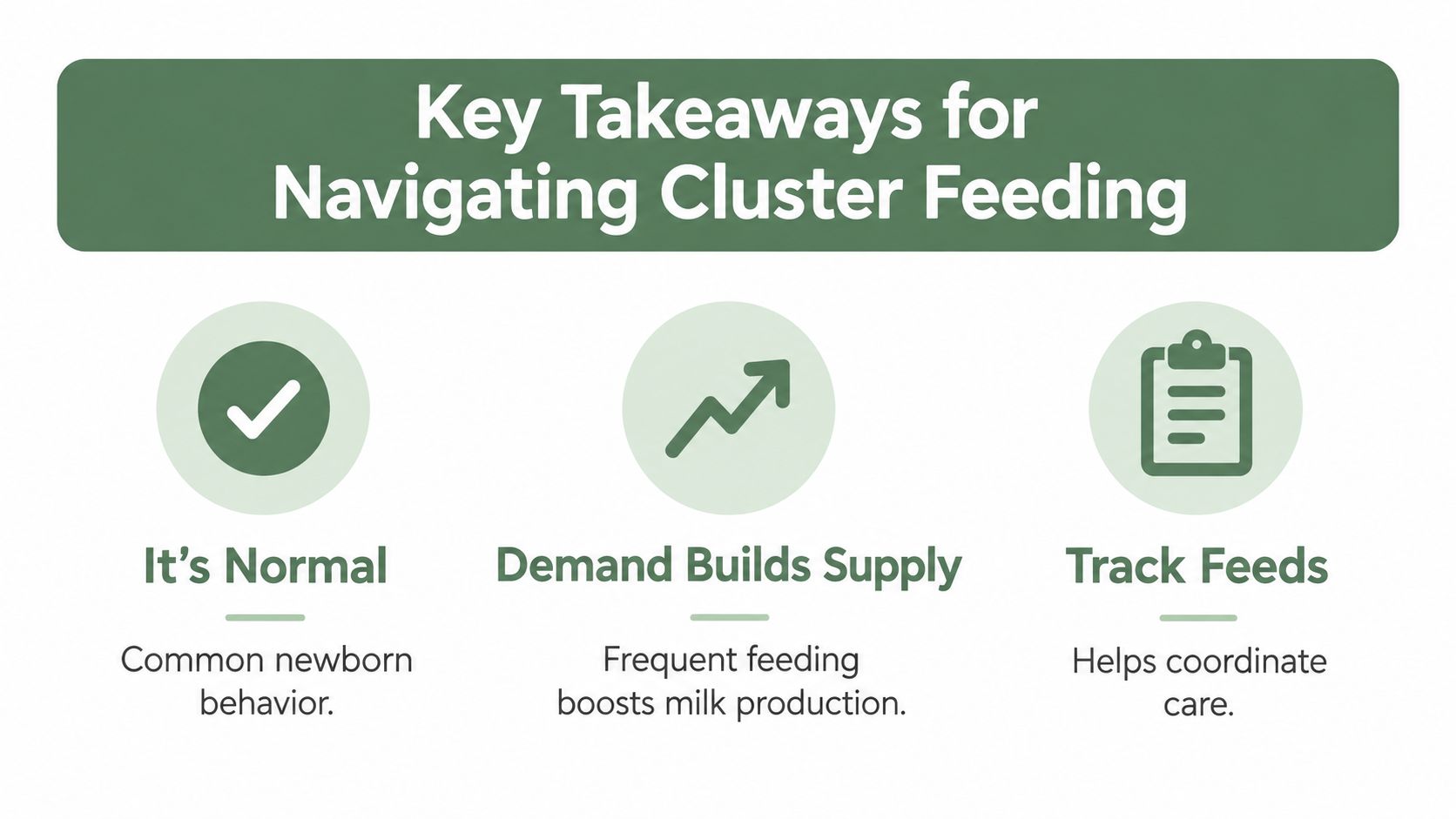
Cluster feeding is a normal intensification of newborn feeding, not a separate condition and not automatically a sign of low milk supply. A baby may nurse repeatedly during an evening or another short period, then take a longer rest. The pattern can feel relentless even when feeding is going well.
Frequency is only one part of the picture. Swallowing, latch quality, contentment, alertness, diaper output, and weight trajectory help show whether repeated feeds are effective. If the baby is feeding fewer than expected, has poor latch or no visible swallowing, continues losing weight after day five, or has concerning diaper output, contact a pediatrician or lactation professional.
Keep the record useful
When several caregivers share care, a systematic record can reduce guesswork. Log the start time, duration, caregiver, swallowing, diapers, stools, and other context across the day. A shared record helps a partner, grandparent, nanny, or daycare provider see whether the baby had one concentrated burst or a pattern that continued around the clock.
Persistent, 24-hour frequent feeding after the first week should be discussed with a pediatrician or lactation professional, especially when paired with poor weight gain, inadequate wet diapers, lethargy, or signs of dehydration. The record won't diagnose the cause, but it can give a clinician a clearer account of what your baby has been doing.
Cluster feeding is demanding, but it's a phase rather than a permanent state. You don't need to have every answer, every feeding position, or every handoff figured out to be caring well for your baby.
Cradlo gives families one shared timeline for recording feeds, breastfeeding sides, durations, bottles, diapers, and caregiver identities, so cluster-feeding patterns are easier to understand across home and childcare. Visit Cradlo to explore the shared tracker and start the 7-day free trial on the monthly plan.