How to Feed Twins at the Same Time Without Losing Your Mind
At 2 a.m., one baby is rooting while the other has just started crying. There are two bottles warming, two burp cloths somewhere under the blankets, and one exhausted parent trying to remember who finished the last feed. You know both babies ate recently, but “recently” isn't a useful record when each twin has a different appetite and pace.
That's the part people often miss when they talk about how to feed twins at the same time. The feeding itself is only half the work. The other half is coordinating two babies, more than one caregiver, changing amounts, pumping, diapers, and handoffs when everyone is tired. Simultaneous feeding can help, but it isn't a parenting exam, and it won't remove every hard night.
Table of Contents
- The 2 a.m. Reality of Feeding Two Babies
- Simultaneous, Separate, or a Mix
- Tandem Breastfeeding Positions and Setup
- Feeding Two Babies Bottles at the Same Time
- Combination Approaches for Real Days
- A Sample Schedule and a Pre-Feed Checklist
- Troubleshooting and When to Ask for Help
The 2 a.m. Reality of Feeding Two Babies
The hallway light is low. One bassinet makes a soft rustling sound, and the other baby has gone from sleepy grunts to an urgent cry. You pick up the first twin, reach for a bottle, and realize you can't remember whether that was Baby A or Baby B who took the larger feed earlier.
Then the questions start arriving all at once. Which side did each baby nurse from? Did one stop because they were full, or because they got sleepy? Did the slower bottle still have a little left? Your partner is asking from the doorway, a grandparent is texting about the next feed, and nobody wants to wake the baby who finally settled.
This scene can repeat several times through the night. No single feeding method fixes the exhaustion by itself. A workable system reduces the guessing, which is often the part of twin care that makes an already difficult feed feel impossible.
The useful question isn't “Am I feeding them the right way?” It's “Can the next caregiver understand what happened without asking me to reconstruct it?”
The American Academy of Pediatrics describes waking the other twin when one wakes to eat as a “golden rule,” so both babies can feed together and follow a more synchronized pattern (guidance on feeding twins on a schedule). That can create a longer shared rest period, but families still need room for individual hunger cues and medical guidance.
A simple log carries some of the mental load. Record the time, which baby fed, the amount or breast side, and anything unusual, such as a difficult latch or an interrupted burp. A phone note works. So does paper on the refrigerator. A shared tracker can be useful when a partner, nanny, grandparent, or daycare caregiver takes over, especially in Spanish-speaking families where more than one person may be helping across shifts.
The aim is not perfect data. It's to stop making a tired brain serve as the only source of truth.
Simultaneous, Separate, or a Mix
Start with the choice of feeding pattern, not with a pillow or bottle. Simultaneous feeding means both babies eat during the same window, often close enough together that one parent can settle them at roughly the same time. Separate feeding means one baby feeds first and the other follows. A mixed routine uses both, depending on the babies, the caregiver available, and the time of day.
Twins Trust states that simultaneous feeding is “not a rule you have to follow”, and some mothers feed both babies together while others feed one after the other (feeding routines for twins). That flexibility matters. A baby with a slower latch may need individual attention, and a parent recovering from birth may find one arrangement physically easier than another.
| Approach | Time per Session | Adults Needed | Tracking Complexity | Best Fit For |
|---|---|---|---|---|
| Simultaneous | One shared feeding window | One adult can sometimes manage it, with help useful | Moderate, because each baby still needs an individual record | Families prioritizing synchronized rest |
| Separate | Two feeds back to back | One adult can do it, though the cycle takes longer | Often simpler for observing each baby | Parents focusing on latch, pace, or one baby's needs |
| Mixed | Varies by feed | Flexible | Highest unless each feed is recorded clearly | Families sharing shifts or adapting to uneven feeding |
Simultaneous feeding can reduce the total time spent actively feeding and may help synchronize sleep patterns. Separate feeding offers more concentration. You can watch one latch, notice swallowing, adjust the bottle angle, or pause for a burp without splitting your attention.
A solo parent may prefer tandem feeds during the day and separate feeds when one twin needs extra help. Partners might alternate who handles which baby. A grandparent or nanny may take one baby while the parent feeds the other. Daycare may use a different routine entirely, so the record needs to travel with the babies rather than staying in one caregiver's memory.
The practical test is simple: does the arrangement leave both babies fed and the adults able to repeat it? If not, change the pattern. You don't need to defend the decision.
Tandem Breastfeeding Positions and Setup
Tandem breastfeeding gets easier when the setup does the work before either baby latches. Put a firm twin-feeding pillow on a stable chair or bed, keep water and bottles on a flat surface nearby, and place a burp cloth over each shoulder. Open your phone or notebook before picking up the babies. Once both infants are in position, reaching for supplies becomes awkward.
The two common positions are double-football and double-cradle. In double-football, each baby rests alongside one side of your body, with their feet pointing behind you and their heads near the breast. Support each head and neck carefully. This position usually gives more control while you're learning because you can see both latches and keep their bodies aligned.
Double-cradle places both babies across your lap, with their bodies crossing toward opposite sides. It can feel more natural later, once both babies have better head control and can stay latched with less hands-on adjustment. Keep your feet supported and raise the pillow high enough that you can sit upright. Bring the babies to your body, rather than bending your body toward them.
A steady sequence for the first attempts
- Settle the pillow and your own posture first.
- Position one baby and help them achieve a stable latch.
- Ask a partner, grandparent, or nanny to hand you the second baby if possible.
- Bring the second baby into position without disturbing the first.
- Check both mouths, shoulders, and necks before relaxing your hands.
Stanford Medicine recommends initially feeding each infant separately until both parent and babies have developed breastfeeding competency, then introducing simultaneous nursing once each baby can latch and stay on independently (breastfeeding guidance for mothers of multiples). That means there's no need to force tandem nursing from the first latch. A partner or helper is especially valuable during the first week of trying it, even if their only job is handing over the second baby.
Many lactation consultants suggest waiting until breastfeeding is established, often around two to four weeks, before adding the second twin to a session. Treat that as a practical starting point, not a deadline. If either baby has a painful latch, poor transfer, or another feeding concern, ask a lactation professional for individual help.
For low-light feeds, a gentle night light can help you check alignment without fully waking everyone. Cradlo's guide to choosing a night light for feeding a baby may help you think through that part of the setup.
Feeding Two Babies Bottles at the Same Time
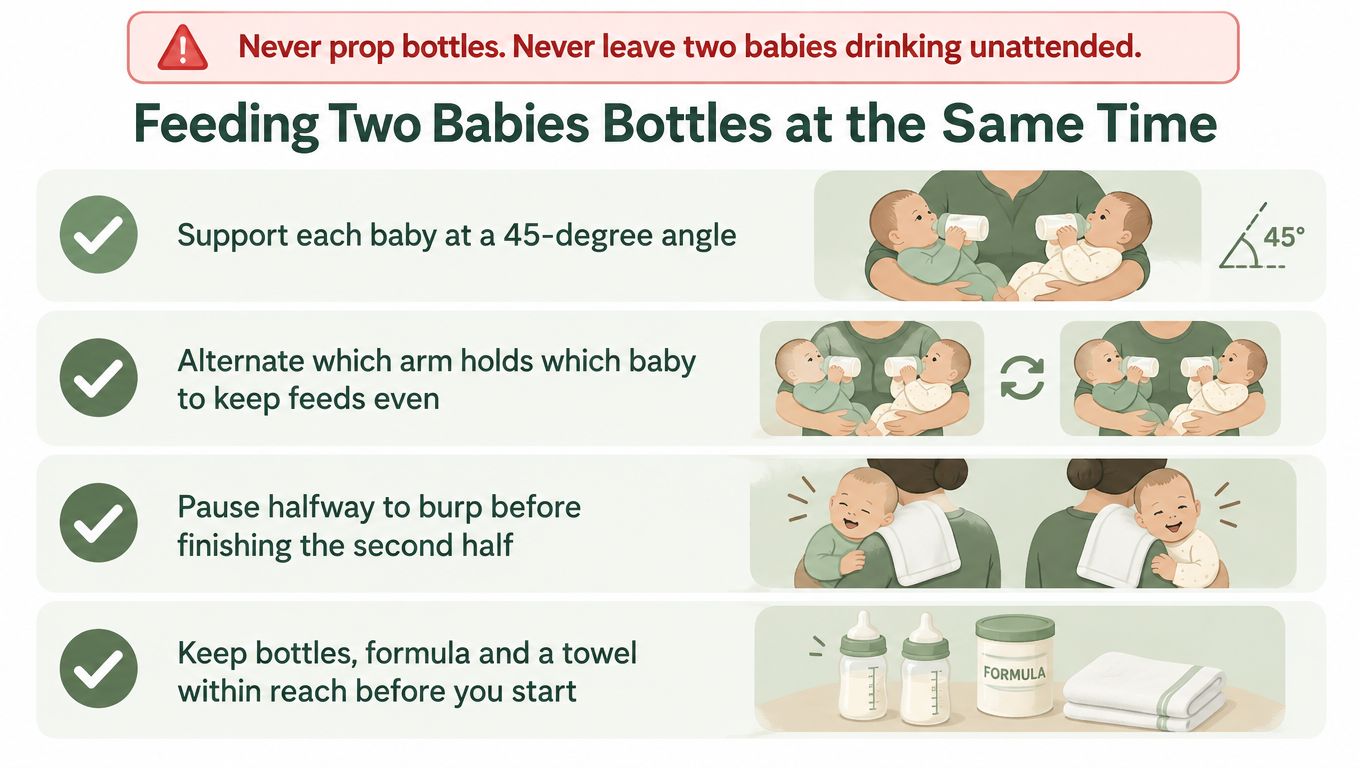
Bottle feeding two babies at once needs its own plan. Never prop bottles, and never leave two babies drinking unattended. One adult can sometimes feed both babies, but that adult needs to stay present, watch breathing and cues, and let each baby finish at their own pace. Twins Trust gives the same safety emphasis in its guidance on how to bottle-feed twins safely.
Prepare the station before you bring the babies over. Use two secure, supportive seats or a twin-feeding pillow, keep bottles and burp cloths within reach, and make sure each baby is supported in an upright position. The arrangement should let you see both faces clearly. If you can't easily reach one baby, change the setup before starting.
Paced feeding keeps the focus on each infant rather than on making both bottles disappear together. Hold the bottle so the baby controls the flow, pause when they show stress or fatigue, and burp according to that baby's needs. The faster drinker doesn't set the pace for the slower one.
When one adult is enough
Solo bottle feeds tend to be more manageable when both babies are stable eaters and the caregiver can respond to each infant without leaving either one unsupported. Newborn fussiness, frequent pauses, or complicated burping can make a second adult the safer choice. Preterm infants and babies with reflux may need more individualized attention, so ask the pediatrician or feeding professional how to structure those feeds.
Watch for early hunger cues in each twin, such as rooting, hand-to-mouth movements, or increasing restlessness. If both babies signal at once, start the baby who is harder to settle, then bring the other into position. During the feed, check the slower drinker first. That tiny habit prevents the more vocal twin from receiving all your attention.
A cue-based approach can coexist with a shared routine. Waking the other twin when one wakes may help synchronize the day, but it doesn't mean forcing either baby to finish a bottle. A schedule can organize the opportunity to feed. The babies' cues determine what happens inside that window.
For practical bottle organization, a baby bottle-feeding schedule resource can help you think through the difference between a repeatable pattern and a rigid clock.

Combination Approaches for Real Days
Twin families often need a menu of methods rather than one permanent answer. You might tandem nurse in the morning, bottle-feed in the afternoon, and feed separately overnight because one baby needs more burping. The pattern can change as latch skills, milk supply, sleep, and caregiver availability change.
| Method | Best Fit For | Main Tradeoff |
|---|---|---|
| Nurse one, bottle one | A solo parent managing different feeding needs | Both babies need clear records so the rotation stays fair |
| Pump plus bottle | A parent who needs another caregiver to take a feed | Pumping adds its own task during an already full day |
| Tandem nursing for selected feeds | Families comfortable nursing together at certain times | It may not work when one baby needs individual latch support |
| Caregiver shifts | Partners, grandparents, or nannies sharing responsibility | Handoffs fail if the last feed isn't recorded clearly |
One useful rotation is to nurse one baby while the other takes expressed milk or formula, then switch at the next feed. Another is to tandem nurse when both babies latch well, while offering a top-up to the twin who still shows hunger. If protecting milk supply is part of your plan, a lactation professional can help you decide where pumping fits without turning every rest window into another obligation.
Shift patterns help too. One parent may handle the first part of the night while the other covers mornings. A grandparent might take the first feed after breakfast, or a nanny might own the log and setup during the day. The arrangement doesn't need to look symmetrical to be fair.
When one twin latches easily and the other struggles, give the struggling baby the method that allows better observation. That might mean separate nursing while the other receives a bottle, not because one baby is “winning,” but because the feed needs a different level of attention.
A workable routine can be uneven. Revisit it as the babies grow, and change the mix when the current version leaves everyone depleted.
A Sample Schedule and a Pre-Feed Checklist
A sample routine for twins around six to eight weeks old can provide shape without becoming a rulebook. Use the baby who wakes first as the signal, then wake the sleepier twin if that fits your pediatrician's guidance and your babies' individual needs. The times below are anchors for handoffs, not promises that every feed will happen on schedule.
| Time block | Possible routine |
|---|---|
| Early morning | Tandem feed, then diaper changes and a caregiver handoff |
| Mid-morning | Separate feeds if one baby needs extra latch or burping support |
| Late morning | Tandem feed, followed by a pumping session if part of your plan |
| Afternoon | One baby nurses while the other takes a bottle, then switch at the next feed |
| Early evening | Shared feed with both caregivers available for burping and settling |
| Overnight | If one baby wakes, prepare to feed both, with the off-duty caregiver handling setup or cleanup |
Before each feed, run through the same short list:
- Set up the equipment: Place the nursing pillow, bottles, pump parts, or formula within reach.
- Check the babies: Look at diaper status and early hunger cues for each twin.
- Assign the roles: Decide who is feeding Baby A, who is feeding Baby B, and who handles burping.
- Open the record: Log the start time, breast side or amount, and anything that needs follow-up.
- Plan the handoff: Note who will take the next feed or check the slower eater.
A shared feeding log can be as simple as time, baby, ounces or breast side, and next due. It gives a partner, nanny, grandparent, or daycare caregiver a clear starting point instead of forcing them to ask, “Who ate last?” Cradlo is one option for recording feeds across separate child profiles, with entries available to the caregivers connected to the family account.
You can also use a baby feeding log template if paper feels faster during the newborn stage. The best system is the one people update at 3 a.m.
Troubleshooting and When to Ask for Help
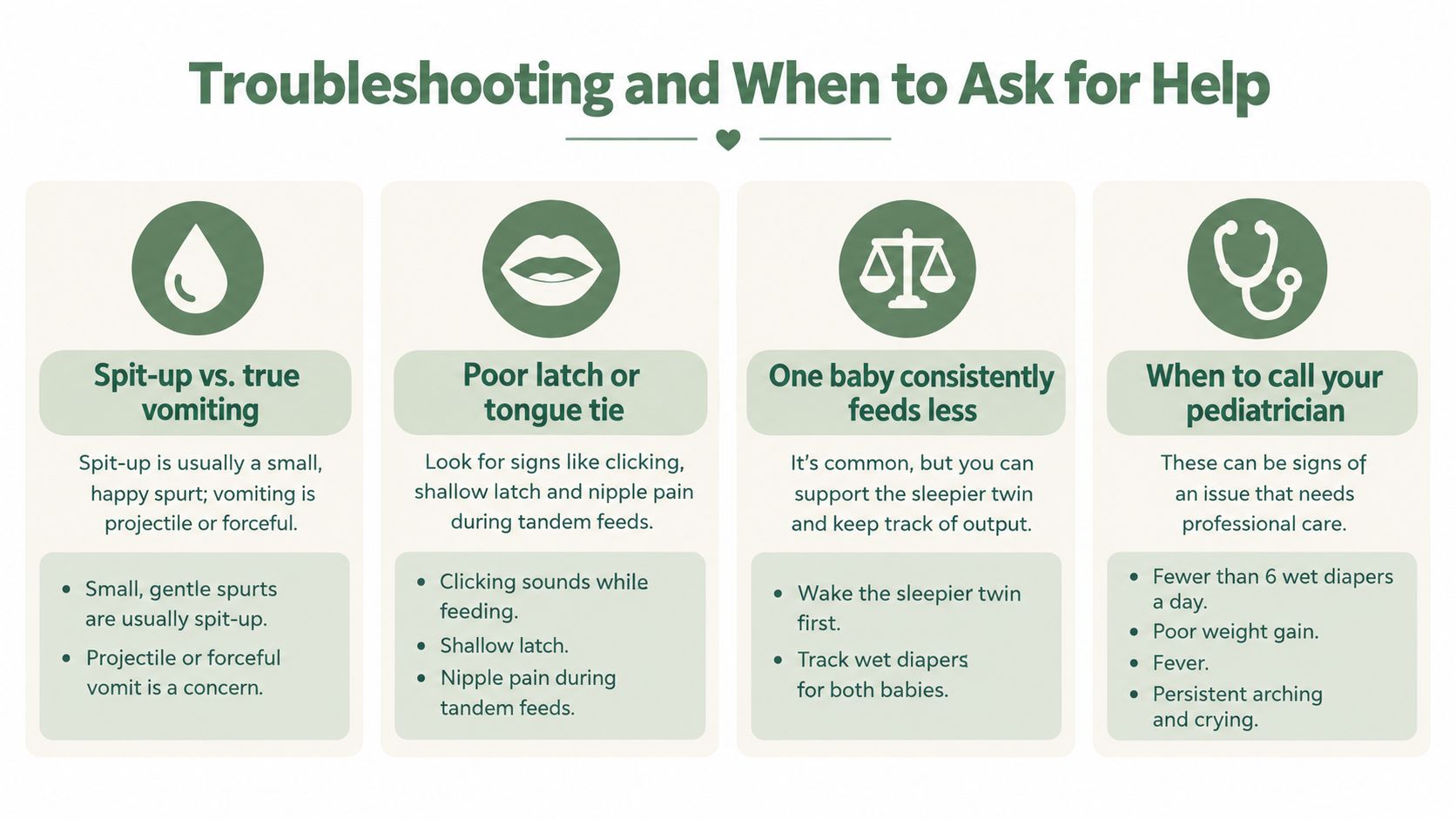
Once the mechanics are familiar, the problems usually become more specific. One baby may finish quickly while the other needs several pauses. One may refuse a bottle, spit up more often, or seem uncomfortable after feeds. The answer isn't always to synchronize more aggressively.
For a faster eater, slow the pace and give that baby pauses. For a slower eater, keep checking in rather than assuming they'll catch up. A mid-feed burp can help when gas is interrupting the feed, but persistent discomfort deserves professional input. Switching which breast each twin uses, and alternating sides between feeds, can help prevent one baby from always receiving the higher-flow side.
Small adjustments worth trying
- Uneven nursing: Alternate breasts between twins and between feeds, while watching latch quality rather than trying to make the sessions identical.
- Different bottle speeds: Pace the faster baby and let the slower baby set their own rhythm.
- Tandem latch collapse: Stop, reset the pillow, and feed separately if either latch becomes painful or unstable.
- Spit-up concerns: Note when it happens and how the baby behaves afterward. Ask the pediatrician whether the pattern needs assessment.
- Bottle refusal: Avoid turning the feed into a struggle. Offer calm, responsive attempts and ask a feeding professional for help if refusal continues.
Don't use a fixed time limit or supplementing plan without advice specific to your babies. Feeding concerns can involve weight, hydration, latch, supply, or swallowing, and those require assessment rather than guesswork.
Call your pediatrician or lactation professional about poor weight gain, signs of dehydration, painful nursing, or a baby who consistently feeds much less than expected. An IBCLC can assess latch and milk transfer. A postpartum doula can help with positioning and handoffs, while a mental health professional can support a parent who feels persistently overwhelmed, frightened, or unable to rest.
Asking for help is a caregiving skill, not evidence that you've failed.
A shared tracker can make those conversations clearer by showing patterns across feeds, pumping, diapers, and caregivers. It doesn't diagnose a problem, but it can help you notice what changed and explain it without relying on a tired memory.
Cradlo gives families, nannies, grandparents, and daycare caregivers one shared place to log each twin's feeds, pumping, diapers, and sleep, with separate child profiles and real-time syncing across connected devices. Visit Cradlo to try the monthly plan with a 7-day free trial and make the next overnight handoff a little easier to understand.