What Is Power Pumping and Does It Actually Work
You're staring at a bottle after pumping, and the amount looks smaller than you expected. Maybe yesterday's session produced more. Maybe someone mentioned power pumping, and now you're wondering whether it could help, whether you're doing enough, or whether the number on the bottle means your supply is low.
That uncertainty is common, but one pumping session can't diagnose a supply problem. Output changes with recent feeds, time of day, pump fit, breast emptying, stress, and individual medical circumstances. Your baby may also remove milk more effectively than a pump, so a bottle measurement doesn't always describe the whole feeding picture. A helpful place to start is learning how infant feeding patterns can vary.
Power pumping is one short-term strategy that may be discussed when supply seems low or has been clinically assessed as low. It isn't a test of your commitment, a replacement for regular feeding, or a promise that your body will respond in a particular way. You'll find a clear definition, a realistic schedule, the body's likely response, and the signs that mean another kind of support would make more sense.
Table of Contents
- The Moment You Start Wondering About Your Supply
- Defining Power Pumping in Plain Language
- How It Interacts With Your Body
- A Realistic Power Pumping Schedule for Real Days
- When Power Pumping Is Not the Right Next Step
- How Power Pumping Fits Into a Broader Pumping Plan
- Red Flags That Mean Stop and Reach for the Lactation Consultant
- A Calm Way to Think About Power Pumping
The Moment You Start Wondering About Your Supply
At two in the morning, a parent may look at a half-filled bottle and think, “Is this all my baby is getting?” A partner may be asleep, a grandparent may be waiting to prepare the bottle, or a nanny may have logged a feeding that doesn't seem to match yesterday's pattern. The number can feel like a judgment, even though it's only one observation.
Pump output naturally varies. A session after a recent nursing feed may look different from one after a longer interval. A different flange, suction setting, time of day, or level of comfort can also change what the pump collects. None of those observations, by themselves, establish that milk production is inadequate.
That distinction matters because power pumping is designed for a specific situation. It's generally considered for a parent trying to address perceived or clinically assessed low supply, not for someone comparing one bottle with a friend's bottle. A clinical review describes it as frequent milk removal at short intervals and notes that it's typically used when supply is low, while lactation guidance cautions that parents with an adequate supply may not need it. You can read the clinical review of power pumping and low supply for that broader context.
A low-looking bottle is a reason to gather more information, not a verdict about your body.
If your baby's weight gain, hydration, or feeding effectiveness is also a concern, a lactation consultant or healthcare professional can assess the situation with you. Power pumping may be part of that plan, but it doesn't need to be your first response to every disappointing session.
Defining Power Pumping in Plain Language
You finish a pumping session, look at the bottle, and wonder whether one more round might help. Power pumping, also called cluster pumping, is a short-term pattern that adds repeated stimulation within one extended session. It resembles the repeated feeding bursts some babies have during cluster feeding.
The pattern is simple: pump, rest, then pump again. A commonly used version begins with 20 minutes of pumping, followed by 10 minutes of rest, then another 10 minutes of pumping, another 10 minutes of rest, and a final 10 minutes of pumping. Alder Hey's power-pumping guidance describes it as a temporary approach often tried once daily for several consecutive days, rather than a permanent replacement for regular milk removal.
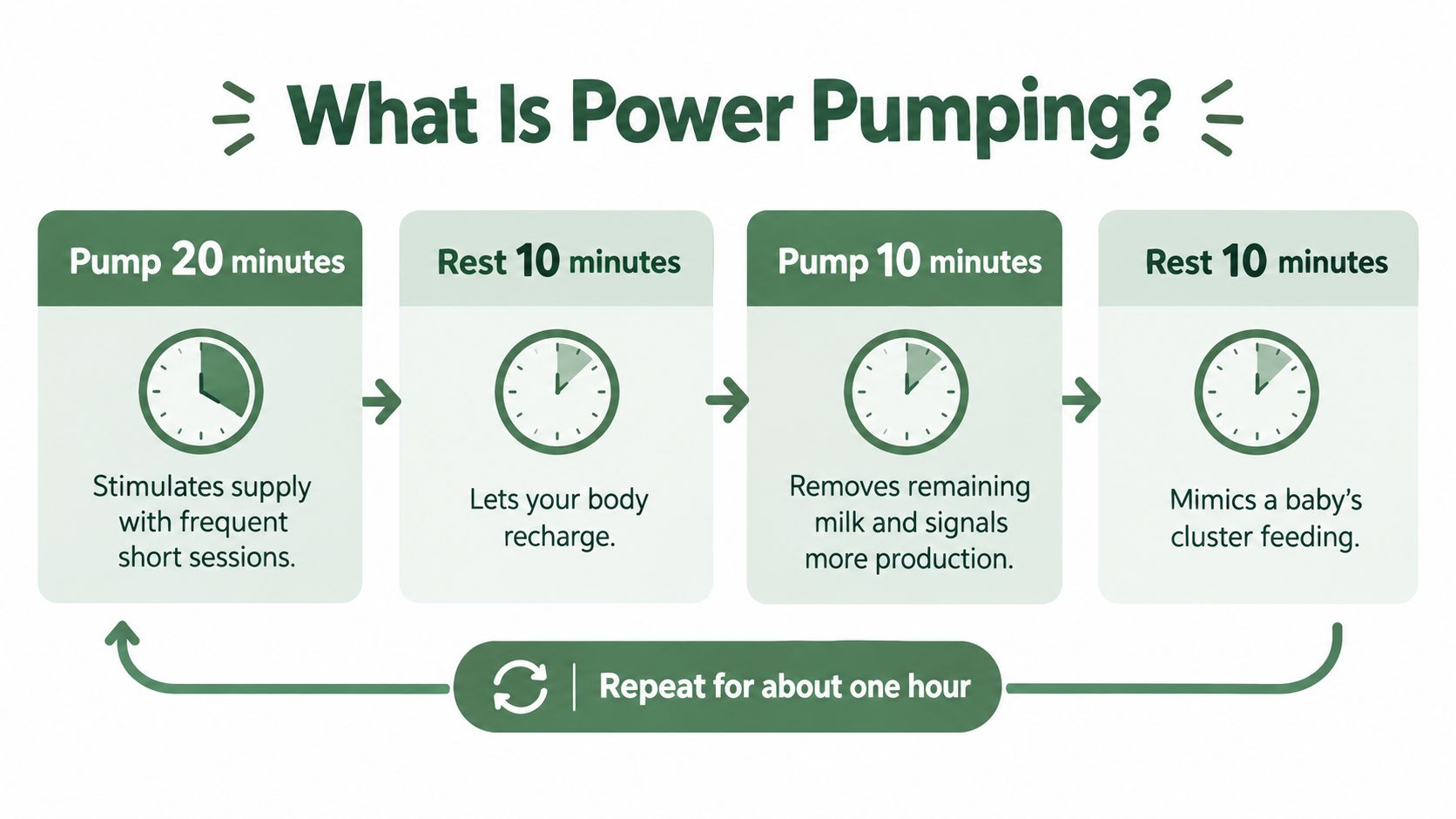
Some NHS trusts describe a shorter variant of three 10-minute pumping periods separated by 10-minute rests. The principle is repeated stimulation, rather than one long, uninterrupted session.
What makes it different from ordinary pumping
A regular pumping session usually involves one continuous period of expression. Power pumping adds starts and stops, creating several stimulation signals during a concentrated window. It does not mean your usual routine has failed. It is one possible tool within a wider pumping plan.
The technique may be considered when supply is low or needs support. A smaller-than-usual session, a baby's cluster-feeding day, or another parent's larger bottle does not automatically mean power pumping is appropriate. Pump volume also cannot show exactly how much milk a baby transfers during direct nursing.
Treat the method as an experiment, not a promise. Some parents notice a change after repeated milk removal, while others need help identifying an underlying issue or a different adjustment. Your overall output pattern, comfort, feeding context, and professional assessment matter more than a single bottle.
How It Interacts With Your Body
Milk production responds to repeated signals. Nipple stimulation from a baby or pump encourages the release of prolactin, a hormone involved in milk synthesis. Regular milk removal helps maintain that stimulation, particularly during early lactation.
Milk left in the breast also sends local feedback that can slow production. Removing milk reduces that signal, giving the breast an opportunity to continue making milk. A breastfeeding guide from Trinity Health describes both parts of this process, hormonal stimulation and feedback related to milk storage.
A simple way to picture the signal
A sink often drains more smoothly when it is used regularly. Water sitting in the basin can slow the flow, while repeated draining keeps the system moving. Power pumping uses several cycles of stimulation and milk removal within one concentrated period.
This helps explain why the technique may support production when milk is not being removed often or effectively enough. It cannot predict the response for every parent, because the reason for low production matters. The body reads the pattern across repeated sessions and days.
Pain, nipple trauma, poor flange fit, uncomfortable pump settings, retained placental tissue, hormonal conditions, and infant-transfer problems each require individual attention. More pumping may fail to address the underlying cause and could make feeding feel harder. A lactation professional can help separate a milk-removal difficulty from a medical or feeding concern.
Your body responds to the overall pattern of stimulation and removal over days, not to any single session.
A low-volume session therefore does not show that power pumping has failed. A larger bottle does not show that supply has permanently changed, either. Compare output across similar sessions, caregivers, and feeding circumstances, while also considering comfort and the baby's intake. That broader view can show whether this tool is helping or whether another adjustment deserves attention.
A Realistic Power Pumping Schedule for Real Days
A 60-minute session can look simple on paper and feel difficult in a real household. The practical question is often not whether you understand the pattern, but whether you can create enough uninterrupted time to use it without losing the rest of your feeding routine.
Choose a window when another caregiver can hold, feed, or settle the baby. That might be early in the day, after a partner takes over, or during a predictable childcare period. Morning may suit one parent, while another has a better opportunity later. Your own energy, support, and daily rhythm matter more than copying someone else's clock.
If a partner, grandparent, nanny, or daycare caregiver feeds the baby while you pump, agree on how the session will be recorded. Note the start time, pumping and rest periods, and expressed amount. These details help you compare similar sessions later, rather than judging the technique from one bottle.
A breastfeeding pumping schedule with practical timing guidance can help you place an extra session alongside regular nursing or pumping. Use the schedule as a way to organize the day, not as a demand to follow every interval perfectly.
Keep ordinary nursing or pumping sessions in place unless a lactation professional recommends another arrangement. Power pumping is an added stimulation session, so check that your flange feels comfortable and your pump settings remain tolerable. Pain, pinching, or nipple rubbing is a reason to adjust the setup, not to push through.
Have water nearby if you are thirsty, but hydration does not need to become another performance requirement. Rest and emotional capacity count too. A plan that leaves you exhausted may be difficult to sustain, even if the timing works on paper.
Trying the pattern once daily for several consecutive days is commonly recommended. A full session added to work, commuting, night care, and household responsibilities can be a substantial ask. If the routine makes daily feeding harder, discuss a shorter, less frequent, or different approach with a lactation professional.
When Power Pumping Is Not the Right Next Step
More pumping isn't automatically better. If your supply already meets your baby's needs, additional stimulation may create problems such as oversupply, engorgement, painful swelling, or blocked ducts. The technique may also be unnecessary when a baby is naturally cluster-feeding, because the baby is already providing frequent stimulation.
A clinical explainer on power pumping describes it as a strategy generally intended for parents addressing perceived or clinically assessed low supply. It also cautions that it may be inappropriate when supply already meets the baby's needs or when the baby is naturally cluster-feeding.
Ask whether the bottle is measuring the right problem
Pump volume is not a direct measurement of everything your baby can obtain at the breast. Output can change with stress, equipment, recent milk removal, time of day, and how well the breasts were emptied. A baby who nurses effectively may transfer milk differently from a pump, while a pump that doesn't fit well may leave milk behind or cause discomfort.
Before adding a concentrated session, consider:
- Supply question: Has a pediatrician or lactation professional identified low transfer or low production, or are you reacting to one smaller bottle?
- Equipment question: Could flange fit, suction, or pump function be affecting comfort and output?
- Body question: Are there painful areas, swelling, persistent lumps, or nipple damage that need attention?
- Capacity question: Would another hour of pumping reduce your sleep or make feeding feel unmanageable?
Power pumping can be counterproductive when the actual issue is oversupply, inflammation, poor fit, or a medical condition. Solving the right problem is more useful than following the most intensive schedule available.
How Power Pumping Fits Into a Broader Pumping Plan
A power-pumping session is one small part of a larger routine. It can add stimulation, but it doesn't replace the overall frequency and effectiveness of milk removal that the plan depends on. For parents who exclusively pump, a common starting point is expressing whenever the baby receives a bottle, with many families needing frequent sessions across the day and night.
That pattern is not a universal schedule. A parent early after birth may need a different routine from someone combining nursing, pumping, and formula. Before adding power pumping, compare your output across several sessions, caregivers, and times of day. One smaller bottle is a clue to examine, not proof that your supply has changed.
Shared care can make that comparison clearer. If one person nurses, another offers bottles, and daycare handles a feeding, the parent pumping later needs accurate context. A shared record can connect:
- Direct feeds, including approximate timing and which side was offered.
- Bottles, including who gave them and how the baby responded.
- Pumping, including start time, duration, and expressed amount.
- Diapers and behavior, which add context beyond milliliters.
- Symptoms and caregiver notes, such as discomfort, refusal, or unusual fussiness.

A shared tracker lets parents, partners, grandparents, nannies, and daycare staff review the same routine instead of relying on memory. Cradlo records pumping start time, duration, and expressed amount, and supports shared logging across caregivers. It is available in English and Spanish. This breast-pumping guide can also help you record the full routine and judge whether power pumping adds useful information, rather than treating one bottle as the whole picture.
Red Flags That Mean Stop and Reach for the Lactation Consultant
Pause power pumping and contact a pediatrician or lactation professional if the experience is becoming painful or if the baby's feeding picture raises concern. You don't need to keep extending sessions while waiting to see whether the problem resolves.
Contact an appropriate healthcare professional for individualized guidance if you notice:
- Worsening pain, especially pain that continues between sessions.
- Nipple trauma or bleeding, including skin damage that isn't improving.
- Breast redness or warmth, particularly when it's accompanied by feeling unwell.
- Fever, which deserves prompt medical attention.
- Persistent lumps, especially if they remain despite ordinary feeding or pumping.
- Concerns about milk transfer, such as ineffective feeding at the breast.
- Concerns about weight gain, hydration, or feeding effectiveness, which should be assessed rather than inferred from pump volume.
These signs don't tell you what diagnosis is present, and this article can't provide medical advice. They do tell you that adding stimulation isn't the only question. A pediatrician or International Board Certified Lactation Consultant can review your baby's feeding, your pump setup, your symptoms, and your broader history.
Shared care can make this easier to explain. Bring the logged details if you have them, including nursing, bottles, pumping, diapers, symptoms, and who provided each feed. A clear record gives the professional more context than a single sentence such as “I'm not making enough.”
A Calm Way to Think About Power Pumping
Power pumping is a short-term, high-frequency pumping pattern that imitates cluster feeding. The commonly used version is one extended session with alternating pumping and rest, often tried once daily for several days. Its purpose is repeated stimulation over time, not an immediate jump in the bottle.
A pilot randomized controlled trial involving mothers of very-low-birth-weight infants with low milk output compared a daily power-pumping session with routine pumping while both groups continued routine lactation support and hand expression every three hours. On day seven, the median amount expressed during the individual power-pumping session was 50 mL, compared with 27 mL during the routine-pumping session, according to the published trial report. That finding supports power pumping as a possible additional short-term stimulation strategy, not a guaranteed fix for every parent.
Before you begin, keep the full picture in view:
- Feeding: Record nursing and bottles, not only pump amounts.
- Pumping: Note timing, duration, comfort, and output.
- Baby's well-being: Track the information your pediatrician or lactation professional asks you to monitor.
- Your body: Pause for pain, bleeding, redness, warmth, fever, or persistent lumps.
- Your capacity: Include sleep, mood, work, and the support available from other caregivers.
- Next step: Seek individualized help when the pattern remains unclear.
Power pumping may belong in your plan, or it may not. The kindest approach is to treat it as one tool, read your output in context, and ask for help when the question is bigger than a schedule.
Cradlo helps families, partners, nannies, grandparents, and daycare caregivers log pumping, feeds, bottles, diapers, and daily care in one shared place, so you can see the pattern without reconstructing it from memory. Visit Cradlo to try the monthly plan with a 7-day free trial and build a clearer record around your feeding routine.