11 Month Old Sleep Schedule: How Many Naps Fit Your Day
It's 9:40 p.m. Your eleven-month-old is standing in the crib, delighted with this new skill, and you're sitting on the floor doing arithmetic. Did the afternoon nap start too late? Was the morning one too short? Should bedtime move?
The baby is fine. The math is the problem.
An 11 month old sleep schedule gets much easier when you stop grading it on one night and start reading it as a whole day. Two naps, awake stretches that make sense, and a bedtime that follows the last nap. That's the shape most families land on around this age. What makes it work isn't precision. It's a routine you can repeat and caregivers around you who know what it is.
Nothing here is a test. Some babies sleep straight through, some still wake once or twice, and both can sit comfortably inside a healthy day.
Table of Contents
- Sample 11-Month-Old Schedules at a Glance
- How to Build a Two-Nap Day Step by Step
- Judging Total Sleep Instead of Night Waking
- Bedtime Routines and Safe Sleep Across Caregivers
- Teething and Separation Anxiety Without Losing the Schedule
- Moving From Two Naps to One Without Overtiring
- Confirm Your Schedule Before Changing Anything
Sample 11-Month-Old Schedules at a Glance
Four day shapes cover most of what you'll see at this age. Find the row closest to the day you're already living.
| Pattern | Wake time | First nap | Second nap | Bedtime |
|---|---|---|---|---|
| Default two-nap day | 7:00 a.m. | about 10:30 a.m. | about 3:00 p.m. | about 8:00 p.m. |
| Early riser | 6:00 a.m. | about 9:30 a.m. | about 2:30 p.m. | about 7:00 p.m. |
| Shorter-nap day | 7:00 a.m. | about 10:00 a.m. (30 to 60 minutes) | about 2:30 p.m. (30 to 60 minutes) | about 7:30 p.m. |
| Late-morning start | 7:30 a.m. | about 11:00 a.m. | about 3:30 p.m. | about 8:30 p.m. |
Start with the default. Wake at 7:00 a.m., nap around 10:30 a.m., nap again around 3:00 p.m., bedtime around 8:00 p.m. It gives two clear awake stretches and keeps the evening from sliding so late that your baby gets a second wind right when you want them down.
The early riser row exists for a reason. If your baby is up at 6:00 a.m. no matter what you try, move the whole day earlier instead of fighting the wake time. Naps near 9:30 a.m. and 2:30 p.m. and a bedtime around 7:00 p.m. usually fit that baby better than a 7:00 a.m. start they never take.
Then there's the shorter-nap day, which is common when naps come in at 30 to 60 minutes around 10:00 a.m. and 2:30 p.m. Two short naps leave a long, tired gap before bed, so bedtime moves to about 7:30 p.m. to protect the evening. Late-morning families run the same logic in reverse: wake 7:30 a.m., naps near 11:00 a.m. and 3:30 p.m., bedtime about 8:30 p.m., with a close eye on whether that second nap ends so late that bedtime becomes a negotiation.
Two naps is the common pattern at this age, but it isn't a rule every baby follows every day. Sleep needs vary, and short naps, illness, travel or a daycare schedule can reshape a day without anyone doing anything wrong.
Pick the row closest to your current reality, then log your baby's actual wake and sleep times for three days before you change a single thing.
How to Build a Two-Nap Day Step by Step
A schedule is just a set of decisions about when sleep happens. Build it in this order and you'll rarely need to guess.
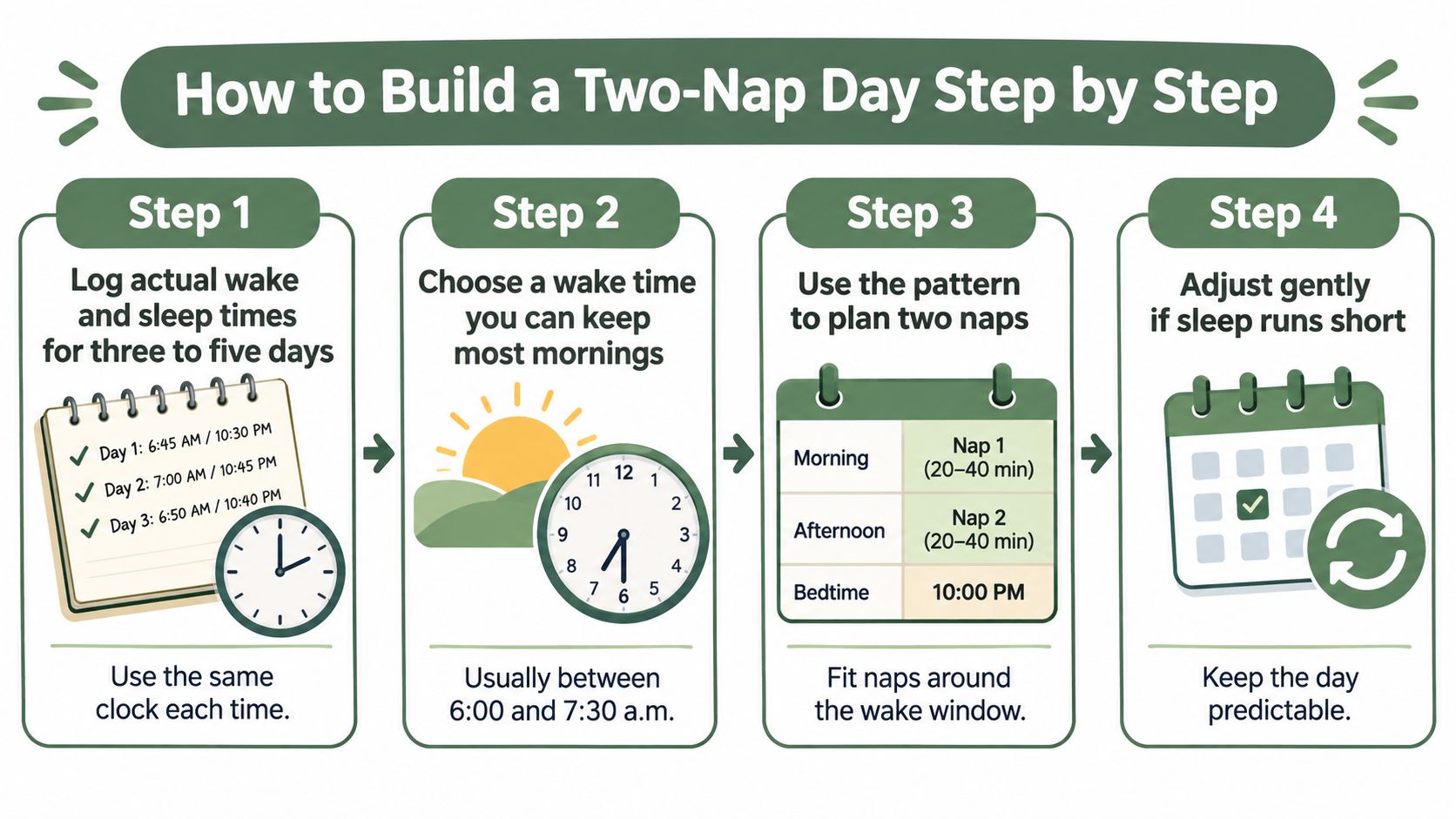
- Log real times for three to five days. Write down when your baby woke and when they fell asleep, using the same clock each time. The common slip is starting the clock when you put them down rather than when they dropped off, which makes every nap look longer than it was.
- Choose a wake time you can hold most mornings. Usually somewhere between 6:00 and 7:30 a.m. A consistent morning anchor does more for the rest of the day than any nap tweak, because it sets when sleep pressure builds.
- Count forward three to four hours to the first nap. Most babies this age manage roughly that stretch awake, which is why the BabyCenter 11-month sleep guidance builds an example day around a 7:00 a.m. wake, a nap near 10:30 a.m., a second near 3:00 p.m. and bedtime near 8:00 p.m. The awake stretch between sleeps is your main planning unit, and our wake window calculator can do the counting for you.
- Let the first nap refresh, not exhaust. Many babies do well with one to two hours. Too short and the middle of the day falls apart; too long and the second nap gets refused.
- Count the next three to four hours to the second nap. Keep this one shorter than the morning nap if your baby tends to fight bedtime, and place it early enough that there's still a real stretch before sleep.
- Set bedtime from the end of the second nap. Leave roughly three to four hours awake after it. The common mistake here is moving bedtime earlier while the naps still run late, which produces a very tired baby and a very early morning.
- Change one thing at a time. Shift a nap in steps of 10 to 15 minutes over several days and watch what happens to nights before you shift anything else.
Practical rule: one change, one week. If you move bedtime and the first nap in the same week, you'll never know which one helped.
A healthy day has a few quiet signals. Your baby wakes content rather than grumpy, goes down for both naps without a long struggle, and falls asleep at roughly the same time most evenings. If two of those three are true, you're close enough.
Judging Total Sleep Instead of Night Waking
Ask a different question. Not "did my baby sleep through?" but "how much sleep did this 24-hour period hold?"
The broad evidence-based target is 12 to 16 hours of sleep in a 24-hour period, including naps, the recommended range for infants from 4 through 12 months and endorsed by the American Academy of Pediatrics, as summarized by the NIH Office of Research Services wellness team. It's a range, not a nightly quota, which means a baby who sleeps more at night and a baby who sleeps more during the day can both be on track.
Here's how the arithmetic looks in real life. A baby who banks 11 hours overnight and takes two 90-minute naps reaches 14 hours, comfortably inside the range. A baby who woke twice but took a long afternoon nap can land in the same place. Add the nighttime total and every nap for each 24-hour period, then look at three or four days rather than one. If you want a fuller picture of typical totals across the first year, this guide to how many hours babies sleep walks through it.
Night waking near the end of the first year doesn't automatically mean the schedule is wrong. Look instead at how your baby functions while awake: mood, alertness, feeding, and whether days feel reasonably similar to each other.
Bring in a pediatrician when totals sit consistently below 12 or above 16 hours across repeated days, or when anything about sleep, feeding, breathing or development worries you. The day, not the night, is the unit worth judging.
Bedtime Routines and Safe Sleep Across Caregivers
A routine works because it's identical, not because it's elaborate. Twenty to thirty minutes is plenty.
Wind-down starts at a set time, and every step stays in the same order:
- Start the wind-down at the same clock time each night, with lights already lower than daytime levels.
- Change the diaper and put on pajamas, narrating what comes next so the sequence is predictable.
- Feed, if feeding is part of your family's wind-down.
- Read one short book or sing one song. One, not four. The end point matters as much as the content.
- Dim the lights, say a calm goodnight, and put your baby down.
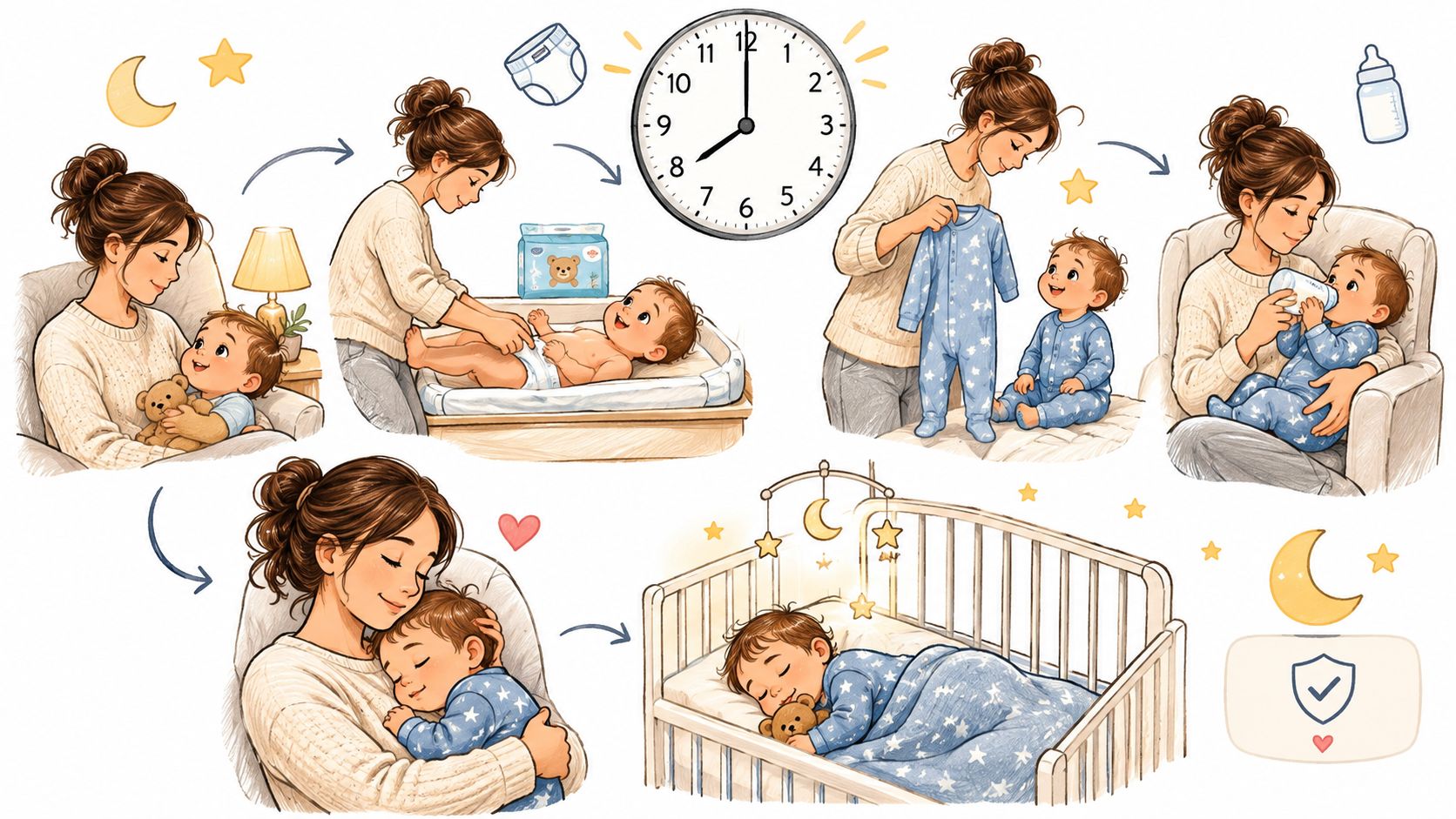
When a nanny, grandparent or daycare teacher handles part of the day, that repeated order does the work for you. A baby who has heard the same five steps a hundred times settles faster for a caregiver following the same script than for one improvising kindly. Write the routine on a single page, and print it in English and in Spanish so every caregiver in the house can follow the same order.
The sleep space doesn't change because your baby can now roll, pull up or cruise. A firm, flat surface, placed on the back at the start of sleep, with no pillows, loose bedding or toys in the sleep area, remains the baseline. What changes is what your baby can do, not what keeps them safe.
Room-sharing is a separate family decision, not an automatic 11-month milestone, so raise it with your pediatrician rather than treating the calendar as the instruction. For more on how nap timing fits around the rest of the day, see this guide to nap hours by age. None of this replaces medical advice.
Teething and Separation Anxiety Without Losing the Schedule
A rough week is not a failed schedule. Around eleven months, several things tend to arrive together: new mobility, a sharper awareness of being apart from you, and teeth.
The most common one you'll read about is the morning nap. Mayo Clinic's infant sleep guidance notes that babies aged 10 to 12 months often drop their morning nap, per Mayo Clinic's nap guidance. That doesn't mean the nap is gone for good. It often means it's being refused for a stretch while your baby practices standing and cruising instead.
| Disruption | Usual effect on the day | What helps | When to ask a pediatrician |
|---|---|---|---|
| Separation anxiety | Night waking or shorter naps around drop-offs | Short predictable goodbye, same caregiver at nap time | Distress that affects feeding or sleep for weeks |
| Teething | Restless nights and short naps for a few days | Steady wake time, extra comfort at bedtime | Fever, poor feeding or pain that does not ease |
| New daycare or travel | Naps shift across locations | Share the log so every caregiver sees the same pattern | Sleep changes that persist after the routine settles |
Notice what doesn't appear in the "what helps" column: a new schedule every few days. During a wobble, the instinct is to redesign the day. The steadier move is to hold the wake time, keep offering both naps, and add comfort at bedtime without moving the clock.
Separation anxiety often shows up at drop-off and again at 2:00 a.m. A short goodbye that follows the same words every time, plus the same caregiver at nap time where that's possible, gives your baby something predictable to hold onto. It's a sign of healthy attachment, not a habit you created.
For teething and travel, comfort more and change less. Wake time stays put, naps are offered at the usual times, and bedtime can come twenty minutes earlier if the day has been rough.
Keep an eye out for anything that needs a clinician rather than a schedule: fever, poor feeding, pain that doesn't ease with usual comfort measures, or sleep disruption that runs for weeks rather than days.
Setbacks here usually resolve on their own timeline, and no single fix works for every baby. Consistency is the part you control.
Moving From Two Naps to One Without Overtiring
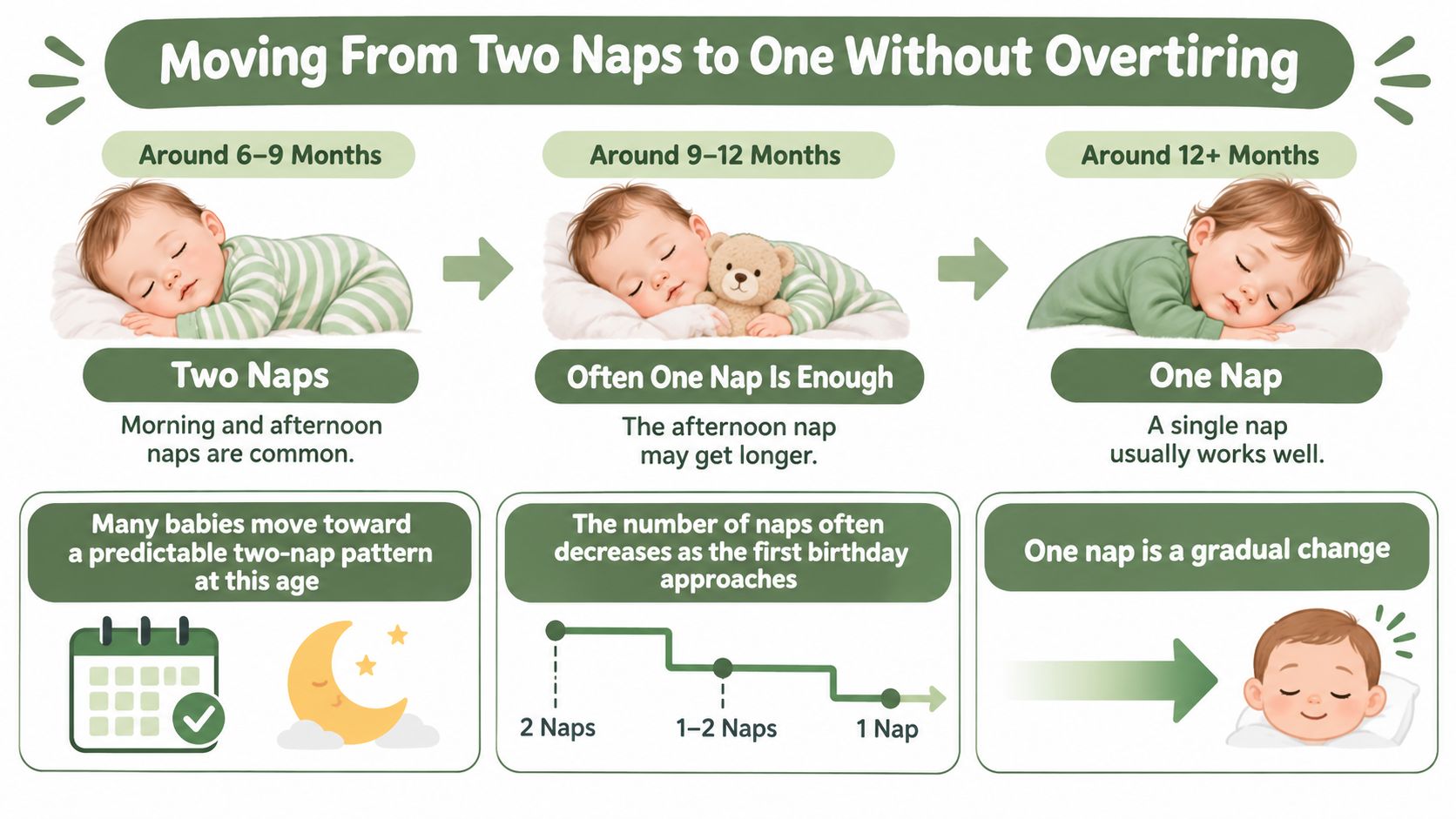
Many babies are moving toward a predictable two-nap pattern at this age, and the nap count usually drops as the first birthday gets closer. Singapore's HealthHub describes infants aged 4 to 11 months as typically having 2 to 3 daytime naps, each lasting from 30 minutes to 2 hours, with the number often decreasing as the child approaches 1 year, according to HealthHub's baby sleep guidance. Two naps is a sensible starting point, not a daily obligation.
One nap is a gradual change, not a switch you flip on a Tuesday.
- Confirm the refusal is consistent. Keep offering the morning nap for about a week. One hard day, or a day with a 5:00 a.m. wake, isn't evidence of readiness. The slip here is declaring the nap dropped after two refusals and then dealing with an overtired baby by Thursday.
- Hold the wake time steady. The body clock anchors on the morning, so keeping it fixed while everything else shifts keeps the transition from turning into chaos.
- Move the first nap later in 15-minute steps every few days. You're gradually converting two naps into one midday nap, and small steps let your baby adapt without a crash.
- Stretch the awake stretch before that single nap slowly. Watch for early signs of tiredness rather than pushing to a target time. The common mistake is jumping straight to a 5-hour morning and getting a 25-minute nap in return.
- Bring bedtime earlier on short-nap days. A baby running on one 40-minute nap needs an earlier night, and an early bedtime protects sleep far better than a late one does.
- Pause during illness, travel or a daycare change. Resume when the week settles. Transitions don't expire.
Readiness looks like a baby who refuses the morning nap but stays cheerful through the morning and sleeps well at midday and overnight. Overtiredness looks different: wired energy, meltdowns at dinner, waking more at night, and a baby who seems to get a second wind right at bedtime.
Worth remembering: most babies who drop to one nap early come back to two for a while. Offering the nap again costs nothing.
Confirm Your Schedule Before Changing Anything
Before you adjust a single time, get an accurate picture of the day you have.
- Log three days of real times. Start each clock when your baby wakes or settles into sleep, not when they're placed in the crib.
- Compare that log to the closest row in the starting-schedule table and mark where your day runs early or late.
- Hold the wake time and change one nap at a time, following the steps in order rather than all at once.
- Agree on the routine card and the log with every caregiver. Parents, partners, grandparents, nannies and daycare staff all need to see the same pattern, not a remembered version of it.
That last point is where most schedules fall apart. Cradlo is a shared baby tracker where parents and invited caregivers log sleep, feeds, diapers, growth and health events, and every entry shows up instantly for everyone, so a pickup conversation starts from a record instead of a guess. Daycares can bookmark a single browser link on their iPad, and those logs reach the parent's phone in real time.
Your schedule is a starting framework. Some weeks will be off, and that's information, not failure. For anything health-related, your pediatrician is the right person to ask.
Cradlo keeps one shared log for the whole care team, so the nap that ended at 2:40 p.m. at daycare is visible to whoever does bedtime, along with feeds, diapers and night wakings, all in one place. Parents, nannies, grandparents and daycare each get their own identity through a QR-code invite, so nobody shares a login and nobody has to ask who did the last bottle. Start the 7-day free trial on the monthly plan and see whether a shared record makes your 11-month-old's day easier to read, at Cradlo.