3 Month Old Wake Windows: How Long Babies Stay Awake
A 3-month-old typically stays awake for about 1.25 to 2.5 hours between sleeps, counted from the moment they wake to the start of the next nap. That range is a planning reference, not a schedule your baby has to match.
It's 9:40 on a Tuesday morning. Your baby woke at seven, fed, kicked at the play gym for a while, and has spent the last ten minutes rubbing their eyes and turning away from your face. Do you start the nap now, or hold out for the two-hour mark because that's what a chart said? That small decision, made four or five times a day, is the part most 3 month old wake windows advice never quite answers. The number is the easy part. Reading your own baby, and getting everyone who cares for them to read the same signals the same way, takes a little practice.
What follows is a walk through what the published ranges measure, how to spot the cue that ends a window, how to work out your baby's own pattern from one nap to the next, and what to do on the days it all falls apart. No rigid timers, and no guilt about the nap that lasted twenty-eight minutes.
Table of Contents
- How Long Can a 3-Month-Old Stay Awake Between Naps?
- How to Tell a 3-Month-Old Is Ready to Sleep
- How to Work Out a Wake Window From One Nap to the Next
- A Sample Day With Naps and Wake Windows
- What to Change When Naps or Nights Go Off Track
- When a Sleep Question Should Go to the Pediatrician
- How Can Every Caregiver Work From the Same Wake Window Record?
How Long Can a 3-Month-Old Stay Awake Between Naps?
The Cleveland Clinic's wake window guidance by age lists 1.25 to 2.5 hours for babies aged 3 to 4 months, and 1 to 2 hours for babies aged 1 to 3 months. It defines a wake window as the stretch from the moment a baby wakes until the next nap begins, which is worth saying plainly because plenty of parents count from the end of the feed, or from the moment they started the wind-down.
At 3 months, both bands apply. A baby who is done at 70 minutes sits inside the younger range and just below the older one, and both readings are correct. The bands overlap because the development they describe is gradual. Treat them as planning references drawn from published guidance, not as a timetable your baby agreed to.
What a Full Day of Sleep Looks Like
The same guidance reports a longitudinal study of 704 parent-child pairs in which daytime sleep at 3 months came to approximately 200 minutes, while total daily sleep averaged about 766 minutes, or 12.8 hours. The study also noted substantial differences between individual infants, which is the sentence that matters most if your baby never matches a chart.
A 24-hour day holds 1,440 minutes. Subtract those 766 minutes of sleep and roughly 674 minutes, about 11.2 hours, remain for feeding, interaction and wakefulness. That time is split across several shorter periods rather than one long stretch, which is why the day looks like a series of small blocks rather than a single stretch of awake time.
Within a single day, the shape shifts. Many babies tolerate a shorter first window and a longer one in the late afternoon, and illness, feeding needs, growth spurts and temperament all move the timing around.
Reference Values for a 3-Month-Old
| Measure | Typical value | Notes |
|---|---|---|
| Wake window, 1 to 3 months | 1 to 2 hours | Range for the younger edge of this age band, from the Cleveland Clinic age table above |
| Wake window, 3 to 4 months | 1.25 to 2.5 hours | Range that applies at 3 months, same source |
| Total sleep per 24 hours | 14 to 17 hours | Broad range for infants up to 3 months, per KidsHealth's summary of National Sleep Foundation guidance |
| Daytime sleep | about 200 minutes | One longitudinal study of 704 parent-child pairs, reported in the Cleveland Clinic guidance above |
What Each Row Measures
The two wake window rows describe one stretch of awake time, from waking to the start of the next nap. The total sleep row describes the whole 24 hours, night included. The daytime sleep row is the sum of the naps, which is a different measurement again.
Reading a 24-hour total as though it were a single window is the most common misreading. A baby on 14 hours of total sleep still has several separate awake blocks across the day, and each one gets judged on its own.
Wake windows measure time awake, not clock time. Two babies who both wake at 7:00 a.m. can need their first nap forty minutes apart, and both can be right, because one woke at the end of a long night stretch and the other woke, fed, and drifted back off. What turns the published range into a personal one is a single record that every caregiver can read.
How to Tell a 3-Month-Old Is Ready to Sleep
Charts give you an outer edge. Your baby gives you the signal. At this age, the signals arrive in stages, and the stage you act on changes how the nap goes.
The Three Stages of Sleepy Cues
- Early cues. Looking away from faces, a glazed gaze, play that slows down, less movement in the arms and legs. This is the decision point, the moment to begin a short wind-down rather than push for one more activity.
- Building cues. Yawning, rubbing eyes or ears, brief fussing when a toy is offered, a sudden preference for being held close. You still have room here, but the wind-down should already be underway.
- Late cues. Crying that's hard to settle, frantic movement, arching away from you. By this point the window has been overrun, and settling usually takes longer than it needed to.
The stages matter because overtiredness isn't an early warning. It's what shows up after the window has already passed, which is exactly why waiting for a yawn in a brightly lit room so often ends in a fight at the cot.
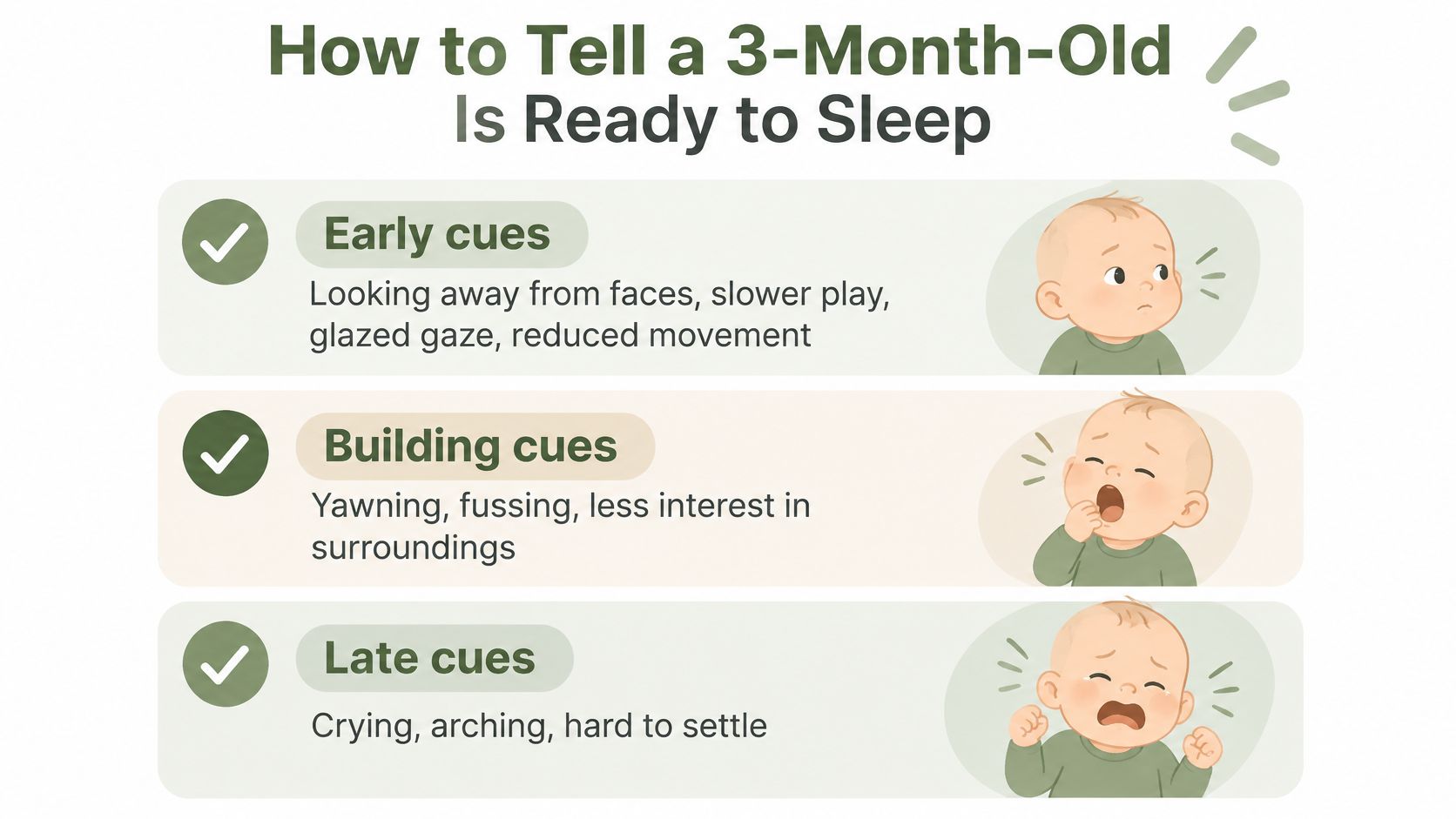
The window ends at the first clear cue, not at the clock.
What Else Fussiness Can Mean
Three things imitate tiredness closely enough to fool anyone. Hunger can look like fussiness, especially if the last feed was a while ago. A bright room, a loud television or a house full of visitors can look like tiredness because the baby is closing down against the input. A wet or uncomfortable diaper can look like restlessness.
Before you decide it's sleep, run a quick check. Fed recently, comfortable, in a calmer room. If the fussing eases once the noise drops and the diaper is fresh, you learned something useful about your baby's cues rather than wasting a nap.
Why No Chart Can Give You the Exact Number
A review of published wake-window guidance notes that no published research validates a specific wake-window number, even though plenty of write-ups present precise schedules as settled fact. That same review points to substantial individual differences and to both change and stability in infant sleep-wake behavior across the first six months.
So the same cue can mean different things for different babies, and for the same baby on different days. A baby with a cold, a growth spurt or a recent vaccination may want to sleep sooner than the range suggests. Three days of notes will tell you more about your baby's real pattern than any single chart, and the last section covers how to keep those notes in one place.
How to Work Out a Wake Window From One Nap to the Next
The window itself is simple arithmetic. What takes practice is deciding where it starts and where it ends, so here is the sequence, with the reason behind each step.
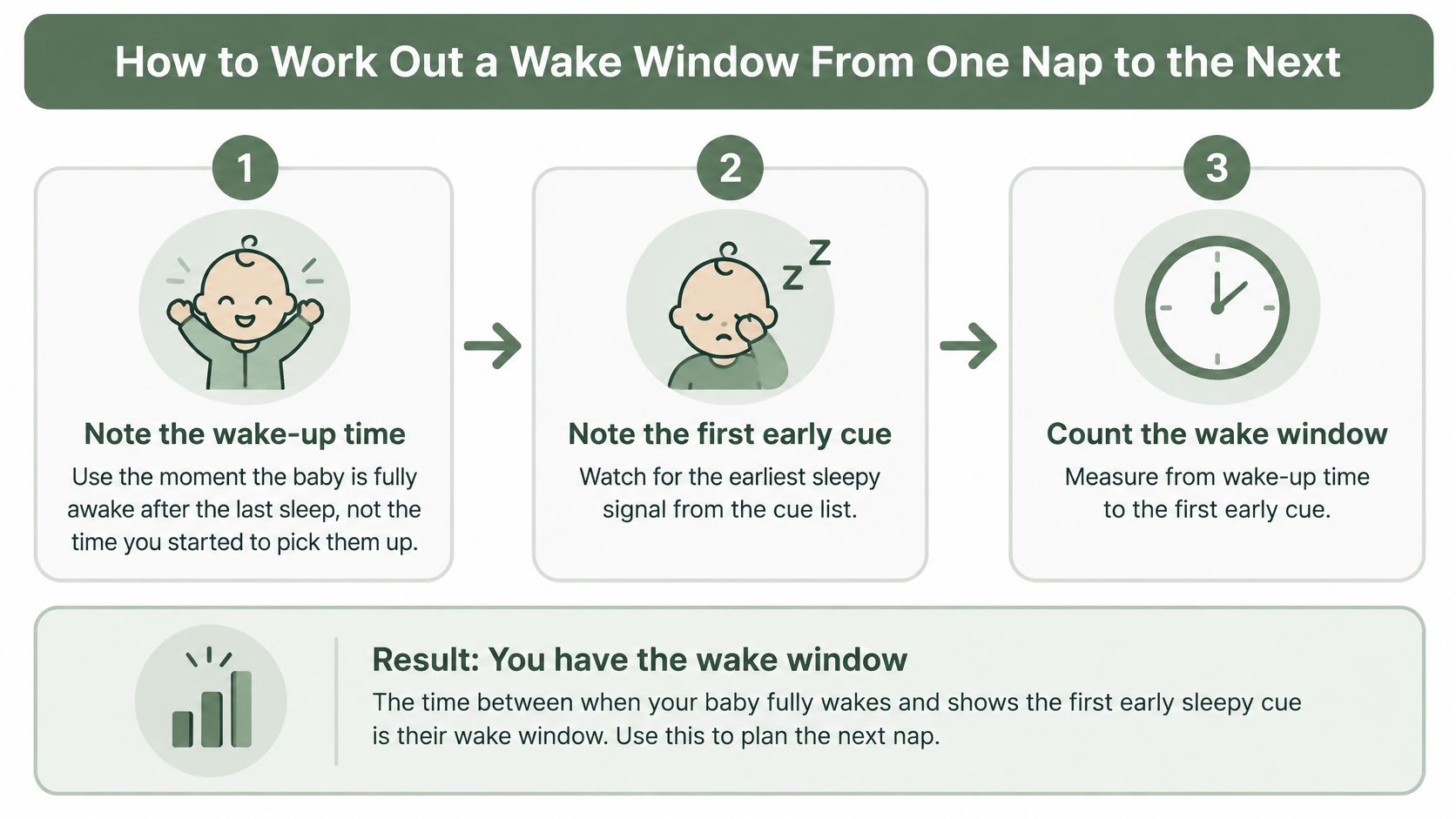
The Steps in Order
- Note the wake-up time. Use the moment the baby is fully awake after the last sleep, not the moment you started to pick them up, because the window begins with them, not with you.
- Watch for the first early cue. That's the signal from the list above, and it marks the end of the window in practice.
- Start a short wind-down before the late stage. A dim room, a feed or a quiet song, done in that order, so the baby is already settling when sleep pressure peaks.
- Record the time sleep began. It will often differ from the time you planned, and that number is the one worth keeping.
- Subtract wake-up time from sleep onset. That's your baby's window for that stretch of the day.
- Compare it with the typical range for this age. A result at the low end isn't a problem, and a result that lands well past the top of the range several days running usually means the wind-down is starting too late.
- Judge the last nap, not only the clock. A short or fragmented nap generally warrants a slightly shorter next window, while a restorative one may support a longer stretch.
- Change only what repeats. One unusual day tells you very little, so wait for the same pattern across several days before you adjust anything.
If you want the broader concept before going further, this explanation of what a wake window actually measures sets out the difference between awake time and clock time.
What the Sleep Data Says About This Age
A longitudinal home-video study of 101 infants found that average nighttime sleep periods lengthened from 2 hours 7 minutes at 5 weeks to 3 hours 32 minutes at 3 months, while total nighttime waking stayed at approximately 40 to 50 minutes, as reported in the published infant sleep study. Sleep is consolidating, but it isn't uninterrupted, and daytime wake periods aren't uniformly long either.
That's why tracking actual sleep onset, nap duration, feeding, and who was caring for the baby helps you distinguish a lengthening window from overtired behavior that makes settling harder.
What a Good Result Looks Like
Success here isn't a perfect table. It's naps that begin inside your baby's window and end without a long struggle, plus a bedtime that doesn't require rescuing the whole day. If two naps out of four run smoothly and the other two wobble, you're reading your baby well, not failing at a schedule.
A Sample Day With Naps and Wake Windows
Your baby wakes at 7:00 a.m., takes a feed, and stays up for company before the first nap. The times below show one possible shape for that kind of day. They are a planning reference, not a score to match. A consistent morning wake-up, regular feeds, and a calm bedtime are the anchors. The minutes flex around those anchors. A day that drifts twenty minutes in either direction is still a good day.
| Time | Event | Wake window before it |
|---|---|---|
| 7:00 a.m. | Wake, morning feed | Start of the day |
| 8:30 a.m. | Nap 1, about 45 minutes | about 1.5 hours |
| 11:15 a.m. | Nap 2, about 1 hour | about 2 hours |
| 2:15 p.m. | Nap 3, about 45 minutes | about 2 hours |
| 4:30 p.m. | Short catnap, about 20 minutes | about 1.5 hours |
| 6:30 p.m. | Bedtime routine and sleep | about 1 hour 40 minutes |
How the Day Adds Up
The first window is the shortest, about 1.5 hours. A baby who slept reasonably overnight often comes out ready to look around, so the first stretch of awake time can be shorter than the ones that follow. The middle windows stretch to roughly 2 hours. The last stretch before bed runs about 1 hour 40 minutes, shorter again, because tiredness has been adding up since morning.
A wake window works like a yellow light. It marks a band of time when sleep is a reasonable offer, not one minute that decides whether the day worked.
The 4:30 p.m. sleep is a short bridge, about 20 minutes. A long nap that late pushes bedtime later and can thin out the night. That catnap carries the baby to bedtime. It is not meant to be a full rest.
Why the Nap Count Can Vary
Three longer naps and four shorter ones can both fit a 3-month-old. Nap frequency typically drops steadily over the first year and a half, from several naps a day toward one. A day with three or four sleep episodes sits in the normal range.
Watch the daytime total across several days, and watch the cues on those same days, before you decide the count is off. One sleepy afternoon does not rewrite the range.
Write each nap start, length, and the awake stretch before it in one shared record. The person who is with the baby at 2 p.m. and the person who handles bedtime then read the same times. They can offer the next window from today's cues instead of reconstructing the day from memory.
Every nap and night sleep in that table happens on the baby's back, in a separate sleep space with a firm, flat surface and nothing loose in it.
How to Shift the Sample Day
- Move everything by the same amount. If your baby wakes at 6:30, shift every time in the table half an hour earlier and the shape holds.
- Keep the order intact. Feed, awake time, wind-down, sleep. Babies read the sequence long before they read a clock.
- Hand the same rhythm to every caregiver. A nanny, a grandparent, or a daycare teacher can follow this shape because it is a sequence, not a list of minute-by-minute rules. The shared record is what lets each of them start from the same day.
What to Change When Naps or Nights Go Off Track
One short nap is not a pattern. Change the schedule when the same problem shows up several days running, and change one thing at a time so you can tell whether it helped.
The stretch around 12 to 16 weeks is where this gets messy, because wake windows, naps, night sleep and feeding stop being separate questions. BabyCenter Canada's review of wake windows by age points out that developmental data show sleep cycles lengthening and sleep bouts gradually consolidating between 3 and 12 months, so a baby can be changing quickly without being ready for a fixed schedule.
| Pattern | Likely reason | First adjustment |
|---|---|---|
| Nap ends after about 30 minutes | Short or fragmented rest | Shorten the next window slightly |
| Baby resists a nap after several attempts | Window may be too long or baby is overtired | Offer sleep at the next early cue |
| Late afternoon fussiness | Accumulated tiredness or overstimulation | Move bedtime earlier and dim the lights |
| Frequent night waking | Feeding needs, growth spurts or changing consolidation | Keep feeding steady and discuss persistent changes with a pediatrician |
The Adjustment That Usually Backfires
The question that comes up most is what to do when a baby wakes after thirty minutes. Extending the next window to "make up" for the short nap rarely produces a longer one, because a tired baby doesn't sleep better by staying awake longer.
After clearly poor sleep, shorten the next window. Preserve feeding and safe-sleep routines as the priority, and let the schedule absorb the disruption rather than forcing the baby to absorb it.
A schedule that needs three caregivers to run it perfectly isn't a schedule. It's a source of friction.
When One Caregiver Handles the Bad Nap
A disrupted daycare day or a nap that went sideways at a grandparent's house is where coordination breaks down. The next caregiver needs to know what happened, not a summary that starts with "she was fine."
Log the wake-up time, the nap length and whether the baby was fed or soothed back down. Then the next window gets adjusted from the same facts by everyone, rather than three adults guessing from three different versions of the morning.
When a Sleep Question Should Go to the Pediatrician
The afternoon nap ran short, the next stretch awake ran long, and someone caring for the baby is already asking whether that means something is wrong. Most of that variation is ordinary. A wake-window chart cannot diagnose a health problem. A tracker shows the pattern, and a pediatrician decides whether that pattern is healthy for this baby.

At this age, "sleeping through the night" often means a stretch of only 5 or 6 hours, not ten or twelve, as KidsHealth's guidance on infant sleep explains. Many babies also settle into three to four daytime naps, then a longer nighttime stretch after a late feed. Those are planning references, not targets.
Bring these to a pediatrician rather than trying to fix them by lengthening or shortening a wake window:
- Feeding difficulty, including regular refusal of feeds or feeds that seem hard work for the baby.
- Weight gain or growth concerns, which belong with the clinician who tracks them.
- Breathing concerns, such as pauses or noisy breathing during sleep.
- Persistent distress that doesn't ease with comfort, or crying that seems different from usual.
- Signs of illness, including fever, or unusual sleepiness that makes the baby hard to wake for feeds.
- A sudden change in sleep after an illness or a new medication.
For feeding questions, a lactation professional can work alongside the pediatrician. Keep one shared log of wake times, naps, feeds, and diapers for about a week and bring it with you. A week of the same clock times, written by whoever was with the baby, gives the visit more to use than three adults remembering three different days. For more on what this age typically looks like, this guide to 3-month-old sleep covers the wider picture. Asking early is appropriate. Your pediatrician is the right person to decide what is typical for this particular baby.
How Can Every Caregiver Work From the Same Wake Window Record?
Your partner thinks the baby has been awake for about 90 minutes. The daycare teacher thinks the last nap ended later than that. Same baby, two clocks, and the next nap gets timed from whichever memory is loudest.
Give the household three days to replace those guesses with one record. For each nap, write three items: the wake-up time, the time sleep began, and the earliest cue you noticed beforehand. Ask everyone who handles the baby to record those same three items, whether that is a partner on night duty, a grandparent, a nanny, or a daycare teacher. If care happens in both English and Spanish, keep the entries short and note times rather than long descriptions.
After three days, line those windows up with the published range and with the sample day above. A wake window at this age is a flexible range you read from the baby's cues, not a single minute everyone must hit. Pick one change to test, not four, so you can tell what helped. Before you decide a day needs fixing, this guide to nap hours by age gives a reference for how much daytime sleep is typical now.
Cradlo is a shared baby and child care tracker for families with children from newborn through age 5. Parents and invited caregivers log sleep, feeds, diapers, growth, and health events on one timeline, and every entry shows up in real time for the people invited in. Daycare bookmarks one browser link on an iPad, with no app install and no login, and those logs reach the parent's phone as they happen. A wake window calculator supplies age-based estimates. NapCast predicts the next nap window, GapFill catches a log someone forgot, and a daily brief sums up the day next to the notes caregivers add. The record is available in English and Spanish.
Start with tomorrow morning's wake-up time. Log that one number before the first nap, and the first full window is already on the shared record.
Cradlo offers a 7-day free trial, then Plus at $4.99/month or $49.99/year, or Lifetime at $99.99 one time. Visit Cradlo to start the 7-day free trial and read the next nap window from the same record everyone else is using.