4 Month Sleep Regression: Is It Normal and What to Do
It's 3 a.m., and the baby who slept longer stretches for a few weeks is awake again. You're deciding whether to feed, to wait, or to call this a bad night. A partner, grandparent, nanny, or daycare teacher may ask the same question on the next shift.
People call this the 4 month sleep regression. The name is common. The nights are not the same for every baby, and one hard night isn't a verdict on your parenting.
Table of Contents
- What the Four-Month Sleep Change Actually Is
- How to Tell a Regression From Normal Variation
- Why Sleep Shifts Around Four Months
- Safe Sleep Rules That Do Not Change at Night
- Bedtime Routines That Hold Up Across Caregivers
- Keeping Caregivers Consistent Without Identical Routines
- Start One Shared Log This Week
What the Four-Month Sleep Change Actually Is
Say you're up with a baby who, two weeks ago, settled after one late feed and stayed quiet until early morning. Tonight the same rocking doesn't hold. Eyes are open. The question isn't only how to get back to bed. It's whether tonight starts a new pattern.
"Four-month sleep regression" is a label families use rather than a formal medical diagnosis. It points to a developmental transition in sleep, one that arrives on its own schedule for each child. It works more like a growth spurt in how the brain organizes sleep than an illness with a fixed start date: some babies reorganize with only a few extra wakes, others have a bumpier stretch. Neither pattern proves sleep will get worse and stay worse.
A longitudinal study that followed 40 infants with actigraphy for one week at 4, 6, 8, and 10 months, alongside parent sleep diaries and developmental questionnaires, found that sleep patterns changed most between 4 and 6 months, with older infants showing longer and less fragmented sleep. That finding supports a real reorganization of infant sleep in this window. It does not show that every infant slides backward before improving.
Variation is the usual picture
Across the first year, babies differ widely in how much they sleep at night, during the day, and in total. The biggest shifts tend to come early, with a steadier shape emerging later in the year. Some babies wake often while others hold longer stretches. Plenty of parents already describe sleep as difficult before any four-month shift, so a rough week can mix ordinary variation with the hope that easy nights were here to stay.
One hard night is a data point, not a diagnosis.
This is why the label matters less than the observation. Most of what families see at four months is developmental change doing its work. A pattern that keeps repeating, or one that arrives with signs beyond ordinary waking, deserves a closer look with a clinician rather than a shrug and a label. Name the change without alarm, skip the scorekeeping on a single evening, and notice the pattern over several days: when sleep starts, how long the wakes last, and who helped with settling. Partners, grandparents, and daycare staff who watch the same signals give you a fuller picture than one tired pair of eyes at 3 a.m.
How to Tell a Regression From Normal Variation
Sorting the night starts with what you can see, not with a label. The table below pairs common patterns with what they usually suggest and what is worth writing down or raising with a professional.
| Night pattern | Usually suggests | What to log and check |
|---|---|---|
| Brief wake, settles within minutes without a feed | Ordinary arousal between sleep cycles | Wake time, duration, settling method |
| Long feed, baby alert and hungry after waking | Hunger or a change in feeding needs | Feed times and length; discuss feeding plan with a lactation professional or pediatrician |
| Fussy waking after spitting up or arching during feeds | Possible reflux or discomfort | Pattern around feeds; ask a pediatrician |
| Fever, vomiting, unusual drowsiness or refusing feeds | Possible illness | Contact a pediatrician promptly; do not treat as a regression |
| Naps shrinking and bedtime shifting over several days | Schedule mismatch | Nap times and bedtime; review routine with a pediatrician |
What the pattern does not prove
A brief wake that ends in a few minutes, without a feed, usually fits an ordinary pause between sleep cycles. A long feed with an alert, hungry baby is a feeding question, not a character flaw in the bedtime. Spitting up plus arching, or fever, vomiting, unusual drowsiness, or refusing feeds, belongs with a pediatrician. Shrinking naps and a sliding bedtime over several days are a schedule question to review with that same clinician, not a reason to push a longer day on your own.
Research on infant night waking across the first year does not establish a precise percentage of babies who have a distinct four-month regression, and it does not show a sharp, universal sleep drop exactly at four months. Waking rises and falls through the year rather than following one clock. The same body of work treats four months as a common transition window, not a guaranteed regression with a standard length or severity.
Total sleep still varies a lot from baby to baby, which is why how many hours babies sleep is a different question from whether tonight looks unusual for your child.
A record you can hand to a clinician
For several days, log the wake time, how long the wake lasted, whether there was a feed, the settling method, and when sleep resumed. Read those lines together. If something sits outside the ordinary pattern in the table, share the record with a pediatrician or lactation professional. You are bringing observations, not a self-diagnosis.
Why Sleep Shifts Around Four Months
Think of sleep like a staircase. Around this age, the baby pauses on a landing between floors. The pause is brief and normal. What feels hard is finding a familiar way back up when the landing looks different from the place where sleep began.
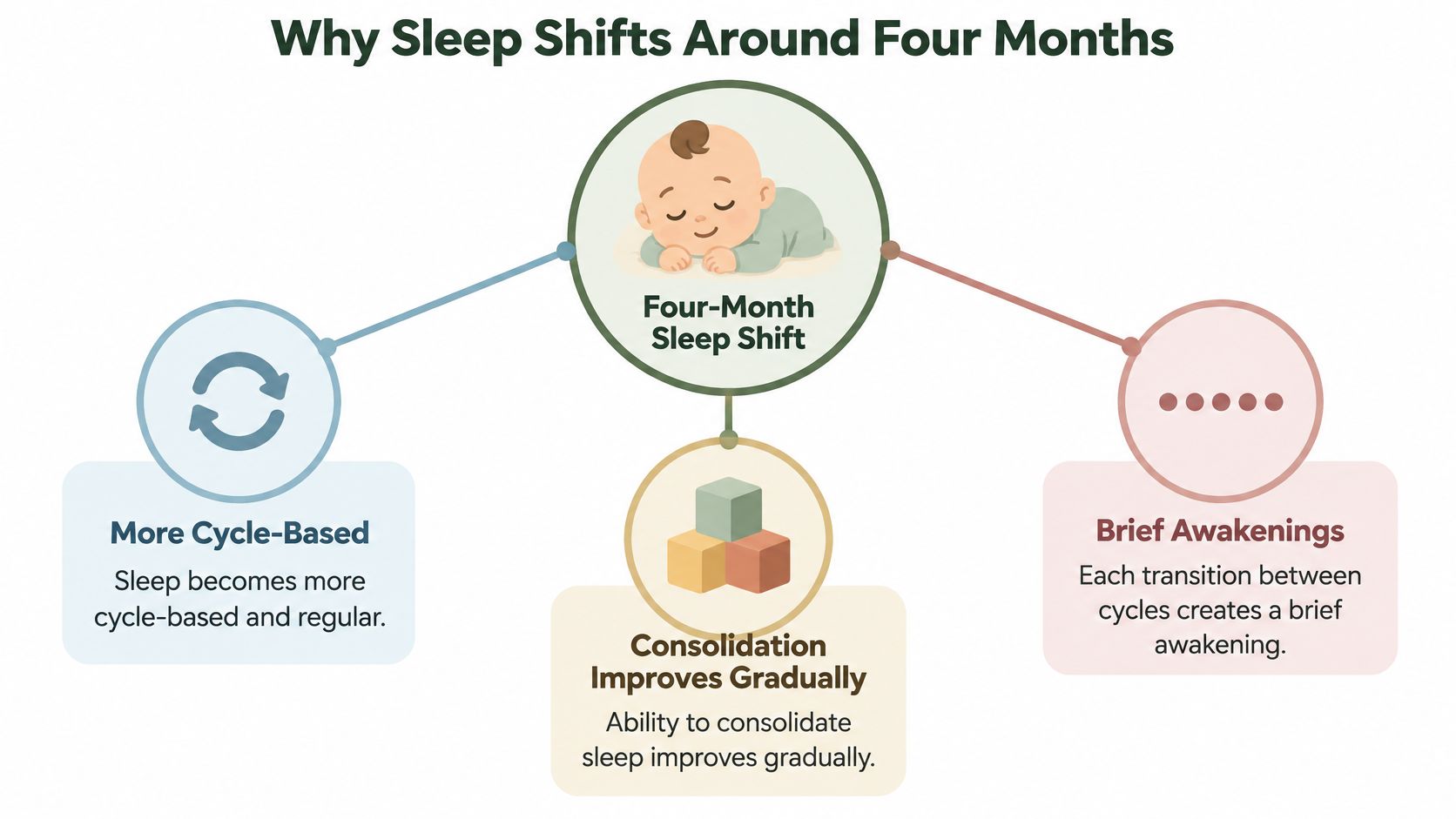
Around four months, sleep becomes more cycle-based and regular. The ability to consolidate sleep improves gradually, not in one night. Each move from one cycle to the next can include a short arousal. Adults do a version of this when they roll over and barely remember it. A baby who needs a different set of conditions to return to sleep will make that pause obvious.
The mismatch at the landing
Say the baby fell asleep while being rocked, fed, held, or given a pacifier. At the next landing, those conditions are gone. The crib is quiet, the arms are absent, and resettling takes longer. The baby isn't failing a test. The start of sleep and the middle of sleep don't match yet.
That mismatch is a skill-building shift. Increased waking does not automatically mean illness or too little sleep. A rough stretch also doesn't mean a caregiver caused a problem. Hunger, discomfort, reflux, breathing concerns, and illness can look similar at 2 a.m., which is why those questions go to a pediatrician or lactation professional rather than staying inside a sleep label.
What to watch across days
One arousal matters less than the shape of several nights. Notice whether wakes are short and settling gets easier in the sleep space, or whether feeds, pain signs, or breathing questions keep showing up. Daytime timing still shapes those nights. A look at wake windows for a 4-month-old can help you see whether the day is running long before you change the night.
If the pattern is mostly short pauses and a mismatch at sleep onset, the response is a steadier bedtime sequence. If the pattern includes illness signs, feeding worries, or anything that feels off for this baby, the response is a clinical conversation, with your notes in hand.
Safe Sleep Rules That Do Not Change at Night
More waking is a reason to recheck the sleep space, not a reason to bend the rules. The American Academy of Pediatrics evidence base for the 2022 safe sleep recommendations recommends placing infants on their backs for every sleep, including naps and nighttime sleep, and continuing that practice until the child reaches one year of age. The recommendation applies to every caregiver, including parents, partners, grandparents, nannies, and daycare staff.
A safe surface is firm, flat, and noninclined. A safety-approved crib, bassinet, or portable play yard with a fitted sheet meets that description. The sleep space stays clear.
Keep out of the sleep space:
- Loose blankets: They don't belong in the crib, even for a short settle.
- Pillows and bumpers: They add softness the surface should not have.
- Stuffed toys and other soft objects: Leave them out for every sleep, naps included.
Propping the baby, tucking in a blanket, or turning the baby to the side to stop crying are unsafe choices. Frequent waking is biologically normal, and it doesn't license a different position.
After each night feed, return the baby to the sleep space and confirm the surface is clear.
Feeding questions, growth concerns, and anything about breathing belong with a pediatrician. Safety rules stay the same while you wait for that conversation.
Bedtime Routines That Hold Up Across Caregivers
A routine that survives a handoff is short, repeatable, and kind to the household's language and culture. Spanish-speaking families can use the same order with Spanish songs, books, or a quiet phrase a grandparent already knows. The sequence matters more than a script.
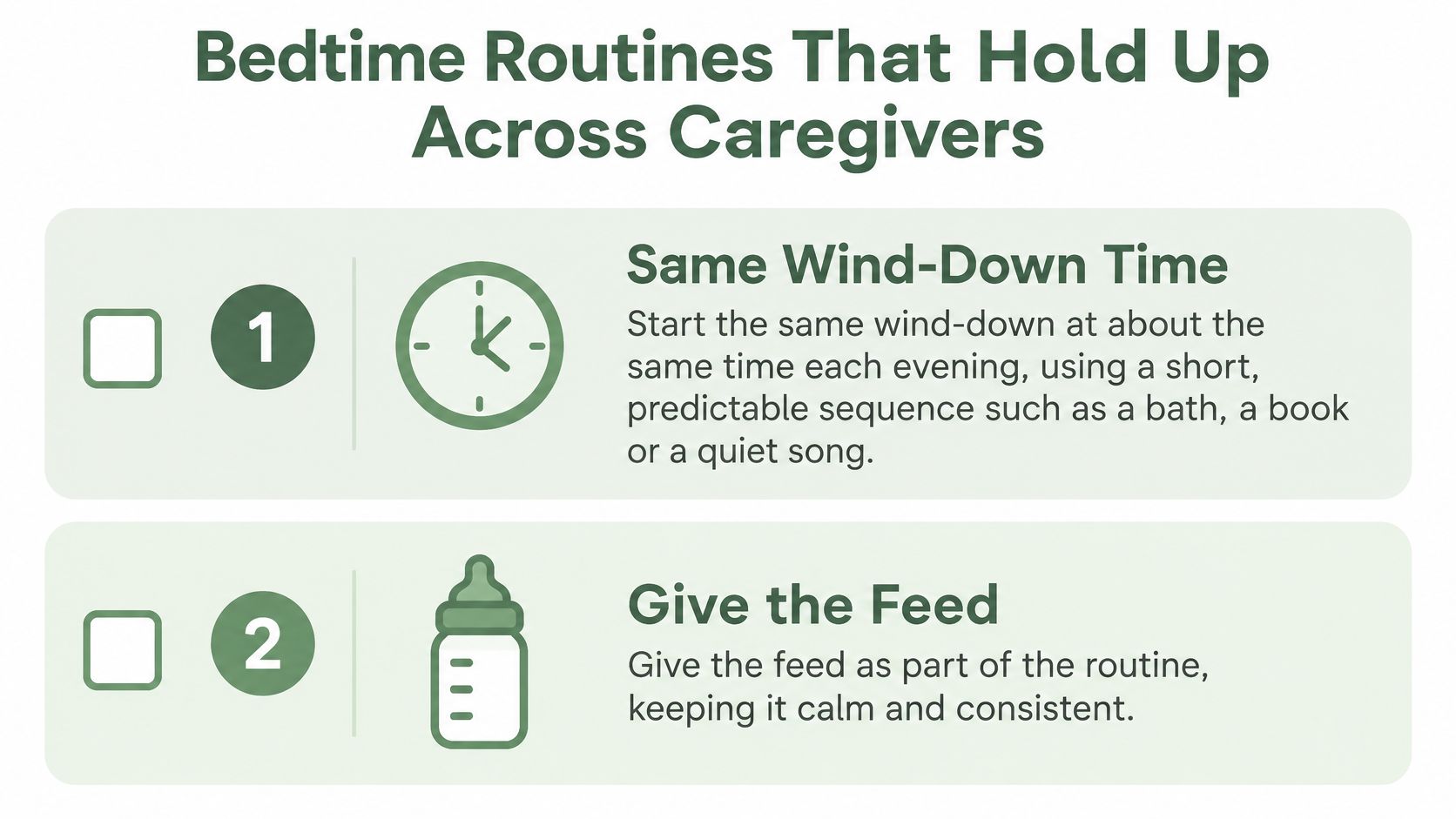
- Start the wind-down near the same time. Use a short sequence such as a bath, a book, or a quiet song. A predictable start tells the baby that night has a shape, even when the person doing bedtime changes.
- Give the feed before the last step. A baby who is still hungry at the final settle has a reason to protest that has nothing to do with the crib. Finishing the feed first separates eating from the last slide into sleep.
- Place the baby down drowsy but awake. The final transition into sleep happens in the sleep space. That match makes the next landing easier, because the baby already knows this room as the place sleep continues.
- Keep night care dim and brief. During feeds and diaper changes, use low light, a quiet voice, and short handling. A bright room and a long play break tell a baby that night has turned into day.
- Write the wake into the shared log. Note the wake time, whether the baby was fed, the settling method, and when sleep resumed, in the one record every caregiver can open.
- Use the same response order. Start with the least intervention that fits your plan, then move to more help only if the baby still needs it. A partner and a nanny can use different voices. They shouldn't invent a new order at 2 a.m.
Why the order carries the night
A dim room is a signal, not a mood. Babies learn night from repeated cues: low light, a short sequence, and a calm return to the same surface. If one caregiver adds a long rock and another skips straight to the crib with no wind-down, the baby gets two bedtimes. Keep the order. Let the tone stay personal.
If a step stops fitting your family, change it in daylight and tell every caregiver, including daycare. A routine you can repeat beats a perfect one nobody shares.
Keeping Caregivers Consistent Without Identical Routines
Consistency matters where safety and confusion overlap, not in every soothing detail. The table separates what every caregiver matches from what can stay personal.
| Element | Same for every caregiver | Can vary by caregiver | Why it matters |
|---|---|---|---|
| Sleep position and surface | Yes, every sleep | No | Safety rules apply to all caregivers |
| Bedtime sequence order | Yes, same order | Pace and tone of soothing | Predictable cues reduce confusion |
| Night feed permission | Yes, set by clinician | Who gives the feed and when | Prevents duplicate feeds |
| Soothing during a wake | Shared boundaries | Gentle touch, voice, or rocking | Respects family and cultural differences |
Shared rules, flexible hands
Sleep position and surface stay identical for parents, partners, grandparents, nannies, and daycare. Back sleeping on a clear, firm, flat surface isn't a style choice.
The bedtime order stays the same so the cues don't scramble. Pace and tone can change. A grandparent's slower song and a parent's quieter hum can live inside one sequence.
Night feed permission is set by the pediatrician or lactation professional who follows growth and feeding. Frequent waking is common at this age, and some babies still wake to feed. No caregiver should drop a night feed on their own. The flexible part is who offers the feed and at which wake, once that permission is clear.
Soothing can include gentle touch, a voice, or rocking, inside boundaries you agree on ahead of time. A family that prefers responsive settling and a family that prefers a shorter settle can both be consistent. They just need the same edges.
A short note in Spanish or English helps the caregiver who prefers the other language.
A shared record lets the next person see who responded last. That prevents a second full feed twenty minutes after the first, and it keeps daycare and home from contradicting each other. Detail can match your household. The habit of writing the wake and the response stays the same every time.
Start One Shared Log This Week
For the next several nights, keep one shared record of bedtime, naps, feeds, wake times, settling methods, and who responded. A parent, partner, grandparent, nanny, or daycare worker writes on the same timeline, so a 2 a.m. wake needs no whispered handoff in the hall.
Keep each entry small. Time of the wake, how long it lasted, whether the baby fed, the settling method, and when sleep resumed. Those five facts are enough to reveal a pattern, and an entry that stays short is an entry everyone keeps writing.
Cradlo is a shared baby tracker where parents and invited caregivers log sleep, feeds, diapers, growth, and health events on one timeline, and every entry shows up instantly for everyone. Cradlo starts with a 7-day free trial, then Plus at $4.99/month or $49.99/year, or Lifetime at $99.99 one time.
How to read it
Give the log several days before you look for meaning. One rough night is weather; a repeated wake time across a week is climate. Notice which settling methods were followed by longer stretches of sleep, and whether the same pattern appears when a different person does bedtime. Wakes that cluster at one hour across every caregiver deserve a closer look. Wakes that scatter randomly are ordinary variation at this age.
Naps belong in the picture too. Typical nap hours help you see whether the day is supporting the night or crowding it.
If the record raises a question about feeding, growth, illness, reflux, or breathing, bring it to a pediatrician or lactation professional. A written few days gives a clinician something a foggy memory cannot.
Start tonight, at whatever pace fits your household. One line is a real start.
Cradlo keeps sleep, feeds, and wakes on one shared timeline so parents, nannies, and daycare aren't guessing who settled the last wake. During a stretch of changing nights, that record makes it easier to see a real pattern and to bring clear notes to a pediatrician or lactation professional. Visit Cradlo when you're ready to start the log with the people who care for your baby.