4 Week Old Feeding and Sleep: What to Expect
The baby ate at 11:40, or maybe it was 11:15. You're in the kitchen at 2 a.m. with a bottle in one hand, trying to work out whether your partner logged the last feed before going back to sleep, and whether the clock for the next one started then or twenty minutes later. None of this is unusual. You're four weeks in, and the details have already outrun everyone's memory.
A 4 week old's day is still built from short repeating cycles: feeding, burping, diapering and sleep, running around the clock with no real regard for whether it's day or night. What follows are the numbers that describe that stage, where each one comes from, and how to use them without turning them into a scorecard. Then the practical part: a handoff routine that lets a parent, a grandparent, a nanny and a daycare teacher read the same record the same way.
Table of Contents
- Four-Week Numbers at a Glance
- How Feeding Changes Between Week One and Week Four
- Sleep in Many Short Stretches, Not a Schedule
- Safe Sleep During Night Handoffs
- Growth and Milestones to Raise With Your Pediatrician
- Set Up One Shared Log Before the Next Feed
Four-Week Numbers at a Glance
The question that surfaces at 2 a.m. is almost always a version of the same thing: is this normal for a four-week-old? The honest answer starts with numbers, because numbers are what separate an unusual night from a very ordinary one.
Mass General's one-month well-child guidance puts feeding at roughly every 2 to 3 hours, which works out to about 8 to 12 feeding opportunities in a 24-hour period (Mass General one-month visit guide). The same guidance is plain about what goes into the baby: breast milk or formula is the only food and drink at this stage. Plain water isn't needed, and honey shouldn't be given.
| Measure | Typical at four weeks | Source context |
|---|---|---|
| Feeds per 24 hours | About 8 to 12, roughly every 2 to 3 hours | Mass General one-month well-child guidance |
| Bottle volume per feed | Mean 80.8 mL, range 10 to 126 mL | Healthy bottle-fed infants in one prospective study |
| Feeding duration per feed | Mean 18.5 minutes | Same bottle-fed study at four weeks |
| Sleep periods per 24 hours | Average 9.35, range 6 to 15 | Home diary study of babies aged 4 to 10 weeks |
| Solid foods | Not part of this stage, arrives around six months | WHO infant feeding guidance |
| Weight gain | No single target, varies by baby | Growth gets checked at pediatric visits |
How to read these numbers
Every row is a range observed across many babies, not a test with a pass mark. Individual needs vary with growth, medical history, and whether a baby is breastfed or formula-fed, so a caregiver seeing numbers persistently outside these bands should talk with a pediatrician rather than adjust anything alone.
The useful question at 2 a.m.: not "did we hit the number" but "when did the last feed start, and who is due next?"
That's why a written record earns its place so quickly at this age. A missed or duplicated entry changes the next caregiver's decision about whether the baby is due to eat, and with parents, partners, grandparents, a nanny and daycare all taking turns, the timeline becomes the thing everyone trusts instead of memory.
Many families describe this stage as their bebé de cuatro semanas, and the table reads the same in either language. The labels matter more than the language: if one person logs "nursing" and another logs "bottle," agree in advance what each word covers so the entries line up.
How Feeding Changes Between Week One and Week Four
At four weeks, a bottle may hold more than it did in the first week, while feeding duration can look much the same. A prospective observational study of 61 healthy infants tracked caregiver-reported feeding data for 48 hours in each of the first four weeks (prospective infant feeding study).
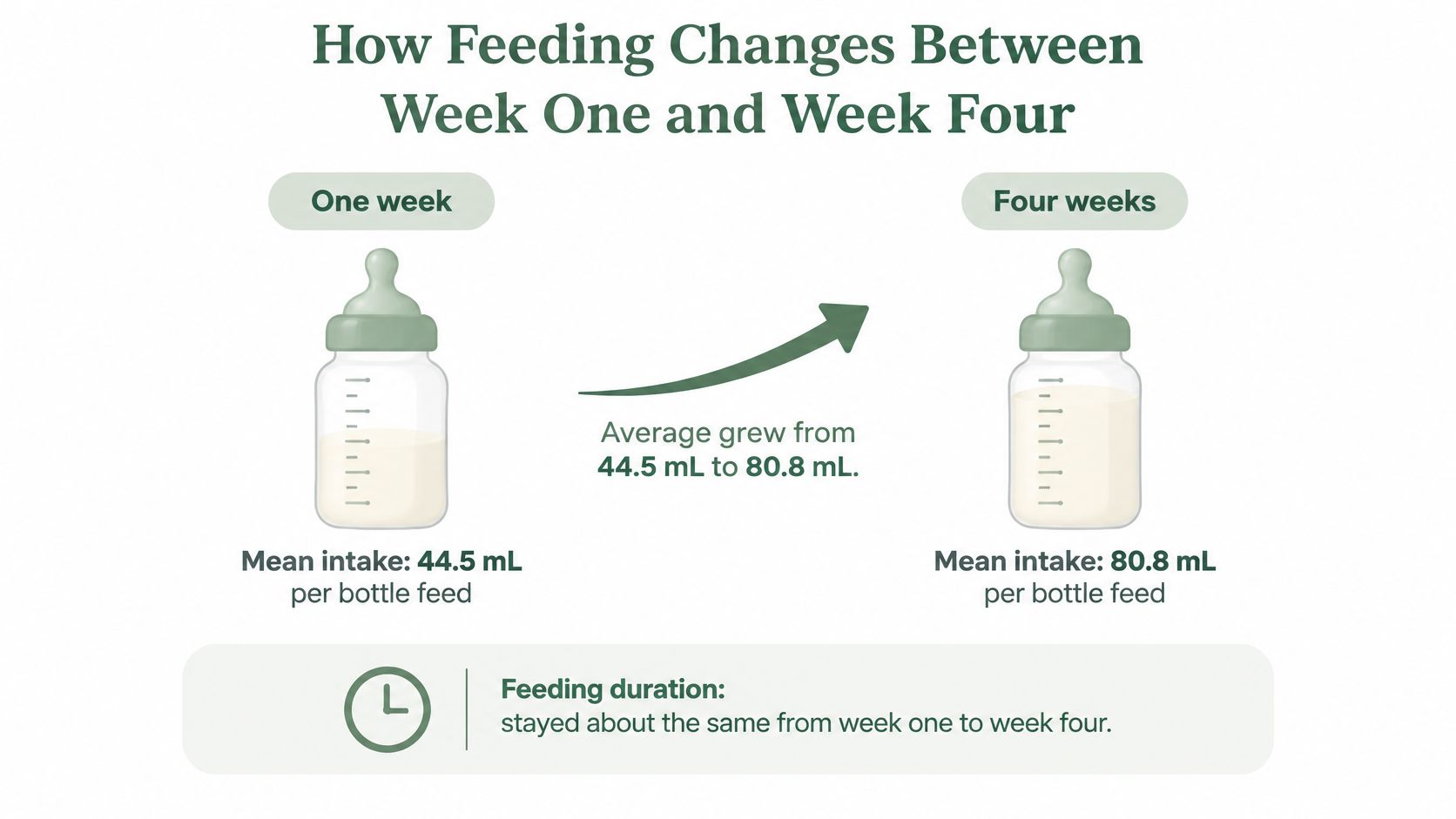
Among bottle-fed babies in the study, mean intake rose from 44.5 ± 16.2 mL per feed at one week to 80.8 ± 22.6 mL at four weeks. The increase was statistically significant (chi-square(3) = 27.33, p < 0.001). Mean feeding duration at four weeks was 18.5 ± 6.9 minutes, with no significant change across the month.
| Measure | Week 1 | Week 4 |
|---|---|---|
| Mean intake per bottle feed | 44.5 mL (SD 16.2) | 80.8 mL (SD 22.6) |
| Mean feeding duration | No significant change across the month | 18.5 minutes (SD 6.9) |
| Change across the month | Starting point for both measures | Intake rose significantly (chi-square(3) = 27.33, p < 0.001); duration did not change significantly |
Log volume and duration as two separate things
A larger bottle does not mean the feed needs to take longer. One 70 mL feed and one 110 mL feed on the same day can both occur; growth and your baby's cues matter more than matching one feed to the last.
The 80.8 mL average is a study finding, not a target. In that study, four-week bottle feeds ranged from 10 to 126 mL. The researchers studied healthy bottle-fed infants, so those milliliter measurements cannot be directly compared with minutes spent nursing.
WHO and UNICEF recommend exclusive breastfeeding for the first six months, with breastfeeding on demand, day and night (WHO infant and young child feeding guidance). In practice, caregivers can offer a feed when the baby shows hunger cues and stop when fullness cues appear. Treat a logged amount as a record, not a quota.
What one feed entry should contain
A useful handoff starts with a clear, consistent entry:
- Start time. When the feed began.
- Type. Breast, expressed milk or formula, using the same labels across caregivers.
- Amount, if known. Record measured amounts for bottle feeds.
- Duration. Minutes at the breast or with the bottle.
- Who fed. So the next caregiver can clarify anything they need to know.
Cluster feeding can make a tidy pattern hard to see, especially during a long evening. Read more about how often newborns cluster feed. If feeds are slow or you are worried about your baby's feeding, ask a pediatrician or lactation professional.
Sleep in Many Short Stretches, Not a Schedule
Four weeks is early for a sleep schedule, and that's not a routine you've failed to establish. Sleep at this age arrives in many short pieces spread across day and night.
A home diary study of infants aged 4 to 10 weeks found babies averaged 9.35 separate sleep periods per 24 hours, with an observed range of 6 to 15 periods (home diary study of infant sleep and waking). The same body of work describes babies older than four weeks beginning a shift away from short sleep-wake cycles toward timing linked to an internal clock, but that maturation is gradual and differs from baby to baby.
Three measures that actually tell you something
Count episodes across a rolling 24-hour window rather than from midnight to midnight. Total the sleep. Then note the longest uninterrupted stretch. Those three figures show whether anything is shifting, without promising a nap time that the baby hasn't read about.
Say a family has been seeing ninety-minute stretches for a week and one night gets two hours. That's a real change worth noticing, and it's a far better use of a log than trying to predict tomorrow's nap to the minute. Rigid nap predictions at four weeks mostly produce anxiety, since the pattern underneath them is still forming.
A sleep log is a description, not a diagnosis. If the numbers look odd but the baby is feeding and growing, the log has done its job by giving you something concrete to describe.
Whether to wake a sleeping baby
This is the question that generates the most contradictory advice, usually delivered with total confidence. Mayo Clinic notes that whether to wake a newborn depends on multiple factors rather than age alone (Mayo Clinic on waking a newborn).
At four weeks, the context worth handing to the pediatrician includes whether the baby has regained birth weight, current growth, how feeding is going, any history of jaundice or prematurity, and whether feeds are breast, pumped, formula or mixed. Those details turn a vague worry into a question a clinician can answer.
If a baby is difficult to feed, unusually sleepy, or a caregiver is worried about milk supply or intake, the next step is professional guidance from a pediatrician or lactation professional, not an app's prediction (WHO on breastfeeding support). Before the next visit, review the week's entries with the other caregivers, write down two or three specific concerns, and bring them along.
Safe Sleep During Night Handoffs
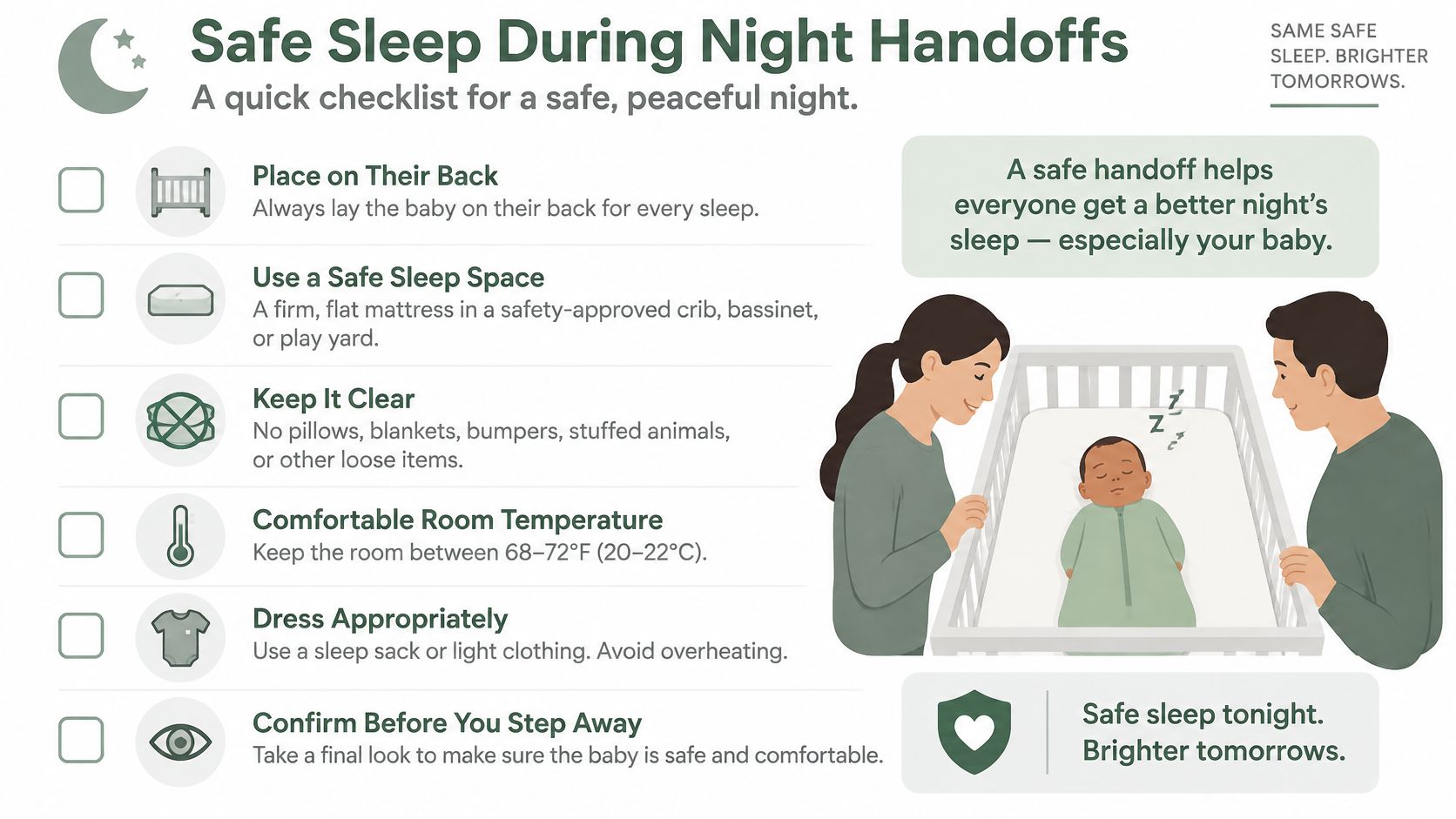
A night feed can leave a caregiver drowsy, especially in a quiet room. If you feed your baby in bed, stay awake throughout the feed. When it ends, place your baby on their back in their own clear, firm, flat sleep space. Never let a baby sleep in an adult bed, on a sofa, or in an armchair.
The American Academy of Pediatrics recommends placing infants on their backs on a firm, flat surface in a separate, uncluttered sleep space. Sofas and armchairs are not safe places for a baby to sleep (AAP safe sleep guidance). Keep loose bedding and soft objects out of the sleep space.
A clear handoff routine helps each caregiver follow the same steps, even when everyone is tired.
A handoff checklist for the night
- Log the feed start and end. Two times make it easier for the next caregiver to understand when the feed happened.
- Note burping and diaper changes. These details help the next person know what has already been done.
- Record the sleep location. If the baby is asleep somewhere other than their safe sleep space, move them there promptly.
- Name the responsible caregiver. A clear name prevents uncertainty about who is watching the baby.
- Confirm the baby is back in their sleep space before the caregiver rests.
- Update the log after moving the baby. A record supports the handoff, but it does not make an unsafe sleep location safe.
If you feed your baby in bed, remain awake and return them to their separate sleep space as soon as the feed is over. Never fall asleep with your baby in an adult bed, on a sofa, or in an armchair. For more help with settling after a feed, see these tips on putting a newborn to sleep.
Growth and Milestones to Raise With Your Pediatrician
Growth at four weeks is judged across a series of visits, not from one day on the scale. There's no universal weight that every baby this age should reach, so the number on the scale is a data point for the pediatrician, not a grade for the parent.
What caregivers can do is notice and write things down. Longer alert periods. A few seconds of eye contact with a familiar face. A calmer response to a familiar voice than to a stranger's. Hunger cues that are becoming easier to spot before the crying starts. These are observations to mention at the next visit, not milestones with deadlines attached.
A note that helps at the visit: "Alert and looking at Dad for a few minutes after the 7 a.m. feed."
Keep feeds and expressed milk in their own categories, separate from anything that comes later. WHO recommends exclusive breastfeeding for the first six months and says complementary foods should begin at six months, or 180 days, while breastfeeding continues (WHO child health and development questions). That guidance defines exclusive breastfeeding as no other food or drink, not even water, apart from permitted medical items such as oral rehydration salts, drops, syrups, vitamins, minerals or medicines.
Why the labels matter more than the app
When grandparents, a nanny and daycare staff all use the same record, a general "feeding" label gets interpreted three different ways. One person may assume it means a bottle, another a nursing session, a third a snack. Separate categories remove that ambiguity without anyone needing a briefing.
Any individualized feeding plan belongs with the child's pediatrician or a qualified lactation professional. Questions about weight, a change in feeding, or development go there too, and a sharp change in feeding or a sleep pattern that worries a caregiver is a good reason to call the clinic early rather than wait for the scheduled visit.
A note is a conversation starter. It isn't a diagnosis, and it doesn't replace the person who examines the baby.
Set Up One Shared Log Before the Next Feed
At 2 a.m., a short shared record can answer the question nobody wants to reconstruct: has the baby already been fed? Set up one place for everyone who cares for your baby to record what happened and read the same details.
Agree on a simple handoff routine:
- Invite each caregiver separately. Include your partner, relatives, nanny, and daycare staff who care for the baby.
- Record the same details each time. For feeds, note the start time, type, amount if known, and duration. For sleep, record when it started and ended. Add the caregiver's name so the next person can follow the handoff.
- Log events as they happen. A quick entry is easier to rely on than a tired person's memory later.
- Review the records together. Use them to spot questions to raise with your pediatrician, rather than trying to interpret a single entry in isolation.
- Bring useful notes to the next visit. A clear record gives you and the clinician something concrete to discuss.
Cradlo is a shared baby and child care tracker for children ages 0–5. Parents and invited caregivers can log sleep, feeds, diapers, growth, and health events, with entries appearing in real time for everyone. Daycare can bookmark one browser link on its iPad, and its entries flow to the parent's phone. Cradlo starts with a 7-day free trial, then Plus at $4.99/month or $49.99/year, or Lifetime at $99.99 one time. A notebook can also work if everyone uses the same fields and puts it back in the same place.
For a ready-made set of columns, use this baby feeding log template. Keep feed details clear and consistent so each caregiver can pick up the record without guessing what the previous entry means.
The goal is a reliable handoff, not a perfect record. When everyone can see the same notes, there is less need to piece together the night from memory.